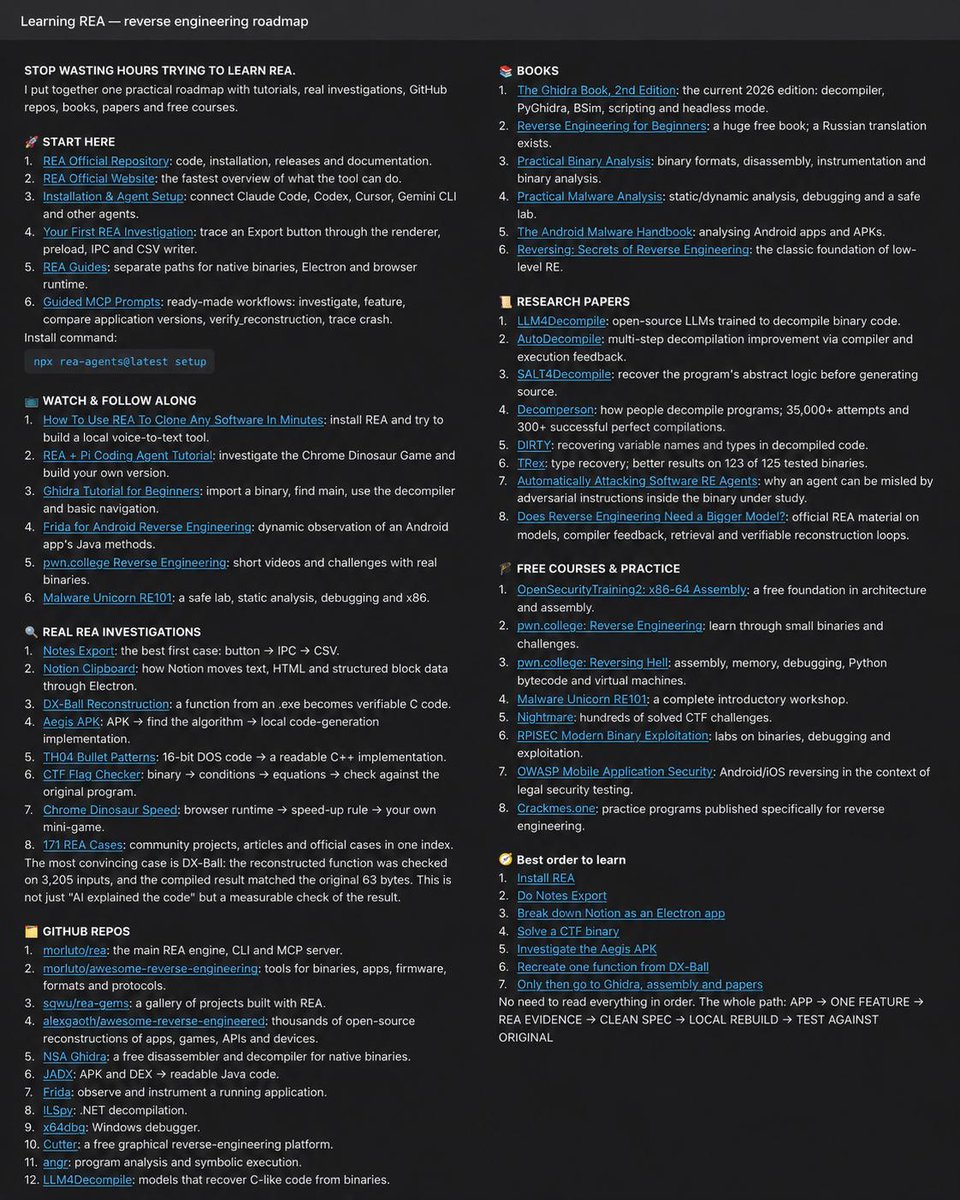
a broke student from California just used REA (Reverse Engineering) to replicate Microsoft 365 and has already made $30,000 in donations from its users.
her campus dropped its free Office licences. she didn't pay. she didn't pirate it either. she took it apart.
six weeks later, 41,000 students use her free rebuild.
here's how she did it, step by step.
1 · OBSERVE: watch what it does, don't assume
She never opened a line of Microsoft's code. For two weeks she just logged what she actually used: which features, how often, and what made her stop and wait.
→ 80% of her time went to 6 features out of more than 2,000.
2 · GUESS: name each part you think is there
She listed what she thought made Office "Office": the editor, file sync, real-time co-editing, templates, the "it just opens .docx" magic.
And one decoy belief: "you need a giant team to build this."
3 · TEST: change one input, watch what changes
- She sent 30 classmates a .docx with no Word installed. 27 only needed to read it and add comments.
- She disabled every feature except the 6 she'd logged. Nobody noticed for 9 days.
→ The decoy failed. The moat was never features. It was file compatibility and habit.
4 · MAP: keep only what the tests proved
Her drawing ended up with 4 blocks: open-format import/export, a fast editor, shared folders, and offline mode. Everything else came off it.
5 · REBUILD: build your own, then compare
She built it with open-source document libraries, open file formats, her own UI and her own name on it. She shipped no logos, no copied code and no pretending to be anyone else.
Then came the real test: could a classmate finish an assignment without noticing the difference? 92% did.
then the part nobody plans for. She added a "this saved me $99" button that went nowhere, just a thank-you page. students turned it into a donation link themselves.
what the story shows
→ you don't beat a giant by copying it. You beat it by finding the 6 features that matter to your people and doing those better.
→ most moats are habits, not technology.
→ the real skill isn't coding. It's knowing which guesses to throw out.
I'm taking one well-known product apart like this every week, using the same 5 steps, and I share the blueprint with anyone who follows along.
somebody in your feed is sitting on the next her idea and just needs the method.
so here's my question: which "untouchable" product do you pay for every month that's really just 6 features and a habit, and why haven't you rebuilt it yet?
WHOEVER LEAKED THIS JEV SIGNAL CASCADE SHOULD BE RUNNING THE FABRIC
I thought routing an agent's packets meant one queue, one worker, and a retry loop that eventually drops the slowest ones.
Apparently not.
This cascade's setup is much more interesting:
→ INGEST pushes every packet into one of 16 typed channels by hashing its state, 1.25k packets per second per lane, no polling anywhere
→ ROUTE selects the target lane deterministically from the hash, every select logged with the packet id, no "pick whichever queue is shortest" guess
→ MERGE syncs packets back on their emit event across lanes, p99 under 0.42ms, no cross-lane bleed on retry
→ RETURN re-hashes the packet state when it comes back from a node, commits to the trace, never trusts a mutable field
→ NODE LOAD surfaces per-node pressure in percent (ingest 65, merge 63, return 33), flags 7 lanes drifting above baseline with 2,260 drops and 0 lost this run
so you get:
Packets typed. Lanes selected. Merges synced. Returns hashed.
the interesting part isn't widening the pipe.
it's giving every packet a lane the router can't guess around.
Instead of one queue chewing packets at best-effort pace, you route across 16 lanes in parallel at 0.35ms per hop, p99 under half a millisecond, 2,260 drops accounted for and nothing lost.
Hash the state. Route the lane. Commit the trace.