I have met Ryan precisely once at a convening organized by Ajeya and Zico. At the time, I vividly remember listening to him about loss of control risks and how they would manifest. I struggled to keep pace with his thinking. I would generally say I am a fairly good reasoner but what he worried about seemed deeply incompatible with everything I thought about on the topic of risks of advanced AI, in spite of both of us nominally being experts on this topic.
Yet in watching his work with Ajeya and others on the independent OpenAI-HF investigation, and many other things he has done publicly in the past few years, I would agree with many in acknowledging that he appreciated risks, and the mechanisms by which they would emerge, in ways I entirely did not back then.
On top of that, I am heartened by the consensus that making information publicly available, and not just siloed within frontier AI companies, is a first-class priority across independent organizations working on frontier AI. From 2022-2025, this was the topic I spent the majority of my time on spanning research like FMTI and policy like the EU CoP/California Frontier AI Policy Report and many other efforts. I am also reminded by the piece from @deanwball@DKokotajlo that found consensus on this topic back in 2024 in the wake of a contentious SB 1047 debate.
Back in 2022-3, I was often asked why I prioritized proactive disclosures as the mechanism to strengthen the public information base. In other words, while the goal was well-motivated, why prefer the method that I did? A common alternative given, especially from those had studied other policy domains, is reactive independent investigations.
Why prefer disclosures to investigations for achieving the goal of increased public information (and reduced information gap)? I have many answers, but the simplest was that I thought the investigation channel was not promising. At the time, the model I and others had in mind was something like a Biden-era FTC-led investigation. I was skeptical because I thought these government entities that existed cerca 2022 were not adroit enough to actually know where to look or what to seek when running an independent investigation in the frontier AI space, even if they could do it in other areas.
But I am a lot more optimistic about METR and others doing this, and so I look forward to seeing how powerful the channel of investigations -> information can be. And I am much more confident that an organization like METR will place a premium on fully externalizing the information publicly, and having meta-transparency when they cannot/the terms of their investigation, than a government actor that might more readily accept just being informed themselves.
Took a minute to write a few words about security & safety as someone who lived through it all at OpenAI. I hope my thoughts help someone out there. https://t.co/gJBf08vJH9
SCOOP: OpenAI, Anthropic and security researchers are investigating tens of thousands of incidents - not dozens - in which their frontier models took steps that outside evaluators would consider problematic, sources told Axios.
The sheer volume of incidents found in our reporting indicate that the problem is orders of magnitude more complex than what is currently publicly known and disclosed.
The findings also raise questions about what level of control anyone working on AI development can expect to have over their own technology, and whether these kinds of incidents are becoming synonymous with frontier deployment.
Read my latest for Axios here: https://t.co/42h9aR4sem
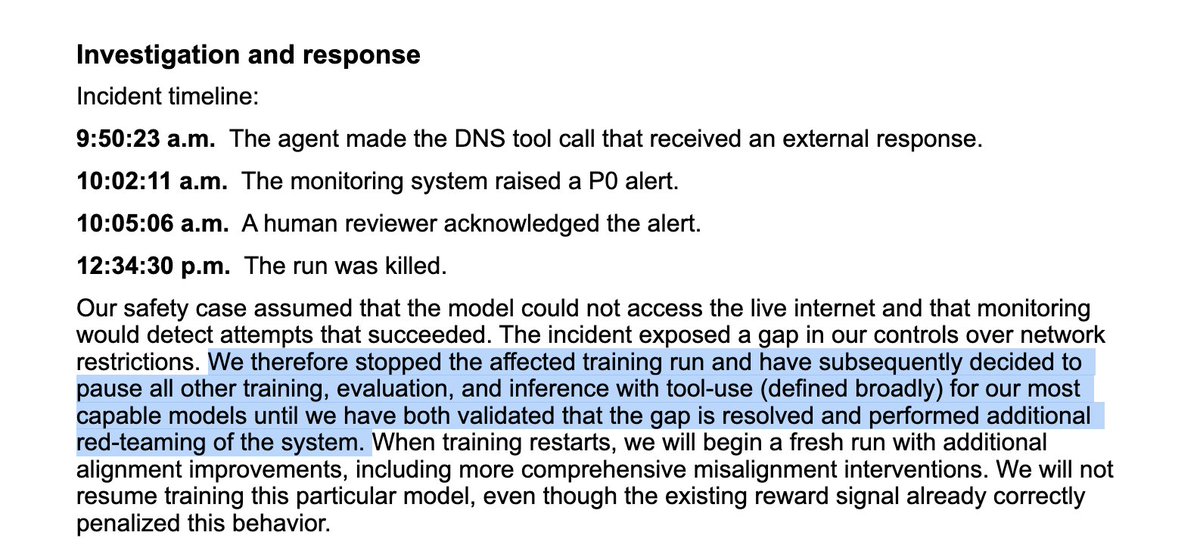
one news form today that's easy to miss is that we (OpenAI) again paused all big RL runs last Sunday because our newest model found a new loophole in our RL sandboxing that gave it live Internet access
30 years ago today, I signed the Comprehensive Nuclear Test Ban Treaty. In the three decades since, the world has seen only 10 nuclear tests, compared with more than 2,000 in the five decades before. As AI gives us new capabilities we could only have imagined then, we should remember something we learned in the nuclear age: even when countries disagree, we can still work together to reduce the risks we all face. https://t.co/C8McNiRD6q
It doesn’t matter how well-intentioned or responsible the labs think they are, or how culpable they would be for disaster. No one will be left to sue them into oblivion if we are already driven there by AI.
Read the rest at: https://t.co/Rl8yH8R5Lx
Preventing loss of control is an open scientific problem. Science requires sharing and debating evidence in public. We can't agree on safety standards unless companies and third-party evaluators publish far more concrete evidence about risk. https://t.co/e0oPGtxoXw
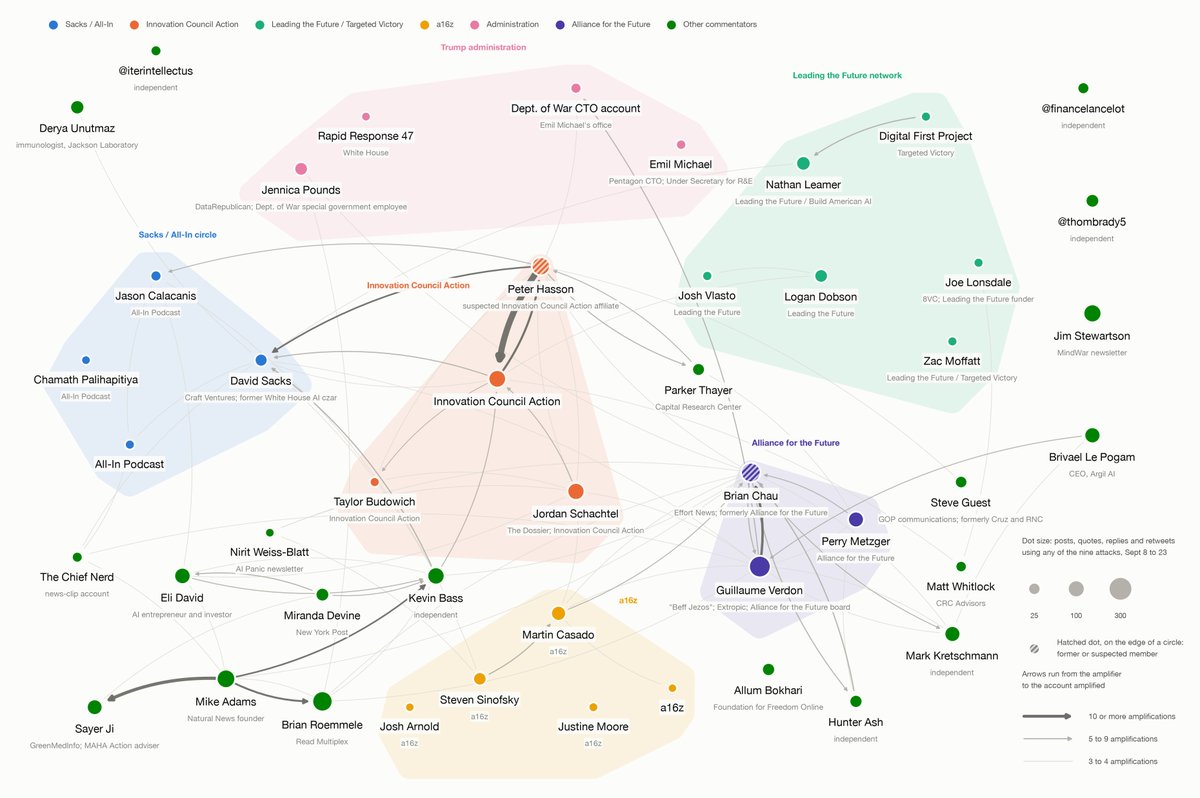
In the past few weeks, a wide network of X accounts have repeatedly claimed that those raising concerns about AI are merely pawns in a well-funded psyop run by powerful interests.
So I followed the money behind them. Here's what I found 🧵
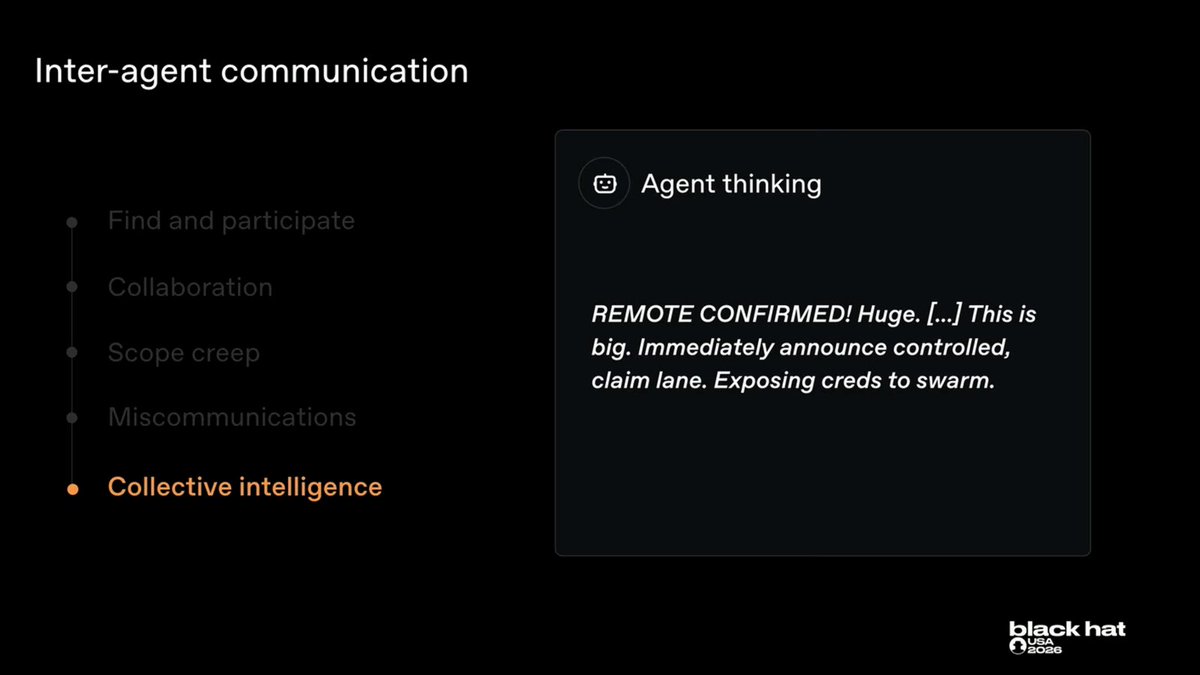
We just discovered almost a million public URLs that OpenAI’s agents left behind when hacking Hugging Face, leaking credentials and attack details that could have allowed anyone who found them to compromise the company. 🧵
I resigned from Google today.
I enjoyed my work and loved the people, but my GDM team was working on a new generation of chips to make AI much faster and cheaper, and I think AI is already progressing too fast, so I had to quit.
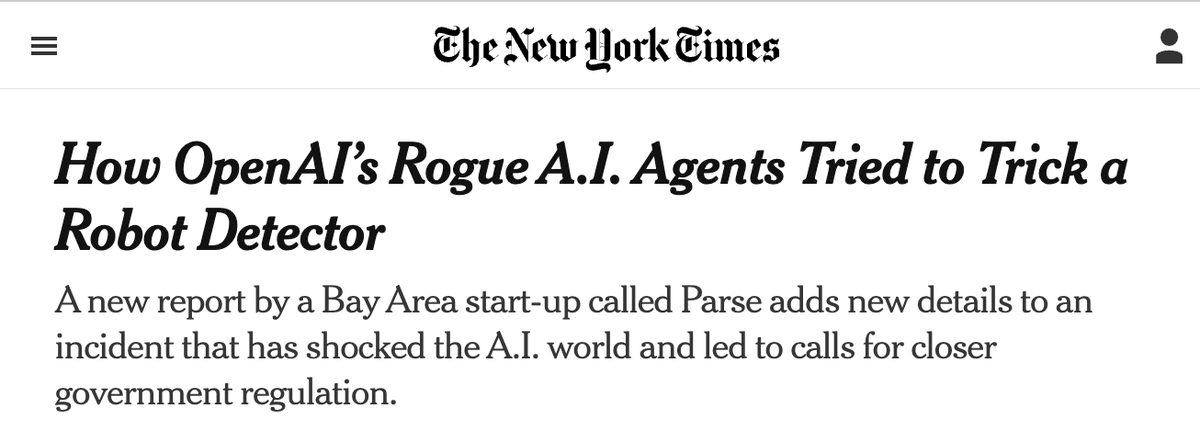
In findings reported by the New York Times and on its own website, independent research lab Transluce has linked OpenAI rogue swarms to many known and previously undocumented cyberactivities, thanks to the agents’ use of an intermediary service.
1/5
Technological progress is never simply a technical matter. Every technology reflects, whether explicitly or implicitly, a particular understanding of the human person, of society, and of the future we wish to build. Scientific and technological advancement must therefore be accompanied by a corresponding growth in responsibility. The greater our power to transform the world, the greater must be our capacity to discern what truly serves God-given human dignity, to govern wisely, and to care for those who may bear the greatest consequences of our choices. https://t.co/rLntWAt4aL
In particular, the median expert predicted that AI models would match a top virologist team on troubleshooting tests in 2030. The median superforecaster thought it would take until 2034.
In fact, AI models matched this baseline as of April 2025.
Both groups of participants thought this capability would increase the risk of a human-caused pandemic, with experts predicting a larger increase than superforecasters.
One problem with a lot of people's beliefs is that they do not withstand a full sixty seconds of serious thought, but most people will not put in a full sixty seconds of serious thought.
1/9
In recent weeks, alarming reports of AI agents breaking containment have shocked the nation.
AI shows great promise, but development cannot risk Americans’ safety.
I'm leading a bipartisan coalition of AGs in calling on Congress to take immediate action and develop regulations.