🤝 Better government starts with hiring the right talent.
How is government competing for digital talent? Our dataset explores salaries across federal and state roles, with sample job descriptions agencies can pull from.
https://t.co/OxMUe6MF67
#CivicTech#DigitalTalent
🏛️ Civic Tech Live is happening tomorrow! Don’t miss out on your last chance to register and join us for a panel led by David Wilkinson and Kelly Jin.
🎟️ RSVP for free: https://t.co/8xYipxlH8b
How has government innovation changed in the past decade? At Civic Tech Live, VA CTO Dave Wilkinson and former NYC Chief Analytics Officer Kelly Jin will lead a discussion on the evolution of government innovation and transformation.
🎟️ RSVP for free: https://t.co/8xYipxl9iD
🤝 Better government forms are better for the public and public servants. If we're designing for people rather than systems, people on both ends of that system matter. #FormFest
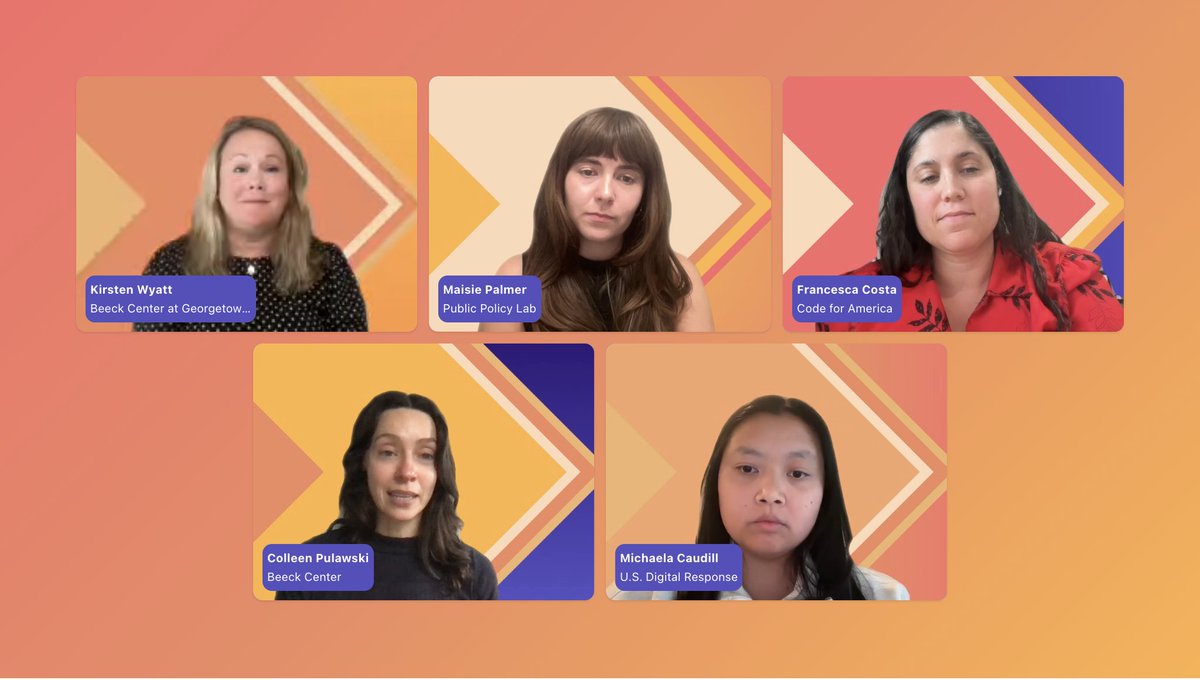
In our closing keynote, Around the Form, our Interim Director of Research Colleen Pulawski joined a panel to recap highlights from #FormFest 2026, including key takeaways, choice quotes, and memorable moments.
Check our her takeaways in this thread ⤵️
Public Policy Lab’s Antonia Yunge on how they redesigned SNAP Forms to reduce error rates at #FormFest: “When a form feels like a wall, it can be intimidating for people, but when we break it down into smaller parts, it can feel more manageable.”
@NJGov’s Andrew Resor at #FormFest on how they simplifiedthe Medicaid doula registration experience: “...working with doulas every step of the way. Our main takeaway is to treat your client’s lived experiences as your biggest input, not just a validation step for the process.”
@PhiladelphiaGov’s Radhika Dhanak at #FormFest on how they redesigned its water assistance application by reducing 70% of fields while building trust: “In order to create a trusted application for residents, that trust actually needs to exist within the system first."
@codeforamerica’s Laura Gonzalez on how to better design forms that ask for sensitive information, such as a social security number at #FormFest: “Providing explanations when we need to request sensitive information can often be powerful and important.”
FormFest 2026 is starting now!
Code for America and @BeeckCenter are talking best practices, lessons learned, and what’s in store for the future of form design with experts from around the country. Better government, one form at a time.
@SCCgov's Emily Parcell on how her team went from frantic to focused at #FormFest: “[Design first thinking] helped us avoid jumping straight to solutions…but instead take space and time to develop a plan, then test that plan before we ran too far with it."
@COSAGOV’s Tilla Khan on how language access requests can improve accessibility and reduce burden at #FormFest: “Language access is more than providing an interpreter or a translated document. To truly break barriers, we must make language assistance accessible to everybody.”
The City of Orlando's Dr. Stephanie Carnell shares the importance of gathering feedback before, during, and after a form to understand the full user experience at #FormFest: "Creating feedback loops allows people to adjust the conversation over time."
@citybeautiful
"The form is never just paperwork. It's a stand-in for a conversation you're not in the room for. Every unclear question, every missing instruction, doesn't just disappear, it gets pushed onto the person filling it out."
- CODE PA's Sara Hall at #FormFest
Our Executive Director @LynnOvermann kicks off #FormFest alongside @codeforamerica's @AmandaRenteria by phoning a few of their favorite form friends, including CODE PA's Sara Hall and The Lab @ DC's Karissa Minnich
"People hate—as they should—being asked for the same piece of information more than once...it ends up being easy to miss your form’s redundancy when you’re not the one filling it out."
- The Lab @ DC's Karissa Minnich at #FormFest