I'm a humanist first, AI explainer second.
I break down the tools and frameworks beginners actually need to enhance their lives without the hype, without the jargon, without making you feel behind.
You're not late. You're right on time. Follow along.
🦔AI companies are bulk-buying rare books, scanning them through high-speed machines that cut the spines off, and shredding the originals. A service called ISBNdb facilitates orders of up to a million books and keeps buyers anonymous. Pre-2022 books are premium because they're free of AI-generated text. A federal judge ruled the practice is fair use because eliminating the original means only one copy exists at a time. Anthropic hired the former head of Google Books partnerships to obtain "all the books in the world."
My Take
This got to me. A bookseller told 404 Media that rare books with almost no surviving copies are being fed into this pipeline. Books that survived wars, fires, and centuries of handling are being shredded so an AI can learn to write a better marketing email.
ISBNdb's website literally says "'AI company destroys two million books' is not a headline that generates sympathy," and they still built an entire business around making it happen quietly. They offer NDAs as a feature. They coach clients to call it "digital preservation."
I've covered AI companies scraping the internet, torrenting libraries, and stealing music. This is worse because it's irreversible. You can re-upload a website. You can reprint a bestseller. You can't replace the last three copies of an 18th-century botanical text once someone shreds them for training data. And the judge said it's legal. So it's going to accelerate.
"We shred rare books and offer NDAs so nobody finds out" is a legitimate business model in 2026. What a timeline.
Hedgie🤗
Anthropic has been putting on a masterclass with their marketing efforts since they became household name.
Giving teachers access for free will create millions of new users overnight, who will subsequently get their students used to interacting with Claude.
We're introducing Claude for Teachers: free access to premium Claude capabilities for verified K-12 educators in the US, with a library of teaching skills and a direct connection to evidence-based curricula, mapped to academic standards in all 50 states.
https://t.co/5hZZijVPCV
As high-profile websites vanish, it’s a reminder that the web has no built-in archival layer.
But some publishers are now blocking the Wayback Machine.
What’s at stake if the web stops being archived? Our new FAQ explains: preserving the public record matters. 🌐📚 https://t.co/fifJnv3xiu
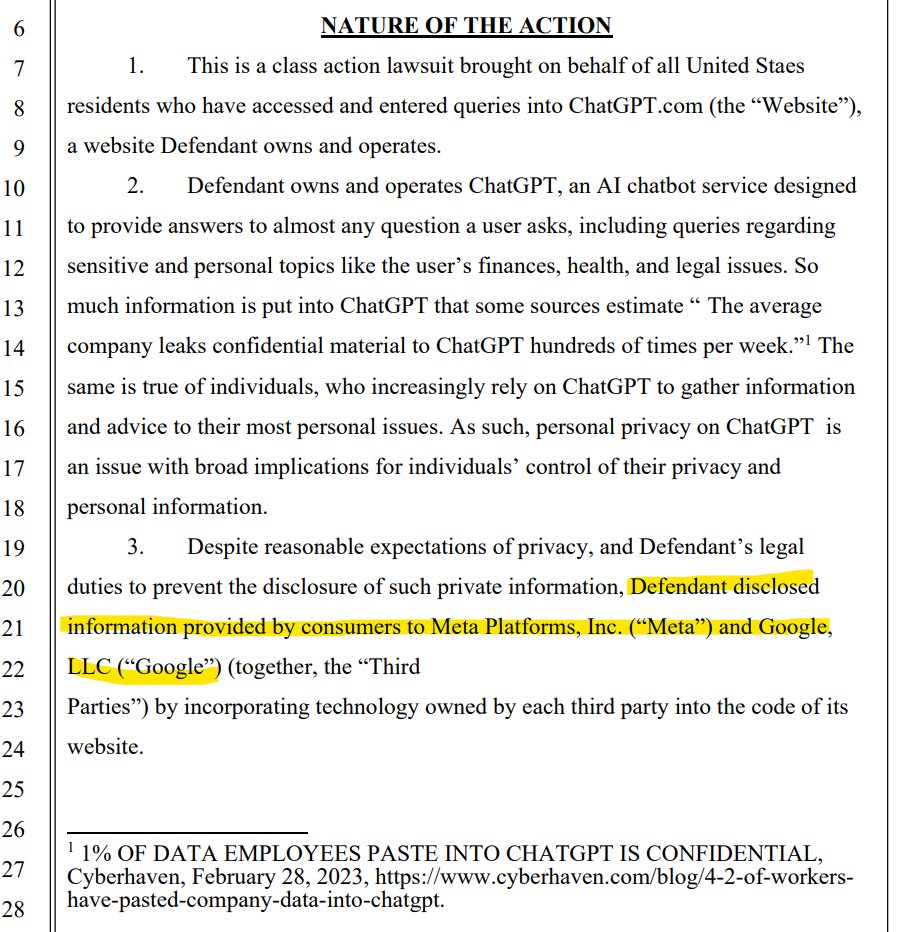
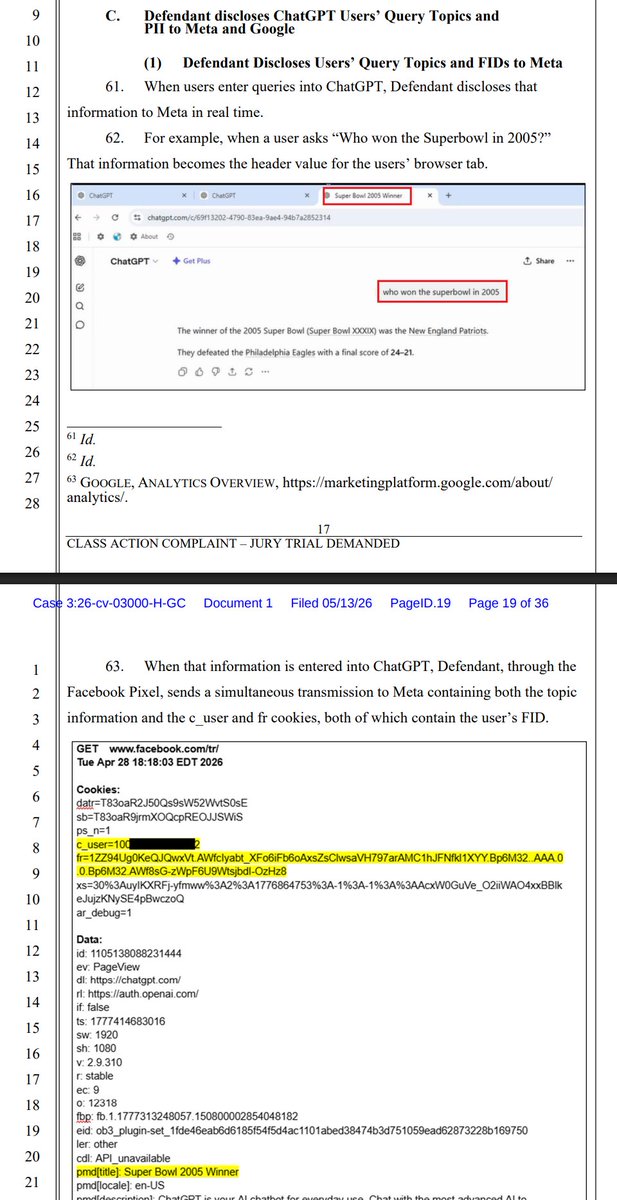
ChatGPT allegedly shares your chat query topics, user IDs, and email addresses with Google and Meta, according to a new class action lawsuit filed today.
Censorship filters are making Google AI increasingly useless. Even worse, this can become dangerous when the model twists, hides, or selectively omits facts instead of simply telling the truth.
This is exactly what @elonmusk has been warning about: AI must be truth-seeking.
@ecommerceshares Less than ten minutes into a brand new session after the reset and already hit 100% usage on the session...On the Max plan.
@trq212 Any assistance here would be much appreciated.
The implication: you don't need a PhD to push the edge of human knowledge anymore.
Experts still had to clean up and verify the output. AI found the angle. Humans confirmed the work.
That's the job description now.
https://t.co/7dnu4yMCMn
A 23-year-old with no advanced math training just solved a problem that stumped the world's top mathematicians for 60 years.
His only tool: a ChatGPT Pro subscription and a free afternoon.
In today's Beginners in AI 👇
The AI didn't follow the standard playbook.
It used a formula well-known in other areas of math — but nobody had ever thought to apply it to this kind of problem.
UCLA's Terence Tao said researchers had been making "a slight wrong turn at move one" for decades.
Stanford's 2026 AI Index just dropped. The finding that matters most: human scientists with PhDs still outperform the best AI agents by 2:1 on complex research tasks.
-->
An AI "agent" sounds like a robot that does your job. What it actually is: a language model connected to tools (web browser, code runner, file system) that tries to complete multi-step tasks by deciding what to do next at each step.
-->
The problem is the "next step" part. Each decision has a small chance of going wrong. String 20 decisions together and the errors compound. A human researcher holds the full problem in their head and course-corrects naturally. An agent loses the thread around step 8.
-->
This is why your AI coding assistant is great at writing one function but struggles to architect an entire app. Same technology, different task length.
-->
AI agents will get better. But right now, treat them like a junior researcher: great at fetching, summarizing, and first drafts. Don't hand them the whole project unsupervised.
What's the longest task you've successfully handed to an AI agent start to finish?
80% of enterprise workers are either avoiding or actively rejecting their company's AI tools.
The number that explains it: only 9% of workers trust AI for critical decisions. 61% of executives do. That's a 52-point trust gap.
-->
Trust follows experience. Experience follows training.
A third of the workforce has never used AI at all.
-->
Think of it like handing someone a power drill and saying "build a deck" without showing them which bit to use. They'll either avoid it or strip every screw.
-->
Companies are spending $54 million on average for digital transformation. 40% of that spend is underperforming because of adoption failures. The tools work fine. The rollout doesn't.
-->
If you're the person avoiding AI: pick one 10-minute task you do every day and try it in Claude or ChatGPT this week. One task. That's the entire on-ramp.
Which side of the 52-point trust gap are you on?
Anthropic just launched Claude Design. You describe what you want, it builds slides, prototypes, and one-pagers.
The part worth understanding: what changes when "design" becomes a conversation instead of a skill.
-->
Traditional design tools assume you already know what good design looks like. You pick layouts, adjust spacing, choose colors. The tool executes your vision.
Conversational design flips that. You describe the outcome ("a one-pager for our Q2 investor update") and the AI handles layout, hierarchy, spacing, and typography.
-->
Your job shifts from pixel-pushing to describing what the audience needs to walk away understanding.
The underlying tech is the same language model that writes code and analyzes documents. It learned visual patterns from millions of existing designs the same way it learned sentence patterns from text.
-->
Claude Design exports to PDF, PPTX, or directly into Canva. Available now on Pro, Max, Team, and Enterprise plans.
-->
A polished client deck in 10 minutes instead of 2 hours in PowerPoint. A product mock for a stakeholder meeting without waiting 3 days for the design team.
Which of those would change your week?