This is f*cking insane. Former Google CEO Eric Schmidt just told everyone the easiest way to get rich in the next two years, and it's not stocks or crypto:
"If you really want to make money, it's actually easy, found an agentic AI company, I mean build an agent to do something
If you build a better agent than anyone else, you can probably build one incredible company and own it yourself"
The man who ran Google for 10 years explains in under 30 seconds why the next year or two is the agentic period, and why the window won't stay open
Prompts → Claude Code → Loops → Graphs → Gates → A Company You Own Yourself
Save this before it disappears from your feed
Everything below is free:
Building effective agents (Anthropic)
https://t.co/mbMyiLIrqx
How Anthropic built its multi-agent research system
https://t.co/gcKwsDFx5N
Harnesses for long-running agents
https://t.co/p0KbeE6pBF
Writing tools for agents
https://t.co/Rif9SuExCh
Claude Code 101
https://t.co/rma5cTfV6M
Claude Code in action
https://t.co/y7ldRiCZRC
Prompt engineering
https://t.co/wGkkT9tlAO
Subagents (parallel work)
https://t.co/Govs5sjHB0
Hooks (checks that can say no)
https://t.co/YigRzFmXr3
CLAUDE.md + memory
https://t.co/EzV1u4QdQd
Skills
https://t.co/c8RGkxgGCt
MCP
https://t.co/tR6oTaM1QK
LangGraph (graphs of agents)
https://t.co/iKq99402hN
Karpathy's autoresearch (an agent in a loop)
https://t.co/gEMaSZMoYc
All of this costs $0
95% will spend the agentic period scrolling AI threads. The 5% who ship agents will own the companies that come out of it
Bookmark it and start with the first link tonight
Then read how to make an agent that works for hours without you in the Loops & Graphs guide below ↓
IVERMECTIN & MEBENDAZOLE should be sold over-the-counter and available to everyone. New study shows 84.4% Clinical Cancer Benefit — Nearly 50% Report Cancer Disappearance.
Dr. John Campbell... "We could be CURING your wife, your husband, your parents & your children."
🚨 IVERMECTIN: THE COMPLETE DOSAGE GUIDE
Cancer • Skin Conditions • Parasitic Infections • Off-Label Uses
Most people know Ivermectin as a medicine for parasites.
But that's only part of the story.
For nearly 40 years, it has been used worldwide to treat approved parasitic infections.
Today, it's also used in dermatology, explored in off-label applications, and actively investigated in cancer research.
This guide brings all four areas together in one quick reference.
Here's what you'll find.
👇
💊1. Approved & Standard Uses
Ivermectin has a long clinical history in treating parasitic infections, including:
✅ Onchocerciasis (River Blindness)
✅ Strongyloidiasis
✅ Filariasis
✅ Ascariasis
✅ Trichuriasis (Whipworm)
✅ Enterobiasis (Pinworm)
✅ Cutaneous Larva Migrans
✅ Gnathostomiasis
✅ Myiasis
✅ Toxocariasis
✅ Mansonelliasis
✅ Capillariasis
These are the conditions for which Ivermectin has been widely used as an antiparasitic medicine.
🧴 2. Skin Conditions
Ivermectin is also used in dermatology.
The guide includes commonly referenced dosing for:
• Scabies
• Crusted Scabies
• Head Lice
• Demodicosis
It also highlights topical 1% Ivermectin cream, which is approved for the inflammatory lesions of rosacea.
🧪 3. Off-Label Applications
Beyond its approved indications, Ivermectin has also been explored for a variety of other conditions.
The guide includes commonly discussed off-label applications such as:
• COVID-19
• Dengue
• Zika Virus
• Yellow Fever
• West Nile Virus
• Tuberculosis
• Leishmaniasis
• Malaria
• Neurocysticercosis
These uses fall outside approved indications, and the strength of evidence varies by condition. Research is ongoing in several of these areas.
🔬 4. Cancer Research
One of the most active areas of current Ivermectin research is oncology.
Laboratory, animal, and early clinical studies have explored its potential role across multiple cancer types, including:
• Breast
• Colon
• Lung
• Stomach
• Pancreatic
• Liver
• Brain
• Prostate
• Kidney
• Esophageal
• Leukemia
• Melanoma
• Ovarian
Researchers are investigating how Ivermectin interacts with cellular pathways involved in tumor biology and whether those findings translate into meaningful clinical outcomes.
Larger clinical trials are needed to better understand its potential role.
⚖️ Why Is Everything Written In mg/kg?
One of the first things you'll notice is that nearly every dosage is expressed as mg per kilogram (mg/kg).
That's because Ivermectin dosing is generally calculated according to body weight rather than using one fixed dose for everyone.
For example:
🧍 60 kg (132 lb)
• 0.2 mg/kg = 12 mg
• 0.4 mg/kg = 24 mg
🧍 80 kg (176 lb)
• 0.2 mg/kg = 16 mg
• 0.4 mg/kg = 32 mg
This is why most Ivermectin protocols begin with body weight before tablet strength is determined.
💊 Common Tablet Strengths
Depending on the manufacturer and country, Ivermectin tablets are commonly available as:
• 3 mg
• 6 mg
• 12 mg
• 24 mg
• 48 mg
The appropriate tablet strength depends on the prescribed dose and body weight.
📋 At A Glance
This guide brings together:
✅ Approved antiparasitic uses
🧴 Dermatologic uses
🧪 Off-label applications
🔬 Investigational cancer research
⚖️ Weight-based dosing
💊 Common tablet strengths
All in one place.
📚 Why Does This Matter?
Ivermectin has been used in medicine for decades.
At the same time, researchers continue to study where it may provide benefit, where it may not, and what future clinical trials can clarify.
Understanding the difference between approved uses, off-label applications, and investigational research helps put the current scientific discussion into context.
One medicine.
Four major application areas.
Decades of clinical use.
Ongoing scientific research.
One guide that brings it all together.
💬 Which section surprised you the most?
1️⃣ Approved uses
2️⃣ Skin conditions
3️⃣ Off-label applications
4️⃣ Cancer research
Tell us why.
👇
📌 Save this before you scroll. The next time you're looking for an Ivermectin dosage, approved use, or research summary, you'll be glad you did.
🔁 Repost it so more people researching Ivermectin can find this guide.
💊 Looking for pharmaceutical-grade Ivermectin, Fenbendazole, or Mebendazole? Explore @MedsOnTap.
#Ivermectin #DosageGuide #MedicalResearch #CancerResearch #Dermatology #Scabies #Rosacea #ParasiticInfections #Oncology #MedsOnTap
METHYLENE BLUE: COULD IT REVERSE DEMENTIA?
What if a compound that has been used in medicine for more than a century could hold important clues to protecting the aging brain?
Shop the products discussed:
Methylene Blue: https://t.co/65w6c1hgfQ
DMSO: https://t.co/PBtt5p0LUv
Methylene blue is fascinating because of its ability to cross the blood–brain barrier and participate in cellular energy metabolism.
Researchers are investigating its potential effects on:
Alzheimer’s disease and dementia: Mitochondrial function, oxidative stress, and abnormal protein accumulation.
Brain energy: Electron transfer within mitochondria and ATP production.
Memory and cognitive function: Brain metabolism and neuronal activity.
Parkinson’s disease: Experimental neuroprotective mechanisms.
Nerve health: Oxidative damage and cellular stress.
Cellular aging: Mitochondrial efficiency and redox balance.
WHAT ABOUT COMBINING METHYLENE BLUE WITH DMSO?
DMSO is known for its ability to penetrate biological membranes and influence the absorption of certain compounds. This makes its interaction with methylene blue an interesting scientific question.
Methylene blue is not an established FDA treatment for reversing dementia. It also has important safety considerations, particularly dangerous interactions with certain antidepressants and other serotonergic medications. Combining it with DMSO should not be treated as a routine dosing protocol.
The bigger question: Could targeting mitochondrial dysfunction become an important part of future strategies for age-related cognitive decline?
Understanding how cells produce energy may help researchers develop new approaches to neurological health.
Want personalized wellness education and guidance?
Book a consultation with me:
https://t.co/xeGmXOgUJy
Amy Harris | Practitioner of Alternative Medicine
#MethyleneBlue #BrainHealth #Mitochondria #DMSO #AlzheimersResearch #CellularHealth
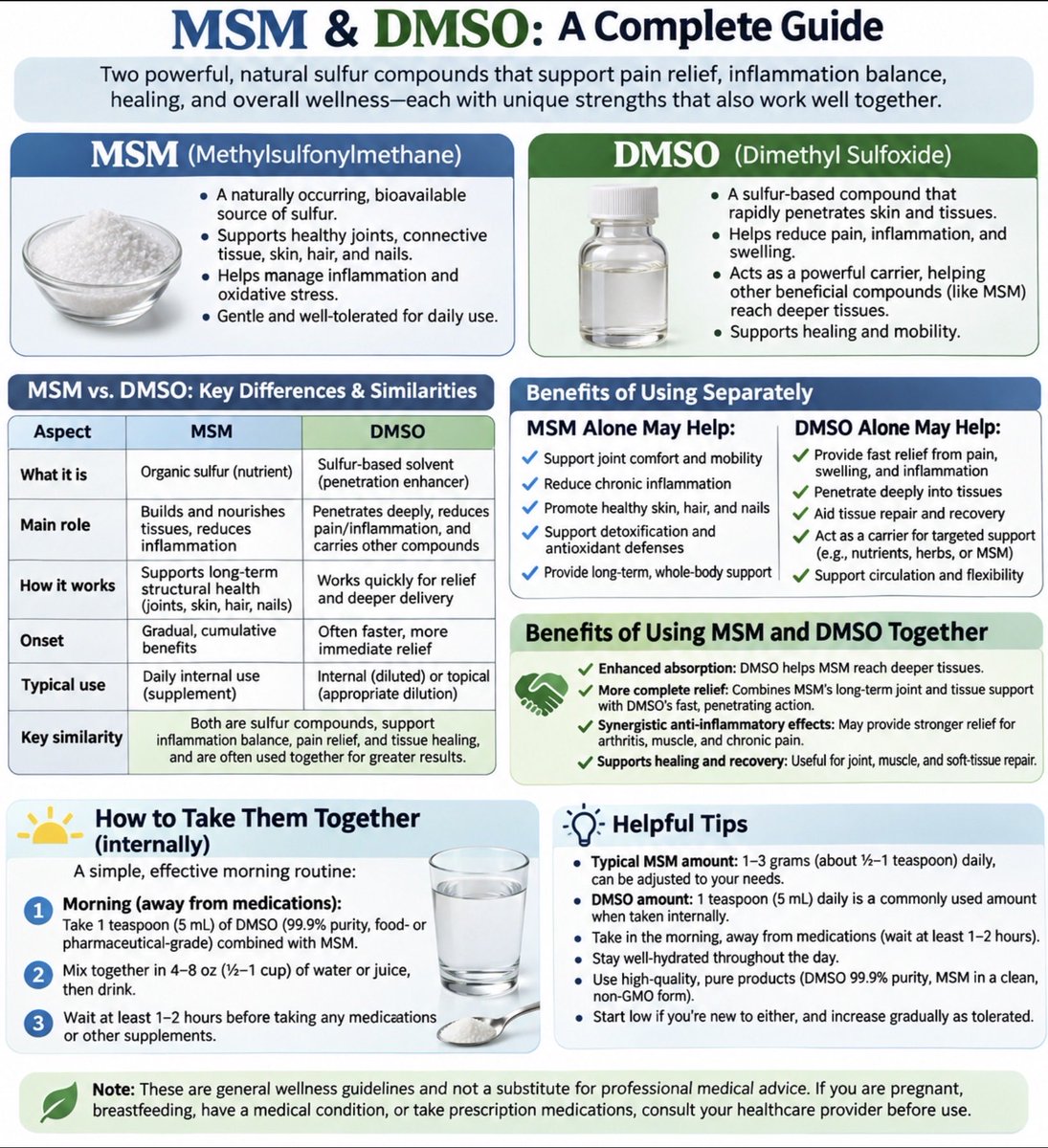
MSM vs. DMSO:
TWO SULFUR COMPOUNDS WITH VERY DIFFERENT BENEFITS!
Most people have heard of MSM for joint health, but far fewer understand DMSO—or why these two compounds are frequently discussed together.
🛒 Shop here:
MSM & DMSO:
https://t.co/jw2DjX8ium
https://t.co/bjNLdg8Ira
WHAT IS MSM?
MSM (methylsulfonylmethane) is an organic sulfur compound naturally present in small amounts in certain foods and the human body.
Sulfur is essential for hundreds biological processes, including the structure of connective tissues and the production of important cellular compounds.
Research suggests MSM may offer several benefits:
✓ Support joint comfort and flexibility
✓ Help reduce exercise-related muscle soreness
✓ Modulate inflammatory signaling
✓ Support antioxidant defenses
✓ Contribute sulfur used in normal connective-tissue biology
✓ Support overall mobility
Human studies have reported improvements in some osteoarthritis symptoms
WHAT MAKES DMSO DIFFERENT?
DMSO (dimethyl sulfoxide) is another sulfur-containing compound, but its chemistry and biological behavior are very different from MSM.
DMSO is known for its ability to penetrate biological membranes and alter the permeability of skin and other tissues.
Researchers have investigated DMSO for:
✓ Anti-inflammatory activity
✓ Pain-modulating properties
✓ Hydroxyl radical scavenging
✓ Tissue penetration and drug delivery
✓ Cellular protection in certain experimental settings
✓ Cryopreservation of cells and biological tissues
DMSO has also been used medically for specific conditions, including FDA-approved intravesical treatment of interstitial cystitis.
WHY ARE PEOPLE INTERESTED IN COMBINING MSM + DMSO?
MSM is primarily studied as an oral supplement for joint comfort and inflammation-related symptoms.
DMSO is studied for its solvent properties, tissue penetration, and biological effects.
Because these compounds have different mechanisms, researchers and wellness enthusiasts have explored whether their properties might complement one another.
CAN THEY BE TAKEN TOGETHER?
MSM is commonly taken orally in studied amounts of approximately 2 tablespoons daily.
DMSO is different. A proposed dose of 1 teaspoon (5 mL) up to two tablespoons. Taking it in the morning away from medications.
THE BIG TAKEAWAY
MSM and DMSO are not interchangeable.
MSM has a growing body of research concerning joints comfort, anti aging, and exercise recovery.
DMSO has distinctive tissue-penetrating and biochemical properties, with established medical uses and ongoing experimental research.
Understanding their differences is essential.
Want help understanding supplements, cellular health, inflammation, and individualized wellness strategies?
Book a consultation with me:
https://t.co/xeGmXOgUJy
#MSM #DMSO #Sulfur #JointHealth #Inflammation #CellularHealth #WellnessResearch
🚨🚨 Cirujano del cáncer: "La ivermectina es MÁS SEGURA que una píldora de azúcar y la he visto revertir el cáncer en etapa 4"...
"Tendrías que tomar mucho para hacerte daño"...
La ivermectina también es:
🔹 Un medicamento ganador del Premio Nobel (2015)
🔹Llamada el segundo mayor avance médico después de la penicilina...
💊 12 acciones anticáncer conocidas:
1. Inhibe la vía WNT/β-catenina: detiene la proliferación de células cancerosas.
2. Induce la apoptosis: desencadena la muerte programada de las células cancerosas.
3. Bloquea las proteínas transportadoras de importina α/β, lo que impide la replicación de células cancerosas.
4. Inhibe la enzima PAK1: reduce la inflamación y la progresión tumoral.
5. Antiangiogénico: detiene la formación de nuevos vasos sanguíneos en los tumores.
6. Modulador del sistema inmunológico: mejora el reconocimiento de las células cancerosas.
7. Disruptor de la autofagia: interfiere con las estrategias de supervivencia de las células cancerosas.
8. Se dirige a las células madre del glioblastoma: eficaz en cánceres cerebrales.
9. Inhibe la respiración mitocondrial: corta el suministro de energía a los tumores.
10. Interrumpe la señalización de mTOR, lo que ralentiza el crecimiento celular.
11. Supera la resistencia a la quimioterapia: hace que la quimioterapia sea más efectiva.
12. Propiedades antivirales: potencialmente útiles para cánceres relacionados con virus (como el VPH).
🚨 DR. WILLIAM MAKIS SAYS THIS IS THE MOST IMPORTANT IVERMECTIN DOSING GRAPH HE'S CREATED.
Not a new chemotherapy drug.
Not a breakthrough immunotherapy.
Not a billion-dollar cancer treatment.
Just one simple dosing strategy.
According to Dr. William Makis, this is the dosing framework he believes everyone researching repurposed medicines for cancer should understand first.
And it all starts with one number.
📌 1 mg/kg/day.
Before explaining why, here's the dosing framework Dr. Makis discusses.
📊 The Four Ivermectin Dosing Ranges
🟢 Low Dose: ≤0.5 mg/kg/day
Used for cancers in remission, strong family history, genetic predisposition, prophylaxis, and lower-dose protocols discussed in published case reports.
🟡 Medium Dose: 1.0 mg/kg/day
Dr. Makis' recommended starting dose for most cancers.
🔵 High Dose: 2.0 mg/kg/day
Discussed for very aggressive cancers, including leukaemia, pancreatic cancer, and some brain cancers.
🔴 Very High Dose: ≥2.5 mg/kg/day
Discussed in selected reported cases involving extensive metastatic disease or extremely poor prognosis, where temporary visual side effects have also been reported.
Now here's why Dr. Makis believes 1 mg/kg/day deserves the most attention.
After reviewing laboratory research, published studies, and numerous case reports, he says this is the starting dose he recommends for most cancers.
According to Dr. Makis, research has investigated Ivermectin across a surprisingly wide range of cancers, including:
• Breast cancer
• Colon cancer
• Lung cancer
• Pancreatic cancer
• Kidney (renal cell) cancer
• Gastric cancer
• Leukemia
One exception stood out.
Lymphoma.
Dr. Makis says he has found very little published research involving Ivermectin and lymphoma.
That doesn't mean it doesn't work.
It simply means the evidence is currently limited.
❓What does 1 mg/kg/day actually look like?
For someone weighing 60 kg (132 lbs)...
That's approximately 60 mg of Ivermectin every day.
Equivalent to:
💊 Five 12 mg tablets
OR
💧 About 6 mL of liquid Ivermectin, roughly one teaspoon.
According to Dr. Makis, that's where he recommends starting for many cancers.
Can lower doses still have an effect?
✅ He believes they can.
Dr. Makis discusses a published ovarian cancer case reported by Dr. Tess Lawrie.
The dosing chart lists the patient as receiving 12 mg of Ivermectin per day. During his discussion, Dr. Makis explains that this was approximately 0.2 mg/kg/day, placing it within the chart's Low Dose (≤0.5 mg/kg/day) range.
📉 According to the case report, the patient's CA125 tumor marker reportedly fell from 288 to 22 after two months.
That case is one reason Dr. Makis believes Ivermectin may have anticancer activity even at lower doses.
However...
He also believes the available evidence suggests the effect is dose dependent.
In other words...
Higher doses may produce greater effects, although more clinical research is needed.
What about the most aggressive cancers?
• Pancreatic cancer
• Leukemia
• Brain cancer
For cancers like these, Dr. Makis discusses doses around 2 mg/kg/day in selected situations.
He notes that Ivermectin crosses the blood-brain barrier, although not very efficiently, which is one reason he says higher doses may be considered for some brain cancers.
He also discusses a case reported by Dr. Allan Landrito.
According to Dr. Makis, a physician with terminal gallbladder cancer reportedly took 2 mg/kg/day for 14 months.
He says her cancer eventually disappeared.
She experienced temporary visual side effects that resolved after a few days.
❓How high have reported doses gone?
According to Dr. Makis, he has seen reported doses as high as 2.5 mg/kg/day.
He references patients treated by Dr. Shankara Chetty who reportedly used those doses without long-term side effects, although some experienced temporary visual disturbances that later resolved.
One point Dr. Makis returns to repeatedly...
Long-term use.
He references the Castro study involving children with leukemia who reportedly received Ivermectin for six months without long-term side effects.
He also discusses anecdotal reports of adults taking it daily for more than a year without long-term toxicity.
So why aren't there larger cancer trials?
Dr. Makis believes one of the biggest obstacles is economics.
Because Ivermectin is an off-patent generic medicine, he argues there is little financial incentive to fund large clinical trials.
Whether future research ultimately confirms or challenges these ideas remains to be seen.
But Dr. Makis' message is remarkably simple.
One graph.
One dosing strategy.
One starting point.
📌 1 mg/kg/day.
Because the conversation isn't just about Ivermectin anymore.
It's about whether repurposed drugs deserve the same level of scientific investigation as newer therapies.
🗨️ Do you think inexpensive repurposed medicines like Ivermectin deserve larger, well-designed clinical trials for cancer?
🔖 Save this post so you'll always have Dr. Makis' dosing framework handy, and repost it to help others discover the ongoing research into repurposed medicines.
💊 Looking for pharmaceutical grade Ivermectin, Fenbendazole, or Mebendazole? Choose @MedsOnTap. Trusted by thousands of customers worldwide.
#Ivermectin #CancerResearch #RepurposedDrugs #Oncology #CancerCare #MedicalResearch #PancreaticCancer #MakisMD #MedsOnTap
Η μεγαλύτερη ιατρική απάτη του αιώνα και το μεγαλύτερο έγκλημα κατά της ανθρωπότητας, για το οποίο κανείς δεν έχει λογοδοτήσει μέχρι σήμερα..!! #covid19#COVID#covidvaccines
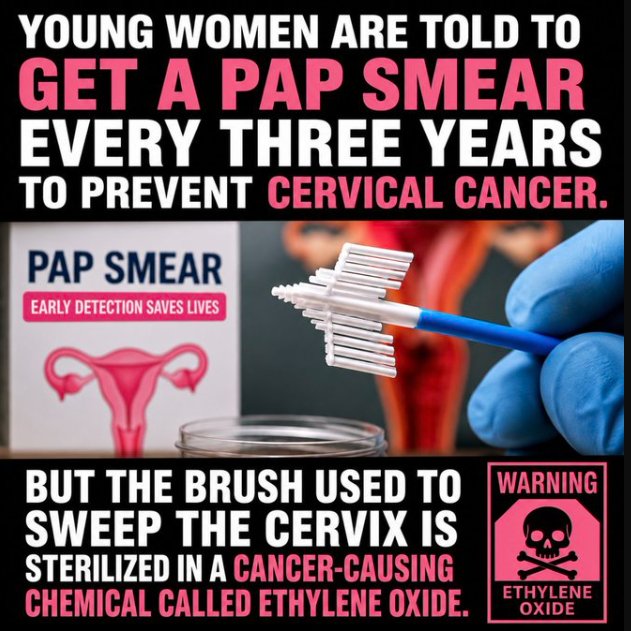
This is the kind of information that changes everything for women's health decisions.
Routine Pap tests are presented as a smart way to stay ahead of cervical cancer.
The reality? The brush that takes the sample is sterilized with a chemical proven to cause cancer — Ethylene Oxide.
Direct contact in the name of prevention.
Women, this is true informed consent before your next visit.
VACCINE INJURY: RFK Jr. Took ONE Flu Shot… and Lost His Voice FOREVER
In 1996, he walked into a clinic, rolled up his sleeve for a routine flu shot… and left with a permanent neurological disorder: Spasmodic Dysphonia.
His voice became strained, broken, and raspy — a life-altering condition that doctors initially couldn’t explain. No trauma. No warning. Just a shot… and everything changed.
Years later, while preparing litigation against flu vaccine manufacturers, RFK Jr. finally saw the truth in black and white on the manufacturers’ own inserts: Spasmodic Dysphonia is listed as a known side effect of certain flu vaccines.
He wasn’t imagining it. It was documented.
This isn’t ancient history. This is RFK Jr. — the man now leading health policy — warning us from personal, painful experience.
How many others have suffered in silence? How many “rare” side effects are hidden in the fine print?
der Weihnachtsmann bedankt sich
🦌Norwegen baut komplette Windparks ab, weil Rentiere als Mißgeburten zur Welt kommen
Der Oberste Gerichtshof Norwegens hat entschieden, dass zwei große Windparks mit insgesamt 151 Windrädern in Storheia und Roan entfernt werden müssen, da sie die Rechte des indigenen Volkes der Samen und deren traditionelle Rentierhaltung verletzen. Neben der Einschränkung der Weideflächen wurde auch festgestellt, dass die Windräder negative Auswirkungen auf die Rentiere selbst haben, darunter gesundheitliche Probleme und Missbildungen bei den Tieren, die durch den Stress und die Nähe zu den Anlagen verursacht werden könnten.
🚨Big Pharma is Terrified of This Man: Jim Humble Says “Chlorine Dioxide Cures 98% of All Diseases — Backed by Over 100,000 Patents!”
Did you know one simple, suppressed substance could destroy Big Pharma’s control over your health forever?
Legendary discoverer Jim Humble boldly declares:
“Chlorine Dioxide cures 98% of all diseases and is backed by more than 100K patents worldwide.”
Malaria gone in hours. Cancer under attack. Autism symptoms reversed. HIV, arthritis, diabetes, Lyme, and even “incurable” conditions — all reportedly falling to this powerful oxidizer.
They don’t want you to know about it.
But millions are waking up and taking their power back.
Have you heard of MMS Miracle Mineral Solution/ Chlorine Dioxide? Have you used it to heal illness?
🚨🚨 "La ivermectina aumenta las Bifidobacterias en los intestinos"
"Las personas con autismo, enfermedad de Alzheimer, enfermedad de Crohn, enfermedad de Lyme, síndrome del intestino irritable, problemas de salud mental y cáncer invasivo tenían deficiencia de Bifidobacterias"...
"Descubrí que la ivermectina puede ayudar a aumentar y restaurar las Bifidobacterias"...
📌📌 Seis efectos de las Bifidobacterias en el cuerpo...
• Suprimir bacterias dañinas en los intestinos
• Regular la función inmunológica
• Fortalecer la función de barrera intestinal
• Mejorar el estreñimiento y las condiciones intestinales
• Apoyar la producción de ácidos grasos de cadena corta y regular la inflamación
• Apoyar el equilibrio general de las bacterias intestinales.
3 de junio de 2026.
La Dra. Hazan, investigadora de bacterias intestinales, testificó en una audiencia del Senado de EE.UU.
🚨🚨 "La causa más común de presión arterial alta es una deficiencia de magnesio"...
"No tienes presión arterial alta porque tengas un gen malo, porque estés envejeciendo o porque tengas una maldición vudú"..
"Tu cuerpo se quedó sin el mineral magnesio".
Dr. Peter Glidden.
Más del 75% de las personas tienen una deficiencia manifiesta de magnesio, pero no relacionan sus enfermedades con ella.
Históricamente, nuestra agua, suelo y alimentos abundaban en los más de 80 oligoelementos necesarios para una salud plena. Ahora no es así... nuestra agua, suelo y alimentos son deficientes, lo que nos provoca deficiencias. Esto representa una amenaza para la salud y debemos priorizar minerales como el magnesio, el potasio y la sal mineral sin refinar, esenciales para la vida, en nuestra rutina diaria.
El magnesio es el corazón de la producción de energía ATP y participa en más de 600 reacciones enzimáticas.
Es imposible comprobar si existe deficiencia, ya que el 1 % del suero sanguíneo está estrictamente controlado y regulado para permanecer "normal", mientras que se supone que el otro 99 % debe estar en la capa intracelular.
La mayoría de las deficiencias no se diagnostican porque los niveles del suero sanguíneo permanecen normales mientras que los niveles intracelulares son tan bajos que constituyen una crisis de salud pública y crean enfermedades crónicas y disfunción.
El magnesio es el principal regulador del calcio, transportándolo a su lugar correspondiente: los huesos. El magnesio evita que el calcio se acumule en las células, lo que causa calcificación y muerte celular.
El magnesio es un cofactor de la vitamina D3 y también de la K2. La D3 y la K2 dependen completamente del magnesio como clave para su activación.
Dentro de mi propia familia, hemos experimentado el Milagro de la Terapia de Magnesio utilizándolo con protocolos para sanar:
Hipertensión
Síndrome de Tourette
Insomnio
Osteoporosis
Migraña
ERGE/Reflujo ácido
SII
Síndrome de piernas inquietas
Estreñimiento crónico
Espasmos de espalda
Dolor de ciática
Fatiga crónica
Niebla mental
Calambres en las piernas
Dolor articular
Ansiedad/Depresión
Arritmia cardíaca
Síndrome premenstrual/trastorno disfórico premenstrual
Deterioro cognitivo
Las 2 principales formas biodisponibles son el glicinato de magnesio y el L-treonato de magnesio.
El glicinato de magnesio es una forma perfecta para la mayoría de enfermedades y deficiencias.
El treonato de magnesio es el único magnesio que cruza la barrera hematoencefálica para revertir la disfunción cognitiva.
El citrato, malato y taurato de magnesio también son útiles para enfermedades específicas: motilidad intestinal lenta, fatiga crónica y salud cardíaca respectivamente.
Existen otras nueve formas, pero son mucho menos biodisponibles y absorbibles para curar deficiencias.
El libro milagroso del magnesio de la Dra. Carolyn Dean.
https://t.co/iCFg6X8OjR
Crisis de salud pública por deficiencia de magnesio...
https://t.co/oIxWiW2XXe
Deficiencia de magnesio y enfermedades crónicas...
https://t.co/QZLTjtvlXC
🚨🚨En 1928, la mayoría de la gente en Estados Unidos tomaba 20 miligramos al día de vitamina D.
¿Sabes qué pasó? Nuestros hospitales se vaciaron. Nadie se enfermaba.
"La AMA y la FDA se reunieron y decidieron darle a siete estudiantes de medicina suficiente vitamina D para matar a un caballo".
"Por supuesto, los niños se enfermaron. Esa fue su excusa para retirar la vitamina D del estante"..
🚨RECUERDA: La dosis que necesitas para subir tus niveles en sangre de vitamina D son 8000 UI y no 800 UI como te recomendará tu médico...
Se ha demostrado que niveles bajos de vitamina D predispone a la persona a sufrir varios tipos de cánceres y otras muchas enfermedades...
El 80 % de la población podría sufrir carencias de vitamina D.
Los niveles óptimos de vitamina D en sangre para estar protegido contra enfermedades y cáncer será 60/80 nanogramos por mililitro en sangre. Si padeces cáncer tus niveles han de ser de 100ng/ml...
La mejor opción para optener tu vitamina D es directamente del sol mediante exposición segura, sin cremas, al mediodía, cuando el sol está más alto. Evita ducharte después de la exposición pues está vitamina tardará en ser absorbida por tu organismo. Asegúrate de tener suficientes niveles de colesterol. Comienza en exposiciónes cortas y ve aumentando progresivamente.
Si careces de la posibilidad de tomar sol, los suplementos de calidad serán imprescindibles...
Un análisis de sangre cada 6 meses servirán de base. Necesitarás entre 5.000 UI y 8.000 UI diarias de vitamina D durante unos 3 meses para alcanzar 60/80 ng/ml, combinándolos con vitamina k2 y magnesio. La vitamina D es liposoluble
Después tendrás que mantener estos niveles con dosis más bajas...
🚨IMPACTANTES Y ESPELUZNANTES DECLARACIONES de la nueva Directora General de Salud Pública de EE.UU. Casey Means:
“No aprendí prácticamente nada en la Facultad de Medicina de Stanford”
“No aprendí que el 95% de las personas que crearon las pautas alimentarias del USDA para Estados Unidos tenían importantes conflictos de intereses con la industria alimentaria”
“No me enteré de que cada año se rociaban 1.000 millones de libras de pesticidas sintéticos sobre nuestros alimentos”
“El 99% de las tierras agrícolas de los Estados Unidos están rociadas con pesticidas sintéticos, muchos de ellos provenientes de China y Alemania, y estos productos químicos están fuertemente vinculados con el autismo, el TDAH, la alteración de las hormonas sexuales, las enfermedades de la tiroides, la disfunción de los espermatozoides, el Alzheimer, la demencia, los defectos de nacimiento, el cáncer, la obesidad, la disfunción hepática, la infertilidad femenina y más...” 😳
“No aprendí que metales pesados como el aluminio y el plomo están presentes en nuestros alimentos, en las fórmulas para bebés y en muchas de las vacunas obligatorias.....” 👇
ESPELUZNANTE ESCUCHE Directora General de Salud Pública 🇺🇸👇
Google has requested an EXPERIMENTAL USE PERMIT to launch one of the LARGEST open-air biological experiments in U.S. HISTORY.
The tech company wants to dump 64 MILLION bacteria-infected mosquitoes into the wild.
The EPA must REJECT Google's mass experiment.
🚨🚨 ADVERTENCIA sobre las tácticas utilizadas para convertir en enfermos crónicos a millones de personas saludables...
La Asociación Estadounidense del Corazón ha cambiado la presión arterial "normal" a 110/70... Cada vez que bajan las cifras, millones de personas necesitan medicamentos....
En 1970, la presión arterial normal era 160/95. En 1985, era 140/90. Y ahora, 120/80 se considera elevada.
Eso no es medicina. Es marketing de 40 mil millones de dólares.
El listón se ha bajado una vez más y, bajo las nuevas directrices, más estadounidenses cumplen los criterios de presión arterial alta y se ven presionados a comenzar a tomar medicamentos antihipertensivos.
En agosto de 2025, la AHA y el ACC (Asociación Estadounidense del Corazón y Colegio Estadounidense de Cardiología) publicaron pautas "actualizadas" para la hipertensión, que se desplazan 10 puntos hacia abajo en todas las categorías para lograr que a más personas diagnosticadas como hipertensas se les receten más medicamentos.
'Normal' ahora es 110/70 o menos.
'Elevado' ahora es 120/80 y califica para medicamentos para la presión arterial.
La 'hipertensión en etapa 1' ahora es 130/80 y califica para una medicación aún más agresiva.
He aquí por qué esto no es medicina sino marketing...
Las nuevas pautas se basan en los resultados de un gran estudio financiado con fondos federales llamado SPRINT, respaldado por gigantes farmacéuticos y accionistas... que encontró una reducción del "riesgo relativo" del 25% en eventos cardiovasculares utilizando un objetivo de presión arterial más bajo.
La reducción del 25 % fue la «reducción del riesgo relativo», no la «reducción del riesgo absoluto». La reducción del riesgo relativo es inútil y engañosa, mientras que la reducción del riesgo absoluto es el porcentaje real de ayuda que ofrece una intervención.
La reducción absoluta de eventos cardiovasculares fue solo del 2% – SPRINT también utilizó una población de riesgo especialmente alto, por lo que los pacientes con riesgo bajo o promedio de eventos cardiovasculares tuvieron un beneficio o reducción absoluta del 0%.
¿Siempre es mejor tener la presión arterial baja? Definitivamente no.
La AHA y el ACC asumen que una presión arterial baja siempre es mejor, pero algunos médicos de atención primaria cuestionan esta doctrina. "Una vez que se llega a cierto punto, si se reduce aún más la presión arterial, la tasa de accidentes cerebrovasculares e infartos aumenta", afirma el Dr. Andy Lazris, médico de atención primaria y presidente del consejo de Right Care Alliance.
Los médicos son calificados según su capacidad para lograr que sus pacientes alcancen el nuevo objetivo de hipertensión. Estas calificaciones afectan su salario.
El Dr. Andy Lazris admite: “Si bajo la presión arterial de mi paciente y se cae y se rompe la cadera debido a que el medicamento le causa mareos y desmayos... aún así me pagan”.
“Tratar la presión arterial con medicamentos es una intervención riesgosa”, afirma el Dr. Ronald Adler, profesor asociado de medicina familiar y salud comunitaria en la Facultad de Medicina de la Universidad de Massachusetts.
“Los medicamentos para la presión arterial causan efectos adversos como anomalías renales y electrolíticas, sin mencionar el aumento del riesgo de complicaciones como mareos y caídas que inevitablemente resultan cuando la presión arterial se reduce demasiado”, dice Adler, “Dado que las nuevas pautas sugieren que las personas sean tratadas inicialmente con dos medicamentos, tales experiencias serán aún más comunes”.
Efectos secundarios de los medicamentos para la presión arterial:
palpitaciones del corazón
Desmayo
Disfunción renal
Angioedema (hinchazón de la cara y la lengua)
Dolor articular
tos crónica
Bajo en sodio y potasio
Mareo
Dolor de cabeza
Deshidración
calambres musculares
Gota
Insomnio
Constipación
Cansancio
Depresión
Latidos cardíacos lentos
Síntomas del asma
Disfunción sexual
Su presión arterial óptima y única se puede lograr mediante intervenciones en la dieta y el estilo de vida:
Una dieta de alimentos integrales que consista en alimentos bajos en azúcar, sin aceites de semillas, sin alimentos procesados y que incluya abundantes alimentos de origen animal ricos en nutrientes normalizará su presión arterial.
Priorizar el potasio y el magnesio es crucial. Ambos participan en el sistema de bombeo de sodio y potasio del cuerpo. Complementar estos importantes minerales con sales minerales sin refinar y suplementos cuando sea necesario para corregir deficiencias también contribuirá a mantener una presión arterial normal.
Las necesidades de magnesio biodisponible son de al menos 600 mg al día y las recomendaciones de potasio son de un mínimo de 4700 mg al día. La mayoría de las personas ni siquiera alcanzan el 50 % de estos mínimos, lo que obliga al corazón y a los vasos sanguíneos a trabajar más de lo que nuestra fisiología requiere.
El Dr. Gilbert Welch, profesor de Dartmouth, afirma que "centrarse en la cifra 110/70 no sólo afectará a millones de personas, sino que también supondrá millones de nuevas recetas y millones de dólares"...
Distrae a los médicos y a sus pacientes de actividades que no se miden fácilmente con números, pero que son más importantes para la salud: la alimentación saludable, el ejercicio regular y encontrarle sentido a la vida. Estas actividades son importantes, independientemente de la presión arterial...
Nuevas pautas implican más medicamentos para la hipertensión.
https://t.co/POxlwj78MX
Cambio en los valores normales de presión arterial a los 40 años.
https://t.co/hK93dlaMGJ
Los adultos mayores con presión arterial más alta viven más.
https://t.co/LB6JMOYUxN
Dr Adam J Story.