Well said Graham Norton.
“If the price we’re paying for it is those big data centres using all the water and all the electricity, let’s just not have AI. The world wasn’t hell before AI happened. Seems like the world is more hellish since AI.”
18 new U.S. Senators. One application. 🇺🇸
The U.S. Senate Employment Office is collecting resumes for every incoming U.S. Senator-elect, through a single application.
📅 Apply by January 3, 2027
Apply here: https://t.co/dsfKlUcjYF
Congress should not fast-track a rapid expansion of data centers on public lands. If the current version of the permitting bill is passed, it could threaten clean water, air quality, and wildlife habitat. 🏞️🚫
Tell Congress to Change Course 📲: https://t.co/zkZY2V2VuY
A new Harvard study estimates that 403 of the largest data centers in the United States were responsible for 25.7 million metric tons of carbon dioxide emissions in just one year. That's roughly as much as Denmark produces in a year.
So while the rest of us are told to turn down our heaters, switch off our lights and avoid wood burners because of net zero, the big tech data centres get to guzzle vital energy supplies and emit vast amounts of CO2.
🚨 BREAKING: U.S. babies are being born with measles as falling vaccination rates fuel outbreaks, with 13 congenital cases reported from January 2025 through September 2026, according to AP.
These babies were infected in the womb.
Newborns are too young for the MMR vaccine, making maternal immunity and high community vaccination rates critical.
This is the cost of turning lifesaving vaccines into a culture war: children face the consequences before they’ve even taken their first breath.
The truck drivers thought they were heading to a routine production meeting.
They had no idea what was walking through that door.
Scott Swift — Taylor's father — stepped into the room on a Monday morning in early August 2023. He didn't make a speech. He didn't build anticipation. He just moved quietly through the room, handing an envelope to each of the nearly fifty exhausted drivers who had spent the last six months living in truck cabs, hauling the biggest concert tour in history from city to city.
When they finally opened them, the room went silent.
One driver thought his check said a thousand dollars. Another read it as ten thousand. A third stared at his for a long moment and said out loud what everyone else was thinking.
*"This has to be a joke."*
It wasn't.
One hundred thousand dollars. Each driver.
The industry standard bonus from the biggest stars in music runs five to ten thousand dollars. Taylor had given them more than ten times that. These were people who hadn't seen their families in twenty-four weeks. People who lived out of truck cabs. People who, until that morning, would never have owned homes.
Until that envelope.
But that moment — the shock, the tears, the disbelief — was just the beginning of the story.
Across the entire Eras Tour, Taylor Swift quietly distributed one hundred and ninety-seven million dollars in bonuses.
The dancers. The band. The riggers. The lighting technicians. The sound crew. The caterers. Every single person who built the show from the ground up — they each received bonuses, handwritten notes, and wax-sealed personal letters. When the dancers opened theirs on camera for her documentary, some of them couldn't speak. Some of them wept. Some of them said they couldn't believe she was real.
Her explanation for all of it was four words.
*"They work hard. They deserve it."*
But the crew wasn't the only quiet revolution happening on that tour.
In every city the Eras Tour touched down, a call went to the local food bank before the show arrived. No press conference. No announcement. No photographer waiting. Just a donation — one that fed seventy-five thousand meals here, hundreds of thousands of pounds of fresh produce there. Across the full run of the tour the total reached millions of meals delivered in complete silence.
She never posted about a single one.
And none of this was new.
In March 2020, when the pandemic locked down the world, Taylor was scrolling through social media watching her fans break apart in real time. A photographer about to lose everything. Someone staring down eviction. She sent direct messages with rent money attached — three thousand dollars here, thirteen thousand there. Enough to cover months of bills. She had read the names. She had noticed. She had helped.
She never mentioned it publicly.
Then in October 2025, a mother filmed her two-year-old daughter Lilah — fighting a cancer so rare that only fifty-eight families in America had ever encountered it — dancing in her living room to a Taylor Swift song. Lilah called Taylor her friend.
A few days later the family's GoFundMe received a hundred-thousand-dollar donation.
The note read: *"Sending the biggest hug to my friend, Lilah! Love, Taylor."*
Music industry veterans who have worked with the wealthiest names in the business for decades said the same thing when they saw how the Eras Tour bonuses were handled. They had seen the standard playbook.
They had watched billionaires guard their fortunes jealously while their crews scraped by. They had seen generosity used as a branding tool.
What they saw with Taylor was different.
The biggest concert tour in history grossed two billion dollars. The woman behind it became a billionaire from her own songwriting — not inheritance, not investment, not corporate machinery. Her own words, her own music, her own work.
And then she sat down and signed her name onto hundreds of envelopes by hand.
And sent enough money back to the people who built her dream that they stood in a production meeting on a Monday morning in August and wept holding a check they thought must be a mistake.
That isn't strategy.
That isn't a publicity stunt carefully engineered for a news cycle.
That's what happens when someone, somewhere along the way, never forgot what actually matters.
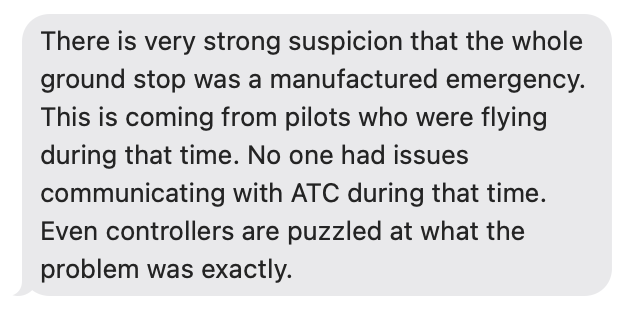
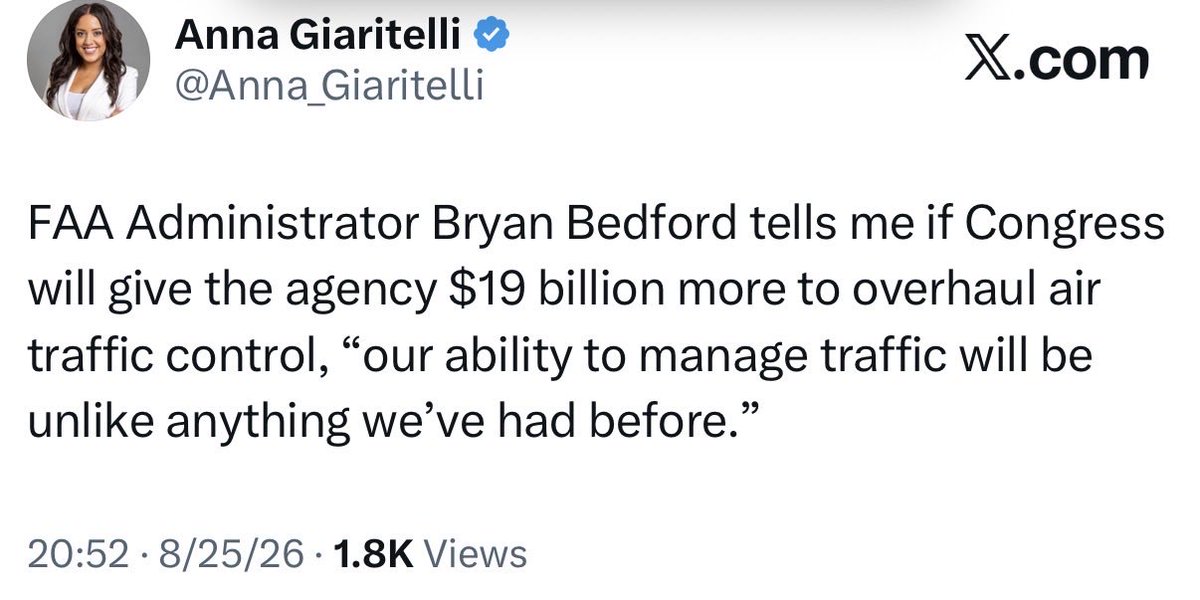
In August, FAA Administrator Bryan Bedford told me they needed $19 billion to complete the air traffic control overhaul.
With no explanation, that number jumped to $30 billion in a September press conference where Bedford and DOT Sec. Sean Duffy spoke.
Last night, Duffy threw out a new figure. $50 billion. No explanation other than we need it. This is on top of $12.5 billion that Congress funded last year.
DOGE laid off approximately 400 FAA employees, including technicians responsible for maintaining and upgrading critical navigational systems, which raised concerns about aviation safety and operational efficiency within the agency
https://t.co/iO78aatRyu
Most of you know that I oversaw the "aging, outdated system" at SSA for six years.
We made almost daily updates each night at 8pm and tested like crazy all night because even small changes would create problems in seemingly unrelated legacy software.
This risk is greater when the changes are infused with AI.
What you have here are inexperienced administrators who didn't understand their old technology & had too much confidence in their sexy new technology.
Their rollout last week was premature, and the country paid a horrible price for it.
Air traffic controllers told me that they believe FAA Administrator Bryan Bedford is approaching agency management entirely backward, treating a federal safety agency like a corporate balance sheet by trying to squeeze out every ounce of productivity from controllers. Critics say he is running the FAA like a capitalist businessman, prioritizing cost-effectiveness as he did at his former company, regional Republic Airways, while treating public safety as a secondary concern.
One controller from the New York Center who retired in August said he chose to leave after more than two decades due to the deteriorating culture.
“With the administration that’s in now, the morale in that building is at an all-time low,” he said, speaking on the condition of anonymity.
The retired controller stated that management at his facility focused heavily on keeping controllers on shift longer, a move he says actively endangers the public.
https://t.co/iAp9fahKXE
President Biden's 2021 Infrastructure Bill allocated $25 billion for air travel, which included $5 billion for the FAA to upgrade its systems.
Are you aware of who voted against that legislation?
Indeed, it was Markwayne Mullin.