@sanchezcastejon You fucking wanker, you created the mess. You are a traitor to your people, every Spanish citizen that is raped or murdered by an invader their blood is on your hands
@gaceta_es Ha caído Ceuta.
En España NO FUNCIONA NADA!
De qué sirven las Fuerzas Armadas?
De qué sirve el rey?
De qué sirve el CNI?
De qué sirve la oposición?
Por qué no hay una MOVILIZACIÓN NACIONAL?
LA CRUZ ROJA DE CEUTA PIDE AYUDA.
NECESITA DONATIVOS PARA MANTENER A TODOS LOS QUE ESTÁN ENTRANDO 😂😂😂😂😂😂😂😂😂😂😂😂😂😂😂😂😂😂😂😂😂😂😂😂😂😂😂😂😂😂😂😂😂😂😂😂😂😂😂😂😂😂😂😂😂😂😂😂😂😂😂😂😂😂😂😂😂😂😂😂😂😂😂😂😂😂😂😂😂😂😂😂😂😂😂😂😂👇👇👇👇👇👇👇👇👇
@arturovilla Lo peor es q si hay medios, lo q no hay es voluntad política porque todo pasa por el cálculo político. Las democracias parlamentarias están demostrando ser un una herramienta defectuosa q es capaz de ejercer sus funciones en los tiempos actuales.
@arturovilla Y ahora dime dónde se van nuestros impuestos.
Sin medios, sanidad pésima, educación pésima…
Pero tranquilos, que al menos no gobierna la ultra derecha
Se te inunda la casa, no hay medios
Se te quema el pueblo, no hay medios.
Te invaden 40.000 bestias salvajes, no hay medios.
España es un Estado fallido.
Ponerse en forma no es sólo una cuestión estética.
Hay una conexión clara entre cuerpo y mente, se retroalimentan.
Cuando te pones en forma, cambia mucho más que tu aspecto. Cambia tu forma de relacionarte contigo mismo y con el mundo, cambia tu estado de ánimo, tu perspectiva, la forma en que ves las cosas y la forma en que te ves a ti.
No me estoy refiriendo a si tienes o no un 6 pack o glúteos de acero, sino a sentirte físicamente bien en tu cuerpo. Sentirte capaz, joven, con energía, sin neblina mental, sin dolores, sin fricciones diarias derivadas de molestias, rigidez muscular o bajones de energía.
Si quieres una vida mejor y no estás en forma, empieza por ahí.
@RAEinforma#RAEconsulta#dudaRAE
¡Hola!
¿Con qué preposición es más correcto utilizar la palabra «necesidad» en esta frase?
«Sentía una fuerte necesidad por/de desaparecer».
🇩🇪 El Gobierno alemán planea eliminar la jornada de ocho horas
El borrador se debatirá en junio y elimina la jornada máxima diaria por una de 48 horas semanales, permitiendo turnos de 13 horas y de hasta 73 horas semanales en "periodos de alta demanda".https://t.co/Mpx6lqqUMY
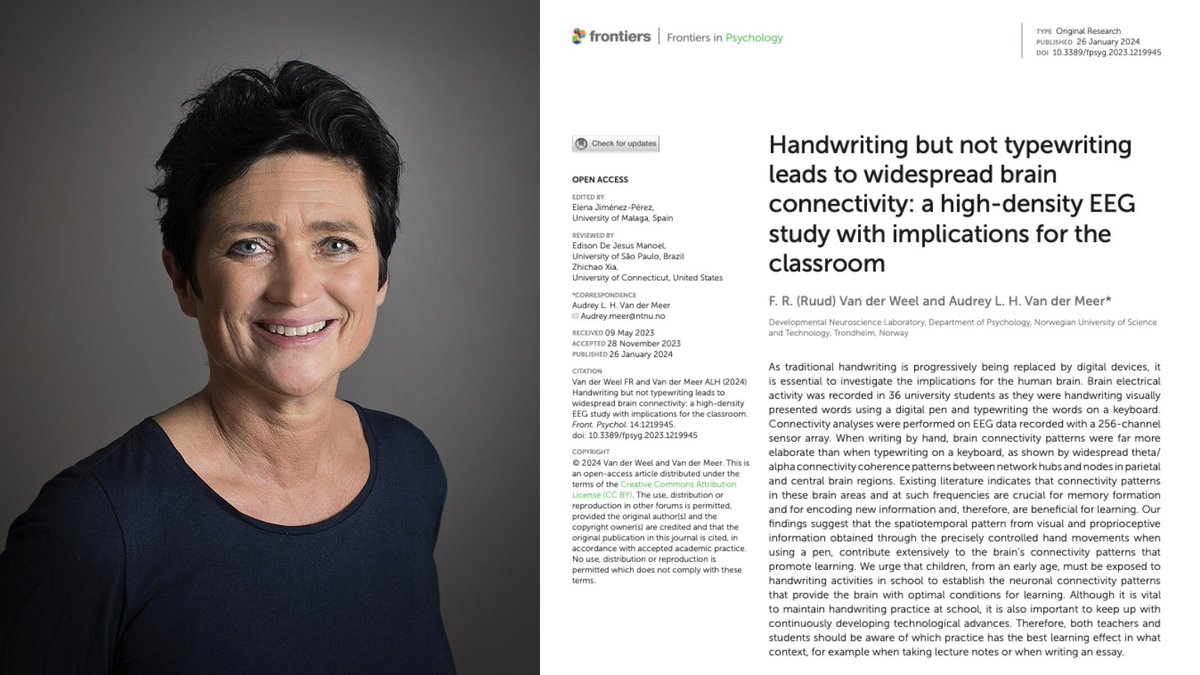
A Norwegian neuroscientist spent 20 years proving that the act of writing by hand changes the human brain in ways typing physically cannot, and almost nobody outside her field has read the paper.
Her name is Audrey van der Meer.
She runs a brain research lab in Trondheim, and the paper that closed the argument was published in 2024 in a journal called Frontiers in Psychology. The finding is brutal enough that it should have changed every classroom on Earth.
The experiment was simple. She recruited 36 university students and put each one in a cap with 256 sensors pressed against their scalp to record brain activity. Words flashed on a screen one at a time.
Sometimes the students wrote the word by hand on a touchscreen using a digital pen, and sometimes they typed the same word on a keyboard. Every neural response was recorded for the full five seconds the word stayed on screen.
Then her team looked at the part of the data most researchers had ignored for years, which is how different parts of the brain were communicating with each other during the task.
When the students wrote by hand, the brain lit up everywhere at once.
The regions responsible for memory, sensory integration, and the encoding of new information were all firing together in a coordinated pattern that spread across the entire cortex. The whole network was awake and connected.
When the same students typed the same word, that pattern collapsed almost completely.
Most of the brain went quiet, and the connections between regions that had been alive seconds earlier were nowhere to be found on the EEG.
Same word, same brain, same person, and two completely different neurological events.
The reason turned out to be something nobody had really paid attention to before her work. Writing by hand is not one motion but a sequence of thousands of tiny micro-movements coordinated with your eyes in real time, where each letter is a different shape that requires the brain to solve a slightly different spatial problem.
Your fingers, wrist, vision, and the parts of your brain that track position in space are all working together to produce one letter, then the next, then the next.
Typing throws all of that away. Every key on a keyboard requires the exact same finger motion regardless of which letter you are pressing, which means the brain has almost nothing to integrate and almost no problem to solve.
Van der Meer said it plainly in her interviews.
Pressing the same key with the same finger over and over does not stimulate the brain in any meaningful way, and she pointed out something that should scare every parent who handed their kid an iPad.
Children who learn to read and write on tablets often cannot tell letters like b and d apart, because they have never physically felt with their bodies what it takes to actually produce those letters on a page.
A decade before her, two researchers at Princeton ran the same fight using a completely different method and ended up at the same answer. Pam Mueller and Daniel Oppenheimer tested 327 students across three experiments, where half took notes on laptops with the internet disabled and half took notes by hand, before testing everyone on what they actually understood from the lectures they had watched.
The handwriting group won by a wide margin on every question that required real understanding rather than surface recall.
The reason was hiding in the transcripts of what the two groups had actually written down.
The laptop students typed almost word for word, capturing more total content but processing almost none of it as they went, while the handwriting students physically could not write fast enough to transcribe a lecture in real time, which forced them to listen carefully, decide what actually mattered, and put it in their own words on the page.
That single act of choosing what to keep was the learning itself, and the keyboard had quietly skipped the choosing and skipped the learning along with it.
Two studies. Two countries. Same answer.
Handwriting makes the brain work. Typing lets it coast.
Every note you have ever typed instead of written went into your brain through a thinner pipe. Every meeting, every book highlight, every idea you captured on your phone instead of on paper was processed at half depth.
You did not forget those things because your memory is bad. You forgot them because typing never woke the part of the brain that would have made them stick.
The fix is the thing your grandmother already knew.
Pick up a pen. Write the thing down. The slower road is the faster one.
@ZoeGutier Protegerlos de todo no es amor.
Es prepararlos para fracasar en silencio cuando tú ya no estés.
El mayor regalo que puedes darle a un hijo no es hacerle la vida fácil.
Es enseñarle a vivir sin ti.
Breakfast, lunch, dinner. That schedule was invented for coal miners burning 4,800 calories a day. You burn about 2,200 at a desk.
The three-meal pattern took off in the 1850s, during the Industrial Revolution. Workdays ran twelve hours, and factory workers and miners needed a midday meal just to stay upright. Before then, most English people ate twice a day. Romans ate once. Lunch didn't even exist as a separate meal.
The average American walks 3,000 to 4,000 steps a day, about a mile and a half. Anything under 5,000 puts you in sedentary territory. A sedentary 35-year-old guy needs about 2,200 calories a day to hold his weight steady. A sedentary woman, around 1,800.
One chain-restaurant dinner runs 900 to 1,500 calories on its own. Researchers at the University of Toronto measured meals at 19 sit-down chains. Breakfasts averaged 1,226 calories, lunches 1,000, dinners 1,128. Do the math: 3,354 calories from main dishes alone. Throw in a soda and dessert and you clear 4,000, roughly what a coal miner used to eat in 1890.
US food supply per person has climbed 23% since 1970. Our step counts have gone the opposite direction. The World Health Organization says more than 1 in 4 adults globally miss even the bare-minimum physical activity level. And 40.3% of American adults are now obese, according to the CDC's latest national health survey. Up from 30.5% in 2000.
Three meals a day was built for people who swung pickaxes. The rest of us are borrowing their meal plan.
@elenadesaa1999 Sinceramente, quizá porque soy un culo inquieto, soy incapaz de sentarme a ver una película por mi cuenta. Para mí ver películas es un acto social. No hay nada como reaccionar y ver cómo reaccionan. Además, ver películas en compañía da lugar a las mejores conversaciones.
Hay una pequeña cafetería donde dos personas llegan y se acercan al mostrador.
—Cinco cafés, por favor. Dos para nosotros y tres “colgados”.
Pagaron, tomaron sus dos cafés y se fueron.
Le pregunté al mesero: —¿Qué significa eso de cafés “colgados”?
—Espera y verás.
Entraron más personas.
Dos chicas pidieron un café cada una, pagaron y se fueron.
Luego llegaron tres mujeres y pidieron siete cafés: —Tres para nosotras y cuatro “colgados”.
Yo seguía intrigado… ¿qué significaban esos cafés “colgados”?
Entonces, un hombre con ropa gastada, que parecía no tener hogar, se acercó al mostrador y preguntó con sinceridad:
—¿Tiene algún café “colgado”?
—Sí, señor.
Le sirvieron un café… y entendí todo.
La gente paga por adelantado un café que será servido a alguien que no puede permitirse una bebida caliente.
Esta tradición comenzó en Nápoles.
Increíblemente, se ha extendido por ciudades y pueblos de todo el mundo.
También es posible pedir no solo “cafés colgados”, sino un sándwich o incluso una comida completa a bajo costo.
¿No sería genial que todos empezáramos a hacerlo en las ciudades y pueblos donde vivimos?
Pequeños actos de bondad como este pueden impactar muchas vidas, de formas que ni imaginamos.
Quizá todos deberíamos intentarlo.