Older muscle needs more protein at a meal to get the same building response as younger muscle. When the two were compared, older men needed about 1.7 times as much protein per kilogram of body weight before muscle building reached its peak.
This is part of why people lose muscle with age even when they think they're eating enough, because a serving that works fine for a younger person can fall short for an older one.
After about 60, I'd aim for a generous serving of protein at every meal, roughly 30 to 40 grams for most adults, and I'd pair it with lifting.
Stopping tirzepatide usually brings much of the weight back. In the trial that tested this, people who had lost about 21% of their body weight and then switched to placebo gained 14% back over the next year, while those who stayed on the drug kept losing.
The drug works well while a person takes it, but the appetite it controls returns when it stops. I think the time to build the habits that hold the weight, like eating fewer carbs and lifting to protect muscle, is while the drug is still working.
Anyone starting a GLP-1 should have a long-term plan with their doctor from the beginning.
Skin tags are usually treated as a cosmetic nuisance, but they can be one of the earliest visible signs of a metabolic problem. In a study of 216 people with skin tags, about 26% had diabetes and another 8% had impaired glucose tolerance, 16 of them didn't know they had diabetes until they were tested, and they weren't more likely to be obese than the general population. High insulin drives skin cells to grow, which is why skin tags often show up alongside the dark, velvety patches on the neck and armpits, and anyone noticing them should ask for a fasting insulin test.
With Halloween a week away, it's worth knowing what intense sweetness does to the brain's reward system. In a 2007 study, rats could choose between sweetened water and intravenous cocaine, and 94% chose the sweet water, including rats that had already been heavily exposed to cocaine, and the same preference showed up with plain sugar. I'm not saying a candy bar is a drug, but sweetness clearly taps the same reward pathways, and that's why 'just one' is so hard for so many people.
Loading the skeleton matters, and for most people the easiest way to do it is lifting, which also improves insulin resistance, one of the biggest drivers of aging. In one study, people with type 2 diabetes and healthy men trained just one leg for six weeks, three sessions a week of no more than 30 minutes, and the trained leg took up more glucose in response to insulin and had more GLUT4 and insulin receptor protein than the untrained leg. A person doesn't need to dunk, but they do need to put load on muscle and bone a few times a week.
Mechanical pressure on shin bones extended mouse lifespan by 80 days (+9.4%).
That’s the human equivalent of 7–9 yrs.
Bone pressure triggers PIEZO1 sensors to broadcast anti-aging signals to the brain, liver, and immune system.
If this translates to humans, my dunk training is flooding my entire body with anti-aging juice.
Insulin is a growth signal, and that's why chronically high insulin concerns me when it comes to cancer. In the Women's Health Initiative, postmenopausal women without diabetes in the highest quarter of fasting insulin had about 46% higher breast cancer risk than women in the lowest, and among women not on hormone therapy the risk was 2.4 times higher even after accounting for estrogen. The link between obesity and breast cancer largely faded once insulin was factored in, and that says a lot about what's actually driving it.
Insulin stimulates growth, so it's perhaps unsurprising that cancer cells are loaded with insulin receptors, the better to promote their rapid growth.
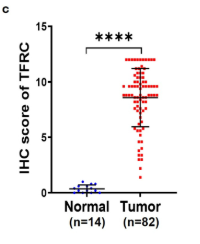
But not enough is said about cancer cells having massively more transferrin receptors, to increase their iron uptake.
Cancers are "iron addicted". They require all the iron they can get.
Shown here: expression of mRNA for transferrin receptor in endometrial cancer cells.
https://t.co/DSJeyfrV8W
The worry that fasting eats muscle has it backwards, because the body raises growth hormone during a fast to spare protein. By day five of a fast in one study, 24-hour growth hormone was about three times higher than on a fed day, and between day one and day five free fatty acids rose almost fourfold and the ketone acetoacetate rose about fourteenfold. That's a body moving to its own fat for fuel while it protects muscle, and in my view it can do that because insulin has fallen low enough to allow it.
Fasted, your growth hormone climbs several-fold to protect your muscle.
Fasted, your insulin drops low enough to let your own fat out of storage.
Fasted, you burn the fuel round your middle instead of waiting for a delivery.
Fasted, your brain switches on orexin, the chemical that keeps a hungry animal awake and alert.
Fasted for a few days, your metabolic rate goes up, not down.
Fasted, your muscles are still full of yesterday's fuel, because an overnight fast mostly drains the liver.
Fasted, your cells start breaking down and recycling their own worn-out parts.
Fasted, there is no mid-morning slump, because there was no breakfast.
Fasted, there's nothing sloshing about when you brace for a squat.
Every hunter in history went out on an empty stomach.
Nature never once put the hunt after breakfast.
A high-carb diet leaves less usable fuel in the blood a few hours after a meal than a low-carb diet with the same calories. This has been measured directly in people trying to keep weight off after a diet.
The insulin surge from the carbs pushes fuel into storage and holds back the release of fat, so three to five hours after eating, the blood carries less energy the body can use. I think that's a big reason people get hungry again so soon after a carb-heavy meal.
If a person is fighting constant hunger, I'd lower the carbs before cutting more calories.
This was in old mice with their shin bones loaded, and it's a striking result. People have their own evidence, too. In postmenopausal women with low bone mass, eight months of heavy lifting and impact training twice a week improved bone density at the spine and hip, and it didn't cause fractures.
Bone responds to heavy load at any age, and I'd put lifting ahead of any supplement for aging well.
Mechanical pressure on shin bones extended mouse lifespan by 80 days (+9.4%).
That’s the human equivalent of 7–9 yrs.
Bone pressure triggers PIEZO1 sensors to broadcast anti-aging signals to the brain, liver, and immune system.
If this translates to humans, my dunk training is flooding my entire body with anti-aging juice.