An eighth generation Texan; Ben is a former Marine, school teacher, retired Texas Highway Patrolman and an award winning author with six books to his credit.
“According to the Bible, God created the heavens and the Earth. It is man’s prerogative - and woman’s - to create their own particular and private hell.”
--Rod Serling
The link to this week’s narration for ‘Cristeros’ follows below. Please click to listen and feel free to share:
https://t.co/YoDTDOICji
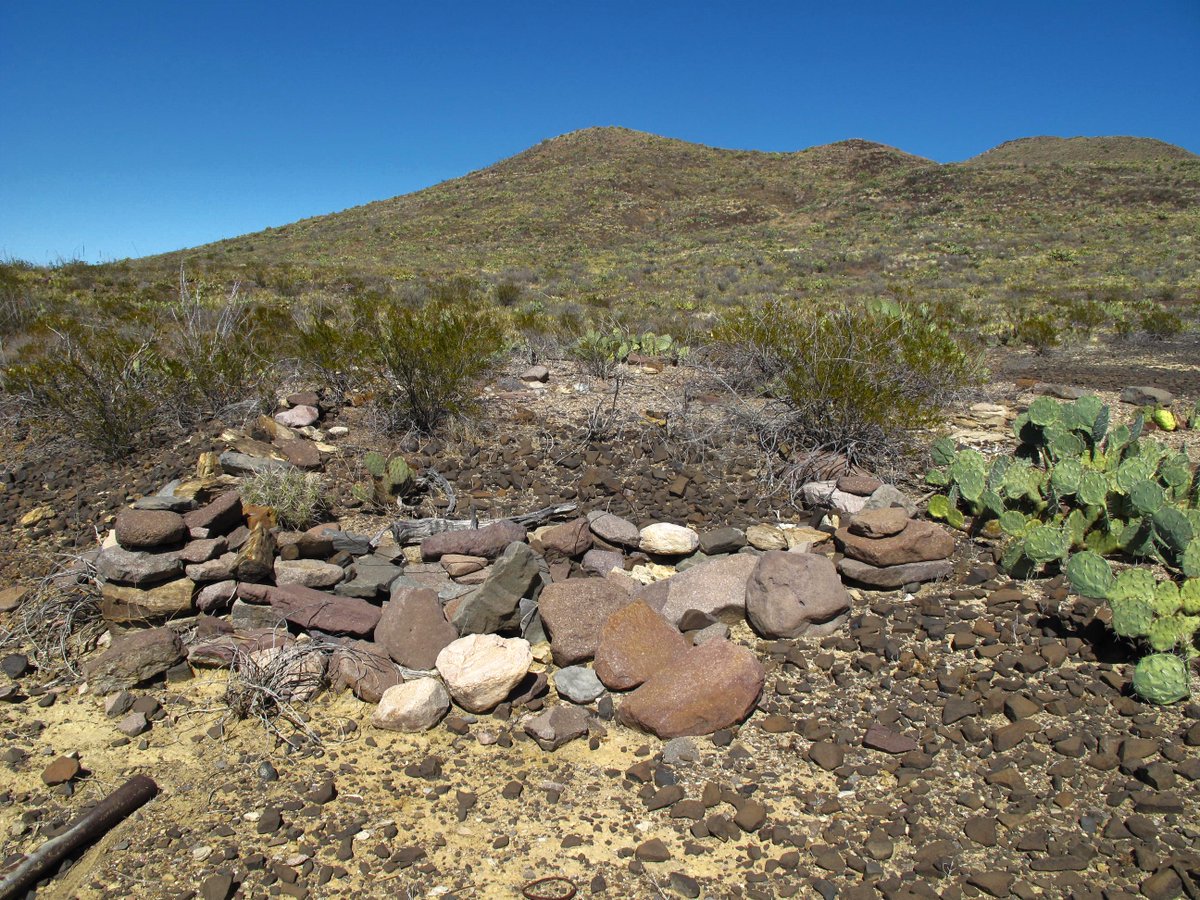
The attached photograph signifies some of the background to this story. These ruins are not more than forty feet from a large adobe building to my rear, once housing Army troops during the revolutionary troubles in Mexico.
To the right and just out of frame is the Rio Grande. Across that narrow ribbon of liquid gold it is known as the Rio Bravo. If the lens was shifted slightly, you could see the spot where the audio clip occurs.
The location itself is the old Jumano settlement of El Polvo, situated next to present day Redford. In March of 2023, I was honored to be invited to the 175th Anniversary of the founding of El Polvo.
But this area has a far older history than those few years. Less than a quarter of a mile away are the remnants of an old mission, reportedly dating back to the end of the seventeenth century.
The mission was for the Topacolme settlement nearby, which in turn was there due to the river crossing known as the Vado Rojo. This crossing was assuredly used by the Ancients thousands of years ago.
For miles to either side of this point, where the ground is high enough to avoid the once mighty floods are cemeteries, are pantheons, archeological sites, middens, mortars, metates and the remnants of hundreds of camps of those same ancients who lived and died here.
For those who are interested, this is where the CBP plans to build a thirty foot wall, with no concern to the damage done and history lost.
Not to mention businesses, properties and homes eradicated, and a new category of second class American citizens will be created.
Things to think about, my friends. Things to think about…
God bless to all,
Ben
BOOK EVENTS:
~~~~~~~~~~~~~~~~~~~~~~~~~~~~~~~~~
ALPINE, TEXAS Friday, October 9 Big Bend Octane Fest. I will be present to sign books and visit with my readers.
HORSEHEAD CROSSING, TEXAS Saturday, October 10. (9a-5p) Signing books, selling books and generally enjoying this historical celebration!
~~~~~~~~~~~~~~~~~~~~~~~~~~~~~~~~~
Ben H. English
Alpine, Texas
USMC: 1976-1983
THP: 1986-2008
HS Teacher: 2008-2010
Author of ‘Yonderings’
‘Destiny’s Way’
‘Out There: Essays on the Lower Big Bend’
‘The Uvalde Raider’
‘Black And White: Tales of the Texas Highway Patrol’
‘¡Cristeros!’
Facebook: Ben H. English
Webpage: https://t.co/dRL9RoJxGW
X: Ben H. English
‘Graying but still game.’
@jtlynch60 Well explained and stated, Jeff. Do not let that certain element get under your skin. You do fine work and I personally appreciate you sharing. God bless, sir.
SOMEWHERE IN THE LOWER BIG BEND:
"Mine is a rugged land but good for raising sons---and I myself, I know of no sweeter sight on earth than a man's own native country."
--Homer's Odyssey
I have been writing these essays since my first book was published in 2017, sharing my enduring passion for a land that saw six generations of my family come and go. Some were well known, some little so, but each possessed that same passion I inherited from them.
My stories have ranged across the depth and breadth of the lower Big Bend, and on occasion the other side of the river. Without that river’s existence, many of those stories would have never happened. For in truth if the desert and the mountains are the flesh and bone, the river and the major watersheds feeding into it provide the heart and arteries.
All are essential, and the creation of our area parks has helped this land remain as it once was; wild, free, unfettered and unbending, a gifted portal into a not so distant past.
But today my spirit is deeply troubled, and I write on a subject that I have no desire whatsoever to address. There will be no natural beauty or tales of endurance, no relating of lasting lessons, no joy, no awe, and no mysteries enshrouded in this magical land.
It has been a tortuous path through human ignorance, greed, bureaucratic lies, obfuscations and manipulations, and so-called ‘public servants’ at every level of government who are wholly undeserving of their chosen self descriptor.
The public they are supposed to be serving has been purposely lied to repeatedly, aided and abetted by so-called ‘news’ agencies who are usually more interested in the number of clicks on their site than in actually learning the truth.
Finally there are the contractors for this massive act of unconscionable behavior, seeding deceit and distrust with massive amounts of our own taxpayer money to alienate neighbors, fellow citizens and former friends over the morality in a quick buck.
All this for a colossally stupid project of unimaginable destruction that will do more damage to the land they are trying to ‘protect,’ than has been done before in all of this region’s recorded history.
And now it is coming to pass.
Presently those contractors are inside our national park, behaving as if they have no limits nor boundaries in their butchery of what the National Park Service has been trying to protect for over eighty years.
Along with the now forgotten promises made to land owners and their descendants who were basically forced out, stating their sacrifice would benefit generations of Americans to come. It would give all a free and unfettered place to roam, and that it would remain that way for perpetuity.
Instead, we as a people get this:
-They claim there will be no physical wall inside the park, but somehow fail to mention there will be 17.3 miles of four to six foot high vehicle barriers, all for a half dozen or so disused, grown over river crossings that could be effectively blocked off with large boulders over a length of several yards.
-Nor they did not mention the road system they envision for this construction, and that the material will come from the nearby soil of the park itself, creating ghastly gravel pits and eyesores by the score.
-They also do not make mention of the fact the NPS will likely be responsible for these new networks, at a time when the park infrastructure is as bad as I can remember in my lifetime. The National Park Service presently does not have the money nor the manpower to maintain their own roads.
-On top of this is the plan to drill numerous wells inside the park for the needed water, which will likely number into millions of gallons amid a desert where there is often not a capful to spare. The irony of ironies will be when they find the only reliable water source will be from the river itself.
-No mention was made about the damage done to the park’s paved roads. They were are not made for heavy commercial traffic, have no shoulders, no bar ditches and will be ruined by the ensuing construction traffic.
- No attention is being focused on the man camps being put inside the park itself, and the lasting damage that will come from such nonsensical, freehanded ‘development.’
-Nothing about the amount of trash, garbage and assorted junk being scattered hither and yon by hundreds of people and their attending machinery, and who will not have one iota of concern for where they are and what it truly signifies.
-There is no discourse concerning the centuries upon centuries of remnants of human life along the river, including those of a culture and language now long dead. This will be their fate, obliterated by money hungry fools for no good purpose.
-Finally the final resting places and cemeteries dating back over the past hundred and twenty years or so, all lined out along the banks of the Rio Grande. It was where they lived and died, and their markers and stones will serve nothing more than where to aim the bulldozer’s blade.
This country will never be the same again.
Ever.
The majority of people living in this area want strong border security. They understand an open border is like an open sore to any sovereign nation’s continued good health. But there are far wiser, far less intrusive, monetarily sensible and effective methods to do so.
Many people understand this, but many have also decided to sit on their hands and hope for the best. To those I say let your conscience be your barometer for the rest of your days.
For the few who will benefit from their thirty pieces of silver and worship at the altar of the all-mighty dollar, I leave you with a telling verse from the First Book of Timothy: “The love of money is the root of all evil.”
And for those others, who share in my passion and love for this singular land, and continue to fight the good fight? From the bottom of my heart, I thank you. I also caution that if you want to see the river and the land as God intended it to be, come soon or it will be too late.
And please pray. Pray hard for Divine Intervention because that is about the only thing that can save what we all love so dearly.
God bless to all,
Ben
Ben H. English
Alpine, Texas
USMC: 1976-1983
THP: 1986-2008
HS Teacher: 2008-2010
Author of ‘Yonderings’
‘Destiny’s Way’
‘Out There: Essays on the Lower Big Bend’
‘The Uvalde Raider’
‘Black And White: Tales of the Texas Highway Patrol’
‘¡Cristeros!’
Facebook: Ben H. English
Webpage: https://t.co/dRL9RoK5wu
X: Ben H. English
‘Graying but still game.’
“The Spanish called it El Despoblado.”…
This week’s audio clip from ‘Cristeros’ runs five minutes in length, and occurs in the second chapter of the book. You can listen to it by clicking on the link:
https://t.co/oJGyPuATXJ
As far as the photo, it was taken about a mile and a half downriver from where Gideon crossed the night before. Looking through and over the walls of these ruins, you can see the mighty Sierra Ponce rising from the desert floor.
Near mid-frame, the cliffs rise even higher and are marked by a cleft in the sierra’s face. Here was where Gideon first camped on his way to meet Guillermo McKenna.
As described in the story, this sierra runs from dozens of miles into Mexico, terminating near the Chihuahua-Coahuila line. In doing so, it arrows into some of the most desolate, unforgiving desert country in the North American continent.
Thing is, it hasn’t changed much even these days.
I hope you enjoy mys little blurb and feel free to share with others.
God bless to all,
Ben
Ben H. English
Alpine, Texas
USMC: 1976-1983
THP: 1986-2008
HS Teacher: 2008-2010
Author of ‘Yonderings’
‘Destiny’s Way’
‘Out There: Essays on the Lower Big Bend’
‘The Uvalde Raider’
‘Black And White: Tales of the Texas Highway Patrol’
‘¡Cristeros!’
Facebook: Ben H. English
Webpage: https://t.co/dRL9RoK5wu
X: Ben H. English
‘Graying but still game.’
Ma'am, thank you for such a compliment. I am honored. One needs to remember that Hitler did not seize power in Germany in 1933, he was elected to it. I go into this situation in some detail in my fifth book 'The Uvalde Raider.' The vast majority of the German people were pro-Hitler, until he started losing the war. Even then only a few tried to stand against him, including the Lutheran Church. When found out most were executed in some fashion, or sent to concentration camps. Recently there has been some revisionist 'historians' who have tried to say otherwise, but leading scholars such as Victor Davis Hanson have debunked their claims with facts time and again.
SOMEWHERE IN THE LOWER BIG BEND
Many years ago, I heard rumor of a small German POW camp being in this area during World War II. I did not pay too much attention at the time, as I was young and by habit rumors and fables run rampant about such strange events.
One could say they add flavor to a land that is a conundrum of possibilities, remote though they may be.
But recently I heard this story again, coming from someone who knows this country and has familial roots here. He described the location and my memory snapped back to a prowl a few years before, south of Croton Peak.
I was passing through, headed for the Paint Gap Hills via the original Todd Hill cut. While enroute, I stumbled upon relics of a past era that left me scratching my head due to the oddity of it all.
A fairly large encampment had been there, with improvements and building material not often seen in this land at that time. A near vanished dirt road ran north, and following it I found some sort of diggings about a half mile away.
Listening to my acquaintance’s description, I realized this was where he was talking about. So some time later, I journeyed back for a more detailed look.
Now unusual sights and locales seem to be the norm when near Croton Spring, as the availability of reliable water has attracted different cultures since man first ventured into the lower Big Bend. Signs of the Ancients abound, as well as those of more recent inhabitants.
As I examined the locale in question, my mind crowded with much the same. There were large timbers scattered about, as well as bits of window glass and more of the aforementioned concrete foundations. Also present were bits of wire, rusting cans, remnants of a rock structure, bent and disfigured water pipes and other sorts of castaway paraphernalia.
There was also more than one road, a network of such was running through the abandoned encampment. An encampment, by the way, that gave evidence to dozens of people living here.
Another real oddity was once finished doing so, a concentrated effort was made to obliterate what had been constructed. The concrete foundations and slabs were buckled and smashed into heaps. Not a straight water pipe was to be found, nor a complete board or section of wood.
Everything present had been turned into so much junk, unusable for any future design. The diggings to the north had been filled in, with little remaining save for some broken timbers, and a fifty-five gallon drum cut in half for the extraction of soil.
The only structure left to the elements is the dwelling in the photograph, which is in itself just as odd as the others being so thoroughly uprooted. Further research and questions led to furrowed eyebrows and more questions directed back. Not one piece of documentation has been unearthed, nor any written clue as to the intended purpose.
Was it really some sort of POW camp?
At first glance the whole idea sounds outlandish at first glance, best placed in the category marked aliens, monsters, spooks, secret UFO bases, lost lodes of treasure and whatever else that might fit.
However I do know there was a German POW camp at Fort D. A. Russell during the war, and as with any other detention facility, I am certain they had their problem children.
In this case it would have been the die hard, fanatical fringe of Nazis. Those who attempted to dominate the camps even to the point of murdering fellow POWs, who were judged less than true believers.
That much is documented in the pages of history and occurred repeatedly, along with escape attempts numbering into the thousands. And frankly, I can’t think of a better spot to iron out some habitual troublemakers.
Again, a lot of questions with no answers and no eyewitnesses stepping forward to tell the tale.
Save for this desert, and as usual she is not fond of speaking of her long-held secrets.
God bless to all,
Ben
Ben H. English
Alpine, Texas
USMC: 1976-1983
THP: 1986-2008
HS Teacher: 2008-2010
Author of ‘Yonderings’
‘Destiny’s Way’
‘Out There: Essays on the Lower Big Bend’
‘The Uvalde Raider’
‘Black And White: Tales of the Texas Highway Patrol’
‘¡Cristeros!’
Facebook: Ben H. English
Webpage: https://t.co/dRL9RoJxGW
X: Ben H. English
‘Graying but still game.’
Yes sir, I am still running this down and trying for verifiable facts. Today I was contacted by a friend of my long deceased grandfather, who was a lifelong peace officer. He is now 92 years old and told me of going with his father into the lower Big Bend while handling Army payrolls. He said there was a POW camp down there, and what I found was likely the spot.
@westexascindy Ma'am, as mentioned in my article where there were large camps they also had full bore, sieg heil Nazis, and they tried to run those camps to the point of murdering their fellow prisoners. They were also enhanced escape risks, so they had to be dealt with in some manner.
“Muddy water is best cleared by leaving it alone.”
--Alan Watts
The link to this week’s audio clip for ‘Cristeros’ follows below and is a little over five minutes long:
https://t.co/xjrq1cmAE2
In the attached photograph, I am standing at the crossing described in the passage. It is situated about a half mile upriver from what is now Cottonwood Campgrounds in Big Bend National Park.
As you can tell from the disturbed soil, the crossing still serves the same purpose presently for both livestock and wildlife, and likely human on occasion.
The creek itself is called Blue Creek. It originates along the western slopes of Emory Peak, the highest point in the Chisos Mountains. Some of those reading will recall Blue Creek Trail, running from the Emory Preak area down to the foreman’s place for the Homer Wilson Ranch.
From head to the river, the creek travels some twenty miles. It has numerous branches, including one angling near due north from where the photo was taken.
That branch, which starts south of Black Mesa, figures into the story.
Please feel free to share with others.
God bless to all,
Ben
Ben H. English
Alpine, Texas
USMC: 1976-1983
THP: 1986-2008
HS Teacher: 2008-2010
Author of ‘Yonderings’
‘Destiny’s Way’
‘Out There: Essays on the Lower Big Bend’
‘The Uvalde Raider’
‘Black And White: Tales of the Texas Highway Patrol’
‘¡Cristeros!’
Facebook: Ben H. English
Webpage: https://t.co/dRL9RoJxGW
X: Ben H. English
‘Graying but still game.’
(Photo Courtesy of Julie B Childs)
SOMEWHERE IN THE LOWER BIG BEND:
“There are two great certainties about things that shall come to pass – one is that God knows, and the other is that we do not know.”
--Charles Spurgeon
The search for physical evidence concerning the Petty family murders of November 1884 continues. I documented the start of this project in a prior essay posted on the 16th of May.
This investigation has not been a solo affair. Assistance has come from Thomas Alex, retired national park archaeologist, who has also been looking into this mystery for decades. Tom and I have worked together on other projects, and his knowledge and passion for the history of this land is near inspirational.
Also heavily involved is Julie B. Childs, executive director for the BBNHA. Julie is a born researcher and has been my prowling partner for the past three years. In that time period, she has soaked up knowledge an incredible amount of information about this country.
When my time comes, she will know where all the bodies are buried.
Literally.
In regards to our search, a Mr. S.D. Brough has figured into the story. Brough had mining leases on four sections of land near Roy’s Peak, and headquartered at what was called Brough’s Mining Camp.
The camp was close to where the Pettys lived and he visited them frequently. Authorities were fearful he had been another victim but was later found safe. He had been to the Pettys that morning, and noted two unknown Mexicans who came in to ask for food.
Doing some extrapolating on the four sections leased, I calculated his mining camp would have been as close as possible to where these sections joined. Studying an old map, I could see where a road went into the area and ended very close to this spot.
Our prior ventures had approached this locale from the west. Along this route we noted the last fading remnants of a wagon road, as well as several branches of more leading from it.
These forks were likely for mineral explorations, but I believe one led to a low water crossing built on Tornillo Creek by the Army. This crossing was destroyed by a flood some years later.
Another led to where the Petty family; a man, woman, and two small girls were brutally assaulted, robbed and finally butchered by what was described as Mexican raiders.
Along the main road we found cans, nails, pieces of wire, a near gone holding pen, and a series of small cairns. These cairns were unobtrusively placed; as if someone was marking their way for future reference but not wanting to be obvious in doing so.
This week we came in from the northeast. The distance was shorter but the terrain far rougher than the westerly route, as it navigates through rugged slopes leading off Roy’s Peak. We found a series of old trails running hither and yon, with a few sporting the same style of cairns.
So far we have not made it to where I think Brough’s Mining Camp was located, each time only scouting about and getting a feel for the surroundings. This last trip did take us within five hundred yards or so of where research says to begin scouring.
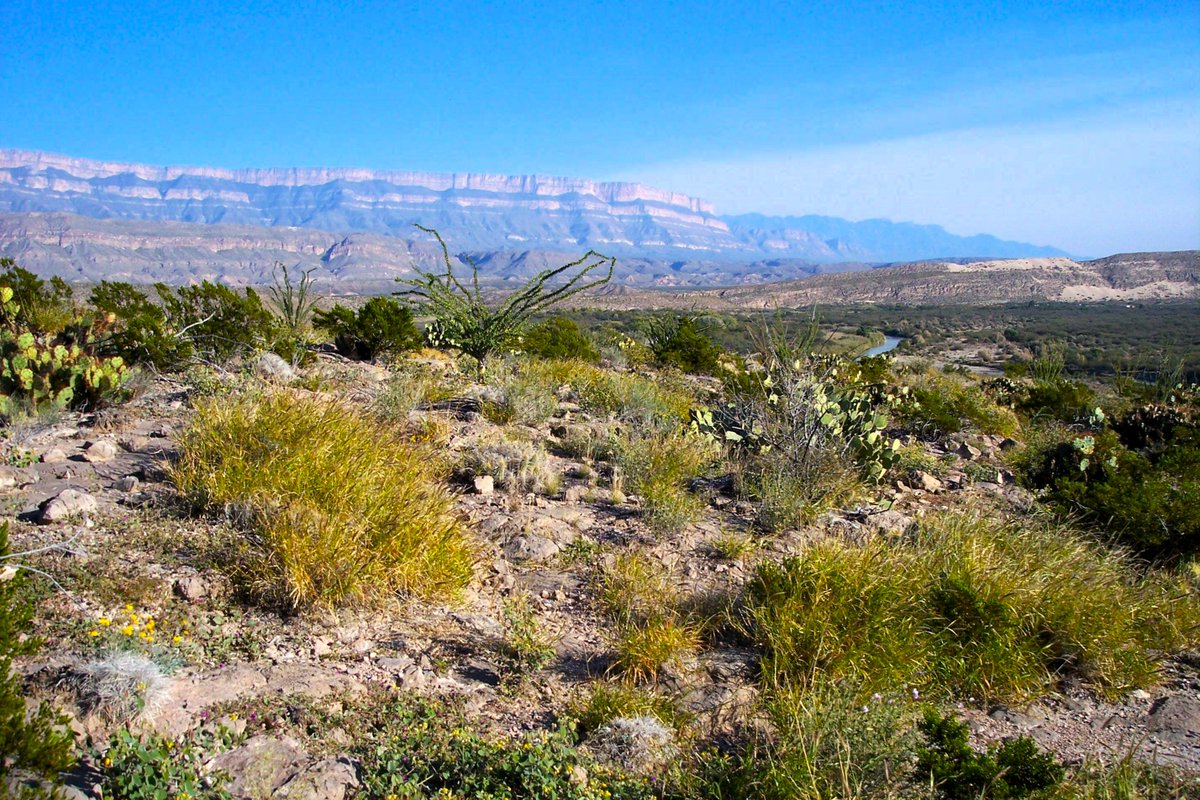
In the attached photograph, you get an idea of the terrain and the vistas one finds along the way. The near high ground falls into a narrow canyon ending at the head of Banta Shut in, where the Tornillo is squeezed into a solid rock chute with sheer walls on both sides.
On the horizon is the Chisos range, with Elephant Tusk and Nugent Mountain plainly visible. One interesting note is the geological dividing line to the front; light colored, often grayish rock to the left with solid formations of red rock running for miles off to the right.
So far, all signs of any sort of mining activity has been in these reddish hills paralleling the Tornillo.
The quest continues…
God bless to all,
Ben
Ben H. English
Alpine, Texas
USMC: 1976-1983
THP: 1986-2008
HS Teacher: 2008-2010
Author of ‘Yonderings’
‘Destiny’s Way’
‘Out There: Essays on the Lower Big Bend’
‘The Uvalde Raider’
‘Black And White: Tales of the Texas Highway Patrol’
‘¡Cristeros!’
Facebook: Ben H. English
Webpage: https://t.co/dRL9RoK5wu
X: Ben H. English
‘Graying but still game.’
“Again I entered my smithy to work and forge something from the noble material of time past.”
-- Jean Froissart
This is the second audio clip from my sixth book ‘Cristeros’ and is about six minutes long. You can click on the link to listen.:
https://t.co/B4bHgVx9K4
Now for the photograph.
It was taken only a few days ago along the eastern slopes of Roy’s Peak, looking roughly north. In the distance to the right side of the frame, you can see the valley where this scene occurs.
The ruined ranch headquarters that was once Gideon’s home lies in that valley, obscured by the intervening high ground in between.
You can also see where a near gone wagon road once passed through an old fenceline gap to your direct front. This gap would have been in use during the time of the story.
Please feel free to share with others.
God bless to all,
Ben
Ben H. English
Alpine, Texas
USMC: 1976-1983
THP: 1986-2008
HS Teacher: 2008-2010
Author of ‘Yonderings’
‘Destiny’s Way’
‘Out There: Essays on the Lower Big Bend’
‘The Uvalde Raider’
‘Black And White: Tales of the Texas Highway Patrol’
‘¡Cristeros!’
Facebook: Ben H. English
Webpage: https://t.co/dRL9RoJxGW
X: Ben H. English
‘Graying but still game.’
SOMEWHERE IN THE LOWER BIG BEND:
“There was no desert in his heart, though there was a desert around him.”
–Charles Spurgeon
Recently we were on a scout via vehicle, covering the area west of Hen Egg and toward El Solitario. Some sixty years ago this made up part of a ranch my family had, one of five we either owned or leased. These days they call it the Three Bar, but when I was a boy it was the old Fulcher Place.
The Fulcher Place was my father’s headquarters and where we lived. The ranch once covered most everything from Sawmill Mountain to just below Hen Egg Peak, and from the eastern slopes of El Solitario over to Highway 118.
As we paralleled a near gone fenceline south of Black Ridge, I remarked that was once our north boundary line. Casting an eye to where Terlingua Creek lay hidden by interceding high ground, I made the comment of Crenshaw’s Crossing being due east.
We came to an intersection that piddled off to the north.
“In fact,” I added, “I be that road takes us to it.”
Julie guided her Jeep onto the new heading, asking me questions.
“Been there a long time, at least 125 years and likely longer. One of the few spots where you can cross Terlingua Creek in a vehicle.”
“When was the last time you were there?” she enquired.
“I’ve never been,” I admitted.
“You’ve never been there before?” she asked.
“Nope, but I remember it well.”
And therein lies the story.
I was eleven years old at the time. We had a small Ford tractor, an 8N if I recall correctly, with a blade on the back. Dad used it to maintain our assorted roads on the ranch, usually to hunting camps, and would let me drive the tractor to wherever he needed to do some work.
He had recently finished some repairs and a new wire gap on what is presently called Hen Egg Road. Of course, it wasn’t much of a road in those years, but it got us where we needed to go.
While doing so he was asked to do blade work up by Crenshaw’s Camp, west of Hen Egg Mountain. More specifically, it was to improve the spot known as Crenshaw’s Crossing.
Now my dad, the third Ben English or ‘E.B,’ possessed a curious mind and like the rest of the family, a real feeling for the land and the history to it. I suppose my own curiosity was sparked by his, and he would regal me with stories of who, where, when and why.
This included the crossing, which was a will-o-the-wisp sort of locale that hid in plain view. Some maps had it, some didn’t and a few didn’t even show the road. The crossing itself had changed many times, along with the whims of the creek.
As most anybody with any experience can tell you, when the Terlingua comes down on one of its mean streaks things change. Rock bottom to mud and back again; stark, steeply etched banks where gentle slopes and green grass stood before, even jumping out of its banks and creating new channels.
He told me all this about the crossing, and I was raring to go and see for myself.
On the day anointed we left headquarters and headed north, tacking a good clip with dad trailing me in his GMC. His recent work made the trip extra quick and I actually got to use fourth gear in the tractor. The hot desert wind was in my face, cooling the sweat of summer, and I had to take care my straw hat didn’t blow off.
Our north fenceline was about a mile and a half from the crossing, and you approached it by dropping off an incline about sixty feet in elevation. At the bottom was dad’s new pride and joy, that wire gap he had just finished.
He had warned me repeatedly about it being there, so when I crested the incline my right foot was hard on both brakes. Problem was, they weren’t doing anything.
Like the man said in the song, “it was kind of like stepping on a plum.”
Off the high ground the little Ford tractor roared, the tiny flathead engine screaming for mercy as dad honked the horn repeatedly on the GMC, giving me an unneeded warning of what was about to happen.
I checked left and right along the fenceline, vainly trying to figure a way out of this deal. But there tweren’t none, no place to go and if I could I’d still roll the tractor.
Doing so wasn’t a good idea even at eleven, so I centered up that wire gap just as pretty as you please and ran right through with a full head of steam. Down the road I went, parts and pieces of wire and post dangling off the front end and flopping around underneath.
Finally I spied a low uplift to the left, and steered the Ford up until the momentum played out and we rolled to a stop. Dad was still beeping on the GMC’s horn, I guess there was nothing else he could really do.
But once he got out of that truck, there was something else. He cussed a blue streak of thunder and damnation that would make a Baptist preacher turn to the bottle. It went on for a good five minutes, and I don’t think he ever used to same words twice.
After he paused for a breath from the steam of profanity in both English as well as Mexican, I managed to make him aware that I had no brakes. We left the tractor at the scene of the crime for future repair.
Yep, I never made it to Crenshaw’s Crossing, until a recent summer day in June.
But I do remember it well!
God bless to all,
Ben
Ben H. English
Alpine, Texas
USMC: 1976-1983
THP: 1986-2008
HS Teacher: 2008-2010
Author of ‘Yonderings’
‘Destiny’s Way’
‘Out There: Essays on the Lower Big Bend’
‘The Uvalde Raider’
‘Black And White: Tales of the Texas Highway Patrol’
‘¡Cristeros!’
Facebook: Ben H. English
Webpage: https://t.co/dRL9RoJxGW
X: Ben H. English
‘Graying but still game.’