@0cInane@WorldHallOfFun@Austen Foreign aid falls into 4 categories - humanitarian, political (to combat authoritarianism, communism, etc.), military, and economic.
These are soft power mechanisms that equip allies, encourage development, support American democratic ideals, and encourage human rights.
@rfranks263@Andrew__Roth For instance in 2022, Ukraine, Israel and Egypt were 3 of the 5 largest recipients of aid from the US. A large chunk of that aid is in-kind transfers of existing military equipment or funds to buy American-made military equipment.
@rfranks263@Andrew__Roth Foreign aid comes in 4 broad categories - humanitarian, economic, political, and military. The last two will have need for SCIFs as they sometimes coordinate the delivery of sensitive aid (military equipment, etc.) to address foreign policy objectives.
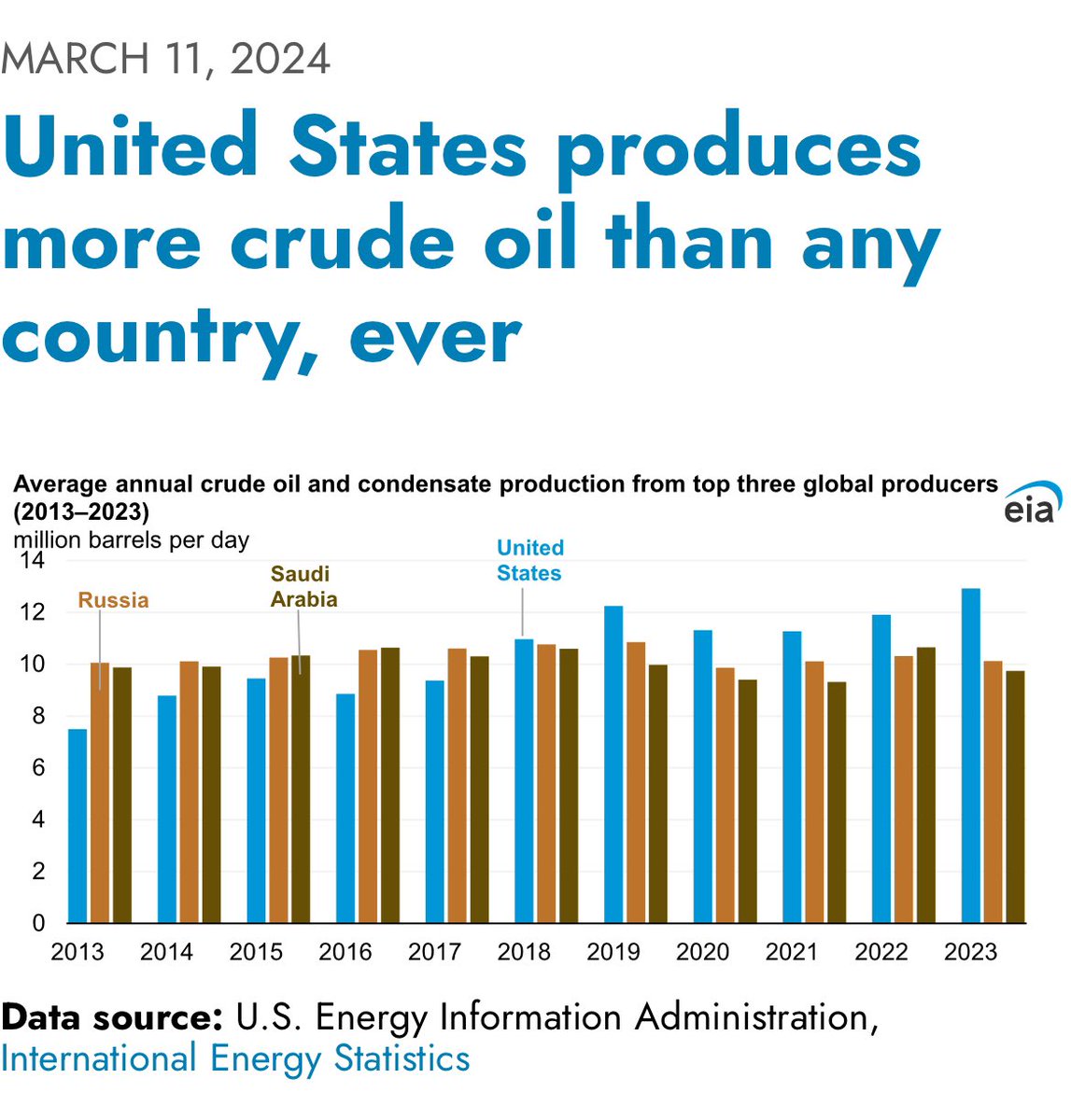
@jps56789@NoPatria@cturnbull1968@catturd2@Canada The “oil” production you are citing includes “field production of crude oil and natural gas liquids, renew. fuels and oxygenate plant net production, and refinery processing gain.”
@jps56789@NoPatria@cturnbull1968@catturd2@Canada As for imports, the US is a NET exporter of oil and has been since 2020 (yes including all the Biden years). We do import millions of barrels of oil, but export more. https://t.co/7W7lSCPLMU
https://t.co/kXmmT7mSl9
@jps56789@cturnbull1968@catturd2@Canada You are mixing up consumption with production. The US produces between 13 and 14 million barrels per day. In 2024, the US consumed between 20 and 21 million barrels per day.
We are a net exporter of oil AND natural gas, but are far from a net exporter of just crude oil.
@smartox67 @cturnbull1968@catturd2@Canada Even if this is true, this is how you want to treat a neighbor, partner and ally, you think we should threaten to “freeze” them? SMH
@drvolts@JigarShahDC Ditto on this point.
I had a variety of other terms I preferred, but it is not worth the debates. That said there should be additional terms that could further characterize an aggregation.
Listening in at #DERVOS and cannot help but think that problems don’t change, but technology does.
We underestimate the impact of technological change over the long-term and overestimate it in the short-term. Regulation has to bridge that gap and regulators are struggling.
“If we build one too many transmission lines or conduct one too many pilots that do not go exactly as planned, it is ok. We should not let the perfect be the enemy of the good.”
-paraphrased @ClementsFERC at #DERVOS
@curious_founder This is a blind spot for many forecasters. Many assume that the African auto market will not respond to low price EV cars and bikes.
These vehicles are game changers though. Especially in markets where power is available and road trips are not common.
@danushman@the_transit_guy Europe stilll has open roads between cities and in rural areas. This is not one of them because it looks to be a residential street (as most are in cities and suburbs).
@drvolts@ClementsFERC Are companies that are building large load facilities taking on of the long-term investment risk for new power capacity? Should they put their own long-term capital on the line to protect long-term price stability or could load growth be diverse enough to mitigate these risks?
Great quote (paraphrased) to inspire positive change from @leahstokes - “If you have a car in your house, you are running your own little fossil power plant. The easiest way to make a difference is buy an EV, and get out of that business.”
#ClimateWeekNYC