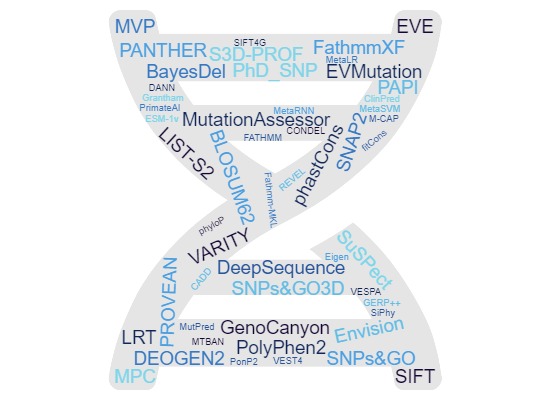
In our new Nature Communications article, we identify and discuss factors that can lead to discordance between computational variant effect predictors and functional assays.
https://t.co/ZjJNrcsiTK
We hope that this benchmark will be useful to those considering using VEPs in their work for making an informed decision on which ones to consider. Thanks to everyone at @jmarshlab and @mrc_hgu for their help and support of this work.
In our new paper (https://t.co/X4SwhkMJPl) we update our previous benchmark of variant effect predictors (VEPs) using deep muational scanning (DMS) data. Read on to learn about our findings from benchmarking 55 VEPs with 26 human DMS datasets with improved methodology!
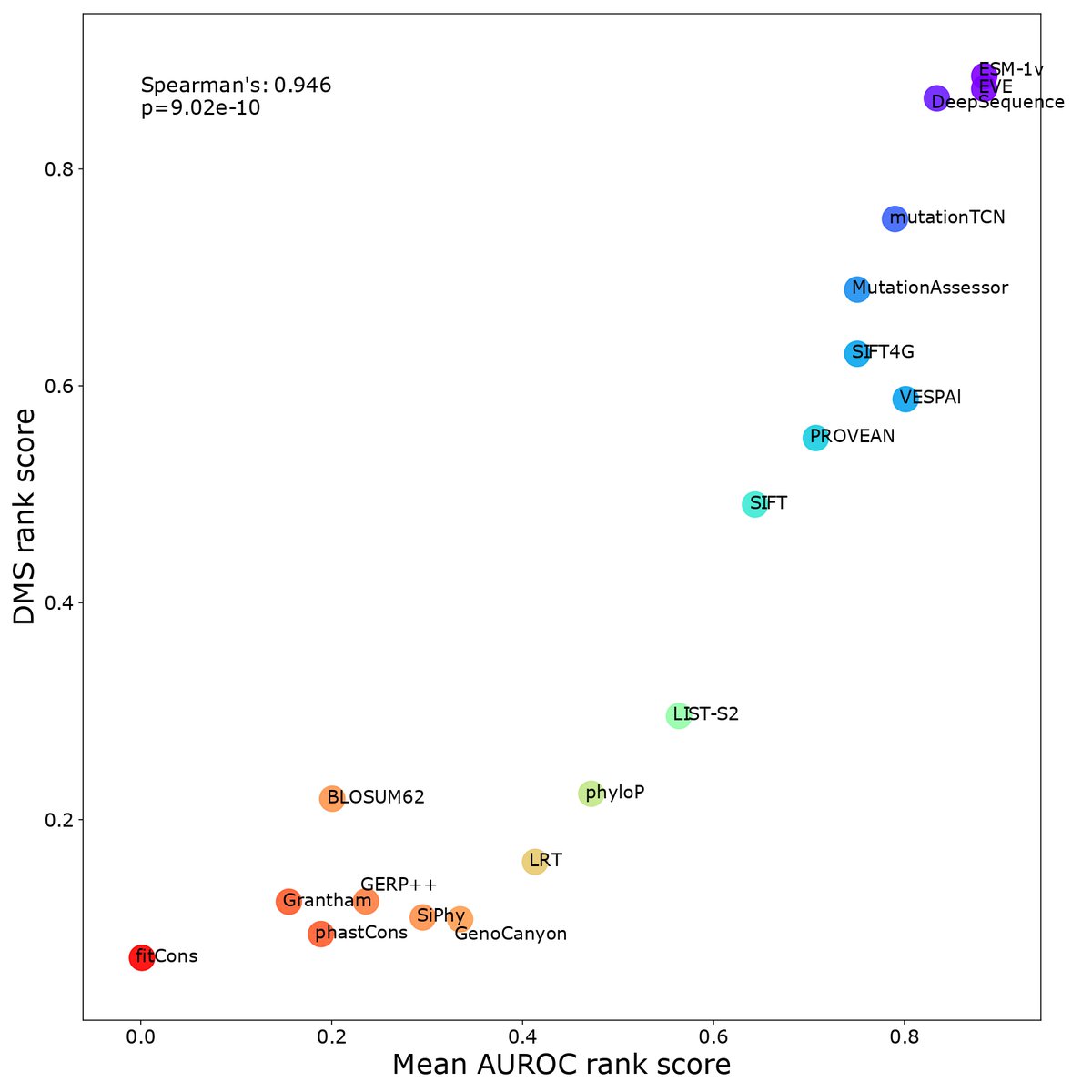
There is a strong correlation between the performance of unsupervised VEPs against DMS data and their performance against sets of known mutations. This lends confidence to our benchmark as a true reflection of actual VEP performance, even for supervised VEPs.
Celebrating the release of my first paper @MolSystBiol with a #tweetorial! I’m a PhD student in @jmarshlab studying at @mrc_hgu @mrc_igmm @EdinburghUni. Discover how deep mutational scanning data has been used to benchmark variant effect predictors. https://t.co/SOGSSM0A03
Experimental DMS data is actually more predictive of clinical outcome than any VEP for the majority of proteins we looked at. DMS is likely to be tremendously useful for direct variant prioritisation in the future!