We've got this incredible feature on the BBC through the World Cup. For games the BBC cover, you can watch the games live (or back) in this 3D space, freely controlling the camera angle or viewing it in first person from any players' POV. Top for tactical insight. See here: https://t.co/jAqYFbSPBU
✍️ New post on the Global Performance Insights blog…
'An Introduction to Complex Systems in Sport: Why It Matters for Sports Scientists'
I outline an intro to complex systems and why this matters for practitioners working in sport.
https://t.co/wmJ3rjcpDK
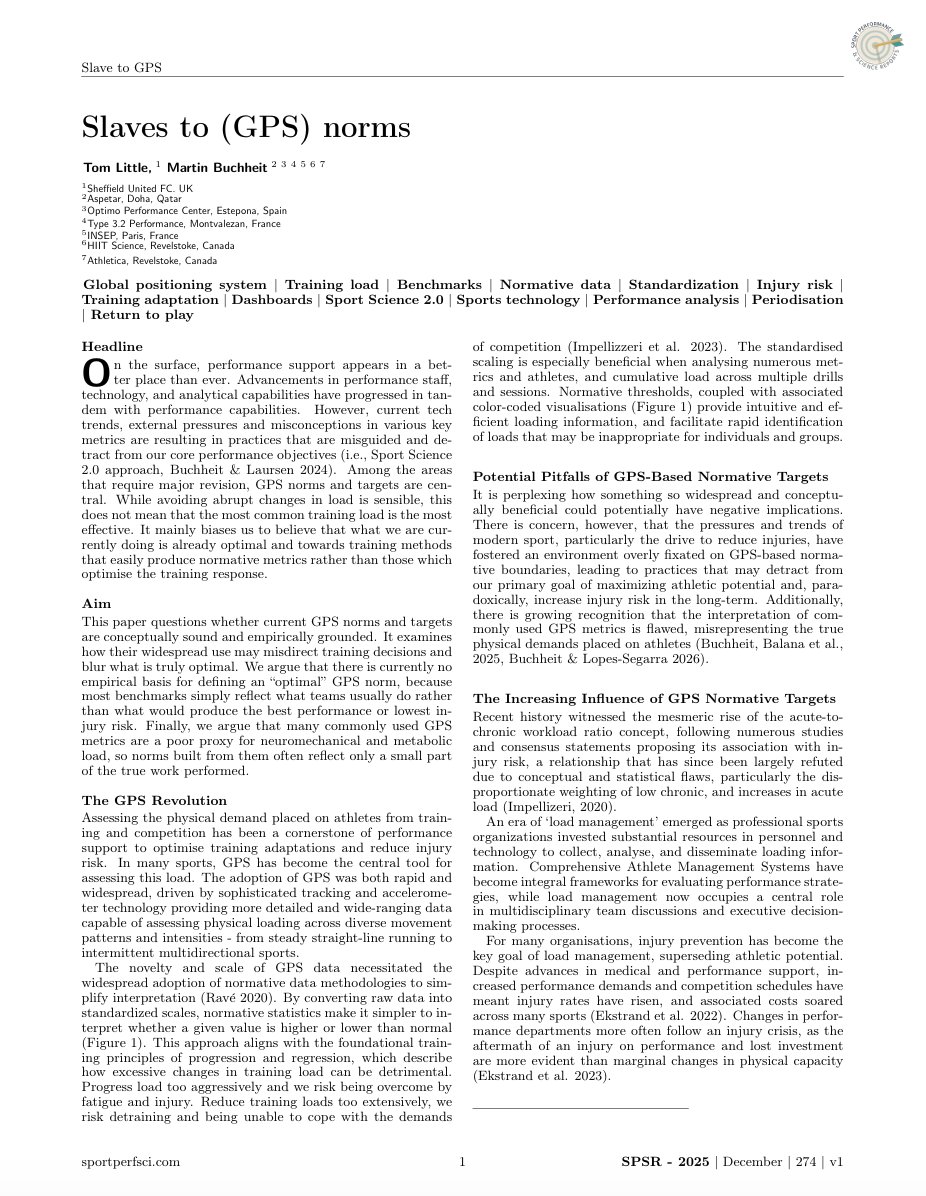
🔝"GPS norms remain useful for day-to-day squad monitoring & communication with coaches, but they should act as contextual guides, not fixed targets or substitutes for sound training principles ⚽️"
👉@drlittletom@mart1buch et al. 2025 🏴
📂Open Access: https://t.co/cADK03RYX3
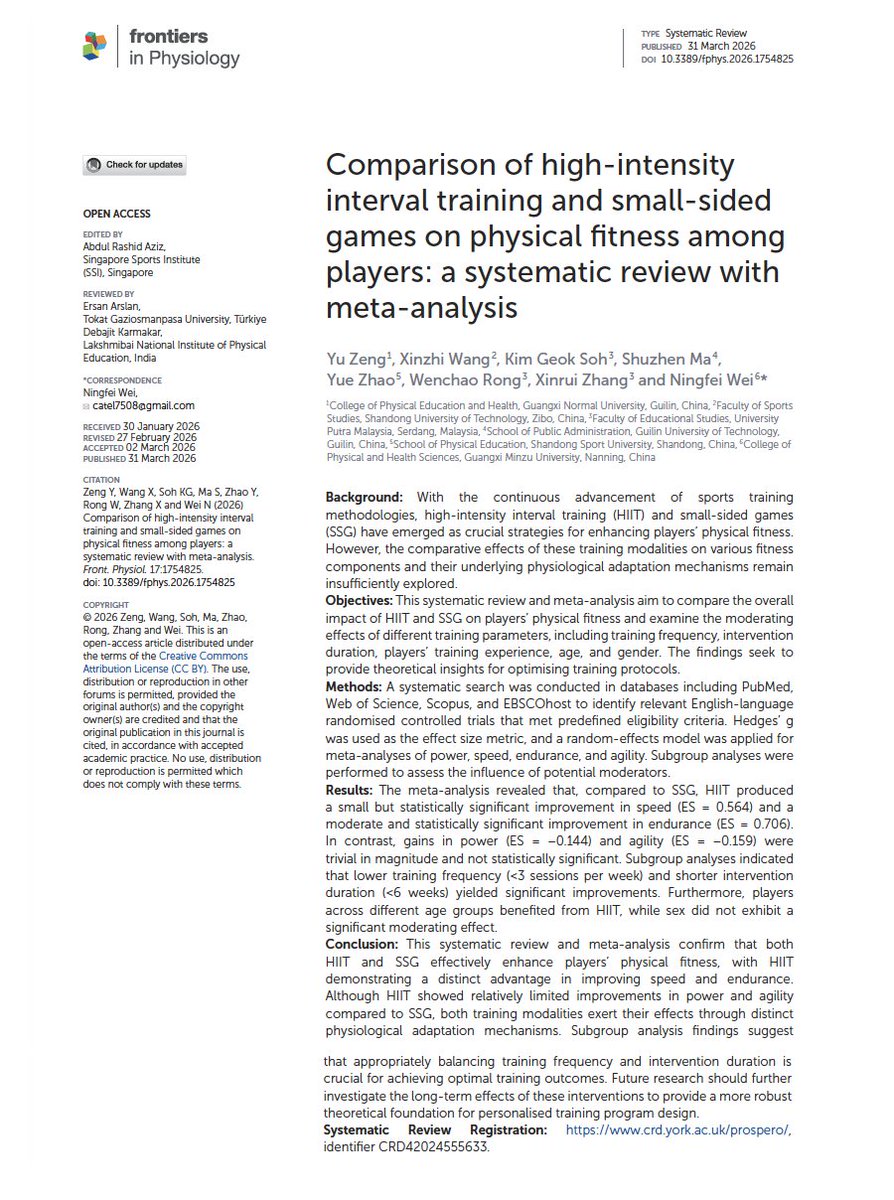
🆕"This systematic review aimed to compare the overall impact of HIIT & SSG on players’ physical fitness & examine the moderating effects of different training parameters ⚽️"
➡️Frequency, duration, age & gender
👉 Yu Zeng et al. 2026 🇨🇳
📂Open Access: https://t.co/WSrqGMDZOT
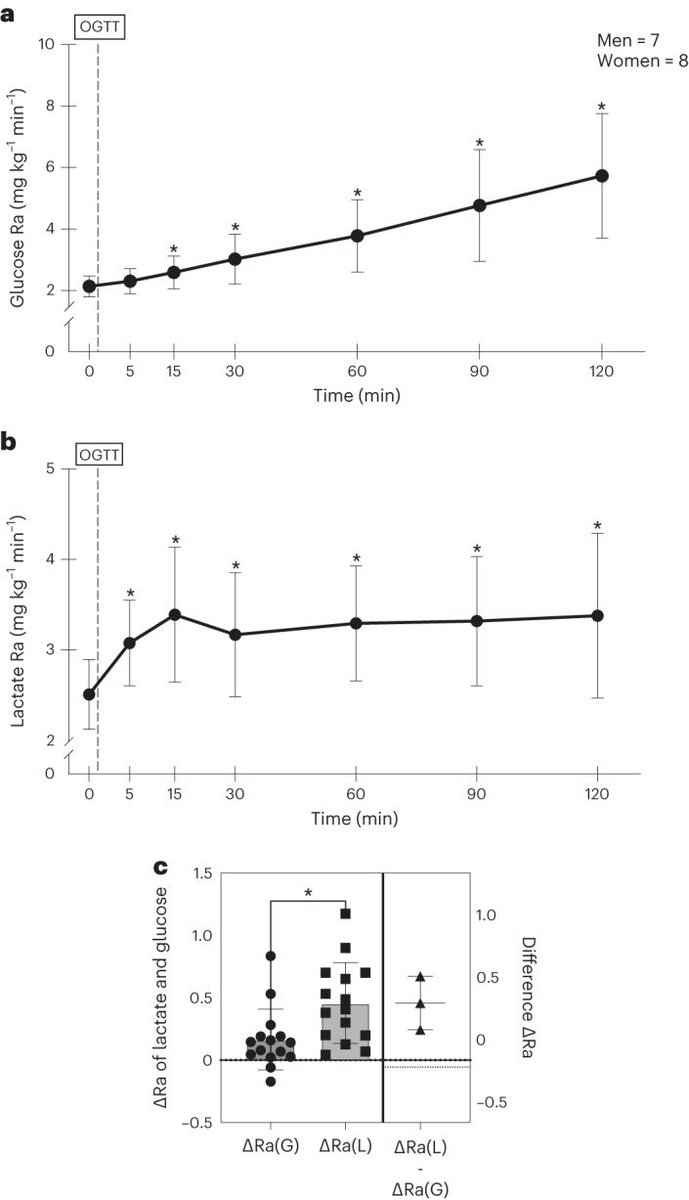
New in @Cell_Metabolism : Lactate isn’t waste—it’s a key circulating fuel, tightly regulated between production and clearance, essential for whole-body energy balance.
https://t.co/siUTsQgYmI
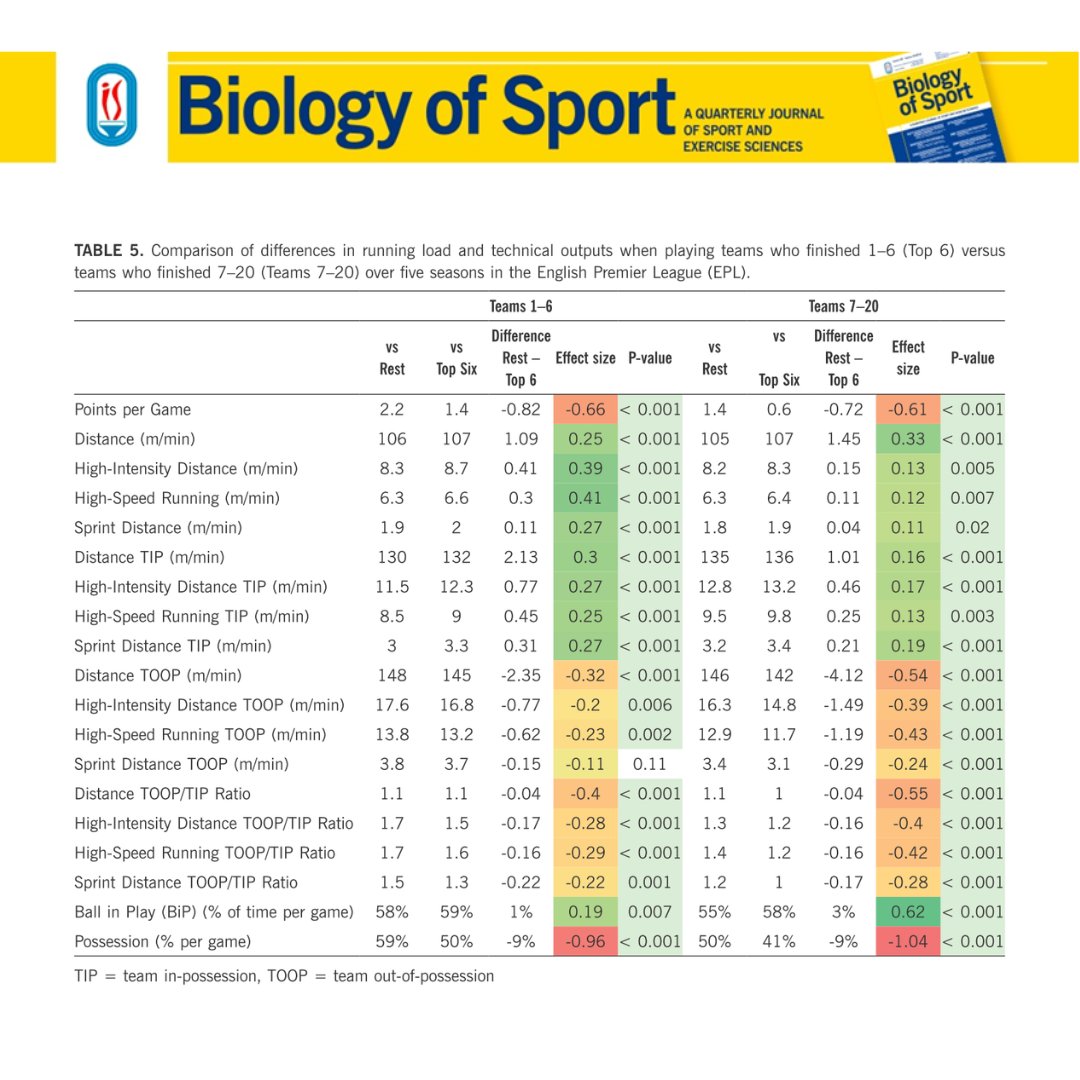
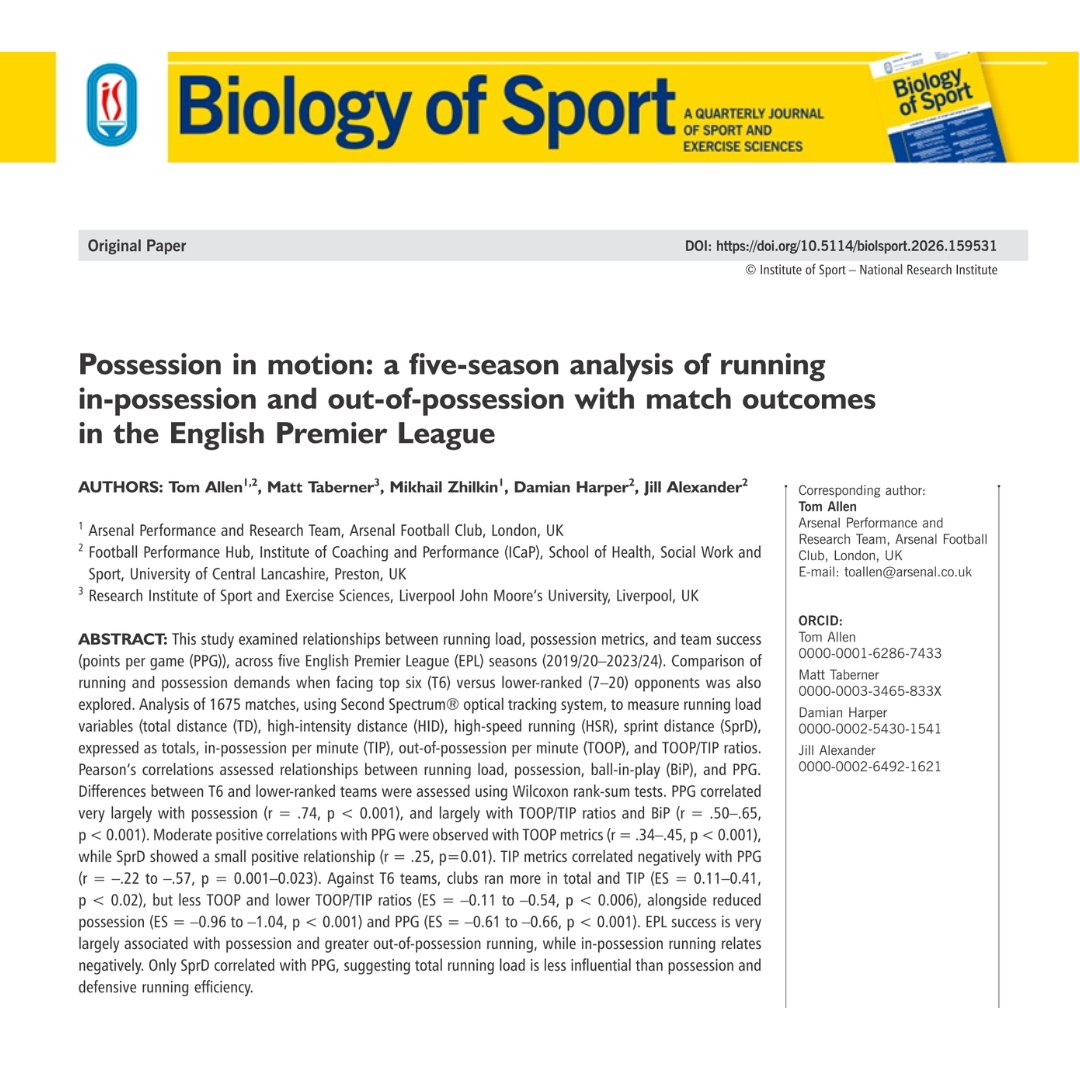
Context > total load in @premierleague
Allen et al show possession is strongly linked to success with higher out-of-possession and lower in-possession running associated with more points. Total load matters less, only sprint distance relates to PPG
🔓DOI: https://t.co/XA7CwwIPPx
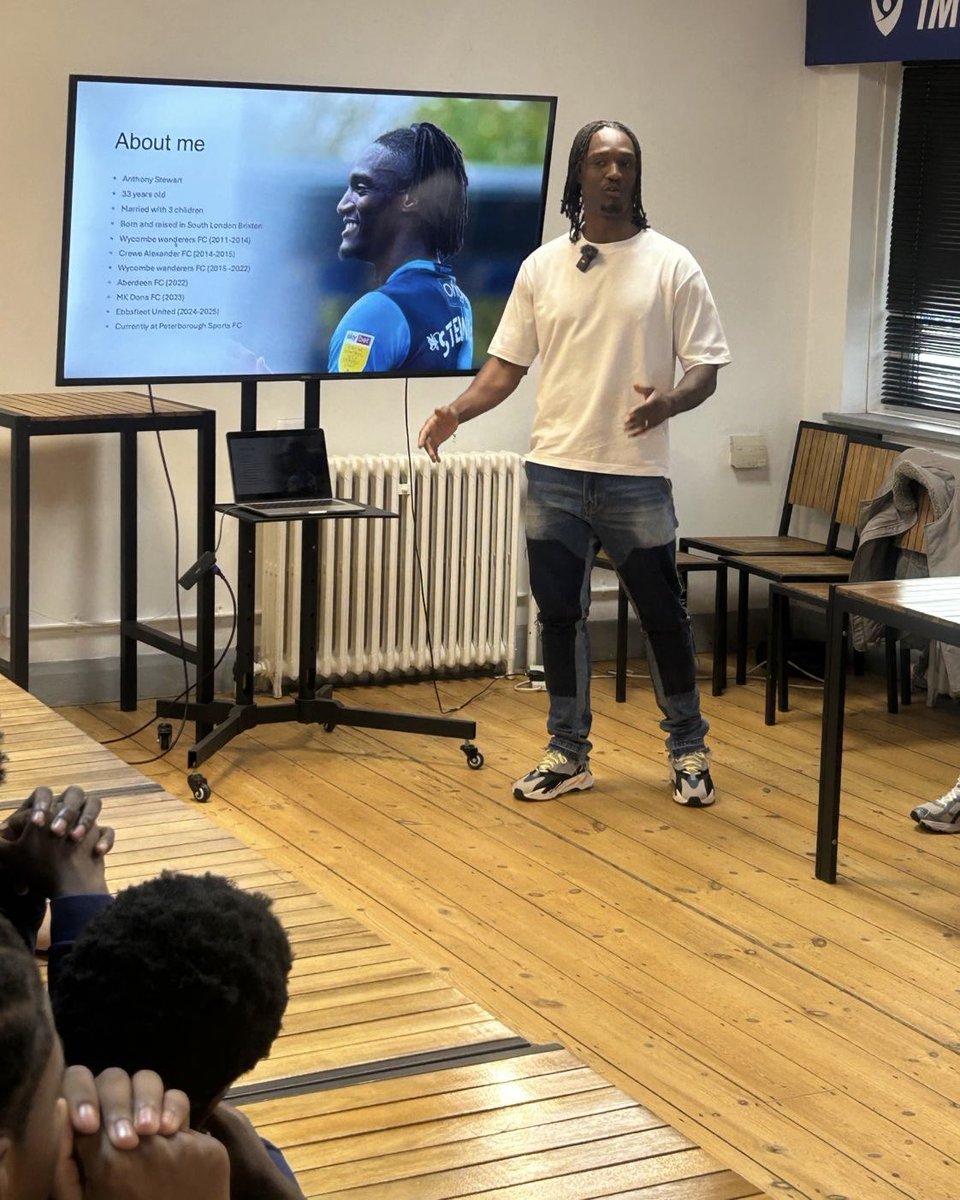
We have been incredibly lucky to have @wwfcofficial academy graduate and double promotion winner @A_Stewart_5 with us at Harlington today.
He shared his challenges as a scholar, experiences as a professional and the key attributes needed as a person to succeed in not only football but in life.
Great to have you with us Anthony!
NO HIIT FOR ME ANYMORE
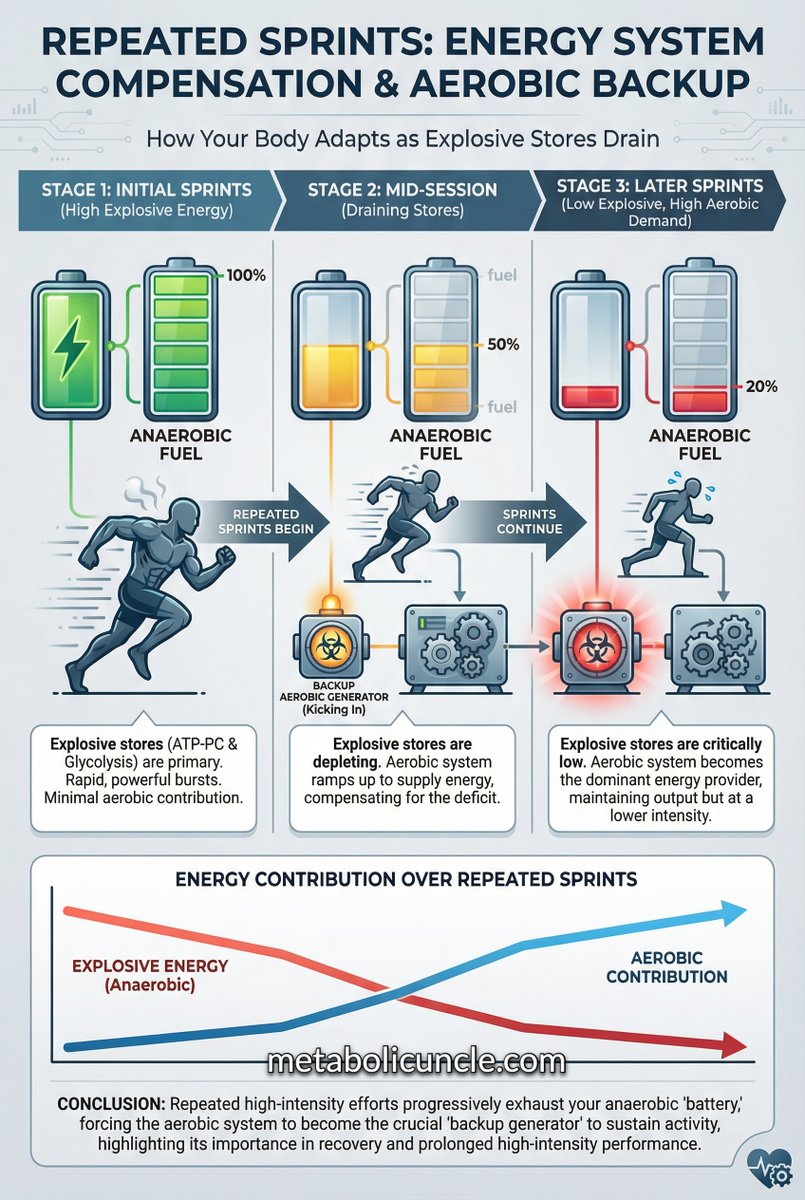
I'm not doing high-intensity interval training anymore. Not the four-minute Norwegian method, not the classic HIIT protocols everyone talks about. I switched a while ago to repeated sprint training, and I'm not going back.
Here's why. When you do traditional HIIT, you're under load for three to eight minutes at a time. Several times.
Your body floods with cortisol and other stress hormones. Recovery takes longer. The metabolic cost adds up. Yes, it works for VO2 max gains, but the price is higher than most people realize.
Repeated sprint training gives you the same gains without the metabolic beating. You sprint all-out for five to ten seconds. Then you rest. Not full recovery, just 30 to 60 seconds. Then you go again. Every minute, another sprint. Ten minutes total and you're done.
The beauty is in what happens physiologically. Short sprints rely almost entirely on your phosphocreatine system. This is the fastest energy pathway your body has.
When you jump, lift heavy, or explode into a sprint, phosphocreatine donates a phosphate group to ADP molecules, instantly regenerating ATP. No oxygen needed. No lactate buildup. Just pure, fast energy.
But here's the trick. Your phosphocreatine stores deplete fast during that first sprint. Maybe 60 percent gone in ten seconds. Then you rest, but not enough to fully recover.
After 30 or 60 seconds, your stores are still partially depleted. So when you sprint again, your body can't rely on phosphocreatine as much. It has to pull more energy from your aerobic system.
Sprint after sprint, this pattern intensifies. Your phosphocreatine contribution drops. Your oxygen consumption rises. By the final sprints, you're hitting close to your VO2 max, even though each individual sprint is only five to ten seconds. You're training your aerobic system through repeated explosiveness.
It doesn't matter that your sprints get slower. With this training method, the all-out effort is what counts!
Research backs this up. A 2024 meta-analysis looked at 51 studies and over 1,200 athletes. They compared repeated sprint training, traditional HIIT, sprint interval training, and continuous endurance work.
Repeated sprint training and HIIT tied for the biggest VO2 max improvements. Both showed large effect sizes, statistically significant and biologically meaningful, with RST having a slight edge in effectiveness.
But repeated sprint training has even more advantages HIIT can't match. First, time efficiency.
Ten minutes versus 30 or 40 for a full HIIT session. Second, metabolic stress. Short sprints don't flood your system with cortisol the way sustained high-intensity efforts do.
Third, skill and power development. Every sprint trains explosiveness, speed, and total-body coordination. You're engaging every muscle fiber, not grinding through sustained discomfort.
Fourth, repeated sprint training can actually increase your total daily energy expenditure. After a session, your metabolism stays elevated.
Two or three sessions per week and you're always burning more calories at rest, not fewer. Traditional HIIT can suppress metabolism if you overdo it. Repeated sprints avoid that trap.
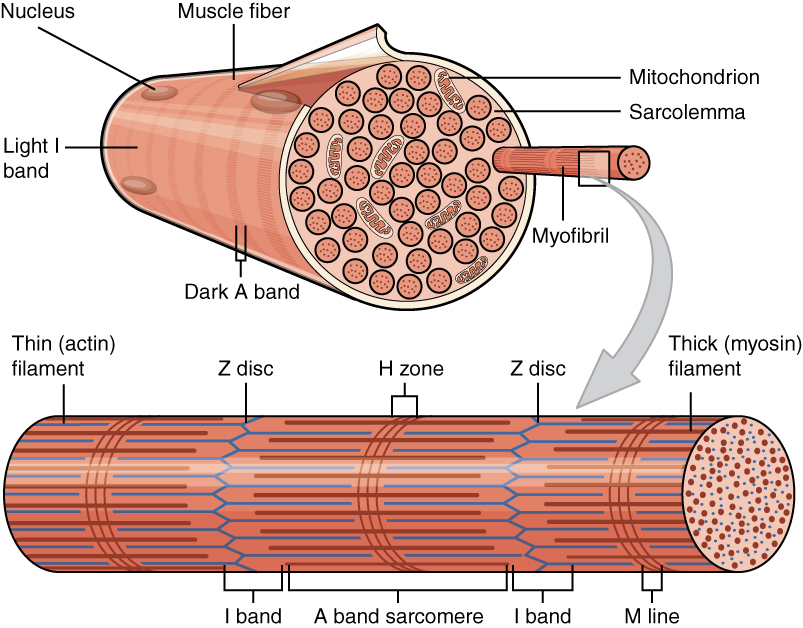
The mechanism makes sense when you think about muscle fiber recruitment. Short, maximal efforts activate fast-twitch fibers. These fibers have huge growth potential and high metabolic demand.
You're training power and endurance simultaneously. Over time, your body adapts. Phosphocreatine stores regenerate faster. Your aerobic system gets better at supporting repeated efforts. Your nervous system learns to recruit fibers more efficiently.
If you're already fit, you can use a cluster approach. Do four to six sprints every minute on the minute. Then rest two to four minutes. Repeat the cluster two or three times. This lets you maintain higher power outputs across the session while still accumulating the aerobic stimulus.
The key is insufficient recovery between sprints. If you rest too long, your phosphocreatine stores fully recover and you're just doing power training. Useful, but not the same stimulus. The magic happens when you force your aerobic system to step in because your anaerobic system can't keep up.
I'm not saying abandon endurance training entirely if you like it. Long, slow Zone 2 cardio is ineffective for VO2max, but it builds capillary density around muscle cells, improving oxygen delivery, which will level up the effect of your RST.
That matters for long-term aerobic development. But for time-efficient VO2 max gains with minimal metabolic downside, repeated sprint training alone wins.
Ten minutes. Full-body engagement. Speed, power, and aerobic capacity in one package. No cortisol overload. No metabolic suppression.
Just clean, effective training that makes you faster, stronger, and fitter without the recovery cost of traditional intervals.
That's why this is my preferred method now. I get the same gains in less time with fewer downsides. For anyone serious about improving VO2 max without accumulating unnecessary stress, repeated sprint training deserves serious consideration.
There is so much misunderstanding about the force-velocity relationship of muscle. This thread is an attempt to help.
TLDR: Muscle fibres impose a real constraint on movement, but the body has many ways to manage that constraint.
Lactate is a buffer agent, but not only on pH.
👉🏼 Lactate buffers CARBOHYDRATES in the body.
🛩️🆙 Lactate elevates up the travelling status of carbons: from traveling in Economy (glucose) to a privilege seat in Business (Lactate) 😜
Read this paper 👇🏼
https://t.co/Hpdi2vfyk3
New study shows sleep deprivation impairs brain function, reducing communication networks by 15-24%. Even more sobering, these effects can last for over 2 weeks. Prioritize sleep! #SleepScience#BrainHealth