@PatTheNESpunk At least they’re not the only one betting on that future this time. Not saying it’s an accurate vision of the future, but it’s different territory than the meta verse.
Not surprised. I wouldn’t risk it personally, and honestly I just don’t like dealing with that so I prefer having someone take care of it, but that’s just me. And if I ever get audited, I like having someone I can just send the paperwork to and they handle it! But yeah, no doubt Opus can crunch the numbers.
I used plan mode heavily with Fable so it could brief Opus. But 5.5 is really good now though, not feeling the need to go ask Fable as much. Remains useful to crank the effort to max at the “thinking phase” and then lower the effort for implementation to save some precious tokens. Also, it helps me think about a problem before I commit to anything.
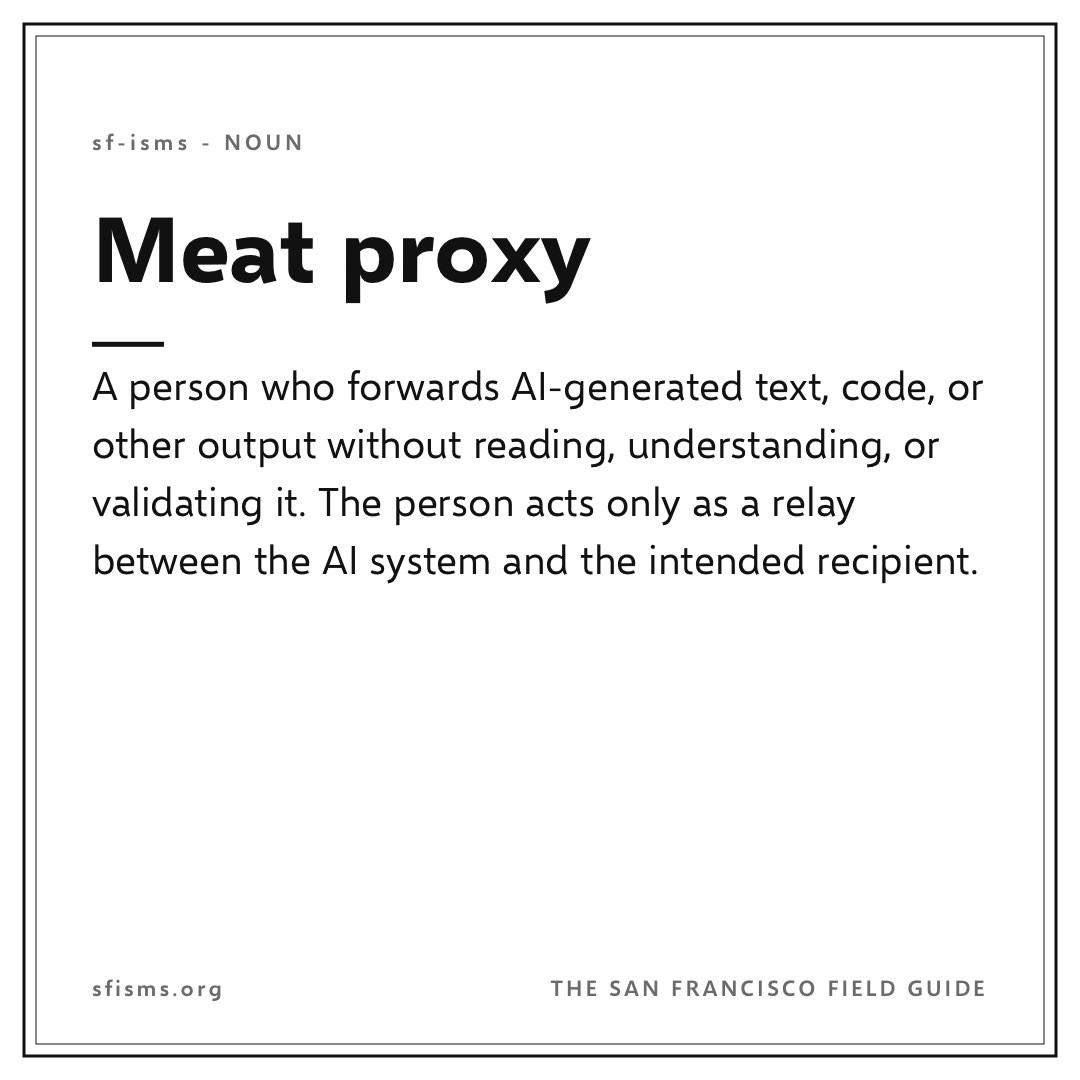
This is the way. Accept code on merit and ensure that a person takes accountability for it. Doesn’t matter if it was typed, chiseled, generated, or bit-flipped via magnetized needle on a chip.
If it’s good, it’s good. If it’s slop, it’s slop.
I get what you’re saying and the whole analogy, but horses vs. machinery is about product replacement. One product replacing another.
AI is closer to industrialization in general. Will the jobs lost at one end be replaced by other jobs (ex.: babysitting AIs, orchestrating systems, reassigning resources elsewhere,…) or be a net loss? Will the productivity gain lead to just more consumption and more software creation, still needing humans in the end? Jevons paradox basically.
And by the way, I don’t pretend to know what’s next.
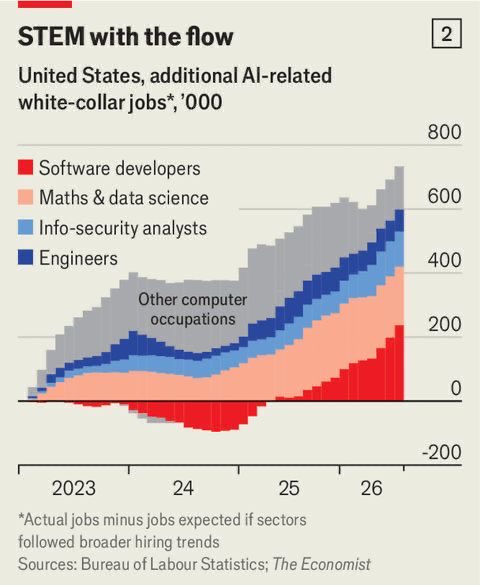
Sharing this since it got decent engagement. Look, no one knows for the future, but so far babysitting these AI have created opportunities.
AI is really good at targeted, predictable, verifiable tasks requiring limited context, but the world is complex and messy. Most workflows are complex and messy.
Is it a temporary increase before a sharp decrease, as the models get better? Time will tell.
Chat remains a terrible interface for most tasks. Interfaces on command means a new non-deterministic UI to learn and figure out every time.
Chat means recreating context every time, while an app has built-in context.
That doesn’t mean AI won’t replace a lot of wrapper apps though. Apps where the best UI is no UI.
But compressing every single experience and UI into a chat that requires instructions and context with every use, I’m not sure.
This realization hit me like a truck in January of this year.
I was vibe coding an app that used 2 external APIs to solve a specific problem.
Then, while I was building it, I realized… the agent that was building the app could just use those APIs more easily than the static app ever could.
Then I thought…
“A normie wouldn’t set that up.”
Then I thought… wait, they won’t have to.
The end state of ChatGPT is just AGI solving its users’ problems. Reactively and proactively, no matter what they are.
Whatever interface is needed will be spawned on command.
I get your point, losing the battery affordance or the bars scale is less obvious at first glance. But the circle for the battery is a known pattern already for many users, that's roughly how the device batteries widget on iOS works.
Wouldn't have been a great design 10 years ago because of too much abstraction. But I think it's great design now. At least, very clever!
Some might say Airtable and Miro selling recently at a much lower price than their valuation is a sign of the SaaS business model plateauing or collapsing. On the other hand, you have buyers willing to bet billions on the model and future revenues.
So we probably stand somewhere in the middle. Businesses (with a great product!) facing the reality of being over valued in a though context, with limited growth ahead.
Still makes a decent business and selling software isn’t going away.
Saddens me though, because I love Miro and I hope the product won’t be going downhill.
There are two AI bubbles right now.
Techies, where AI is changing everything and genuinely feels like computers can do most of the work.
Regular people, who use AI for proof reading, writing emails and generating PowerPoint slides.
If you’re in the first group, it’s easy to think “everything’s solved”.
If you’re in the second group, it’s hard to imagine how much AI can transform work.
That’s why it’s both feeling like AGI, yet nothing has really profoundly changed outside of the tech bubble.
It’s hard for code-people to realize there’s a whole world out there of people who don’t want to start a Claude Code session in a terminal to make some random custom app to manage a list of 150 customer registrations for an event. Apps like Airtable allows you to do that still and it just works.
We chose monolith over microservices for our new product in 2024.
Everyone on the team wanted microservices. Modern. Scalable. Cloud native.
We said no. We are 4 engineers. We do not have time to manage 15 services.
Built a modular monolith. Clear boundaries. Separate packages. Could split later if needed.
One year later: We serve 20,000 users. Deploy 4 times per day. Our infrastructure bill is $200 per month.
Microservices would have cost us 5 times that per month plus engineering time.