In the Old Testament I've found one of the beatitudes (Psalm 36:11), the counsels not to take a high seat in order not to be humbled (Proverbs 25:6-7), love thy neighbour (Sirach 27:18), forgive sins so that your sins will be forgiven (Sirach 28), feed the hungry, house and clothe those in need (Isaias 58:7), even the golden rule (Tobit 4:16).
As well as a multitude of prophecies which are repeated in the New.
Only a cursory glance could make someone who calls themselves "Christian" dismiss or condemn the Old Testament as if it's somehow opposed to the New.
June 26th. The Venerable Raingarda, Widow.
She was married to Maurice, a nobleman of suitable birth and fortune, and a person also of eminent piety. In her choice of this state she consulted only motives of religion, and by earnest prayer endeavoured to draw down the divine blessing upon her undertaking,
being sensible that a happy marriage is the great source of happiness in life, and a powerful help to virtue; but that any poison in this fountain communicates itself very far, infects with bitterness all the pleasures of life, and endangers all moral and Christian duties...
The education of her children was one of her most weighty concerns. She never ceased most earnestly to recommend them to God...
Good example is like an inheritance entailed by a parent on a son, and almost an infallible means of conveying the virtues of one to the other. If parents are virtuous, children will easily, and as it were naturally, take the same cast, unless dissipation and bad company abroad adulterate or efface the ideas of the good they see at home...
After his [Maurice's] funeral was over, and she had put her affairs in order, she retired to the Benedictin monastery of Marsigny, which, after the death of B. Robert, she preferred to Fontevraut.
A gallant train of gentlemen attended her to the gate of the monastery, endeavouring by entreaties and tears to draw her from her resolution; but she took her leave of them, saying with a stern countenance, "Do you return into the world: for my part, I go to God."
Butler's Lives of The Saints 1926
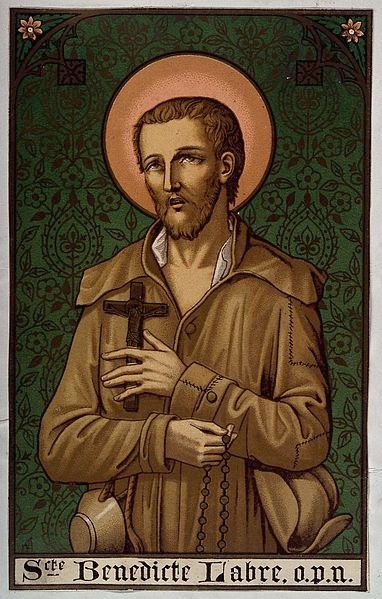
The Life of St. Benedict Joseph Labre
Chapter 13
Mr. Zaccarelli his friend and benefactor having offered him some money for his expences in his journey to Loretto, Benedict refused to accept any part of it, alleging as his reason, that he had in his possession a piece of money of the value of ten sous, or five pence English: and that this sum was sufficient for him at present.
Animated by the same spirit of Evangelical poverty, he at first refused a pair of shoes which the same M. Zaccarelli offered him. But this gentleman pressing him to accept them, at the same time shewed him three other pairs of shoes which had been used:
Benedict therefore at length yielded to the solicitations of his Benefactor and accepted a pair, but chose those which had been most worn.
As he used to wear a straw hat, which was all unsewed and torn, they had all unimaginable difficulty, to prevail upon him to accept another which was a little better, though that itself was very old and in a bad condition...
June 25th. St. Prosper of Aquitain, C.
A.D. 463.
Without the succour of divine grace, we can do nothing; (John xv. 5.) we cannot so much as form one good thought conducive to eternal life, nor take the least step towards God by supernatural virtue.
"As the eye of the body, though perfectly sound, cannot see unless it is assisted by the light, so neither can a man live well but by the eternal light which is derived from God," as St. Austin says.
God, who desires that all men be saved, offers this treasure to every one, enlightening every man that cometh into this world. (John i.)
If we neglect to pray assiduously for this divine succour; if we are not solicitous faithfully to preserve and improve this most excellent gift of God, we are Pelagians in conduct, though we condemn their erroneous principles;
for we ungratefully despise the divine mercy, destroy in our souls the principle of our spiritual life, and of eternal glory, and trample under our feet the price of Christ's sacred blood.
The graces which we reject are seeds which would fructify to a hundred-fold; they are talents which, if put out to the banker, would be multiplied; faithfully corresponded with, they would make us saints;
but the abuse of them will be our greatest crime and our heaviest condemnation. "Wo to thee, Corosain, &c."
Butler's Lives of The Saints 1926
The Life of St. Benedict Joseph Labre
Chapter 13
"To a great humility and a singular contempt of his own body, which he called his carcass, he joined an unbounded charity for his neighbour;
whom he assisted to the utmost of his power in a spiritual way, by continually offering his most fervent prayers to God for the conversion and salvation of sinners:
and though he was poor himself, he gave all that he had in alms, to the poor, reserving for himself only the smallest portion, of what was given to him, and such as was scarce sufficient for his support for the present day, without keeping any thing for the morrow."
June 24th. The Nativity of St. John The Baptist.
St. Austin observes that the church usually celebrates the festivals of saints on the day of their death, which is, in the true estimate of things, their great birthday- their birthday to eternal life.
The same father adds, that the Nativity of St. John the Baptist is excepted from this rule. The reason of which distinction is, because this saint was sanctified in his mother's womb, so that he was brought forth holy into the world;
which St. Bernard and many other eminent divines understand not only of an external sanctity, or deputation to piety, but of the gift of sanctifying grace, by the remission of original sin, which they doubt not to have been imparted to him by the presence of our Divine Redeemer in the visit made by the Blessed Virgin to St. Elizabeth...
How loudly does his penitential youth condemn those pretended Christians whose life is altogether earthly, and who, instead of curbing their inclinations, and keeping their senses in due subjection, study by softness and pleasure to gratify them in almost anything.
They renounce for ever the happiness which Christ has promised to His followers, who do not take His word and actions for the only rule of their conduct.
Butler's Lives of The Saints 1926
Pope Boniface VIII, Unam Sanctam, Nov. 18, 1302, ex cathedra: “With Faith urging us we are forced to believe and to hold the one, holy, Catholic Church and that, apostolic, and we firmly believe and simply confess this Church outside of which there is no salvation NOR REMISSION OF SIN…”
Denzinger 468-469.
The Life of St. Joseph Labre
Chapter 12
But why should we fear for the just man whom God purifies in the furnace of afflictions. God tries the just, but He never abandons them: and His divine Providence watches over His Elect with a particular care, even at the very time when He seems to have forsaken them.
It was therefore from the very source, and in the very height of his troubles, that God was pleased to make peace shine upon him: and sent him a ray of comfort, which thenceforward never ceased to direct and fix him in that state of life to which He called him.
"*Finally, one cannot consider as schismatics those who refuse to obey the Roman Pontiff because they would hold his person suspect or, because of widespread rumors, doubtfully elected* (as happened after the election of Urban VI) or who would resist him as a civil authority and not as pastor of the Church." (Canonist Franz Xavier Wernz, _Ius Canonicum_, Volume 7, Number 398, edited by Pietro Vidal, Gregorian University, Rome, 1937)
"Nor is there any schism if one merely transgress a papal law for the reason that one considers it too difficult, or *if one refuses obedience inasmuch as one suspects the person of the pope or the validity of his election*, or if one resists him as the civil head of a state." (Ignatius Szal, _Communication of Catholics with Schismatics_, 1947)
June 23rd. St. Etheldreda, or Audry, V. A.
A.D. 679.
This great queen and saint set so high a value on the virtue of virginity, because she was instructed in the school of Christ how precious a jewel and how bright an ornament that virtue is in His divine eyes, who is the chaste Spouse and Lover of true virgins, who crown their chastity with a spirit of prayer, sincere humility, and charity.
These souls are without spot before the throne of God; they are purchased from among men, the first-fruits to God and the Lamb, being the inheritance properly consecrated to God; they sing a new canticle before the throne, which no others can sing, and they follow the Lamb whithersoever He goeth. Apoc. xiv.
"Whither do you think this Lamb goeth? where no other presumes, or is able to follow Him," cries out St. Austin. "Whither do we think that He goeth? into what groves or meadows? Where are found joys, not like those of this world, false, empty, and treacherous; nor even such as are afforded in the kingdom of God itself to those that are not virgins; but joys distinct from theirs.
The joys of the virgins of Christ are formed of Christ, in Christ, through Christ, and for Christ. The peculiar joys of the virgins of Christ are not the same as of those that are not virgins; for though others have their joys, none have such."
He adds: "Be solicitous that you lose not this treasure, which if it be once forfeited, nothing can restore. The rest of the blessed will see you, who are not able themselves so far to follow the Lamb.
They will see you, nor will they envy you; but by rejoicing for your happiness, they will possess in you what they do not enjoy in themselves. And that new song which they will not be able to say, they will yet hear, and will be delighted with your so excellent a good. But you, who shall both say it and hear it, will exult more happily, and reign more joyfully."
Butler's Lives of The Saints 1926
@carlosazuletc@GeneAndrea34215@FreeIrishman7 Does he explicitly say Mary Redeemed us with Christ which the article claims with the letter to a prayer group, not infallible, Inter Sodalicia. You deny it says another Redeemer then post an article saying she redeemed us with Christ. So which is it?
https://t.co/mxIlthsZMp
Catholic Magisterium:
Pope Pius XII Deleted All References To Our Lady As “Co-Redemptrix”
Fr. Charles Ballic was a Franciscan theologian and a consultor to the Holy Office under Pope Pius XII. He was also President of the International Marian Academy. Later on he was appointed (by the Vatican II “Church”) to be a theological expert at Vatican II. According to Yves Congar (who was a significant figure at Vatican II), “Balic told us that [Pope] Pius XII had deleted the word Co-Redemptrix in all the documents bearing this title and had replaced it by ‘Socia Christi Redemptoris’ (Associate of Christ the Redeemer).” (Yves Congar, My Journal Of The Council, Liturgical Press, 2012, p. 72).
Pius XII never used the term “Co-Redemptrix” as pope. He probably recognized that the term is indeed inaccurate and problematic, and that’s why he deleted it from drafts. For a full treatment of this matter, see the video called: Is Mary The “Co-Redemptrix”? – A Catholic Analysis
https://t.co/Vkia0fOFG2
https://t.co/6513Jwbz3w
Statutes for Benedictine Oblates 1927
19) Oblates should know that they must first of all fulfill the duties of the state of life with the utmost fidelity; for to neglect what is necessary in order to take upon oneself extraordinary and more perfect obligations is most strongly to be condemned.
The Life of St. Benedict Joseph Labre
Chapter 12
But God never permits any man to be tempted beyond what he is able to endure. The Servant of God being firm in this persuasion, and entertaining in his Soul an unshaken confidence in the Divine Goodness, like Abraham hoped against all hope.
Sept-Fonts was the place which now remained for him to try wherein to get admittance, And notwithstanding the excessive fatigue which he had undergone, the length of his journey, and the continual rains, which had made the roads almost impassable:
he departed a second time from La Trappe, and arrived at Sept-Fonts so soon, that on the 28th of October he was admitted to take the Habit of a Choir Novice by the name of Brother Urban.