Crypto gaming made a promise: worlds worth playing, assets worth owning, and communities that help shape what comes next. Too many projects went dark before delivering.
**Gala can lead the comeback. 🔥**
Gala’s Phoenix Labs aims to combine game development expertise, AI, and community conviction to give abandoned games another chance—with **GALA at the core of every comeback**.
The goal is to support the original games’ NFTs and tokens wherever possible, including bridging them into GalaChain. Existing assets and communities should have a place in the next chapter. Rights, contracts, and technical feasibility will determine what’s possible.
**Rally your community around the game you want back.**
Find it in the Graveyard—or suggest it. Burn GALA to show your support. A qualifying contribution of **10,001+ GALA** unlocks a design recommendation, and others can back your ideas to increase their influence. We will use every design recommendation but weight them by highest to lowest burn.
Bring your guild, your holders, and the players who still believe. Share your referral link and track **eligible 10% referral credits** after registering a receiving wallet on the relevant network.
Community backing will strongly influence which projects we consider and how we approach their design. A burn supports that consideration; it doesn’t guarantee development.
The servers went quiet. The community doesn’t have to.
**Start burning GALA. Stoke the fires of rebirth.**
[https://t.co/BuIYix1tWo](https://t.co/GnR7uLDLKO)
New community wishlist idea on Gala Phoenix Labs: @doodles.
A Gala game with Doodles NFT utility and interoperability — an idea to explore, not announced or affiliated.
Suggest what you'd want to see, then vote or support 👇
https://t.co/oWr3yaRzFn
#GalaGames#Web3Gaming #NFTs #Doodles
New community prototype on Gala Phoenix Labs: GearBeasts.
3v3 robo-creature arena brawls in your browser. Pick your beast, choose Ember or Frost, and fight in Core Control, Takedown or Spark Rush.
Community-made, not announced or affiliated. Play it, leave feedback and vote for the build 👇
https://t.co/zvk0i9xTKI
#GalaGames #Web3Gaming #NFTs
@pudgypenguins was suggested by the community on Gala Phoenix Labs.
Holding a Pudgy? Imagine new ways to use it, with perks and in-game utility for holders.
Just a community idea, not announced or affiliated. Cast your vote 👇
https://t.co/3t2vBp4pij
#PudgyPenguins#GalaGames #Web3Gaming #NFTs
Dryas: The Sunken Age, updated: it loads in about half the time, the first turn now walks you through it, and it plays in Korean, Japanese, German and Spanish.
A Civ-style game about keeping a drowned civilization alive. In your browser.
https://t.co/nnv8PmVMUZ
Old $Gala: $1M a month to run infrastructure. New Gala: $10K.
That's what rebuilding a company around AI looks like.
We ship. Watch.
The old Gala needed $1M a month just to run its infrastructure.
The new Gala runs it for $10K.
We rebuilt the company AI-first. GalaSwap V2 last month. More this week.
This is not the old Gala.
We used AI to cut Gala's infrastructure bill from $1M a month to $10K.
Then we kept shipping.
AI-first. Our own chain. Moving faster than we ever have.
New $Gala.
We have a much more detailed write up but I think its worth mentioning to you all who are reading my posts...using AI we were able to reduce our expenses for the operation of Gala by 90%!
solana:eEUiUs4JWYZrp72djAGF1A8PhpR6rHphGeGN7GbVLp6
Mirandus Eternal Night Update – Wayfinder
https://t.co/di44tkqKrB
The Night does not stop when you leave your desk. Wayfinder keeps your adventure with you, wherever you are.
Open it, send your heroes out, and come back to see what they found. Short visits, through the day, every day.
https://t.co/di44tkqKrB
#GalaGames #GalaChain #Mirandus
Galachain supports bridging from ETH, SOL, BSC and TON. We will be adding many more EVM chains very soon...
Here is a prompt you can pass to your AI agent that will help you build a tool to use the Gala Chain bridge.
## 🤖 Build-your-own bridge — paste everything below into your LLM
> Copy the block below into Claude/GPT and say *"build me a CLI bridge from this spec."*
> It's the real GalaChain bridge surface — accurate endpoints, flow, and signing.
```
GOAL: Build a CLI tool `xbridge` that moves a token between GalaChain and one of
{ethereum, bsc, solana, ton}. GalaChain is the hub; every route passes through it.
Language: pick TypeScript (node) OR Go — whichever the user prefers. Ask if unclear.
TWO DIRECTIONS
A) BRIDGE IN (ethereum|bsc|solana -> galachain): lock/deposit on source chain,
GalaChain mints the mirrored token to the user's GalaChain address.
B) BRIDGE OUT (galachain -> ethereum|bsc|solana|ton): 3-step GalaSwap Connect API.
BASE URLS
Connect API : https://t.co/vxXL6acl5b
DEX backend : https://t.co/tjDNk83QRF
Gala gateway: https://t.co/eMEKcGSmOU
KEYS / SIGNING
- GalaChain wallets use secp256k1 keys (same curve as Ethereum). Wallet address
format is "eth|<40-hex>" or "client|<id>".
- Bridge-out DTOs are SIGNED: canonicalize the DTO to sorted-key JSON, keccak256
hash it, secp256k1-sign with the GalaChain private key, attach as `signature`.
(This is the standard GalaChain/GalaSwap signDto scheme — reuse an existing
signDto helper if available.)
- EVM side (bridge-in) signs a normal contract tx with the source-chain key.
- Solana side signs with a base58 keypair.
DISCOVERY (do this first, both directions)
GET {ConnectAPI}/v1/connect/bridge-configurations
-> returns bridgeable tokens, each with: source token class, supported
destination chains, per-destination chain ID, and fee metadata.
Use it to validate the requested (token, dest) pair and resolve the token
class / destination chainId before building any request.
BRIDGE OUT — 3-STEP FLOW (galachain -> dest)
Step 1 POST {ConnectAPI}/v1/bridge/fee
body: { walletAddress, destinationChainId, tokenInstance{collection,
category,type,additionalKey,instance}, quantity, uniqueKey }
-> oracle-signed fee assertion (fee denominated in GALA). Generate and
PERSIST `uniqueKey` (random) BEFORE this call; reuse it on retries.
Treat the quote as stale after 10 minutes and refetch.
Step 2 POST {ConnectAPI}/v1/RequestTokenBridgeOut
body: signed DTO { tokenInstance, quantity, recipient (dest address),
destinationChainId, feeAssertion (from step 1), uniqueKey, signature }
-> { bridgeRequestId }
Step 3 POST {ConnectAPI}/v1/BridgeTokenOut (UNSIGNED)
body: { bridgeRequestId }
-> submits the finalize; poll status until confirmed on destination.
BRIDGE IN — deposit flow (evm|solana -> galachain)
1. Resolve the bridge contract + the source-chain token address from
bridge-configurations for (sourceChain, token).
2. EVM (ethereum, bsc): send an ERC-20 approve (if needed) then call the bridge
contract's deposit/lock method with (token, amount, galachainRecipient).
BSC == Ethereum path with chainId=56 and a BSC RPC URL. ETH chainId=1.
3. Solana: transfer the SPL token (or native SOL) to the bridge deposit address
with the GalaChain recipient encoded per bridge-configurations.
4. Poll GalaChain for arrival: query the recipient's balance via the gateway
(POST {gateway}/api/asset/... FetchBalances) until the mirrored token appears.
REQUIRED BEHAVIOR
- `xbridge --from <net>/<wallet> --to <net>/<wallet> --token <SYM> --amount <n>`
- `--dry-run` prints the resolved route + fee, makes no network calls.
- IDEMPOTENT: persist a checkpoint {step, uniqueKey, bridgeRequestId, oracleQuote,
fetchedAt} to a local file; on rerun with the same args, resume from the last
completed step instead of restarting. Never double-submit step 2.
- Preflight: for bridge-out, check the wallet's GALA balance covers the oracle fee
before step 2; fail early with a clear message if short.
- Config: chain RPCs and keys from env vars; never hardcode secrets. EVM chains are
table-driven { name -> {chainId, rpcEnvVar, bridgeContractEnvVar} } so adding a
new EVM chain (arbitrum, base, polygon, ...) is one table row.
- Output: human-readable by default, `--json` for machine output. On success print
the destination tx hash / GalaChain arrival and the fee paid.
DELIVERABLES: the CLI, a chains config table, a signDto helper, a checkpoint store,
and a short README with the env vars and one example per route.
Here is a revised version edited for maximum readability, flow, and structural clarity—perfect for an X long-form post while keeping that sharp, analytical edge.
🔬 Capacity Deep-Dive #1: SOL/BTC (With Live Proof)
SOL is one of the most heavily traded assets on Earth, racking up $2.4 Billion in global volume over the last 24 hours. Because the SOL↔BTC pair moves constantly across dozens of global venues, it represents textbook arbitrage. Every single micro-movement is an opportunity automated bots actively want to capture.
Theory is great, but production numbers are better. The GalaSwap SOL/BTC pool now exists, and because it is young and lean, it is performing exceptionally well.
📊 The Live Dashboard Snapshot (July 7)
GSOL / GWBTC (0.3% Fee Tier)
Pool Depth: Just $26,000
30-Day Volume: $7.57 Million
Daily Velocity: The pool turns over its entire depth ~9.5× every single day.
Annualized Yield: ~262% APR (based on yesterday's single-day fee snapshot).
Let those numbers sink in: a tiny $26k pool routed $7.5M in a single month. This is the exact "early window" phenomenon in action—a small pool catching the full force of a massive, external arbitrage firehose.
📉 The Compression Curve In Action
As a pool grows and matures, its yield naturally stabilizes. You can see this live curve playing out right now across GalaSwap’s 0.3% fee tier pools:
$26k Depth (SOL/BTC) ➡️ ~262% APR
$160k Depth (SOL/ETH) ➡️ ~126% APR
$866k Depth (BTC/ETH) ➡️ ~37% APR
This is our entire capacity thesis wrapped into three live data points: as liquidity depth grows, the rate cools. But notice how yields remain in the double digits even at nearly $1M in depth. Why? Because the volume is driven by external global market volatility, not by the size of our pool.
🚀 Where is the Ceiling?
How much liquidity can the SOL/BTC pool actually hold before compressing to ordinary DeFi rates?
The model indicates the ceiling is set by that massive $2.4B/day external market. Assuming a conservative 5% capture rate at the 0.3% fee tier, this single pool could productively absorb tens of millions of dollars in liquidity.
Today, it holds just $26k—roughly 0.1% of its implied capacity.
The Big Picture: One major trading pair, a pool turning over 9.5× daily, and a runway that is three orders of magnitude larger than its current size. Now consider that the GalaSwap grid has hundreds of pairs waiting to be built—some deeper, some hotter, and most still completely untouched.
SOL/BTC isn't just a proof of concept anymore. It’s the live demo. 🟡
(All pool figures from GalaSwap's public dashboard, snapshot 2026-07-07; global volume from CoinGecko. APR figures are single-day snapshots and swing with activity — past ≠ future. Capacity is a model estimate under stated assumptions (κ=5%, 0.3% fee), not a forecast; capacity ≠ guaranteed yield; LP carries risk incl. impermanent loss & loss of capital; not financial advice; DYOR.)
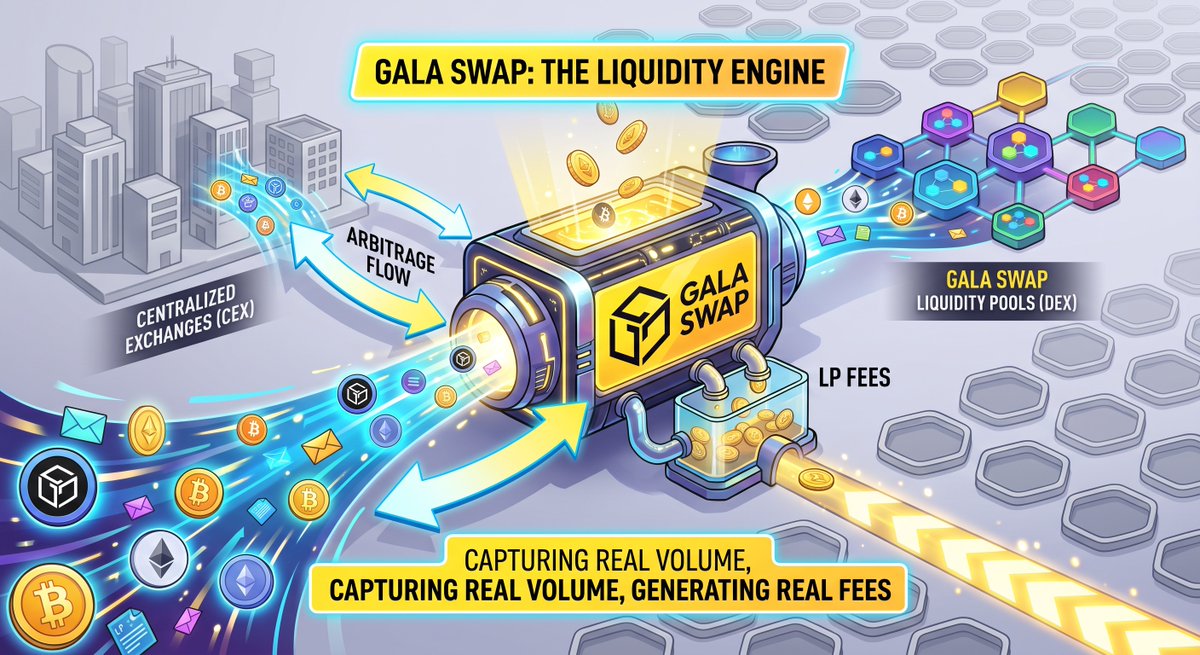
🚀 Gala Swap isn't just another DEX. It’s a powerful engine built to capture value directly from market inefficiencies, and it’s fueling a serious opportunity for liquidity providers.
Here’s the breakdown on why this is a potential game-changer, especially for new pools:
The Arbitrage Engine Is Already Running
Let's talk about that brand-new pool you just saw launch. How does it earn anything on day one? The answer is simple: Arbitrage.
The moment a pool goes live, its price can slightly differ from the prices on major centralized exchanges (CEX). Smart traders and automated bots, known as arbitrageurs, are constantly scanning for these tiny gaps. They buy where it’s cheap and sell where it’s dear.
This isn't theoretical volume. Even today, with only a handful of live pools on Gala Swap, millions of dollars in arbitrage volume are flowing through the platform daily. Every single one of those trades pays a fee to the liquidity provider (LP).
Real Volume, Real Fees (Not "Farm Token" Emissions)
This is what makes Gala Swap different. The yield isn't based on inflationary "farm token" emissions that you have to constantly race against.
The LP rewards on Gala Swap are generated by real trading activity—the essential work of keeping the DEX price in sync with the broader market. When you provide liquidity, you become the infrastructure that makes this flow possible, and you earn your share of the fees from that volume.
The Real Gold Rush: Expanding the Surface
The current volume is impressive, but here’s what’s truly exciting: the bottleneck isn't the demand from traders; it's the surface area available for the arbitrage engine to work across.
A few dozen pools can only capture a few dozen tokens' worth of flow. Imagine this same efficient arbitrage engine running across hundreds of pools that simply don't exist yet.
The Takeaway:
The traders are ready. The volume is real. The arbitrage engine is already running. What's missing is the liquidity to serve that volume and capture those fees across a much broader range of pairs.
Gala Swap provides the infrastructure; you provide the liquidity to unlock the full potential. 🟡
#CryptoMarkets
ethereum:0xd1d2eb1b1e90b638588728b4130137d262c87cae
🗺️ The Massive, Untapped Frontier on GalaSwap
Most people are completely missing the scale of the opportunity currently sitting on GalaSwap. Let’s break it down:
Think of GalaSwap as a vast, newly opened map with 2,000 prime plots of digital real estate. How do we get that number? Take the top ~500 most traded tokens and pair them against the four market heavyweights: BTC, ETH, USDT, and USDC.
Every single combination is a potential liquidity pool.
The "Wide Open" OpportunityHere is the crazy part: today, only a few dozen of those 2,000 pools have been established. The rest is completely untouched territory. There are over 1,900 viable markets just waiting for someone to build them.
Why Being First Pays OffIf you provide liquidity to a pool that already exists, you are just renting space—splitting the trading fees with everyone else in the crowd.
But if you are the first person to fund an empty pool, you are staking a claim. You become the only liquidity provider, which means you capture 100% of that pool's trading fees until someone else shows up, and you get to set the initial terms. You aren't just joining a market; you are creating it.
This month, we’re going to explore this wide-open frontier. We'll look at which empty spaces have the highest pent-up demand, how much volume they can hold, and exactly how you can plant your flag.
Thousands of open plots. Dozens claimed. The map is yours. 🟡
(Model framing; LP carries risk incl. impermanent loss; not financial advice; DYOR.)
https://t.co/CI5gqjhDV6
🛡️ **Why bots literally *can't* sandwich you on GalaSwap — the technical version.**
A sandwich attack isn't magic. It needs three ingredients, and every EVM DEX serves all three. GalaSwap's architecture removes all three. Here's the teardown.
**A sandwich needs:**
1. **Visibility** — the attacker has to *see* your pending trade.
2. **Ordering control** — it has to *place* transactions right before and after yours.
3. **Re-pricing at execution** — your trade has to be *re-quoted* against the pool state the attacker just moved.
On Ethereum, all three are free: your swap broadcasts to the **public mempool** (visibility), bots win placement by **bidding gas** in a priority auction (ordering), and because EVM chains **order first, then execute**, your swap gets priced against whatever state exists at execution — including the front-run (re-pricing). Three ingredients, one sandwich.
**GalaChain — built in the Hyperledger Fabric lineage — takes away all three:**
🔒 **No public mempool → no visibility.** Transactions aren't gossiped into a global pending pool for searchers to scan. There's no waiting room to watch. *Ingredient #1: gone.*
⚙️ **Deterministic, validator-ordered consensus → no ordering control.** Ordering is decided by the consensus layer, not a fee auction. "Pay more, get placed first" doesn't exist — gas tips, bundles, priority fees, none of the EVM/Solana ordering levers apply here. *Ingredient #2: gone.*
🧬 **Execute-order-validate → no silent re-pricing.** The deep one. EVM is *order-then-execute*: your outcome is decided at execution time, after reordering. GalaChain flips it — transactions are **endorsed against a specific state version first, then ordered, then validated at commit.** Your swap is bound to the state it was validated against; it can't be quietly re-quoted at a worse price by transactions that squeeze in around it. *Ingredient #3: gone.*
Take away visibility, ordering control, *and* re-pricing, and the sandwich has nothing to grab. This isn't mitigation. It isn't a filter that catches *most* attacks. The attack's prerequisites don't exist on the chain.
⚡ **That's why GalaSwap is structurally fair.**
Not "fair-ish." Not "fair until a bot finds the gap." Fair as a *property of the architecture.* The price you see is the price you get — for a $50 swap and a $50,000 one alike. No searcher tax, no invisible slippage, no arms race you're guaranteed to lose.
Every other DEX asks you to trust the bots won't get you. GalaSwap doesn't have to ask — it removed the surface.
Stop feeding the sandwich machine. 🟡
👉 Trade where fair is built in. Trade on GalaSwap.
### 𝕏
🛡️ Why bots can't sandwich you on GalaSwap — technically.
A sandwich needs 3 things:
① see your trade (public mempool)
② order around it (gas auction)
③ re-price you at execution (order-then-execute)
EVM hands bots all 3. GalaChain removes all 3:
❌ no public mempool
❌ no fee-priority auction — deterministic ordering
❌ execute-order-validate, not order-then-execute
Not mitigation — the attack's prerequisites don't exist.
The price you see is the price you get. 🟡
👉 Trade on GalaSwap.
https://t.co/CI5gqjhDV6