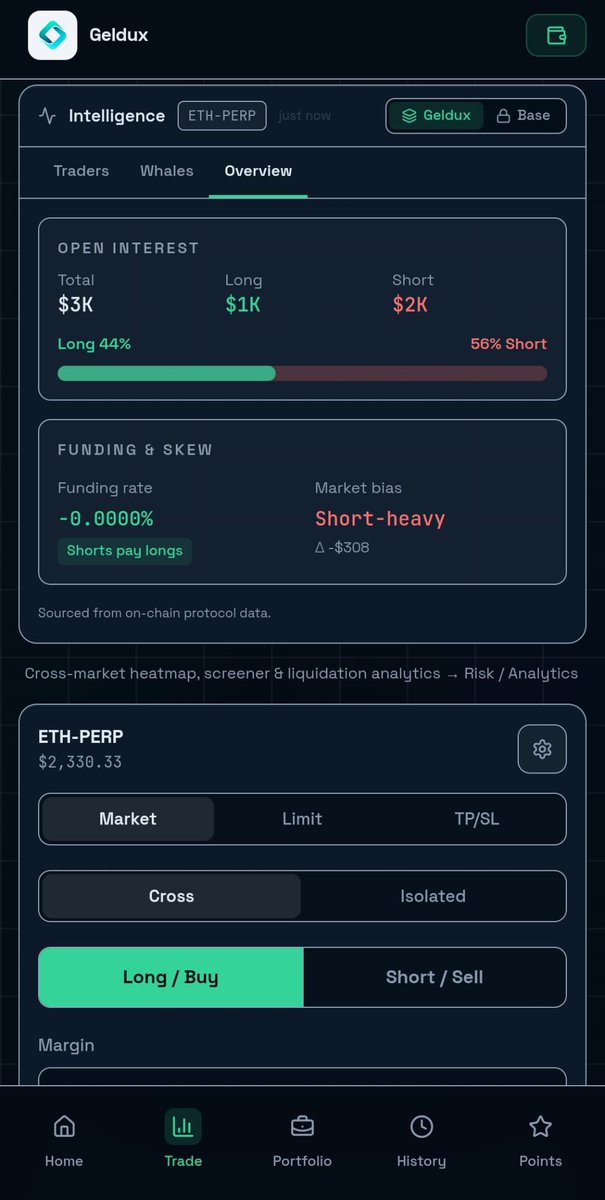
We opened the Geldux Discord for people who want to follow the product more closely.
Geldux is being built around Base-native perps, Atlas market intelligence, session trading, position health, and cleaner onchain execution.
The Discord is not meant to be a noise room.
It is for people interested in:
Atlas risk intelligence
Base Sepolia trading flows
session trading UX
perps product feedback
market structure discussions
bugs, edge cases, and improvements
builder conversations around onchain trading
The goal is simple.
Bring together people who care about better trading infrastructure, cleaner execution, and more useful market context.
Early roles are based on real contribution, feedback, testing, and useful participation.
Onchain trading should not feel like stopping at a wallet popup every few seconds.
That is why we are testing session trading on Geldux.
The idea is simple.
A user approves a limited trading session once, then trades faster inside that approved scope.
This does not mean unlimited wallet access.
It does not mean the app can do anything with the wallet.
A session should be controlled by clear permission limits.
For example:
which market can be traded
which actions are allowed
maximum collateral size
maximum leverage
maximum trade size
allowed margin mode
maximum slippage
acceptable price range
session expiry time
oracle freshness requirement
risk checks before execution
So instead of giving broad approval, the user gives a specific permission for a specific trading window.
That is the main difference.
A normal approval can feel open ended.
A session should feel limited, temporary, and purpose built for trading.
In practice, this can make the trading flow much smoother.
Open a position.
Increase a position.
Reduce a position.
Close a position.
The user should not need to break focus and sign again for every small step, as long as the action stays inside the session limits.
But speed alone is not the goal.
Security matters more.
A Geldux trading session should not be able to withdraw funds freely.
It should not be able to change user settings outside the session.
It should not be able to execute unrelated wallet actions.
It should not be able to trade markets the user did not allow.
It should not be able to exceed the user’s approved collateral or leverage limits.
It should not keep working forever after the session expires.
Every session should have boundaries.
Every trade should still respect risk controls.
Every permission should be understandable before the user approves it.
This is the experience we are building toward:
fewer interruptions
faster trade execution
clear permission limits
self custody
onchain settlement
risk checks still active
Session trading is not about removing user control.
It is about reducing unnecessary friction while keeping user control clear.
This also connects with Geldux Atlas.
Before trading, users should be able to see risk context like market pressure, funding pressure, long and short imbalance, liquidation pressure, position health, and freshness.
So the full Geldux direction is not just faster execution.
It is faster execution with better context and safer permission boundaries.
Trade with fewer interruptions.
Trade with clearer limits.
Trade with a map, not blind candles.
A perp terminal should help answer more than:
“Do I long or short?”
Before taking risk, traders should be able to ask better questions:
Is this market crowded?
Is leverage building too fast?
Is funding becoming one-sided?
Is liquidity thin?
Are liquidation zones nearby?
Is the data fresh enough to trust?
Is doing nothing the better trade?
That is the direction behind Geldux Atlas.
We are still testnet-stage, but the product principle is simple:
Execution should not live alone.
Risk, market context, position health, and data freshness should be part of the trading experience.
Perps should not feel blind.
Trade with a map, not blind candles.
#base #prep #intelligence
One product lesson we’re taking seriously while building Geldux:
Perp traders do not want friction.
If opening, closing, or adjusting a position requires too many wallet interactions, the product feels slow no matter how good the interface looks.
So the direction for Geldux is clear:
• Reduce signing friction
• Prioritize desktop-first and mobile-first trading UX both
• Make risk visible before execution
• Show OI, funding, liquidations, and heatmaps in context
• Keep the terminal fast, practical, and trader-focused
Execution matters.
But in perps, execution + risk clarity matters more.
Built on @base.
#Base #DeFi
Perp trading is one of the most important use cases for onchain markets.
But most perp interfaces still feel the same:
open chart
pick leverage
click long or short
hope you understood the risk
That is not enough.
Before a trader opens a position, they should be able to see the market more clearly:
• where open interest is building
• where long/short pressure is shifting
• where liquidations may cluster
• where liquidity is thin
• where funding pressure is changing
• where whale activity is increasing
• when the market is too noisy to trade
Execution matters.
But context matters before execution.
That is the direction for Geldux.
We are building a Base-native perp trading terminal focused on risk clarity, heatmaps, liquidation data, whale activity, portfolio insight, and trader intelligence.
The goal is not to add more buttons.
The goal is to help traders understand the market before they take risk.
Base has the right ingredients for this:
fast UX, low-cost execution, onchain distribution, and a builder ecosystem that keeps pushing useful products forward.
Geldux is our attempt to build a serious trading layer for that environment.
A better map before every trade.
cc @jessepollak