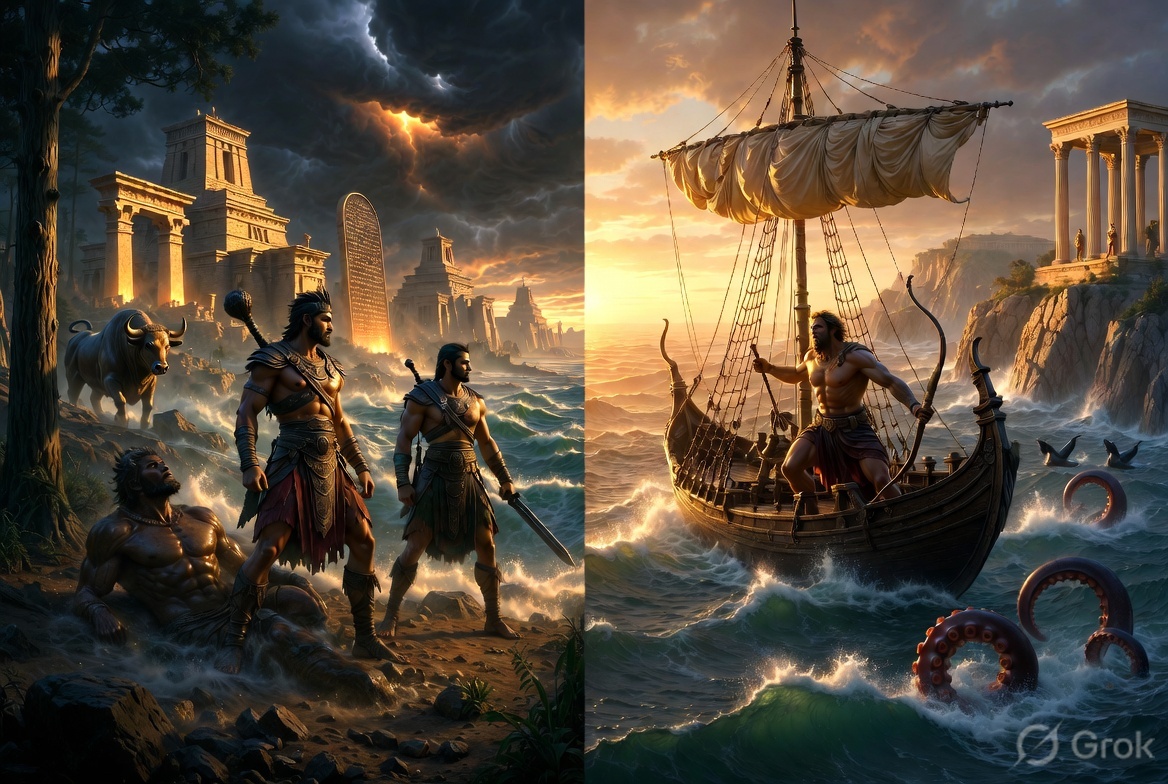
Many classical scholars believe Homer's The Odyssey was indirectly influenced by The Epic of Gilgamesh through shared Near Eastern oral traditions. While direct borrowing cannot be proven, the two epics share striking structural and thematic parallels developed across the ancient Mediterranean and Mesopotamian worlds.
The most commonly renowned mythological texts that project heroic attributes are Homer’s Odyssey and the Epic of Gilgamesh. Comparing different mythical heroes from literature can help understand their different qualities and heroic ideals. This paper makes a comparison of Odysseus and Gilgamesh in order to find out what their similarities and differences are.
The text about Odyssey is written by Homer, while Gilgamesh is written by Shin-Eqi-Unninni. On comparison, Odysseus and Gilgamesh possess traits such as friendliness, courage, and heroism. Odysseus had a hereditary right to the throne and ruled Ithaca that was complemented by his impartiality, ruthlessness and diplomatic skills.
On the other hand, Gilgamesh was the king of Uruk in Babylonia, who is physically sturdy and strong, having supernatural powers and the will to protect his people (George). As Gilgamesh was an oppressor, he was given the title of the goring wild bull.
By taking a look at Homer’s Odyssey, one can observe that he was a hero based on his pure spirituality and strength to take challenges. At the beginning of the tale of Odysseus, he sailed far, reached north, put the ships on Hangar, where Eurylochus, who was second in command of Odysseus, prepared a male and female sheep for sacrifice.
After offering prayers to the dead, the people of the river offered the sheep to them and put the remaining parts in a pit that had been dug with shadows of the dead gathering around. It was a ritual to establish communion with the dead who bore messages for the living and was respected and offered sacrifices. Odysseus has been observed to take the challenge despite the fact he was aware of all the hardships (Louden).
Odysseus was greatly opposed by her wife, mother, and other people who really cared about him. But he continues to achieve his objective, and show is a heroic attribute. There were many memorable quotes mentioned in the Odyssey that show his high morals and astounding insights.
The fact that he had different heroic ideals can be understood by the following quotation from the text. It states that “‘Stand clear, put up your sword; let me but taste of blood. I shall speak true. ‘” Book 11, lines 106-7 (Louden). The above-noted dialogue was delivered by Odysseus’s mother on the event of slaughter of animals by Odysseus.
Similarly, in the Epic Of Gilgamesh, we can note that the protagonist is two-thirds god and one-third human. The character of Gilgamesh is an example of a supernatural force in the story. He is not only brave and sturdy like Odysseus, but also miraculously trusted by the people. Gilgamesh used his power for the sustenance of his people.
For instance, he dug wells and made barren land cultivable for his people, providing them with space for agriculture and paving the way through mountains and making passes for access. He also constructed fortified walls for his people in and around Uruk. Gilgamesh had defiance in him as far as doctrines are concerned about having a thirst for glory (George).
#archaeohistories
Swiss startup Mimic Robotics has unveiled the M1, a robotic hand with human-like movement.
It uses tendon-like cables and learns by copying human hand motions.
It can grip over 25 kg and detect weights as light as 50 grams.
LOOK UP🚨: Scientists are preparing for an Explosion: One of the largest stars in the galaxy is about to explode.
It’s 160,000 light years away from Earth.
Despite the immense distance, when it eventually goes supernova, the explosion will be bright enough to be seen with the naked eye in the southern sky.
A vision of future computing by Robert Tinney in 1981...
In 1981, illustrator Robert Tinney created this concept art for Byte magazine, imagining what personal computing might look like in the future. His vision featured a wrist-mounted computer with a full display, keyboard, and removable storage cartridge, an idea that seemed almost fantastical at a time when most personal computers were bulky desktop machines with monochrome monitors and floppy disks.
While the design was not technically practical, Tinney accurately anticipated several trends that would define the next four decades: wearable computing, portable digital storage, and constant access to information. Today's smartwatches can send messages, answer calls, navigate with GPS, monitor heart rate, make contactless payments, and even run artificial intelligence applications, functions that far exceed what most people imagined possible in 1981.
Tinney produced more than 700 covers and illustrations for Byte magazine, helping visualize the future of computing during the formative years of the personal computer revolution. His artwork inspired a generation of engineers, programmers, and technology enthusiasts.
The IBM Personal Computer had been introduced only months before this illustration appeared. It shipped with as little as 16 KB of RAM, while today's smartwatches typically contain several gigabytes of memory and processing power millions of times greater than the computers that inspired Tinney's futuristic artwork.
#archaeohistories
You are looking at an actual photo of the nucleus of an atom.
Cornell physicists have achieved the highest resolution image of atoms ever recorded, reaching the ultimate physical limit of clarity allowed by nature.
Physicists at Cornell University have shattered records by producing the highest-resolution image of atoms ever captured, magnifying a crystal sample 100 million times.
Using a sophisticated technique known as electron ptychography, researchers bypassed the limitations of traditional lenses by mapping how electrons scatter across a surface and using computer algorithms to reconstruct the atomic structure. The result is a stunningly clear view of praseodymium, scandium, and oxygen atoms locked in a crystalline lattice, where even the slight blur visible is not a technical error but the result of the atoms' own constant thermal vibrations.
This milestone marks what scientists believe is the absolute end of the road for resolution; we have reached a point where the image is as sharp as physics itself permits. By seeing exactly where atoms sit and how they move, engineers can now design more efficient semiconductors, advanced quantum computers, and next-generation nanomaterials with unprecedented precision. As researchers noted, this advancement is akin to upgrading from blurry glasses to perfect vision, finally allowing humanity to observe the fundamental building blocks of matter without any technical distortion.
Source: Chen, Z., Jiang, Y., Shao, Y. T., Holtz, M. E., Odstrcil, M., Guizar-Sicairos, M., Han, K., Muller, D. A. (2021). Electron ptychography achieves atomic-resolution limits set by lattice vibrations. Science.
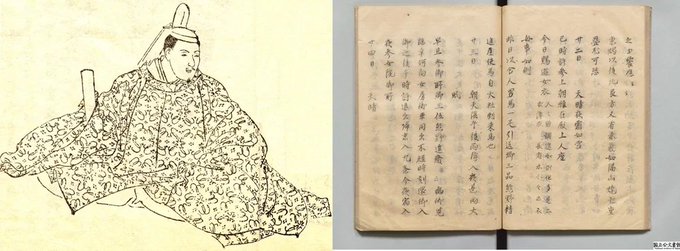
In 1204, a Japanese poet wrote in his diary that the sky turned blood red for 3 nights.
800 years later, scientists drilled into buried trees and confirmed: he was witnessing a catastrophic solar storm that would have fried every satellite on Earth today.
The production set for James Cameron’s Titanic (1997) stands as one of the most ambitious, expensive, and logistically insane engineering feats in film history.
Because no existing studio facility on Earth could accommodate a project of this scale, 20th Century Fox bought 40 acres of waterfront property in Rosarito, Baja California, Mexico, building a brand-new, $40 million state-of-the-art studio complex (Baja Studios) specifically to construct and sink the ship.
Fourier wrapped a signal around a circle in 1822. Every Spotify equalizer, every noise filter in your AirPods, and every frequency layer inside ChatGPT runs on what he found.
The trick is simple. Spin the signal at different speeds. When the spin matches a hidden frequency, the center of mass shifts. That shift is the answer. Claude and GPT use this same idea to separate relevant tokens from noise.
20 minutes. Bookmark & watch today. The math is older than the telephone.
Happy 14th Marsiversary, Curiosity!
Today marks 14 years (and close to 5000 sols!) since Curiosity's dramatic drop through Mars's thin atmosphere and its safe arrival on the planet's surface! Since its landing, Curiosity has explored more than 23 miles of terrain, and found evidence of past habitable environments!
An incredible rescue unfolded at Nanika Lake in British Columbia, Canada, when two men discovered a baby seal trapped between massive logs. Working alongside the pup's determined mother, they managed to create just enough space for the little seal to break free and reunite with its family. ❤️🦭
Super-thin superconducting materials, which are only one or a few atoms thick, have unique properties scientists can leverage to produce more efficient quantum devices. But these fragile materials degrade so rapidly in air that they are difficult to study or manufacture. Researchers from MIT and elsewhere have discovered a method to generate ultrathin superconducting material that remains stable in air. https://t.co/ONd6a1Wijw
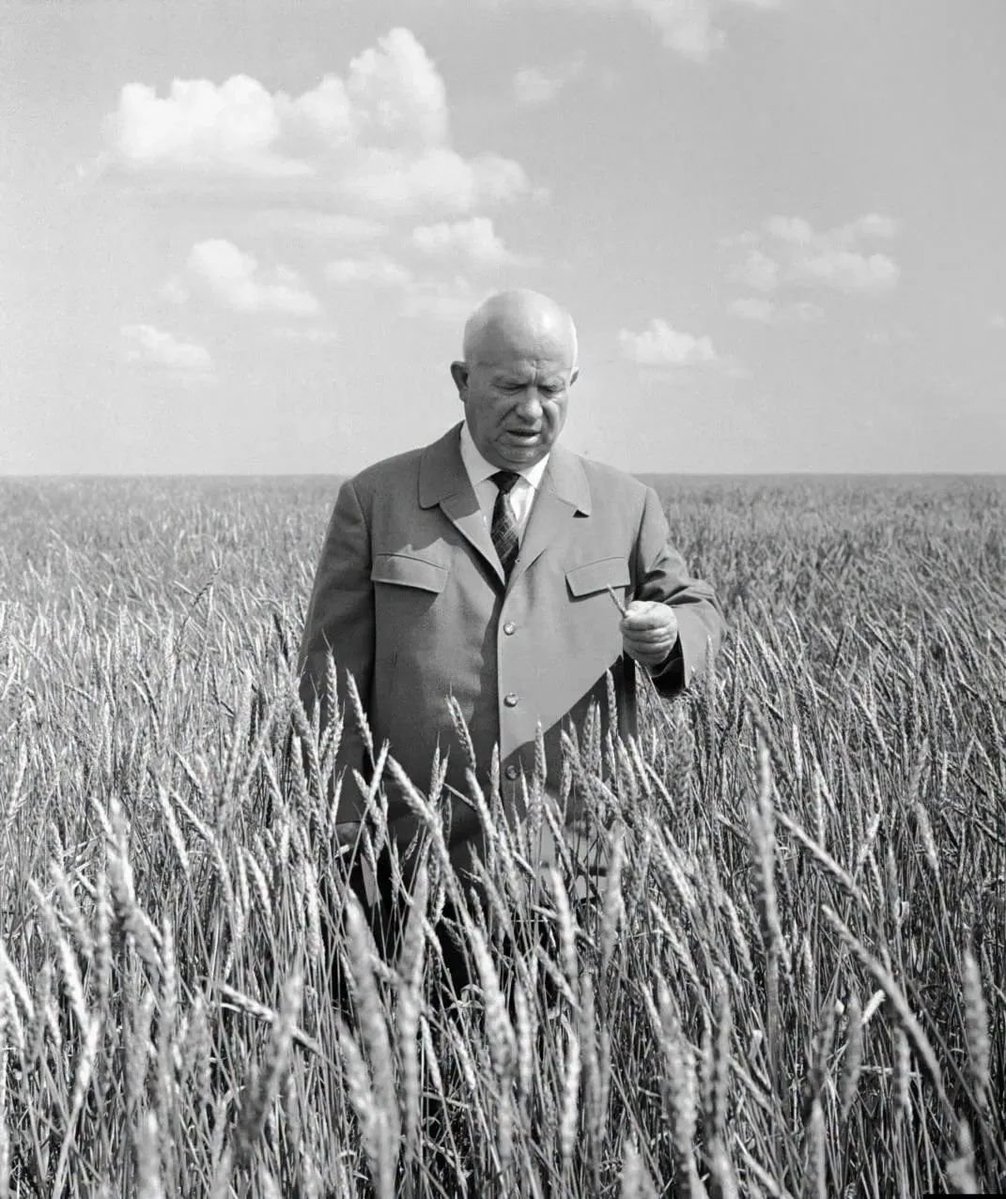
Soviet leader Nikita Khrushchev standing in a wheat field in Kazakhstan, 1964. Khrushchev attempted to farm millions of acres of uncultivated land throughout his time in power. He would be overthrown by his close associates later that year.
Beginning in 1954, Soviet leader Nikita Khrushchev launched the Virgin Lands Campaign, one of the largest agricultural projects in history. The program sought to boost grain production by cultivating more than 100 million acres (over 40 million hectares) of previously uncultivated land, primarily in Kazakhstan and Siberia. Initially, the campaign appeared successful, producing record harvests and temporarily easing chronic food shortages across the Soviet Union.
The long-term results, however, were disappointing. Much of the newly plowed land was poorly suited for intensive farming. Soil erosion, drought, and inadequate infrastructure caused yields to decline dramatically, and by the early 1960s the Soviet Union was again facing grain shortages. In 1963, the USSR was forced to purchase millions of tons of wheat from Canada and other Western nations—an embarrassing reversal for a superpower that had hoped to become self-sufficient.
On October 14, 1964, Khrushchev was removed from power in a bloodless internal coup led by senior Communist Party officials, who cited his erratic leadership and failed economic policies.
Despite his eventual downfall, Khrushchev is remembered for another historic achievement: under his leadership, the Soviet Union launched Sputnik in 1957 and sent Yuri Gagarin into orbit in 1961, making Gagarin the first human in space.
#archaeohistories
Super Athlete AS2-W is Unitree's all-terrain wheel-legged quadruped robot.
It can travel quickly over rough terrain, climb stairs, cross obstacles, and handle steep slopes.
The robot is built for inspection, security patrols, logistics, and exploration in challenging environments.
Green sea turtles are no longer considered endangered worldwide
Decades of protecting nests, reducing hunting, and making fishing safer helped their population rise by around 28%
The inbred Habsburg royals are a historical curiosity that continues to baffle and amaze many. Centuries of intermarriage within their own family—cousins, uncles, aunts—resulted in severe physical and mental defects among the Habsburgs. Ferdinand I of Austria is a notable example. Despite his many health issues, he lived to the age of 82, which was remarkable given the circumstances.
Ferdinand was mentally challenged and unstable, rendering him largely incapable of fulfilling his royal duties. He was known for making unreasonable demands, such as insisting on out-of-season food simply because, in his words, “I’m the Emperor!” Suffering up to twenty seizures a day, Ferdinand was considered unlikely to produce an heir. During his first attempt to consummate his marriage, he experienced five seizures, and despite his efforts, he never succeeded in fathering a child.
In 1848, his nephew Franz-Joseph took over the throne, allowing Ferdinand to retire peacefully—a retirement he seemed to enjoy until his death in 1875.
Charles II of Spain, another Habsburg, suffered even more severe consequences of inbreeding. Known as ‘the bewitched,’ his jaw was so malformed from generations of incest that he could barely breathe or speak. He remained childish longer than most men and became senile early. By thirty, he was completely bald, though portraits depict him wearing wigs.
A French ambassador, expressing pity for Charles’s future wife, described him as “an imbecile so ugly as to cause fear and obviously unwell.” Despite two marriages, Charles II never produced an heir. His first wife endured painful fertility treatments, wrongly blamed for their childlessness when it was likely Charles who was infertile.
The autopsy of Charles II revealed shocking details: a heart the size of a peppercorn, corroded lungs, rotten intestines, a single black testicle, and a head full of water. It’s astonishing that the Habsburgs, despite centuries of suffering, never seemed to realize that their practice of incest was the root cause of their numerous health problems.
The Habsburg Jaw: Inbreeding and European Royalty https://t.co/WrR4MiULZu
The word “tensor” makes advanced physics sound harder than it is. At its core, it is a generalization of familiar objects: scalars, vectors and matrices. The interesting part is what happens when you stop thinking in terms of rows and columns and start thinking in terms of indices and dimensions.