Hon. Minister of the Gospel Christ Jesus. Set apart and useful for honorable and noble purposes, and profitable to the Master, fit and ready for any good work
Disappointments might have broken your heart, but it didn't destroy your destiny. 💔✨ Let your setbacks be stepping stones to a brighter future. As Romans 8:28 assures us, all things work together for good for those who love God and are called according to His purpose. #KeepGoing #DestinyAwaits #TrustTheJourney
I am a page that mercy refused to tear,
A testimony of a God who answers prayer.
Through valleys deep and mountains high,
His grace has been my wings to fly.
Another year, another altar,
A deeper walk with my Heavenly Father.
More than candles, let my life burn bright, For His glory, His purpose, His light!
Happy birthday to me! 🎂🙏
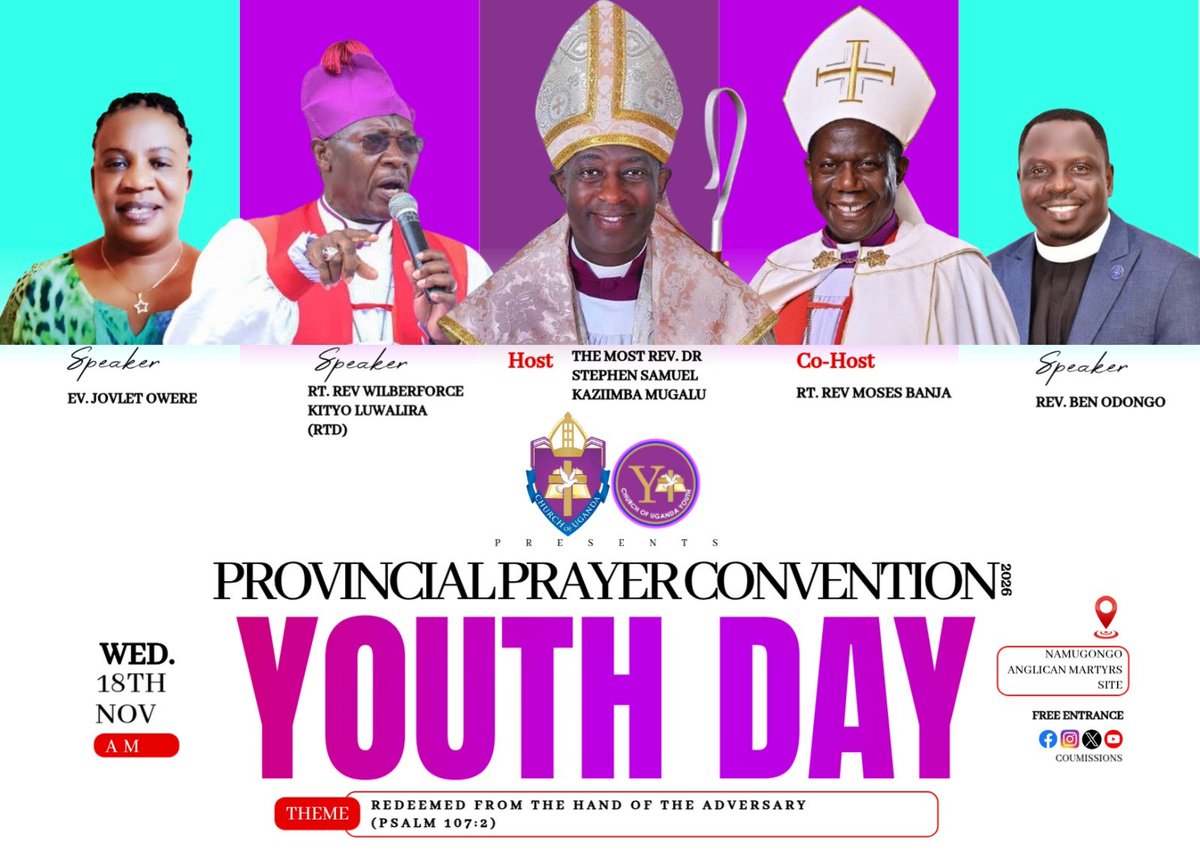
CHURCH OF UGANDA
PROVINCIAL PRAYER CONVENTION 2026
18th - 21st Nov 2026
Namugongo Martyrs Anglican Site.
This is the year of God's favor, the year of breakthrough, the year of God's appointed time in your life.
Mathew7:7 Ask and you will receive, seek and you will find knock and the door shall be open to you.
Breathren come receive your testimony, come receive your deliverance, come receive your healing.
Jesus Christ is waiting for you.
Come with a friend
SOME TREASURES ARE NOT HIDDEN FROM YOU. THEY ARE PRESERVED IN WRITING, WAITING FOR THE DILIGENT READER!
COMPLETE DELIVERANCE
(A Biblical Exposition)
A resource for believers and ministers who desire to go deeper into the whole counsel of God.
Get your copy at UGX 80,000! Available at All Saints Cathedral, Kampala.
For more information contact me.
Thank you, Hon. Minister, for returning to your alma mater to inspire the next generation. It was a blessing to share in this special occasion. Indeed, excellence opens doors, but character and the fear of God sustain destiny. May these candidates excel and fulfil their God-given potential! And may the Lord continually increase you in wisdom, favour and influence, granting you greater grace to raise generations and serve our nation. God bless you abundantly!
4. YOUR QUESTION ABOUT DOMINEERING AUTHORITY DOES NOT DISPROVE THE CONTEXTUAL INTERPRETATION.
You ask, "Are men permitted to domineer?" Of course not!
Jesus explicitly condemns domineering leadership in Mark 10:42-45.
Peter similarly instructs elders not to domineer over those entrusted to them in 1 Peter 5:3.
Therefore, if authentein were understood pejoratively, Paul's instruction would not imply that men were permitted to engage in the same behaviour.
A prohibition addressed to a particular group does not automatically grant permission to everyone outside that group.
However, I will concede something important. If authentein has a neutral meaning and Paul's prohibition is grounded in creation, your interpretation gains considerable strength.
That is why the lexical question matters.
But even then, we must examine the rationale in verses 13-14 before claiming that every alternative interpretation is impossible.
5. YOUR APPEAL TO TWO THOUSAND YEARS OF INTERPRETATION IS HISTORICALLY IMPORTANT, BUT IT IS NOT A SUBSTITUTE FOR EXEGESIS.
I acknowledge that the overwhelming historical practice of the Church has been to appoint men as presbyters and bishops. That evidence must be taken seriously. But historical predominance and exegetical infallibility are not identical.
The question is not whether Christians have traditionally interpreted the passage as you do. Many have.
The question is whether the grammar, literary context and theological reasoning establish your interpretation as the only permissible reading. And that question cannot be answered merely by counting centuries.
The Church's historical interpretation deserves careful consideration. It does not remove the responsibility to demonstrate that interpretation from Scripture.
6. FINALLY, THE ACCUSATION OF FEMINISM DOES NOT ESTABLISH YOUR EXEGESIS.
My brother, you conclude that the egalitarian interpretation is simply feminism entering the Church.
But assigning an ideological label to an interpretation does not demonstrate that the interpretation is grammatically or contextually incorrect.
A person may reach a wrong conclusion through modern ideological assumptions.
Another person may reach a wrong conclusion through inherited cultural assumptions.
Neither possibility settles the meaning of Scripture.
The test is the text, not the label attached to the interpreter.
And I would caution both sides against confusing historical dominance with exegetical infallibility.
The traditional reading has a long and substantial history. That deserves respect.
But respect for tradition does not exempt its arguments from scrutiny.
Byamukama, let me conclude with this.
I have not demonstrated from these passages that women may serve as elders. That positive case still requires argument, and I acknowledge the burden of establishing it.
Equally, the grammatical arguments you have presented do not, on their own, establish that the traditional interpretation is the only possible reading of 1 Timothy 2:11–15.
Those are two distinct conclusions, and intellectual honesty requires us to acknowledge both.
The Church must neither ordain women merely because contemporary culture demands it nor prohibit their ordination merely because an inherited interpretation has become familiar.
We must establish what the apostolic Scriptures actually require.
The authority of Scripture is not under debate. The accuracy of our interpretation is!
Thank you for the exchange, my brother. I respect your scholarship, even where I challenge your conclusions.
Grace and peace!
My brother, thank you for the engagement. I respect your scholarship and your commitment to the authority of Scripture.
However, before you conclude, there are some serious exegetical problems in your argument that deserve attention.😂
1. YOU HAVE NOT ANSWERED THE GRAMMATICAL QUESTION I ASKED.
My question was straightforward: What principle of Greek grammar establishes that the present infinitive authentein cannot describe an improper exercise of authority?
Your response appeals to lexical studies, cognate nouns and comparisons with other verbs.
Those are legitimate areas of investigation, but none establishes the grammatical principle you originally asserted.
The present infinitive expresses imperfective aspect. It does not determine whether the action described is morally acceptable or unacceptable.
A person can continually exercise legitimate authority. A person can also continually abuse authority. Both actions can be expressed using present forms.
Aspect describes how an action is presented. It does not determine the moral character of that action.
That was my question, and it remains unanswered.
2. LEXICAL EVIDENCE AND GRAMMATICAL EVIDENCE ARE NOT THE SAME THING.
You appeal to Al Wolters, whose work argues that authenteō ordinarily denotes exercising authority rather than abusing it.
That is a serious scholarly position. I do not dismiss it. But notice the distinction.
Even if Wolters establishes that the most probable lexical meaning is "exercise authority," that would not demonstrate that the present infinitive itself rules out a negative meaning.
Your argument has shifted from a grammatical claim to a lexical claim. Those are different arguments!
Furthermore, your reference to approximately 114 occurrences requires qualification. Lexical studies differ in their chronological limits, whether they count inflected forms and cognates, and which surviving sources they include.
We must distinguish evidence for the verb itself from evidence for related nouns.
A cognate can illuminate a word's history without automatically determining its meaning in a particular sentence.
And here is something important: I am prepared, for the sake of argument, to grant your preferred translation, "exercise authority."
The theological debate would still not be settled. Because the meaning of an activity and the scope of a prohibition concerning that activity are two separate exegetical questions.
3. YOUR ARGUMENT FROM THE INDEFINITE NOUN OVERSTATES WHAT GREEK GRAMMAR ESTABLISHES.
You argue that because Paul writes gynaiki without the definite article, he necessarily means every woman in every church throughout history.
My brother, that conclusion does not follow from the absence of an article!
Anarthrous nouns in Greek can be generic, indefinite or qualitative, depending on their construction and context.
I agree that Paul's wording can naturally express a general prohibition rather than a restriction explicitly addressed to named individuals.
That is a legitimate argument in your favour.
But a general formulation does not, by itself, establish that the rule applies without contextual qualification in every conceivable situation.
Consider 1 Corinthians 7:1:
"It is good for a man not to touch a woman."
Paul uses general language, yet the surrounding discussion is indispensable for understanding what he means and how the instruction applies.
Likewise, in 1 Timothy 2:12, the absence of an article does not independently settle the prohibition's historical scope.
And your suggestion that Paul would necessarily have used tis to indicate particular women is too rigid. Greek has several ways of identifying particular people, and an indefinite pronoun is not grammatically mandatory whenever an author intends a contextually limited reference.
You cannot turn the absence of a definite article into a doctrine of permanent ecclesiastical exclusion without additional argument.
😂 My brother, theology is not measured by the number of pages but by the accuracy of the interpretation!
However, I agree with you. Let us simplify the discussion and deal with one exegetical issue at a time.
You argued that the present infinitive authentein in 1 Timothy 2:12 rules out a negative meaning such as domineering authority.
My question is simple: What principle of Greek grammar establishes that the present infinitive cannot describe an improper exercise of authority?
Let us settle that one question before proceeding to Adam and Eve. No essays necessary, my brother. Just the grammar and the evidence! 😂
Now, Byamukama, I am not avoiding your strongest argument.
In fact, I believe your strongest argument is not the present infinitive, nor the absence of named female false teachers.
Your strongest argument is Paul's appeal to Adam and Eve in verses 13-14.
That is where the traditional interpretation must be taken most seriously. Because if Paul's reasoning establishes a permanent restriction grounded in the created order, then the egalitarian interpretation must explain that reasoning convincingly.
And if it cannot, it has a serious theological problem.
I am prepared to examine that argument without dismissing it. But before we proceed, let me leave you with one precise challenge concerning your grammatical argument:
Can you demonstrate, from Greek grammar rather than theological inference, that the present infinitive authentein excludes a pejorative meaning and necessarily denotes legitimate pastoral authority?
That is the claim I am challenging.
Once we settle what the grammar can and cannot establish, we can proceed to Adam and Eve.
My brother, the Greek text is inspired. Our grammatical conclusions about that text must still be demonstrated. And that applies to both of us.
Therefore, even if we grant your preferred interpretation of the present infinitive, it does not follow that authentein must denote the legitimate exercise of ecclesiastical authority.
That conclusion must come from lexical usage and context. You cannot extract it from the present infinitive alone.
4. YOU HAVE CORRECTLY WARNED AGAINST ETYMOLOGICAL FALLACIES. BUT THAT WARNING APPLIES TO BOTH SIDES.
I agree that we must not determine the meaning of authentein merely by appealing to the historical meanings of authentēs.
Words must be interpreted according to their actual usage. But the same methodological discipline applies when someone argues that the verb necessarily means the ordinary, legitimate exercise of authority.
The lexical question is not simply whether a cognate could mean “master.” It is how the verb authenteō functioned in relevant Greek usage and what sense is most probable in 1 Timothy 2:12.
Your citation of Al Wolters represents a serious scholarly argument for a non-pejorative meaning. I acknowledge that.
But citing a scholarly conclusion is not the same as demonstrating that no alternative interpretation remains linguistically defensible.
The lexical debate includes questions of chronology, genre, semantic range and the relationship between the verb and its cognates.
And even if, for the sake of argument, we accept that authentein means “exercise authority” without a negative connotation, we have not yet established the scope, duration or ecclesiastical application of Paul's prohibition. That requires further exegesis.
5. THE ABSENCE OF A QUALIFIER DOES NOT AUTOMATICALLY MAKE A PROHIBITION UNIVERSAL.
You argue that Paul does not explicitly qualify the kind of teaching he prohibits.
But consider the structure of the sentence: διδάσκειν δὲ γυναικὶ οὐκ ἐπιτρέπω οὐδὲ αὐθεντεῖν ἀνδρός
Paul says he does not permit a woman to teach or to exercise authority over a man.
Now, we must examine the relationship between didaskein and authentein, connected by oude.
Does Paul prohibit two independently identifiable activities?
Or does their coordination describe closely related activities within a particular teaching-authority relationship?
The conjunction itself does not settle every question about that relationship.
Furthermore, Paul does not explicitly mention the offices of presbyteros or episkopos in verse 12. That connection is inferred from the surrounding discussion and the transition into chapter 3. It is a serious contextual argument, but it remains an argument that must be demonstrated.
And remember, Paul acknowledges women praying and prophesying in 1 Corinthians 11:5.
Therefore, we already know that his instructions concerning women speaking in Christian gatherings must be interpreted with attention to the particular activities under discussion.
An unqualified expression within a sentence is not necessarily an unlimited rule outside its context.
6. TWO THOUSAND YEARS OF INTERPRETATION DESERVE RESPECT, BUT THEY CANNOT REPLACE EXEGESIS.
My brother, the historical predominance of male elders and bishops is undeniable. I am not disputing that. But we must distinguish three claims:
First, the historical Church overwhelmingly appointed men to these offices.
Second, many Christian interpreters understood Paul's instructions as prohibiting women from exercising pastoral authority over men.
Third, the Greek text admits no other responsible interpretation.
The first two claims have substantial historical support.
The third is an exegetical conclusion, not a historical fact established merely by repeating the first two.
Tradition is an important witness to how Scripture has been received.
But the longevity of an interpretation does not eliminate the responsibility to examine its grammatical and contextual foundations.