👏👏👏👏👏 Magnifique intervention remplie d’intelligence…ET c’est tellement RARE qu’il faut féliciter CETTE DÉPUTÉE QUI A DES CACAHUÈTES D’OSER DIRE LES CHOSES ET QUI A DU BON SENS !!!! Qu’on soit de gauche ou, de droite et un minimum de neurones on ne peut pas dire qu’elle a tord même si c’est une #Renaissance !!!
🛑Pour la mémoire de #Mauricette 👉 j’ai gagné définitivement mon procès face a @Maitre_Eolas qui défendait K.Henart qui avait dit que j’avais juste battu ma femme et fait 1 faux certificat de décès 👉pourvoi en cassation rejeté👉ce soir je chante sous la douche !@verity_france
📝Pendant plusieurs années, j’ai ressenti comme un devoir d’alerter.
Observer certaines évolutions de notre société, poser des questions, ouvrir des débats, essayer d’apporter un autre regard.
Je ne regrette pas de l’avoir fait. Parce que je pense sincèrement que le silence n’est jamais une solution lorsque quelque chose nous semble important.
Mais avec le temps, quelque chose s’est déplacé en moi.
J’ai découvert aussi les limites de cet univers de l’alerte permanente.
Les rivalités d’ego, les querelles, la dureté parfois, l'immense mesquinerie.
Et surtout cette étrange sensation que certains finissent par ressembler, dans leur manière d’être au monde, à ce qu’ils dénoncent pourtant chez les autres.
Le manque de générosité de coeur et d'esprit est parfois aussi grand dans ces rangs-là que dans ceux du pouvoir ...
J'ai souvent été déçue et écoeurée de voir ceux qui se disent alerteurs, se comporter à l'image de ceux contre qui ils alertent, avec médiocrité, ambition personnelle mégalo (et infondée), et avarice.
Je crois profondément qu’on ne construit pas un monde plus humain uniquement à partir de la colère, de la peur ou de l’opposition permanente.
Et je crois aussi qu’à force de regarder sans cesse ce qui s’abîme… on finit parfois par s’abîmer soi-même un peu.
J’ai donné énormément d’énergie à tout cela.
Du temps, du cœur, une part de moi.
Avec sincérité, sans stratégie et sans retour concret, ni changements visibles, ni même parfois la simple bienveillance de ceux qui regardent sans jamais agir eux-mêmes.
Alors aujourd’hui, sans renier ce parcours, je ressens le besoin de revenir vers quelque chose de plus essentiel pour moi.
Le beau. L’art. Le rêve. La profondeur.
Ce qui relie plutôt que ce qui fracture et ce qui élève plutôt que ce qui enferme.
Je crois qu’il existe aussi une forme de résistance dans la beauté.
Dans le fait de continuer à créer, à penser, à transmettre de la lumière malgré le bruit du monde.
Et peut-être qu’au fond, ma place a toujours été davantage là.
Dans ce qui rappelle à l’être humain qu’il est autre chose qu’un consommateur anxieux ou un combattant perpétuellement en guerre.
Je n’abandonne pas ma conscience.
Ma boussole restera ce qui est juste.
Je choisis simplement de nourrir davantage ce qui fait vivre l’âme, plutôt que ce qui l’épuise. 🕊️
@ZippoJeje Inutile de remonter en 1976, 2003,2000, il a fait chaud en été ou tout juste avant et il a fait froid en hiver ,c'est incroyable 😅. Le plus incroyable y a encore des idiots pour les écouter ?!
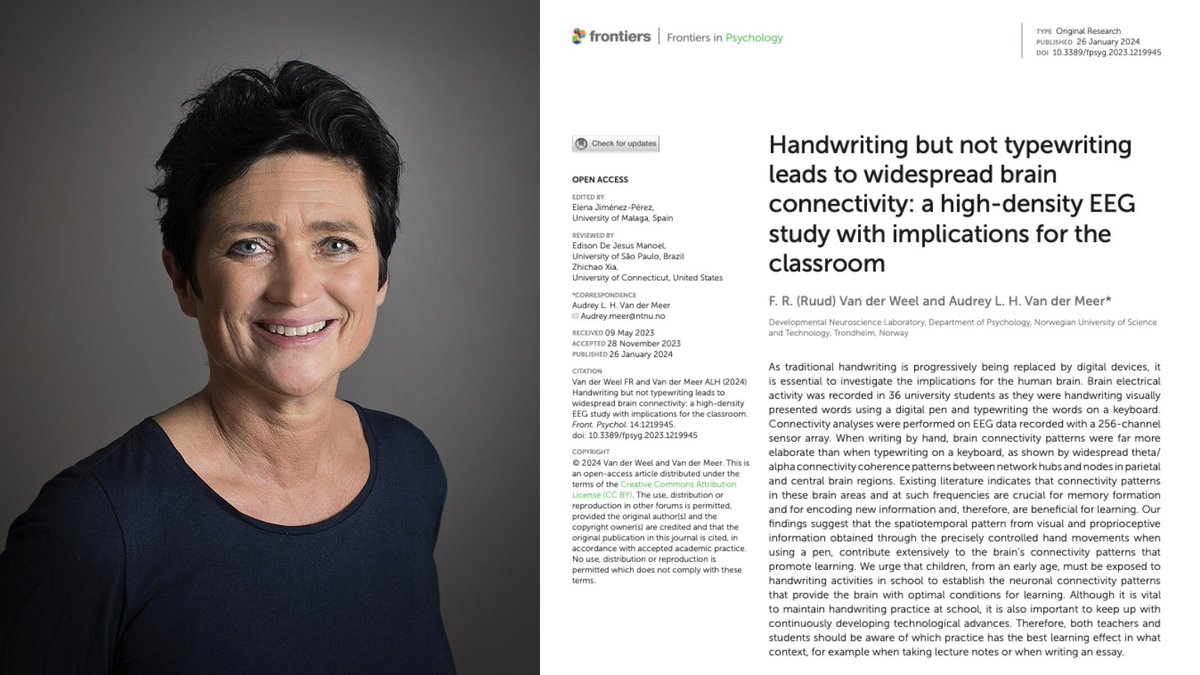
A Norwegian neuroscientist spent 20 years proving that the act of writing by hand changes the human brain in ways typing physically cannot, and almost nobody outside her field has read the paper.
Her name is Audrey van der Meer.
She runs a brain research lab in Trondheim, and the paper that closed the argument was published in 2024 in a journal called Frontiers in Psychology. The finding is brutal enough that it should have changed every classroom on Earth.
The experiment was simple. She recruited 36 university students and put each one in a cap with 256 sensors pressed against their scalp to record brain activity. Words flashed on a screen one at a time.
Sometimes the students wrote the word by hand on a touchscreen using a digital pen, and sometimes they typed the same word on a keyboard. Every neural response was recorded for the full five seconds the word stayed on screen.
Then her team looked at the part of the data most researchers had ignored for years, which is how different parts of the brain were communicating with each other during the task.
When the students wrote by hand, the brain lit up everywhere at once.
The regions responsible for memory, sensory integration, and the encoding of new information were all firing together in a coordinated pattern that spread across the entire cortex. The whole network was awake and connected.
When the same students typed the same word, that pattern collapsed almost completely.
Most of the brain went quiet, and the connections between regions that had been alive seconds earlier were nowhere to be found on the EEG.
Same word, same brain, same person, and two completely different neurological events.
The reason turned out to be something nobody had really paid attention to before her work. Writing by hand is not one motion but a sequence of thousands of tiny micro-movements coordinated with your eyes in real time, where each letter is a different shape that requires the brain to solve a slightly different spatial problem.
Your fingers, wrist, vision, and the parts of your brain that track position in space are all working together to produce one letter, then the next, then the next.
Typing throws all of that away. Every key on a keyboard requires the exact same finger motion regardless of which letter you are pressing, which means the brain has almost nothing to integrate and almost no problem to solve.
Van der Meer said it plainly in her interviews.
Pressing the same key with the same finger over and over does not stimulate the brain in any meaningful way, and she pointed out something that should scare every parent who handed their kid an iPad.
Children who learn to read and write on tablets often cannot tell letters like b and d apart, because they have never physically felt with their bodies what it takes to actually produce those letters on a page.
A decade before her, two researchers at Princeton ran the same fight using a completely different method and ended up at the same answer. Pam Mueller and Daniel Oppenheimer tested 327 students across three experiments, where half took notes on laptops with the internet disabled and half took notes by hand, before testing everyone on what they actually understood from the lectures they had watched.
The handwriting group won by a wide margin on every question that required real understanding rather than surface recall.
The reason was hiding in the transcripts of what the two groups had actually written down.
The laptop students typed almost word for word, capturing more total content but processing almost none of it as they went, while the handwriting students physically could not write fast enough to transcribe a lecture in real time, which forced them to listen carefully, decide what actually mattered, and put it in their own words on the page.
That single act of choosing what to keep was the learning itself, and the keyboard had quietly skipped the choosing and skipped the learning along with it.
Two studies. Two countries. Same answer.
Handwriting makes the brain work. Typing lets it coast.
Every note you have ever typed instead of written went into your brain through a thinner pipe. Every meeting, every book highlight, every idea you captured on your phone instead of on paper was processed at half depth.
You did not forget those things because your memory is bad. You forgot them because typing never woke the part of the brain that would have made them stick.
The fix is the thing your grandmother already knew.
Pick up a pen. Write the thing down. The slower road is the faster one.
@KateriSeraphina Dommage d'avoir compris à 60 ans qu'il faut vivre sans attendre de qui que ce soit. Tout ce qui vient est du bonus. Chaque un jour est un bonus de plus à vivre, alors vivez !
@Bjorn_D_Caverne@Anouar_____ "La bonne mère est naturellement incestueuse et pédophile" une phrase qui devrait la faire condamner. Il en fut rien, comment croire à cette société !
Bienvenue dans le monde de demain !
Sans réaction de notre part, ce scénario en 2032 deviendra notre réalité.
Et vous regretterez amèrement de n'avoir rien fait quand c'était encore possible. 😴💤
La fenêtre d'opportunité est en train de se refermer.
L'union est notre force ! 🤝