“I am honored to serve as director of Berkeley Lab, an institution that has long stood at the forefront of scientific discovery and innovation.” – Kathy Yelick
@UofCalifornia@ENERGY https://t.co/gkPBTSOsCy
"Speed makes people think differently."
Berkeley Lab scientist Gerbrand Ceder on how #AI-powered autonomous labs could change the way research gets done.
Learn more in the latest from @sciam ⬇️🦾
https://t.co/2cj9YXPWfq
“Speed makes people think differently,” says @BerkeleyLab's Gerd Ceder. “When people get rapid answers, they stay engaged with things, and they tend to ask different questions." @patrickcsisson#AI https://t.co/6AMyzUs2NW
“Our job is to show that you can double the pace of science by using #AI appropriately,” says LBNL director Michael Witherell, “We need fusion. We need better reprocessing of water. All these national challenges—and we need to go faster than China.” https://t.co/2cj9YXPWfq
After touring a National Laboratory with her Chatham professors, Gina Cowser ’25 set her sights on a research career. Months later, she was conducting infectious disease research at the Lawrence Berkeley National Laboratory in California.
Read her story: https://t.co/MOm4inXAiT
"This breakthrough will be truly revolutionary if it is able to solve unique structures of small proteins, particularly those inside frozen cells," says @berkeleylab's Peter Ercius. @amiposts@LindaFStewart https://t.co/UMom7V9CiG
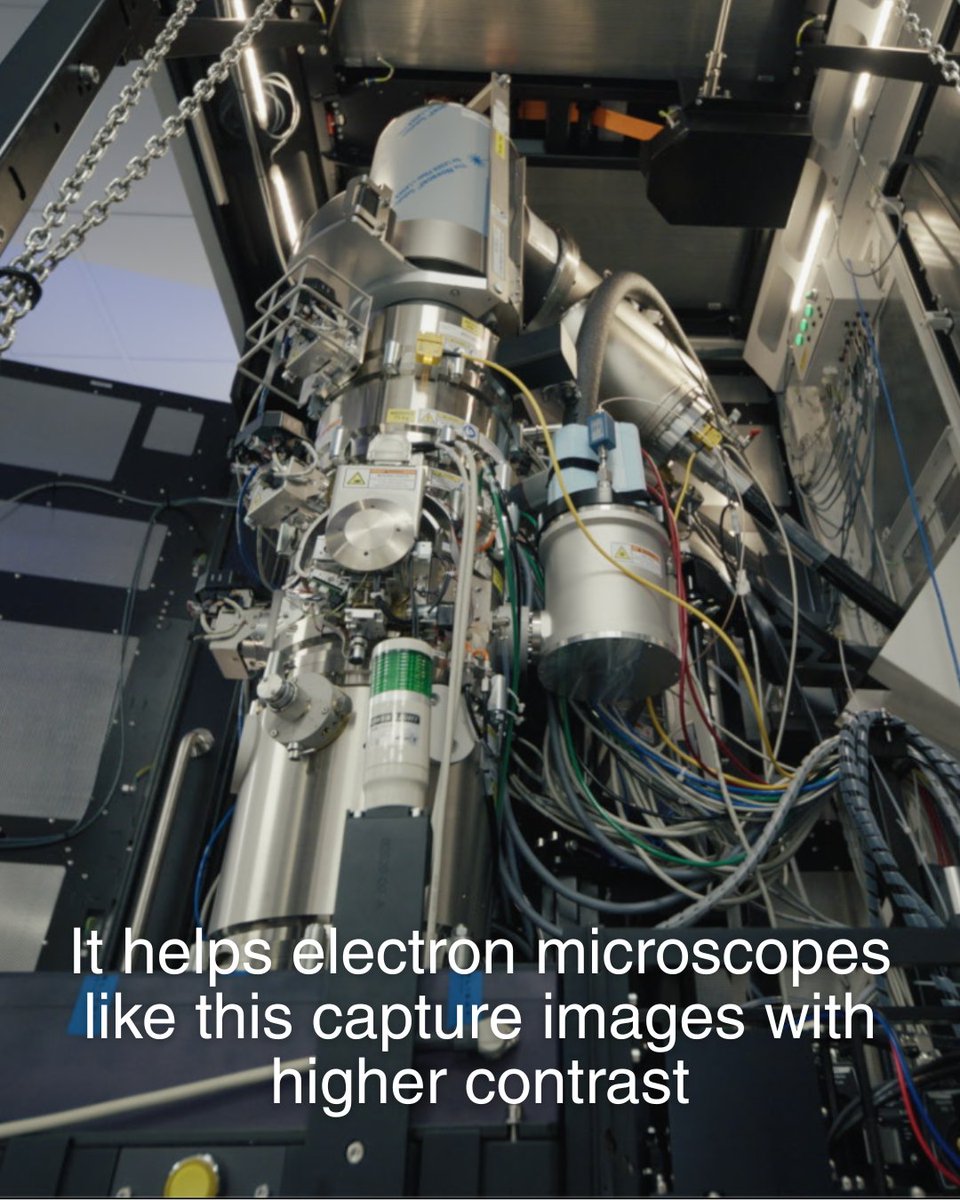
Scientists can now image smaller molecules that are critical to biomedical research with a new form of #cryoEM. The technology, developed by Berkeley Lab, @UCBerkeley, and @biohub, reveals molecular structures that were previously out of reach.
https://t.co/X9impw21ps
“Before, studying structures with cryo-EM was like trying to look at paintings in a dark gallery. With Theia, it’s like the lights have been turned on for the first time.” – Holger Müller, @UCBerkeley professor and LBNL Biosciences Area faculty scientist
https://t.co/rMzFbjMcDq
In a series of 3 papers and preprints, we’re thrilled to share with you the working laser phase plate. In collaboration with research led by Holger Müller at UC Berkeley, this is a huge innovation in imaging to make small and faint objects inside cells visible. https://t.co/trnQhI6OJr
AC Alert: Alameda County Red Flag Warning for Parts of Alameda County from Wednesday 06-10-2026 11pm until Thursday 06-11-2026 9am. Wildfires can start easily and spread rapidly. PREPARE a go bag in case of evacuations. AVOID outdoor activities that can cause sparks. STAY AWARE. NO EVACUATION is required at this time. Times and locations may change. For most updated info go to https://t.co/mFq3Mkk0bw
Please click here for all current Watches, Warnings or Advisories for Alameda County from the National Weather Service.
For more information or translation please visit https://t.co/pJBCHooSjF | Para más información o para obtener traducción, visite https://t.co/pJBCHooSjF.
"Proud to lead the Agentic #HPC Pipeline Initiative, which pairs @ENERGY simulation codes like AMReX with @RescaleInc's #AI agents to help make advanced modeling and simulation tools more accessible to U.S. manufacturers." – Peter Nugent, @LBNLcs
America's national labs have spent decades building some of the world's most powerful engineering simulation software. Today, we're making it accessible to U.S. industry at scale.
Rescale is proud to announce the Agentic HPC Pipeline Initiative (AHPI), a proposed collaboration with three premier U.S. national laboratories: @BerkeleyLab, @ORNL, and @Livermore_Lab.
For too long, these world-class DOE simulation codes have been out of reach for many manufacturers — requiring deep expertise to configure, run, and maintain on HPC infrastructure. AHPI is designed to close that gap. By pairing these codes with AI agents that automate complex workflows on the Rescale platform, American manufacturers can now explore design spaces, validate materials, and optimize manufacturing processes at unprecedented speed and scale.
U.S. codes built on decades of national investment. Deployed for American industry.
Read the press release: https://t.co/mTI89MYpEv
#DigitalEngineering #AgenticEngineering #EngineeringSimulation #AdvancedManufacturing #HPC #NationalLabs
Nanotech, AI, and robotics are coming together to combat #AntibioticResistance! A Berkeley Lab scientist explains the fascinating tech enabling a new era of treatments using viruses that only kill bacteria. https://t.co/fB9Wj0YDWk
@molecularfndry
“I knew that ALS was a world-class light source facility with significant scientific impact,” says Jared De Chant, a postdoctoral researcher at the @BerkeleyLab Advanced Light Source, reflecting on his reasons for joining the Lab.
@DOEScience@ENERGY
https://t.co/CidKU6lAmz
A Lab with a View
Excited to spend my summer at the @BerkeleyLab in California, extending our previous work on Zatom-1!
Check out the paper here: https://t.co/QH6T1HYHYh
On June 6, 1980, Cal Professors and researchers Luis Alvarez, Walter Alvarez, Frank Asaro & Helen Michel published a paper first positing the theory that the mass extinction of dinosaurs was caused by the impact of a large asteroid on Earth - now known as the Alvarez Hypothesis.
What do donuts and the cyclotron have in common? They're both round. One changed breakfast. The other changed #physics. 🍩
Nearly a century later, it's still fascinating to hear Berkeley Lab founder Ernest O. Lawrence explain his invention.
#InternationalDonutDay
Congratulations to Kathy Yelick on receiving the AI Honors Public Science Award from @WashingtonAINet. A pioneer in #HPC and #MachineLearning, Yelick will become Berkeley Lab's new Director on July 1—the first computer scientist to lead the Lab.
Presented by @ScienceUnderSec.
✅ 15,000 miles of fiber
✅ 85 Tbps of capacity
✅ 2.6 exabytes of scientific data moved each year
"When a network like @ESnet works well, it's invisible. And that's our superpower." — @InderMonga, ESnet Executive Director.
You merely adopted the dark 🦇
Our accelerator was born in the dark, more than 20ft underground. When we introduced upgrades like the RF Gun and Low Energy Beamline, (two components built by @BerkeleyLab) this is how they were lowered down into the Sector 0 Equipment Hatch.
"This work makes quantum simulation more efficient by placing multiple 'randomized cameras' on quantum dynamics, allowing researchers to capture more energy information from shorter quantum experiments." – Yizhi Shen, @LBNLcs postdoc
https://t.co/zW8zwR0uiw