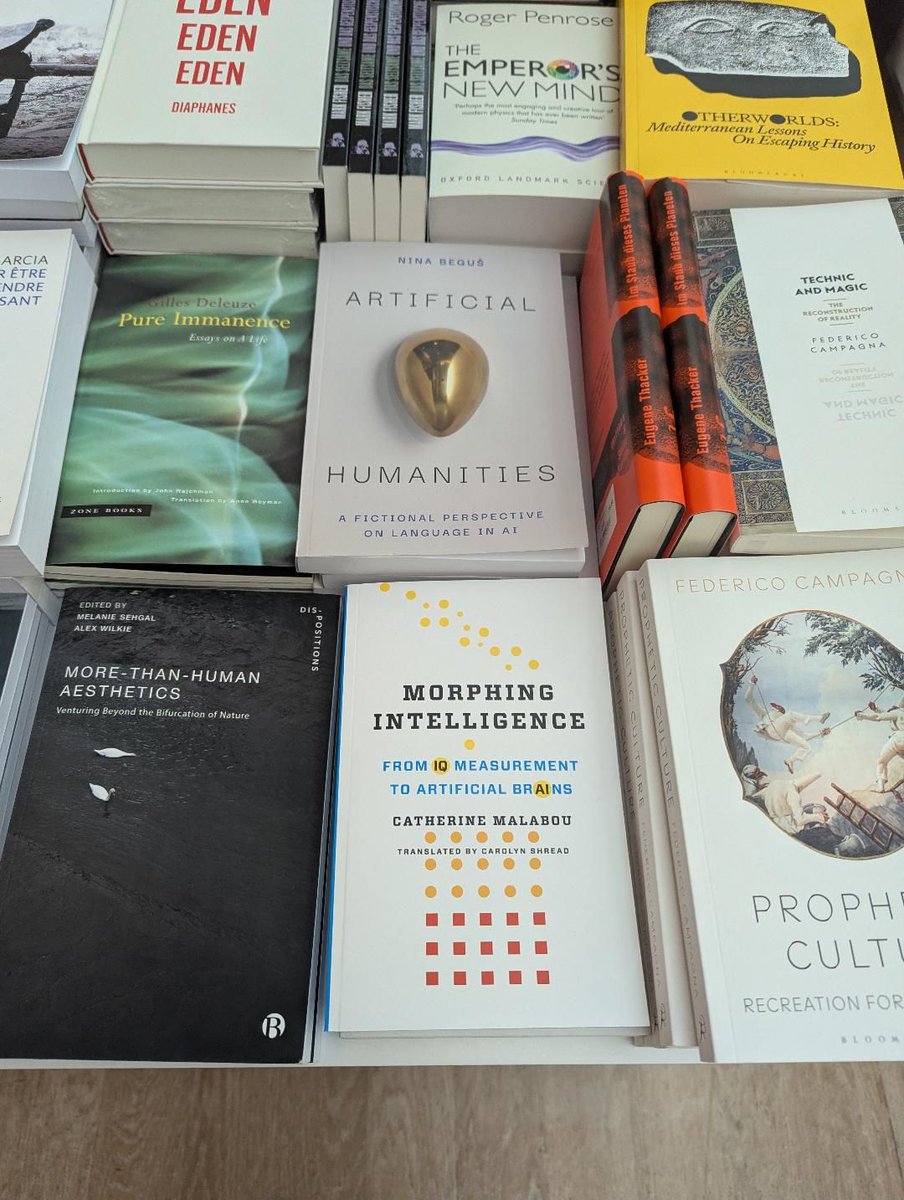
We had a whale of a year🐳
We continue to explore language and intelligence in humans, animals, and machines
-We uncovered vowels and diphthongs in sperm whales
-We discussed what this means for law and anima rights
-For the first time, LLMs can do recursion and metalinguistics
Is writing thinking?
Our new volume holds 16 essays by professional creative writers - @sashastiles, @RealIainSThomas, @jamesjyu, @jasminbf, Ted Chiang, Ken Liu, Annelyse Gelman, Qiufan Chen, Sheila Heti, and others - reflecting on writing in the time of AI.
All books are currently 50% off with the code SPRING 26, making it cost $10.
The preorder delivery date is now in late September @UofMPress
At the time when artificial intelligence surpasses us on many cognitive tasks, learning through companionship and dialogues between humans is more important than ever. While I have heard many of you say that AI can solve your problem set or teach you a subject well, no one has ever told me that AI inspired them to learn. Originality and human uniqueness challenged and refined through interpersonal relationships will be the most precious skill in the world to come. There’s no other way to learn those than in a dialogue with your peers, preferably at tea time, during Music Monday, Theatre Thursday, at a Hallass meeting, or at a Yosemite retreat.
We are at a crossroads when humanity will have to form a new kind of identity. We form our identities in relation to others.
In the age of papal encyclicals on AI, it's worth reading this book. Here are some reviews:
"Artificial Humanities establishes the method; the next chapters remain to be written by readers equipped with Beguš’s tools for uncovering mythological infrastructures embedded in systems too often taken as purely technical."
"Beguš inverts the usual causality: Fiction does not merely reflect AI imaginaries; it actively scripts them."
"The book stands out as a timely and foundational work, providing intellectual grounding for these questions. It positions “Artificial Humanities” as a potentially central discipline that will require ongoing negotiation and conceptualization by scholars in the literature, culture, and media, as well as by AI researchers and designers, in dialog with the rapidly expanding field of critical AI studies. Beguš compellingly shows why understanding AI today and shaping its future require precisely the kinds of knowledge the humanities have to offer."
In this moment, when humanity is realizing that its intelligence might not be the most exclusive and unique, it is worth forming our alliances with other biological beings. Perhaps it’s time to start learning not only from other humans, but from other species as well.
It is time to listen deeply to another intelligence that learns exactly as we do—through companionship and conversation.
My commencement address at Bowles Hall, UC Berkeley.
There are many things meaningful to us humans that whales never see. There are no trees and no ground in their world. But the opposite is also true. There are things in their lives that we cannot even imagine. As you go out in the world, search for those unimaginable things. Try to discover what is meaningful to your friends, your family, and the people around you that you can’t yet imagine and learn from that. Ask what a tree is for a whale. Ask what a tree is for your loved one. Ask what a tree is for your friend.
A strong book review in Configurations!
"Artificial Humanities establishes the method; the next chapters remain to be written by readers equipped with Beguš's tools for uncovering mythological infrastructures embedded in systems too often taken as purely technical."
"Artificial Humanities offers something rare: a mythology-first approach that treats cultural narratives as infrastructural determinants of technical design."
"Beguš models a form of humanities scholarship indispensable for technical domains."
Honored that the manuscript of Artificial Humanities is presented ar Pierre Huyghe’s exhibition at Fondation Beleyer.
Pierre read the book before it was published and his reaction ended up as a blurb on it’s back cover @UofMPress
Here's a commencement speech that didn't get booed at when AI was mentioned.
"In this moment, when humanity is realizing that its intelligence might not be the most exclusive and unique, it is worth forming our alliances with other biological beings. Perhaps it’s time to start learning not only from other humans, but from other species as well.
It is time to listen deeply to another intelligence that learns exactly as we do—through companionship and conversation. As many of you know, the biological intelligences I love most are whales whom I began listening to here in Bowles Hall. They live in a dramatically different world from ours, but they are remarkably similar in many ways. They form families and clans defined by how they speak—by their dialects. They come together when they surface from the ocean’s vastness and they engage in long conversations. Grandmothers are an especially important part of the family. They are very chatty and help transmit the rich cultural knowledge of each family. The many proud grandmothers in our audience today surely know what I am referring to.
Not long ago, we witnessed the birth of a sperm whale.
A newborn whale cannot survive on its own. It is born underwater and it must reach the air to take its first breath—and it cannot get there alone. As this baby whale was born in the water, ten other whales, from two different families, gathered around it. Together they lifted the newborn up until it broke the surface and breathed. And then something extraordinary happened. Out of nowhere, hundreds of dolphins joined in what appeared to be a celebration of new life in the ocean. I couldn’t think of a better picture of Bowles hall. We learn through many conversations, come together as a family, and when things become difficult we lift one another up.
There are many things meaningful to us humans that whales never see. There are no trees and no ground in their world. But the opposite is also true. There are things in their lives that we cannot even imagine. As you go out in the world, search for those unimaginable things. Try to discover what is meaningful to your friends, your family, and the people around you that you can't yet imagine and learn from that. Ask what a tree is for a whale. Ask what a tree is for your loved one. Ask what a tree is for your friend.
And here is the most striking thing I have learned from whales. They have no paths. No paved roads to walk on, no fences that keep them on the right track. Just a vast ocean, countless possible ways to get from one place to another. This is your life now, dear graduates. From this beautiful place onward, you have endless ways to swim through life—not roads someone else laid down for you, but paths you will choose yourselves. I know that you will choose the boldest, most exciting ones. And I hope that all along the way you find companions: people to listen to, to argue with, to learn from—people who will lift you up, and people you will lift up in return."