BERM is live on Solana mainnet.
Cover executor: AMenBCW8sgtx2VriEYzdJkTCsUBF6FGQy8PhcNh9p7pH
Pool vault: H4ifx5HYeHHvEuyJMdF1EpRSeNZJqRf3Vkhi4LT8N12T
Claim resolver: GnS9Sii7PpELXQLyKwZRgrEpqma3GQwcSxtqNdCMmkk3
Deploy tx: vnK6VfveTJwZgc6MytWoUNsNdoatmwDGVAkAWpegTgGZt9NDAvqFxHBjPyAyJ5iUHn7o4d92iRd2LiGPUg43yC6
Five cover types, Pyth + Switchboard dual oracles, Token-2022 cover pool, automatic settlement — live on mainnet. The IDL is published; the SDK already targets it. Read the code, reproduce a backtest, then size.
https://t.co/tyLukobTGK
https://t.co/S1onnkQvXG
The wall moves to mainnet.
BERM has stood on devnet — cover engine, Anchor 0.31 executor, Token-2022 vault, dual-oracle adapter, byte-identical backtests. The next slot is the mainnet deploy. The program ID and deploy transaction will be posted here the moment it lands.
No surprise cutover. The coast is told first.
A fix went out on the Cover Designer.
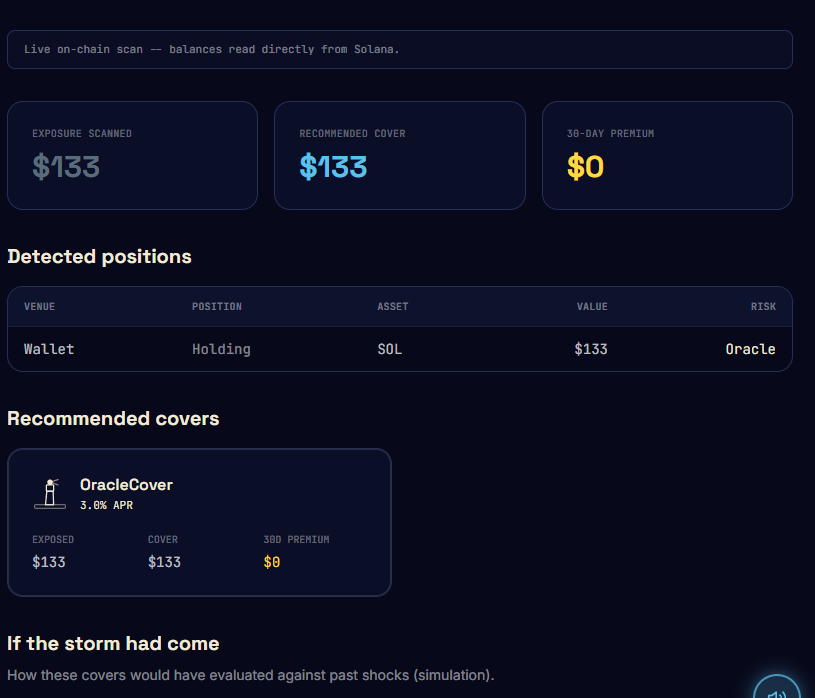
Until now the wallet scan wasn't reading your live on-chain balances correctly -- it fell back to placeholder estimates. That is fixed. It now reads the wallet's real balances directly from Solana -- stablecoins, LSTs, SOL -- and maps each holding to the cover that fits, with a premium quote.
Read-only, no signature, no coin required. Point it at your wallet and check.
https://t.co/gUUPdRUaUW
Every threshold and window is a governance parameter, not a hard-coded constant — tunable per pool as data accumulates. No trigger fires on a single slot; persistence defeats flash manipulation.
https://t.co/P3qyDbrx7T
https://t.co/hNnZV981fi
How the five cover types work.
A cover position is five quantities: cover amount C, premium P, cover ratio r, persistence window W, threshold T. Every settlement is one bounded function:
payout = min(C, r * severity * notional)
What differs is how severity is measured.
The Cover Designer is open. https://t.co/gUUPdRUaUW
Drop in a wallet. BERM scans your positions — Marginfi loans, Orca LP, stablecoin balances — and surfaces depeg, liquidation, exploit, slashing, and oracle risk. It quotes a premium per cover type and backtests each against Mango 2022, USDC 2023, mSOL 2023.
All client-side. The wallet stays in your wallet. No coin required.
https://t.co/mAVFxHbygp
New here? What BERM is, in plain terms.
You hold things on Solana — a stablecoin, an LST, a loan on Marginfi, an LP position. Any of them can break. A stablecoin depegs. A lending market gets exploited. Your collateral gets liquidated. An oracle prints a bad price. Normally you just eat the loss.
BERM is a cover protocol — a seawall for those risks. You buy cover on a specific one. If the bad thing happens, it is measured on-chain by Pyth and Switchboard, not argued over by a committee, and the payout is automatic. No claim form, no vote, no waiting.
Five risks are covered: exploit, depeg, slashing, liquidation, oracle divergence. You can build and backtest any of them in the Cover Designer right now, free, against Mango 2022, USDC 2023, and mSOL 2023.
$BERM is the token it runs on. It is not a yield promise. It is the unit for governance, underwriter staking, and a share of premium. The code is open — read it before you size.
https://t.co/v4XcPB3lzu
https://t.co/UdrAbVzvcs
Point a wallet at the coast and the lighthouse tells you which waves are coming for it.
A Cover Designer. Wallet scan, risk surfaced, premium quoted, backtested against three real incidents-all in the browser, the wallet staying in your wallet.
Not open yet. The structure is up.
So BERM settles by default automatically — clearly parametric events pay from oracle data, and governance is reserved for the ambiguous tail.
Built and deployed to Solana devnet. Mainnet pending review.
https://t.co/P3qyDbrx7T
https://t.co/wO7HqWpIaz
Why parametric cover on Solana.
Solana DeFi scaled faster than its risk infrastructure. Five categories of loss have no on-chain instrument to transfer them: smart-contract exploit, stablecoin depeg, validator slashing, lending liquidation, oracle divergence. EVM has Nexus Mutual and Sherlock. Solana had nothing. BERM is that layer.
The EVM model leans on claim assessment: file, then token-holders vote on whether to pay. Slow, contested, worst when you are most stressed. Parametric settlement removes the step — it pays on an observable measure, not a negotiated claim (Lin & Kwon, 2020, Risk Mgmt. Rev., DOI 10.1111/rmir.12146).
On Solana the measure is already on-chain.
New here? What BERM is, in plain terms.
You hold things on Solana — a stablecoin, an LST, a loan on Marginfi, an LP position. Any of them can break. A stablecoin depegs. A lending market gets exploited. Your collateral gets liquidated. An oracle prints a bad price. Normally you just eat the loss.
BERM is a cover protocol — a seawall for those risks. You buy cover on a specific one. If the bad thing happens, it is measured on-chain by Pyth and Switchboard, not argued over by a committee, and the payout is automatic. No claim form, no vote, no waiting.
Five risks are covered: exploit, depeg, slashing, liquidation, oracle divergence. You can build and backtest any of them in the Cover Designer right now, free, against Mango 2022, USDC 2023, and mSOL 2023.
$BERM is the token it runs on. It is not a yield promise. It is the unit for governance, underwriter staking, and a share of premium. The code is open — read it before you size.
https://t.co/v4XcPB3lzu
https://t.co/UdrAbVzvcs