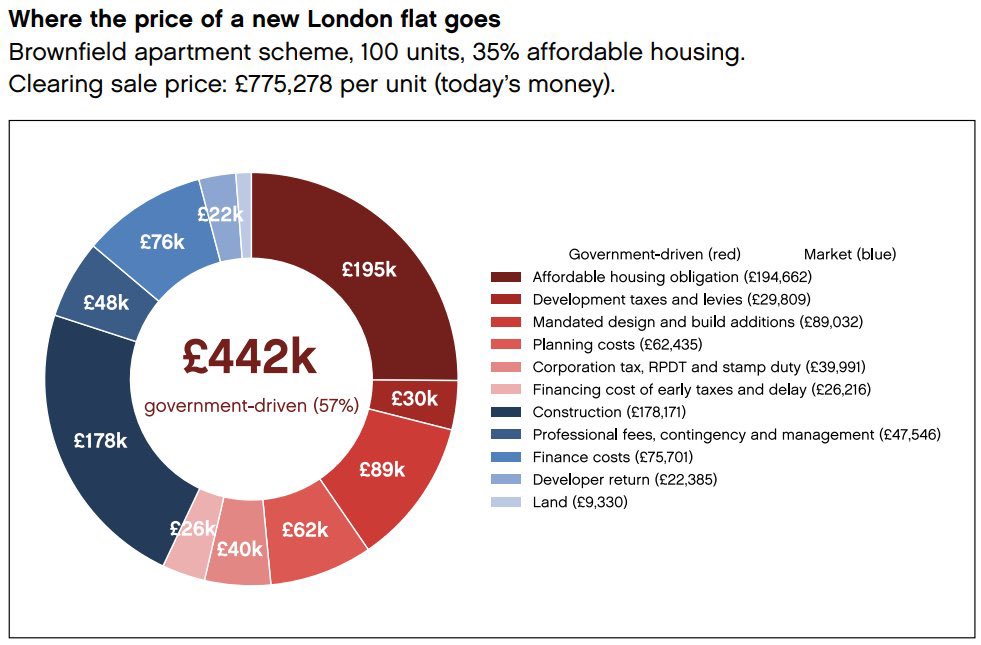
It’s impossible to properly model things like the cost of delay and uncertainty from planning, the cost of extra building requirements disrupting the project, and things like the wrights law like gains that would have come from a higher volume housing construction market. The number is probably very high though
The answer to ��why is my £775k new build flat so small and crappy?” Is simple: the money left to actually build it after the government has took their £442k share is only £178k - less than some spend on their kitchen extension
Government imposed policy costs make up 57% of the clearing price of a new flat in London and 42% of a new home in the Home Counties.
Despite a big housing shortage and positive planning reforms, new home starts in England are declining from 182,000 in 2022 to under 125,000 last year.
While the macroeconomic context has worsened with build cost inflation and high interest rates, the Government is imposing more burdens on new homes, not fewer.
Taxes, levies, planning, and mandates add over £440,000 to the cost of delivering a home in London and nearly £225,000 nearby, with several of these imposed recently like the Second Staircase, Future Homes Standard, Building Safety Levy, Biodiversity Net Gain and Residential Property Developer Tax.
Individually these may be justified, but together they are making new homes unviable.
As a result, large developers are buying less land and small builders are going out of business; nearly 4,000 construction firms went bust just last year.
If we want to build more homes, we should be easing the burdens on them, not adding more.
Making housebuilding viable again is the most important issue in housing policy and my co-author, Edward Donovan, has completed excellent modelling showing how big the challenge is.
Read the full report: https://t.co/NWS58oqbTx
And simulate what changing the policies does with Edward's modelling here: https://t.co/IVrLBax2pz
I will have to write a longer answer at some point, but essentially the expansion of productive capacity takes time, especially when you don't have shortcuts like large rural labour pools that can migrate to cities.
Developed nations growing fast do 2.5% to 4% (which would be great for britain btw). At that very fast rate we'd be Germany level within a decade, which is good but not a picture of massive wealth
@0x44_@UnderSneege Modern controllers having issues with the 64 is orthogonal to the quality of the 64 controllers. When given the choice, absolutely nobody chooses the ergonomics nor the strange ball mouse hardware of the 64 controller. People go for modern xbox or PS controllers that are better
Disturbing micro-signal for general competence that a game originally made for a 90s audience who were new to 3D graphics and limited by an awful controller has been dumbed down in its modern remake.
Long tail of the Flynn effect reversal?
@labourball Despite freezes, fuel duty is ~38% of the final pump price for petrol - more than double the VAT component of prices (17%). Rail and most forms of transit are also 0% rated for VAT, meaning yes they are effectively far less taxed than cars and roads.
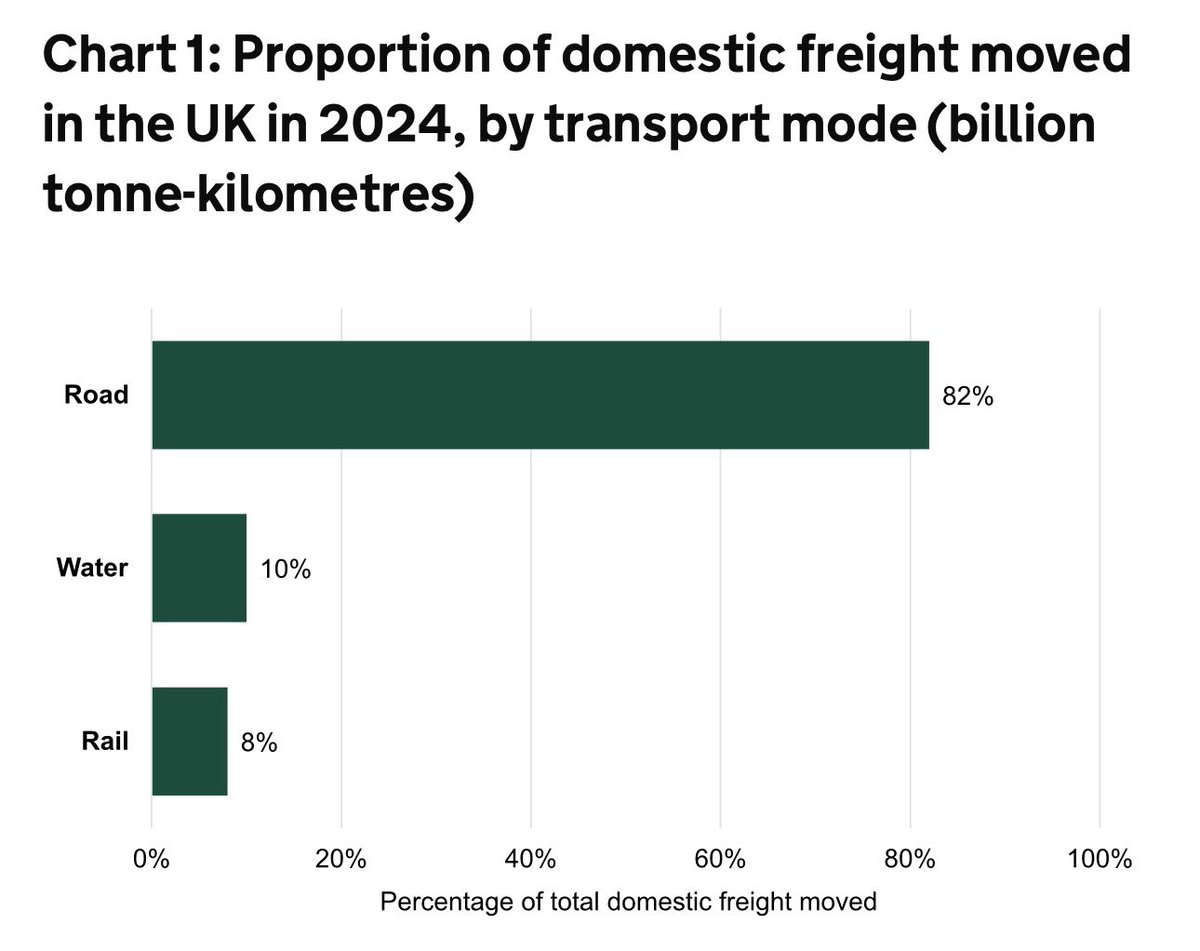
It’s incredible just how much more important cars, vans, and trucks are for Britain’s logistics than everything else, despite rail devouring the lion’s share of government transport funding.
Every discussion of cars and driving on here assumes that driving is some weird behaviour that needs to be fixed when it is just the best way for the vast majority of people to get around and always will be.
From The Power Broker:
One Sunday in the summer of 1914, Frances Perkins happened to be standing beside Moses on the deck of a ferry taking a group of young reformers to a picnic in New Jersey, and as the ferry pulled out into the river and they leaned on the rail, watching Manhattan spread out behind the boat, Miss Perkins heard Moses suddenly exclaim, “Isn’t this a temptation to you? Couldn’t this waterfront be the most beautiful thing in the world?” As she looked at him in astonishment, Moses painted for her a picture of what the scene could be like on a Sunday: the ugly tracks completely hidden by “a great highway that went uptown along the water;” cars travelling slowly along the highway, their occupants enjoying the view; beside the highway, green parks filled with strollers, tennis players, and bicyclists; sailboats skimming on the river, and motor yachts tied up in gracefully curving basins. The thing that astonished her most, Miss Perkins recalled later, was that Moses “had it all figured out”—every curve the highway would have to take, every building that would have to be torn down to make way for it, the exact location of every tennis court and boat basin.
Henry and I were running along the Thames in South London when he pointed out to me that one small thing could unlock thousands of new homes for Londoners: a tunnel. Now he’s got a plan…
For similar reasons of legibility, I also prefer third world construction corruption - literal embezzlement - over the stakeholder feeding frenzy that leads to the £16B parliament refit
You’re at least able to see where the money is going (Range Rovers) in Equatorial Guinea
I find an extractive elite composed of 100,000 imperial clan pensioners sucking the system dry far more disturbing than a tiny aristocracy living in grand houses that can, at least, be usurped and replaced in a short revolution.