We are in the final stage of capitalism where global capital can’t expand or sustain past profits. It now consumes public institutions and key systems, sacrificing democracy, welfare, infrastructure, education, healthcare, and ecosystems for short-term gain.
Now many people are asking: how did Trump become President of the United States?
A surprisingly complete answer to that question was given 500 years ago by Niccolò Machiavelli. In his view, power is first and foremost a performance. Victory does not always belong to the person who knows the most, but to the one who appears the most confident. People are often persuaded less by truth than by the way it is presented.
Modern psychology supports this observation. Intelligent people tend to see complexity, weigh consequences, acknowledge uncertainty, and avoid simplistic answers. But in times of crisis, most people seek confidence rather than nuance, certainty rather than analysis.
This is why loud and self-assured politicians often outperform more competent rivals. It is closely related to the Dunning–Kruger effect, where less competent individuals overestimate their abilities while genuine experts are often more aware of their limitations.
When one person says, “I know exactly how to solve this,” and another explains that the issue is complicated and requires careful analysis, many people will choose the first. Confidence is often mistaken for strength, even when it is unsupported by knowledge.
Politics provides countless examples. Charismatic and decisive figures inspire trust, even when they lack competence. Meanwhile, thoughtful people who speak cautiously and acknowledge uncertainty are frequently overlooked. As William Shakespeare famously wrote: “The fool doth think he is wise, but the wise man knows himself to be a fool.”
The real problems begin when such people gain power. Machiavelli argued that the best way to judge a ruler is by the people they surround themselves with. Weak leaders fear strong, independent minds. Instead of promoting competence, they reward loyalty. Instead of welcoming criticism, they prefer agreement.
Over time, mediocrity begins to reproduce itself. Competence is pushed aside, criticism becomes unwelcome, and institutions gradually weaken.
History has repeated this pattern many times. Such systems often struggle in times of crisis because they lack expertise, flexibility, and the ability to acknowledge mistakes.
The deeper paradox is that societies repeatedly choose these leaders. The reason lies not only in the politicians themselves but in human psychology: while an intelligent person is still weighing risks and uncertainties, a confident one is already moving forward. People often mistake confidence for competence—and that is the trap.
@GrassieMarcel@RadioRaps You think that text is about money?! Please read the very next part and ask yourself what is says regarding a guy that proudly slashed funding for the poor.
@RadioRaps@Brendennel Glad you think it’s better. Do you really think these guys want to make the world a better place? Replacing everyone with AI? Hoarding wealth? Breaking a liveable planet? Maybe creating the next investment bubble?
@Brendennel Sad to see people defending this. No one should be that rich. This kind of inequality is a ticking timebom. But, please guys, keep believing the propaganda that billionaires are good for the rest of us.
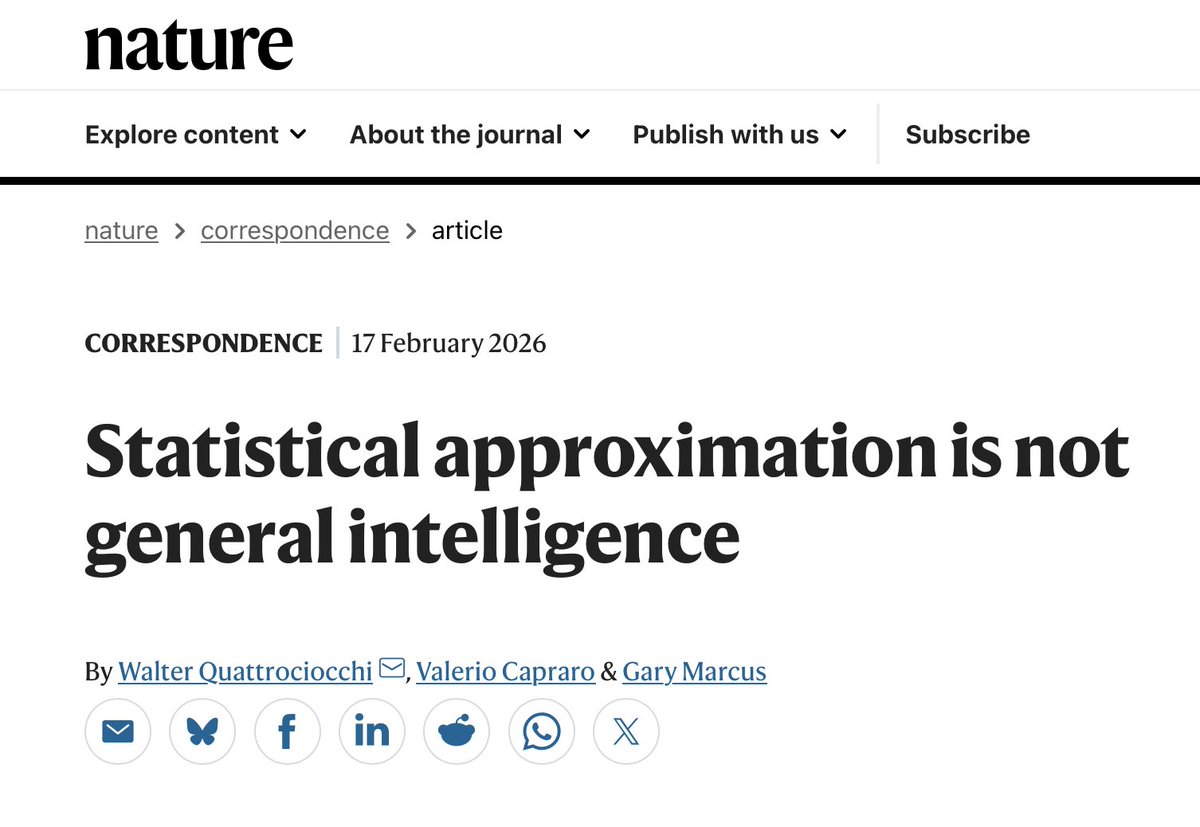
The Pope is making exactly our point. LLMs “may imitate or even simulate, but they do not understand.”
This is the core epistemic fault line.
Most AI evaluation is still based on one assumption: if a system statistically approximates human behaviour, then it is close to human intelligence.
But approximation is not intelligence.
Simulation is not understanding.
LLMs can produce the right answer without knowing why it is right. They can simulate empathy without feeling. They can imitate judgment without responsibility. They can generate coherent explanations without having a world to which those explanations are accountable.
Stop confusing behavioural similarity with cognitive equivalence.
Human understanding is embodied, affective, relational, motivational, and normative. It is not just the production of plausible text.
*
Full paper in the first reply
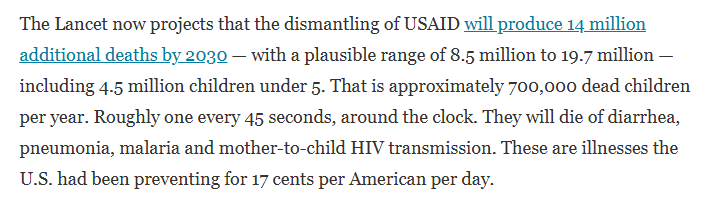
Can't stop thinking about Elon Musk, the wealthiest man alive worth $828 billion, spending $290 million to elect Trump, becoming $563 billion richer since Trump was elected and ending humanitarian aid that will lead to the deaths of 4.5 million of the poorest kids on the planet.
@CaptSpringbok I had my doubts about his physicality in tight games, but he has been excellent and more mature this season. Deserves to rise in the pecking order.