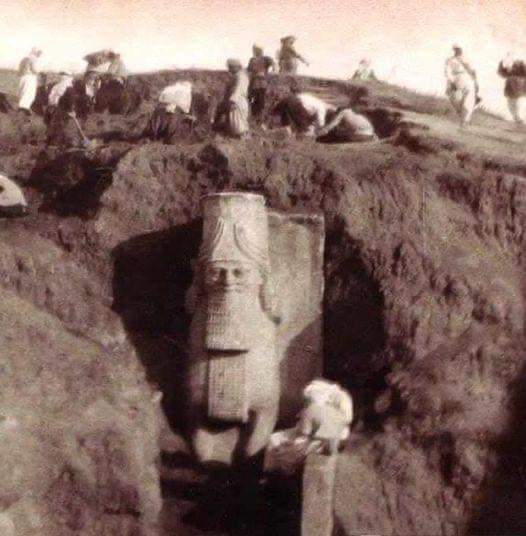
Until about 30 years ago, it was thought that 'civilisation' made its appearance with Sumerians, about 7000 years ago. But few years ago, on border between Syria and Turkey, Göbekli Tepe and neighbouring settlements were discovered. Everything has changed since then.
Oldest remains of Göbekli Tepe date back at least 12,000 years. Some monoliths found in ruins depict human beings dressed only in loincloths. But 12,000 years ago, humanity was in middle of Younger Dryas (small ice age). So, it is impossible for people of that time to have been walking around in just a loincloth. To be able to walk around dressed like that, temperature had to be mild. But last "mild" period before Younger Dryas ended around 110,000 BC, when Last Ice Age began. So at least some parts of Göbekli Tepe may date back to that ancient period.
At Göbekli Tepe ideograms were engraved, i.e., engravings that do not represent animals or things, but abstract concepts. These could be first example of human writing, at least 5,000 years earlier than that of Sumerians. Buildings at Göbekli Tepe are not made of wood, or straw, but are composed of limestone. Some pillars weigh as much as 20 tonnes. Inhabitants of Göbekli Tepe were able to build houses and villages out of stone thousands of years before Sumerians.
On a stone slab called 'Stele of the Cranes', people of Göbekli Tepe tell of an encounter between themselves and 'beings from outside', from sky, at same time that a comet streaked across the sky. Moreover, engraved tale alludes to a period of time when a comet bombardment wrought immense destruction across Earth.
- Subscribe for Detailed Post -
#archaeohistories
In 2003, a significant discovery was made in the Sakya Monastery in Tibet. An ancient library containing a vast collection of 84,000 secret manuscripts was uncovered. These manuscripts, which are over 1,000 years old, are stored on traditional stacks measuring 60 meters in length and 10 meters in height. This extraordinary find offers a unique window into the history and culture of the region.
The Sakya Monastery, founded in 1073 by Konchok Gyelpo, is one of the most important centers of Tibetan Buddhism. The discovery of this ancient library within its walls has provided a wealth of information and insight into the development of this religious tradition and the history of the region.
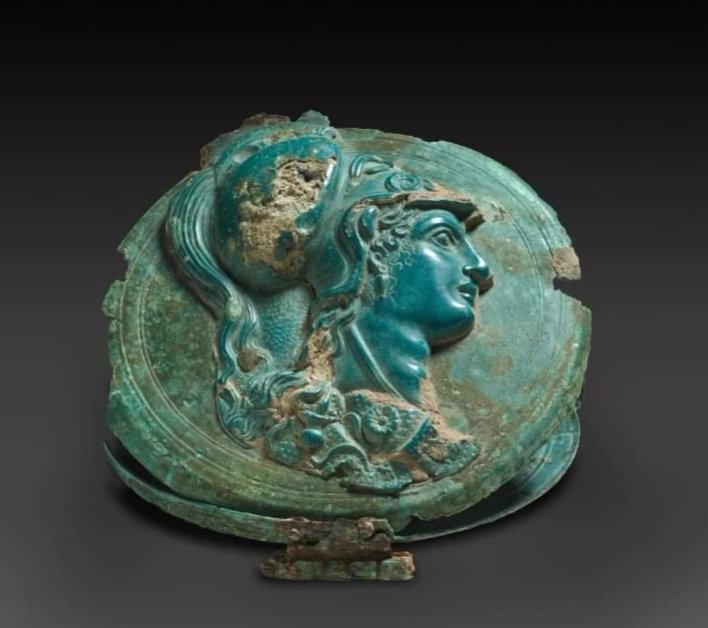
Greek Bronze Box Mirror with Head of Athena (330–270 BC) :
The ancient Greek box mirror resembles a modern, hinged makeup compact in design. While the actual mirror is the top of the bottom half of the box, a highly polished cast-bronze disk the cover often bears relief decoration. This example features a helmeted head of Athena, a virgin war goddess not typically associated with implements of beauty. Several other aspects suggest that this Athena may have been repurposed from another object in antiquity: the striking difference in patina between relief and case; the irregular (noncircular) shape; and the method of attachment, with rivets through the relief rather than solder.
(4 7/16 in.)
Cleveland Museum of Art
#archaeohistories
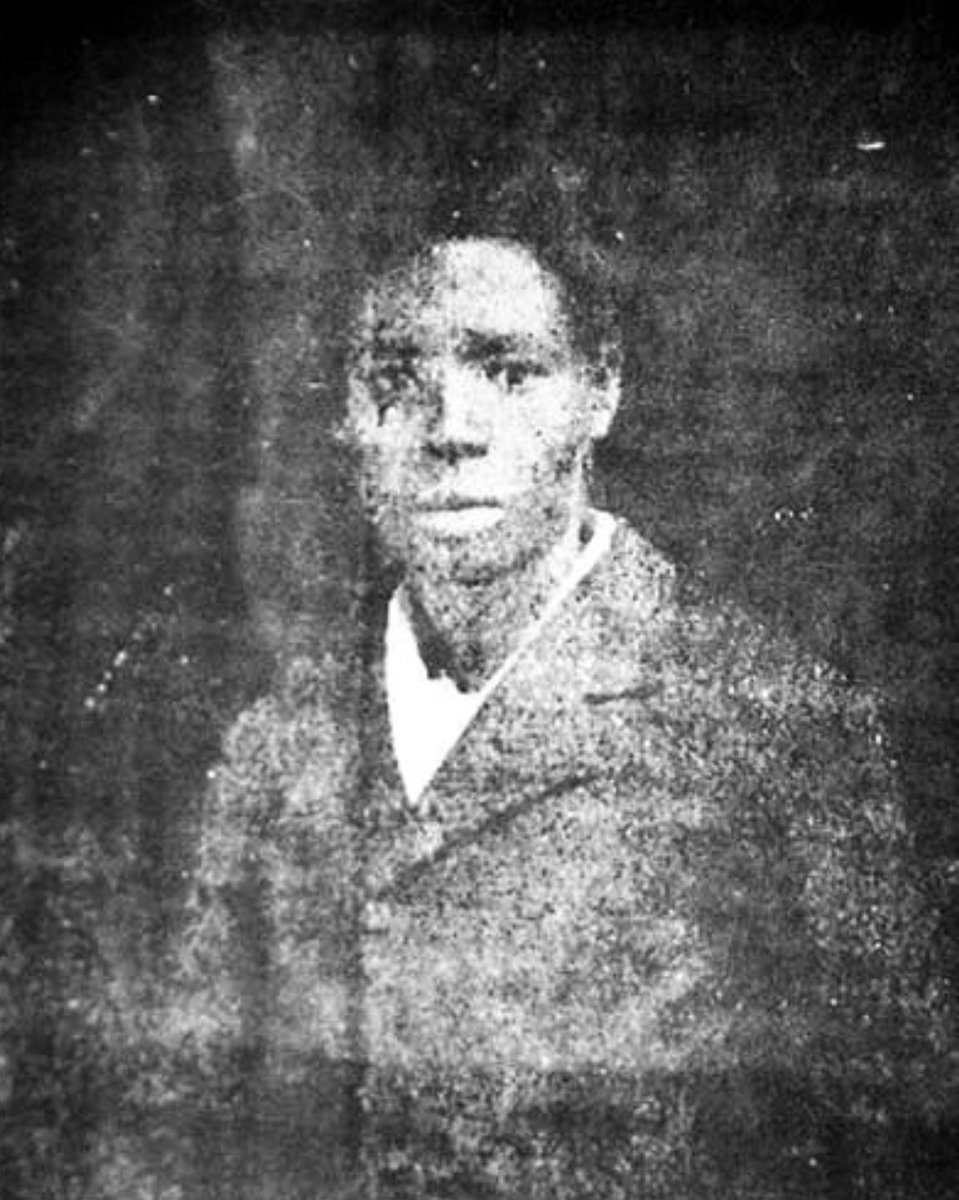
This is Edmond Albius. In 1841, he was an enslaved 12-year old who had no formal education and could not read or write. And yet, Albius was able to discover a technique for pollinating vanilla orchids in a quick and profitable way. Albius had solved a mystery that had stumped the best botanists of his time. Without his technique, vanilla would not be as popular as it is today.
In the 1820s, French colonists brought over vanilla beans to Réunion Island (Albius was born there in 1829) and Mauritius from Mexico. They soon realized that no insect would pollinate the vanilla orchid. In Mexico, this was done by their wild bees. In the 1830s, a Belgian botanist by the name of Charles Morten developed a technique of pollinating the vanilla by hand. While the method worked, it was very time-consuming and required a large labor force.
12-year-old Albius used a blade of grass or a thin stick to lift the flap and fold down the male part so that the pollen came in contact with the female part. Once that was done, he would use his thumb to press down lightly, effectively pollinating the vanilla orchid. While his technique seemed very simple, it single-handedly changed the industry, and Réunion, at one point, became the world's largest supplier of vanilla.
Today, Madagascar is the largest supplier of vanilla and still utilizes Albius' technique.
AVAILABLE TODAY! Columbia Records and Legacy Recordings present EVERGREENS: Celebrating Six Decades on Columbia Records and YENTL: 40th Anniversary Deluxe Edition.
https://t.co/CeefLtRkmU
https://t.co/MgEHOZmJfH
La científica mexicana Ivonne Ventura @IvonneEVentura1 participará en “The European Researchers Night 2023”, con la presentación interactiva “Die Komplexität der Materialien von morgen bändigen”. 29.09.2023
“Universität für angewandte Kunst”, Vordere Zollamtsstr. 7, 1030, Viena
@emmanueltrinida Indeed! A wonderful experience, also the most beautiful murals decorating the interior and the exhibitions on display. However the ice on the cake is the theater curtain and the ballets, concerts etc etc etc..a must visit! Viva México!
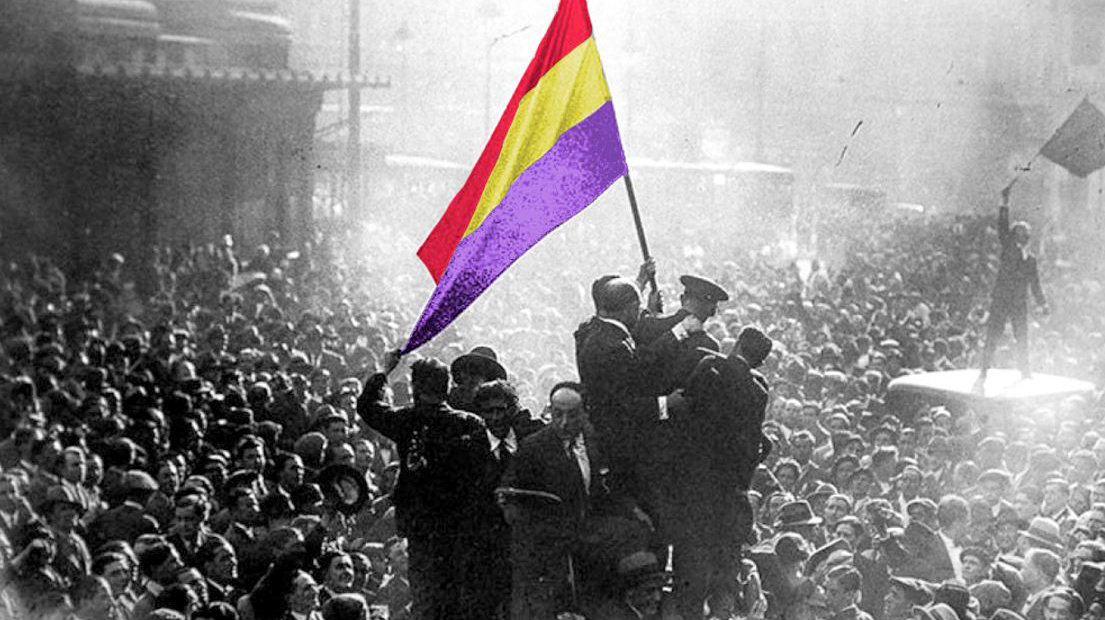
MARIANO CUADRADO, ÚLTIMO ALCADE REPUBLICANO DE TORRELODONES
Mariano Cuadrado, alcalde republicano de Torrelodones fusilado por la dictadura franquista, encarna todo lo que odia la derecha. Maestro, socialista, humanista, ilustrado, acogió en su municipio a 5.000 refugiados que huían de la guerra. Por eso el PP, ya indistinguible de VOX, quita su nombre de la plaza que le había dedicado el pueblo de Torrelodones.
Mariano Cuadrado comenzó a trabajar como ferroviario a los 16 años, lo cual no le impidió estudiar Magisterio y crear la primera escuela laica socialista, la primera biblioteca pública de Torrelodones y colonias escolares en El Escorial y Torrelodones. Su objetivo era acabar con las escuelas insalubres y antipedagógicas.
Mariano Cuadrado no había cometido ningún crimen. Por eso se quedó en Torrelodones cuando fue ocupado por las tropas golpistas. Sin embargo, fue detenido y torturado brutalmente en la cárcel de los Carmelitas de El Escorial. Sometido a un juicio farsa, el 15 de septiembre de 1939 fue fusilado en las tapias del cementerio del Este en compañía de otros once alcaldes y concejales de la sierra. Su cadáver nunca fue devuelto a su familia. Aún hoy permanece en un lugar desconocido.
Vox no es el problema. El problema es el PP, un partido fundado por ministros franquistas y que nunca ha condenado la dictadura. Sin embargo, sostiene que sí lo ha hecho, pero en realidad se limitó a adherirse a una proposición no de ley aprobada en el Congreso en 2002 que ni siquiera mencionaba al dictador. La mayoría de los políticos y votantes del PP piensan que el franquismo fue un "período de extraordinaria placidez", como declaró el exministro Mayor Oreja.
Dado que la derecha seguirá su ofensiva contra la memoria democrática, debemos hacer un hueco a las víctimas de la dictadura en la memoria colectiva. No permitamos que hombres buenos como Mariano Cuadrado mueran por segunda vez. Y que la infamia caiga sobre las cabezas de los herederos ideológicos del franquismo.
Rafael Narbona