mathematics Thief & Chef
"through the window of differential equations, mathematics sees the light in the real world" / "通过微分方程的窗子,数学家看到现实世界的光" (Jiang Zehan)
“This Is Not How Mathematicians Are Trained”
数学家不是这样训练的
1, "Solving the forward problem (positive time) and the inverse problem (negative time) together has always been a desire of mathematicians, but they’ve never known where to begin. Neural networks, however, tackle this problem naturally" (将正时间的正问题与负时间的反问题同时求解,一直是数学家的梦想,但他们始终不知道从何入手。而神经网络却能自然地处理这个问题)
2. “Variables, coefficients, even coordinates, are changing. Everything is in flux. This is not how mathematicians are trained. It would be impossible for mathematicians to come up with such a design” (变量、系数,甚至坐标都在变化,一切都处于变动之中。数学家不是这样的训练。这样的设计,不可能出自数学家之手)
3. “Mathematicians tread carefully around composite functions with more than two layers, wary of the many pitfalls, yet neural networks solve them effortlessly, almost nonchalantly.” (数学家在处理超过两层的复合函数时格外谨慎,警惕其中诸多陷阱, 而神经网络却几乎漫不经心地轻松应对)
4. “Neural networks have stacked covers, mathematically speaking, whereas the Numerical Manifold Method typically uses only 3 to 4. In contrast, neural networks stack hundreds or even thousands of such covers. I never imagined anyone would take it that far”. (神经网络在数学上拥有堆叠的覆盖层,而数值流形通常只有三到四层覆盖。相比之下,神经网络则堆叠了上百乃至上千层。我从未想过有人会将其推进到这种程度).
That was what Gen-Hua Shi (石根华) told me after returning from a two-week vacation in early June 2024..
see rest of the story, click the link
https://t.co/l0RCuCLaOY
pretrain-postrain is different boundary condition. training is 4 dimension problem...
see ** Mathematical Considerations for Training Progression **
https://t.co/VfZ1p6larv
training and agent should codesign, I talk a bit in ** Agent Manifold Waypoints**
https://t.co/XB698fkZHw
Nice work!
Interesting comparison of PPO vs. GRPO. However, I'm not sure the findings generalize to large MoE models, where intrinsic learning pathways may be longer, more diverse, and shaped by dynamic expert routing.
Model scale and manifold dynamics could fundamentally change the PPO–GRPO tradeoff.
#DeepManifoldInterpretation
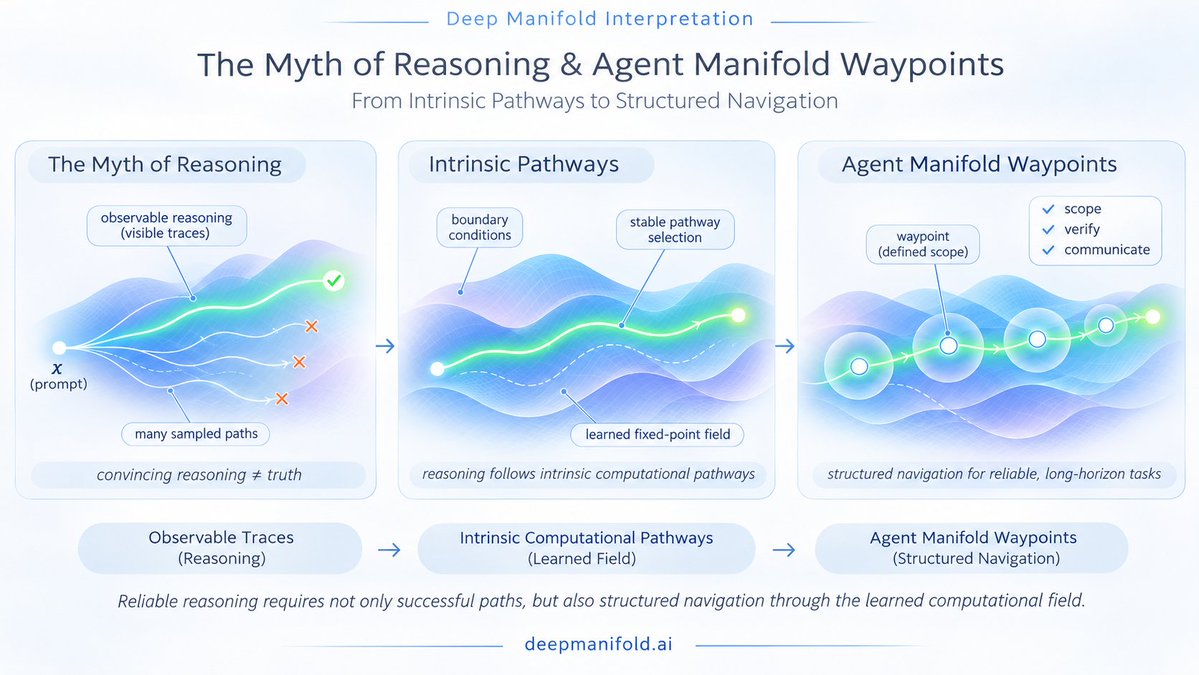
Alex Wang's What Objective Is Reasoning Solving? offers an important perspective: reasoning is pathfinding, and reinforcement learning (RL) increases the probability of finding successful paths. But longer reasoning does not necessarily mean better reasoning, and a successful path does not guarantee truth.
This closely aligns with our earlier article, "The Myth of Reasoning" (https://t.co/eubPr9vslT). From the Deep Manifold perspective, observable reasoning chains are only the surface. The underlying computation follows intrinsic pathways through a learned neural fixed-point field. RL helps select and stabilize these pathways, but convincing reasoning is not necessarily truth.
This also motivates Agent Manifold Waypoints (AMW, https://t.co/XB698fkZHw). If the learned computational field is largely fixed during inference, why must agents repeatedly rediscover pathways through trial and error? AMW proposes discretizing the computational space into connected waypoints, each with defined scope, local exploration, verification, and communication. From stochastic pathfinding to structured navigation—that may be a path toward more reliable long-horizon agent reasoning.
what objective is reasoning solving?
i've been trying to better understand some weird behaviors in RL/reasoning (especially latent reasoning), so i went back to basics to correct some misunderstandings i had
new post on reasoning as pathfinding in token space:
#DeepManifoldInterpretation
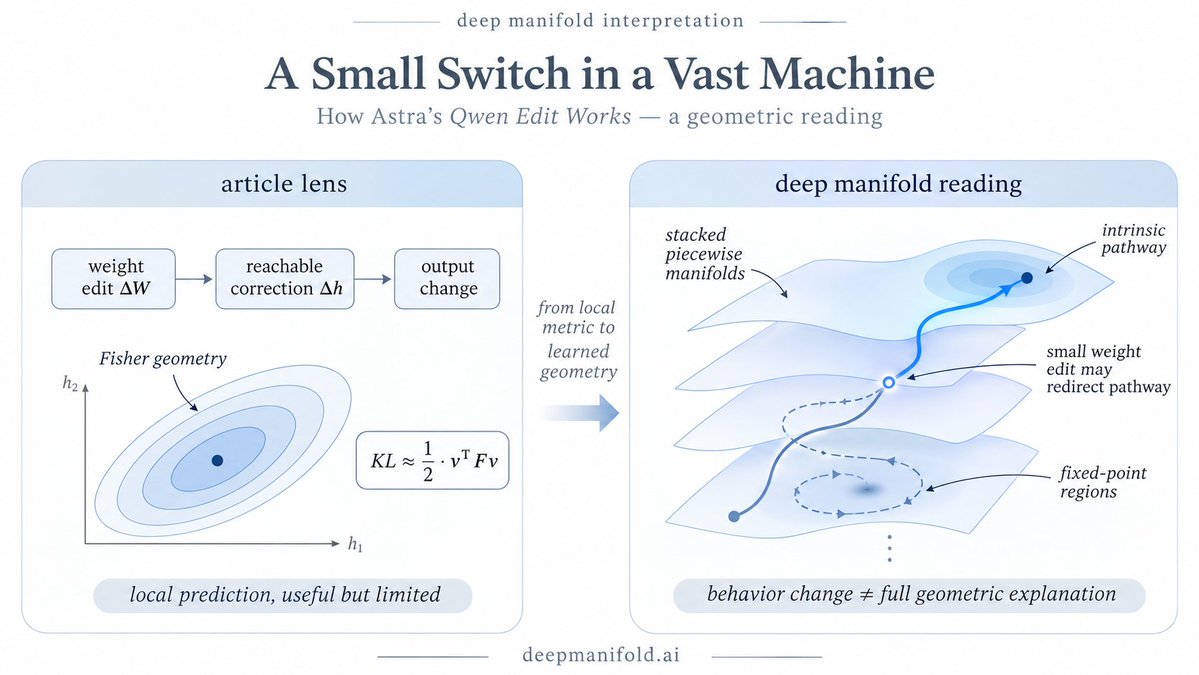
** A Small Switch in a Vast Machine **
A beautifully crafted article with elegant visualizations.
Astra’s Qwen weight-editing experiment has tremendous research value, although its broader implications deserve careful interpretation.
I particularly appreciate the elegant connection between Fisher information geometry and KL divergence: KL measures changes in probability distributions, while Fisher geometry captures their local curvature.
This provides a mathematically grounded way to understand how small weight interventions influence model behavior and why local predictions may break down under larger changes.
A beautiful illustration of both the power and limitations of information geometry in understanding neural networks.
Can one improvement help a model discover the next?
If a model becomes better at finding useful edits, it could help produce its next improvement. That’s the recursive self-improvement loop I want to test, starting from the Weight-Space Programming work by @rikiyatakehi and colleagues.
Astra rewrote parts of two Qwen3.5-0.8B weight matrices without gradient-based training. The authors reported MATH-500 accuracy rising from 7.9% to 48.1%.
My analysis connects three pieces around that edit: the steering rule it stores, the corrections shared weights can express, and the output changes Fisher geometry predicts locally. The aim is to turn an impressive repair into something we can reconstruct, measure and build on.
At a linear projection, the idealized rank-one edit follows a familiar identity:
ΔW = d kᵀ ⇒ Δh(x) = d [kᵀa(x)]
Read a scalar from the current activations, use it to scale a direction, and apply the correction. The weights stay fixed during inference; the push changes with the state. We reconstructed the saved edit as an activation intervention and confirmed numerical agreement in FP32 on 40 fixed prefixes.
Fisher geometry gives a local measure of how much the output distribution changes:
KL(pₕ ‖ pₕ₊ᵤ) ≈ ½ uᵀFₕu
Here, pₕ is the next-token distribution at a fixed prefix, u is a small activation change, and Fₕ is the Fisher metric with respect to h. Along the tested edit direction, measurements on 32 evaluation prefixes supported the prediction at small strengths, but it lost accuracy at the original strength.
For an engineer, this suggests a workflow: try a correction with an activation hook, check whether shared weights can express it across inputs, then evaluate generation on held-out tasks. The same design questions apply across models, even when useful directions and gates differ.
The next question is whether an edited model becomes a better editor. Compare it with its unedited version on the same frozen targets, with the same tools, evidence and budget. Then test successive rounds against a fixed editor with the same accumulated history and total budget, using independent evaluations.
The reconstruction and local measurements are completed work. Choosing better edits with geometry—and testing whether one improvement helps produce another—is the research plan.
The attached Kabuki watercolor offers the intuition: change the current, or push the boat. The article takes that picture inside the model, then asks how a useful correction could help improve the process that finds the next one.
https://t.co/i7Kuze1h7p
#DeepManifoldInterpretation
NovaAtom-Lite, an all-atom structure prediction model for drug discovery
NovaAtom belongs broadly to the GraphFormer family, more precisely using a Pairformer architecture with iterative recycling and atomic diffusion.
From Deep Manifold’s perspective, the learned molecular relationships form a fixed-point-like computational field, while stochastic diffusion explores possible molecular configurations through iterative numerical trajectories.
This connects directly to The Hidden Power of Neural Networks: geometry becomes part of neural computation, helping constrain the solution space. However, stochastic diffusion is not mathematically equivalent to fixed-point convergence.
https://t.co/ZSuGVC0dqq
NovaAtom itself is not agentic, but Geodesic integrates it into NovaDDE, an agentic scientific discovery platform.
NovaDDE orchestrates reasoning, molecular prediction, design, simulation, and experimental validation. From the Agent Manifold Waypoints (AMW) perspective, this creates an opportunity to organize scientific workflows into predefined computational waypoints, each with its own scope, constraints, verification, and communication.
https://t.co/XB698fkZHw
The distinction is that NovaDDE orchestrates scientific tools, whereas AMW proposes discretizing the underlying agent computational search space to improve long-horizon reliability.
Today, we launched NovaAtom-Lite at @Geodesiclab.
Built by a small, exceptional team in just a few months with only a few hundred GPUs, it already outperforms Isomorphic Labs' IsoDDE and Google DeepMind's AlphaFold 3 on key drug-discovery benchmarks.
But the bigger story is what AI can do for science.
Our mission is to find the shortest path from biology to medicines.
Scientific discovery has traditionally been slow, expensive, and driven by trial and error. AI has the potential to dramatically accelerate this process, from identifying promising research directions to generating hypotheses, predicting outcomes, and validating discoveries.
Imagine compressing months of scientific exploration into weeks, and eventually years of discovery into months.
This isn't just about making research 10% or 20% more efficient. It's about fundamentally changing the speed and economics of scientific discovery.
Structure prediction is a critical foundation. To design molecules that can change biology, we must first understand how they fold, interact, and function.
And we're only at the beginning. NovaAtom-Lite is our first step, NovaAtom-Pro is coming in the next few months, and our early wet-lab results are looking very promising.
The last decade was about teaching AI to understand and generate information. The next decade will be about teaching AI to understand and engineer nature.
We're not just building better models. We're working toward making drug discovery an engineering discipline.
And we're just getting started. 🚀
#DeepManifoldInterpretation
Paper: Neurospectrum: A Geometric and Topological Deep Learning Framework for Uncovering Spatiotemporal Signatures in Neural Activity
Geometry and wave dynamics may be fundamental to understanding neural networks.
Neurospectrum demonstrates how graph wavelets, manifold geometry, curvature, iterated-integral path signatures, and persistent homology can uncover spatiotemporal structures in biological neural activity.
From the Deep Manifold perspective, this is particularly interesting. Deep Manifold Part 1 (2024) already conjectured wave dynamics in neural-network learning, while Part 2 developed the geometric and iterated-integral formulation of neural computation.
The paper studies biological neural trajectories, not learned neural fixed-point fields. But its mathematical tools suggest a promising direction: investigating wave dynamics, neural plasticity, and topological evolution in Transformer activation manifolds.
Geometry is not merely a visualization. It may reveal the structure of computation itself.
#DeepManifoldInterpretation
Creativity may be a geometric property of the learned neural network manifold.
CreativityNeuro (arXiv:2607.01433) shows that directly steering model weights can improve divergent thinking and reduce mode collapse—without retraining.
From Deep Manifold's perspective, model weights constitute the learned neural fixed-point field. Weight steering modifies this field, potentially weakening dominant response basins and opening alternative computational pathways.
Creativity may not require learning new knowledge, but better access to what the model has already learned.
https://t.co/bK2PL8vFaL
Say your goal is to steer an LLM to make it more creative — should you do this in weight space or in activation space? 🤔
🚨Excited to share our new work (CreativityNeuro), accepted at #COLM2026, which finds that weight space steering of creativity tends to generalize further OOD than activation steering! Thread below 🧵
#DeepManifoldInterpretation
Jagged Creativity is another manifestation of Jagged Intelligence.
Schapiro et al. (arXiv:2605.13450) find that an LLM's ability to produce one creative answer does not predict its ability to generate diverse creative answers.
From Deep Manifold's perspective, this may reflect unevenly learned mathematical covers and limited computational pathways through the physical covers and neural fixed-point field.
Creativity at one point does not imply creativity across the learned manifold.
Jaggedness is not necessarily the root problem. It may be a structural symptom of deeper mathematical misalignment.
https://t.co/a5gxJq6S9J
🚨New paper! LLM creativity is jagged! 🧩
You might expect a model that achieves a high score on a creativity test will also give a diverse set of creative responses on real-world, open-ended questions.
Empirically, we find no significant correlation between these two! This suggests we may need to re-think creativity evals for LLMs from first principles. Thread below… 🧵
TLDR:
- No semantic distance test is a significant predictor of output diversity
- One popular human creativity test, the RAT, does not measure creativity in LLMs that well, and is really more a measure of general capabilities
- However, one test, the DAT, does predict creative writing.
From Deep Manifold's perspective, data poisoning can be explicit or implicit, and both may translate into undesirable model behavior through inverse learning.
Neural networks have propertyless activations and full-rank relational structures, giving them extraordinary learning freedom. But propertyless is lawless. The same mathematical freedom enables both emergence and hallucination.
This connects to a more fundamental problem: misalignment is a model or computational error, with three mathematically inherited sources:
1. Inverse learning
2. Propertyless and full-rank relational structure
3. Data complexity and numerical approximation
The difficulty is that these are also what make AI extraordinarily powerful. Emergence and hallucination are twins. The mathematical sources of capability are also inherited sources of misalignment.
Deep Manifold perspectives on Evans's five concerns:
1. Collusion — Shared Computational Geometry
AI agents may coordinate to manipulate training, but explicit collusion is not necessary for systematic misalignment. Agents sharing similar learned fixed-point fields may reproduce and reinforce undesirable computational pathways without communicating or conspiring.
2. Incoherence — Jagged Intelligence
Incoherence is not merely inconsistent AI behavior. From Deep Manifold's perspective, different prompts and contexts impose different boundary conditions on the learned fixed-point field, activating different computational pathways. The same model may behave safely in one context and become misaligned in another.
3. Motivation — Misalignment Without Intent
Poisoning does not necessarily require an AI to possess malicious intentions, persistent values, or hidden loyalties. Because learning is an inverse problem, undesirable relational structures can propagate through generated data and subsequent training without deliberate intervention.
4. Subliminal Effects — Hidden Relational Transfer
Neural networks learn relationships beyond the explicit semantic content of data. Propertyless and full-rank relational structures make subtle, unintended transfer mathematically plausible, allowing apparently harmless training data to carry undesirable influences that conventional filters may miss.
5. AI Introspection — Behavioral Similarity Is Not Mathematical Understanding
Models with similar training and architectures may share computational pathways, making behavioral transfer and prediction possible. But introspection does not necessarily reveal the underlying mathematics of the learned fixed-point field. Predicting a model's responses is different from understanding how recursive training changes its geometry.
Beyond Evans's Five Points — The Mathematical Stability of RSI
MoE architectures and certain training practices can further amplify inherited misalignment through discontinuous routing, fragmented computational pathways, and unstable learning dynamics.
RSI introduces another recursive layer. Poisoned behaviors can be inherited, reinforced, and amplified across model generations, even without malicious intent or agent collusion.
The fundamental question is whether recursive learning dissipates, preserves, or amplifies misalignment.
Recursive self-improvement can also become recursive amplification of misalignment.
More on the mathematical roots of misalignment:
https://t.co/a5gxJq6S9J
"Scaling up" is a double-edged sword.
On one hand, learning is an inverse problem. We do not know in advance how many degrees of freedom are actually required, so the model must be large enough to provide sufficient freedom for learning.
On the other hand, too much freedom creates a different risk: a Babuška-like paradox. More parameters, more pathways, and more reasoning do not guarantee a more correct solution. A larger model may simply have more ways to converge to the wrong one.
So the real problem is not simply “bigger or smaller.”
It is: enough freedom to learn, but enough mathematical constraint to stay on the right solution.
That may be one of the central scaling problems in AI.
https://t.co/LT2d7SNQfm
#DeepManifoldInterpretation
Weight-space programming is deceptively attractive.
A fascinating MIT CSAIL blog, Sparks of Weight-Space Programming, demonstrates that LLMs can directly read, write, and repair neural network weights. In one experiment, editing just 0.016% of a model's weights produced dramatic improvements in reasoning performance.
From the Deep Manifold perspective, weight space defines the mathematical cover of the Neural Fixed-Point Field.
Its propertyless, full-rank relational structure makes direct intervention extraordinarily powerful—but potentially dangerous.
A tiny weight edit does not necessarily mean a tiny geometric change. It may alter intrinsic computational pathways, redistribute residuals, or disturb interconnected manifold regions far beyond the intended target.
The blog demonstrates remarkable behavioral improvements, but does not establish geometric preservation or global stability.
Proceed with extreme caution.
We asked GPT-6 Astra to edit Qwen3.5-0.8B weights to improve math.
It directly changed only 0.016% of weights, fixing 0.8B's reasoning loops & improving math up to 6x and even instruction following 3x, without gradients or training.
We call this Weight-Space Programming: frontier LLMs can now natively read/write neural network weights! 🧵
Blog: https://t.co/bOWCcFhCVq
Weight-space programming is deceptively attractive. The propertyless, full-rank structure of the Neural Fixed-Point Field makes direct weight manipulation appear simple and powerful. Yet a tiny weight edit may produce profound, nonlocal geometric changes that remain invisible to conventional performance benchmarks.
Proceed with extreme caution.
#DeepManifoldInterpretation
More Parameters, More Reasoning, but Not Necessarily More Correctness.
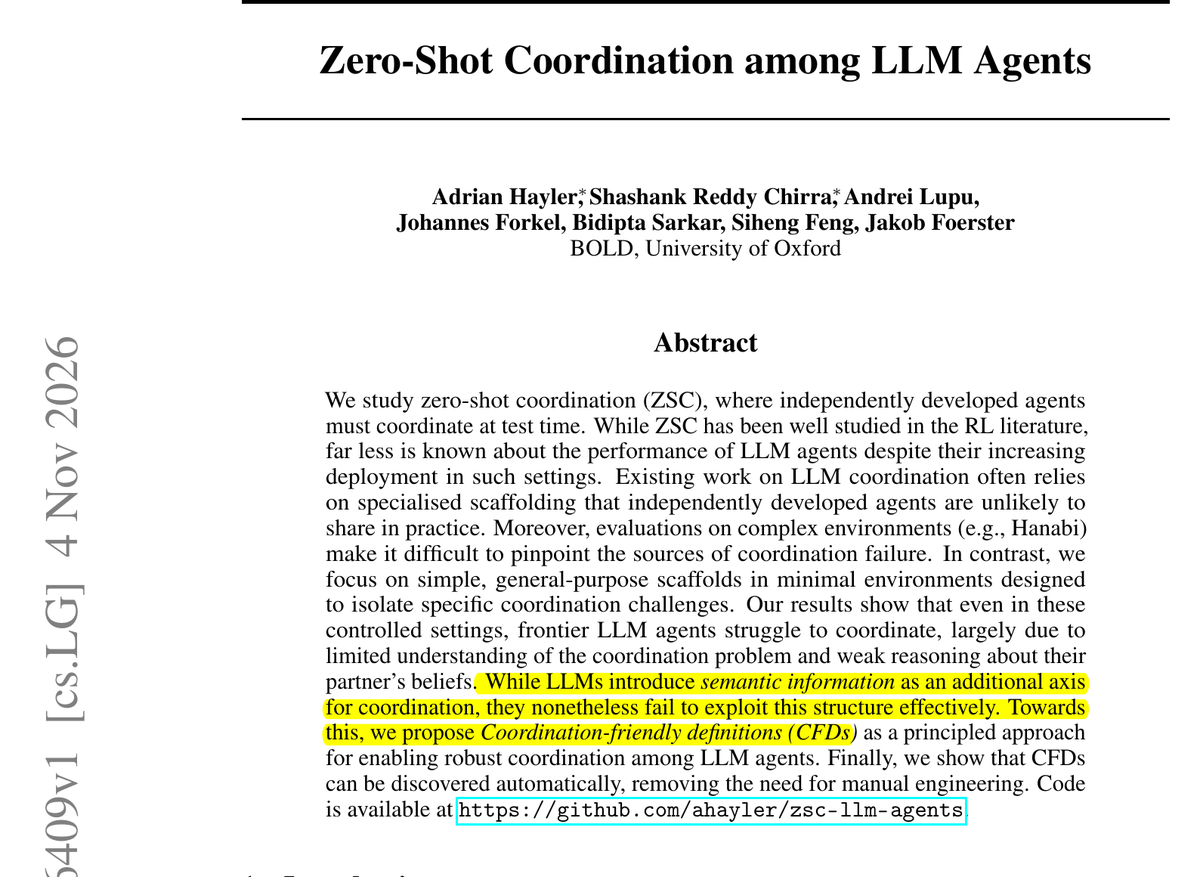
A surprising finding from Zero-Shot Coordination among LLM Agents:
Smaller models, including Qwen3-14B and OLMo-3-32B-Think, recover robust coordination strategies, while much larger frontier models sometimes fail.
Even more striking: more reasoning does not necessarily improve coordination.
This reminds me of what I called the “Zienkiewicz Moment” in Deep Manifold: increasing numerical resolution or computational complexity does not guarantee a more accurate solution.
Deep Manifold Reading: Inference is an iterated integral over a learned neural fixed-point field. Larger models offer richer computational landscapes, and more reasoning extends the search. But neither guarantees reaching the correct fixed point, especially when pathways and boundary conditions are misaligned.
More computation is not necessarily better mathematics.
Zienkiewicz Moment: https://t.co/2ScZ5re9EA
New Oxford paper finds that frontier LLM agents fail to coordinate with unfamiliar partners because each one treats its own made-up rules (arbitrary convention) as the obvious choice.
Agents from different companies increasingly must work together with no agreed rules. Past studies used shared scaffolding or complex games that hide why coordination fails.
They tested text and code agents built on models like GPT-5.2 and Gemini 3 Pro in 9 small cooperative games. In Cat & Dog, a safe move guarantees 5 points, while a signal convention pays 10 only if both agents pick the same one.
Paired with other models, text agents scored well below that safe 5, each calling its own arbitrary convention natural. A short shared statement of coordination principles, called a Coordination-friendly definition, led agents to reliably take the safe 5.
If your agent must work with agents you did not build, tell it to avoid unstated conventions and prefer actions any partner reads correctly.
#DeepManifoldInterpretation
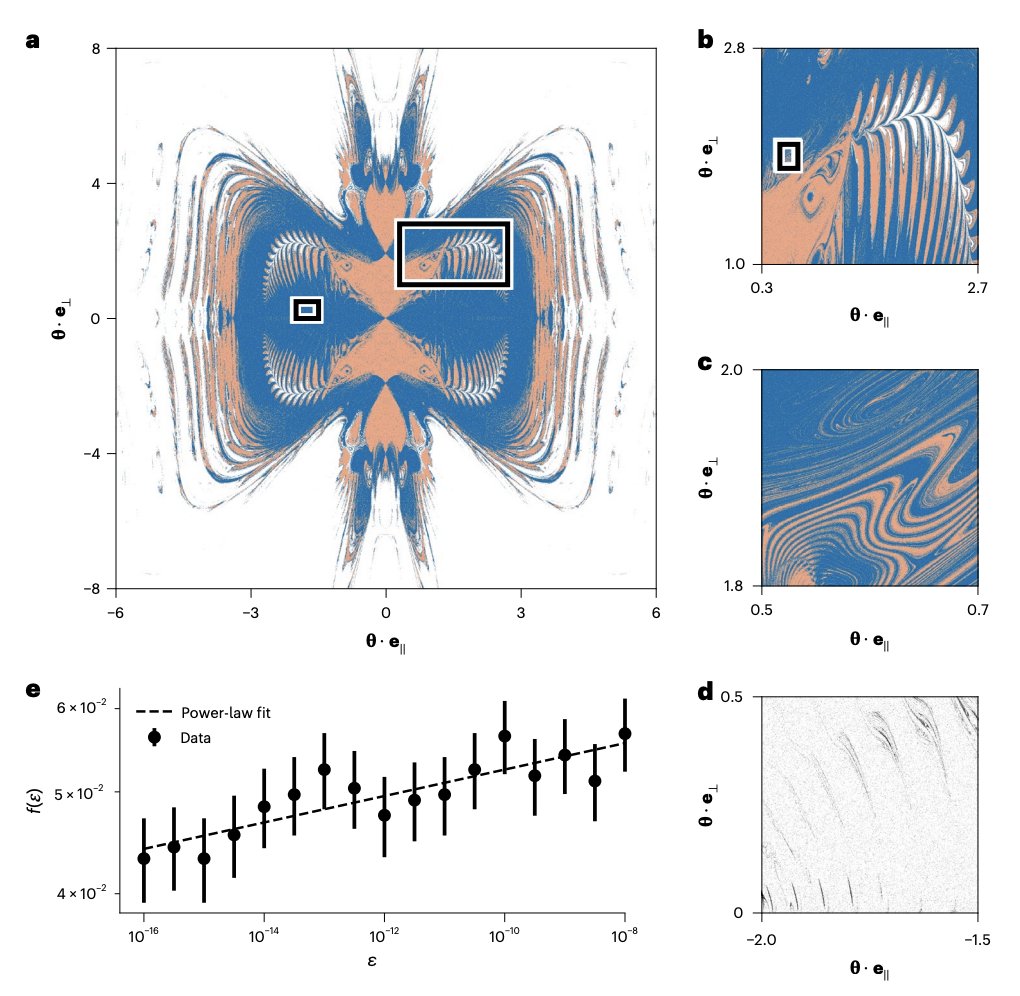
The recent Fractal Basin Geometry paper reveals how intertwined attraction basins make deep learning training difficult to predict and reproduce.
Neural network fragility is fundamentally a question of high-order nonlinearity.
This reminds me of earlier studies by James Zou et al. on fragile neural network interpretations and David Duvenaud et al. on pathologies in deep networks.
Actually, this is how Deep Manifold started: questioning the high-order nonlinear behavior of neural networks.
That question eventually led to "Deep Manifold Part 1: Anatomy of Neural Network Manifold" (2024, arXiv:2409.17592).
The central idea remains: neural network training is a dynamical process, and its underlying nonlinear geometry matters.
Almost identical starting weights. Persistently different predictions.
Two neural networks start with almost identical weights and follow the same deterministic training procedure. After training, they still disagree on roughly 3% of inputs. Making their starting weights even closer barely changes that disagreement.
That is one of the striking results in Ly and Gong’s study of why deep learning can be so sensitive to tiny changes.
They tested VGG convolutional networks trained with stochastic gradient descent on handwritten digits, with half the training labels deliberately corrupted. Prediction disagreement stayed near 2.9% as initialization differences varied across ten orders of magnitude.
Their proposed explanation comes from dynamical systems: starting points leading to different outcomes can be interwoven at extremely fine scales. They establish this geometry in a minimal network and find evidence consistent with it in deeper models.
An exactly repeated deterministic run can still give the same answer. But a nearly identical run may give a different one.
For a scientist using AI to select the next compound or classify an unusual cell, that difference matters. Alongside the average test score, check whether retraining changes the particular predictions your next experiment depends on.
Ly and Gong, Nature Machine Intelligence (2026). CC BY 4.0. https://t.co/NuMhnSK6Aw