Lots of talk about glyphosate, so I want to add some context to the noise.
Glyphosate is a molecule.
It has been studied for 50 years.
Hundreds of regulatory reviews.
Tens of thousands of pages of data.
Toxicology, residue studies, epidemiology, environmental fate.
You don’t have to “trust Monsanto.”
You can read assessments from:
🇺🇸 EPA
🇪🇺 EFSA
🇯🇵 PMDA
🇨🇦 Health Canada
Here’s what gets lost in the shouting:
Hazard ≠ Risk.
Risk = Hazard × Exposure.
Real‑world dietary exposure?
Measured in micrograms.
Hundreds of times below conservative safety limits.
That’s risk assessment.
And no- IARC saying “probably carcinogenic” does not mean “causes cancer at real‑world exposure.”
It means same category as:
– Red meat
– Night shift work
– Very hot beverages
Context matters.
If you think farmers spray poison because they enjoy it, you’ve never met a farmer.
They use tools.
Tools are evaluated.
If they don’t work, they’re dropped.
If they aren’t safe under regulation, they’re not approved.
The claim that we are all being secretly poisoned? That collapses under dose‑response curves and biomonitoring data.
Emotion spreads faster than toxicology. But toxicology still wins.
If you care about food, health, and the environment, learn the difference between hazard and risk.
It will change how you see almost every chemical debate online.
And yesterday, SCOTUS (7–2) made something else clear:
You don’t get to turn fear into a label.
If regulators didn’t require a warning,
you don’t get to invent one through litigation.
Their Coffee Is More Toxic Than Glyphosate
Last week Del Bigtree (@delbigtree) and Food Babe (@foodbabe) rallied outside the Supreme Court against glyphosate. I've met these people. I exposed them in my films. They are not honest brokers.
And they weren't alone. Cory Booker (@corybooker) and AOC (@aoc) are taking the bait on Glyphosate as evil— politicians I respect on a lot of issues. But not on this one. The science doesn't care about your team.
The global scientific consensus is clear: the EPA, EU, Canada, Japan, and Australia have all concluded glyphosate does not cause cancer at real-world exposures.
Oh — and their coffee is more toxic than glyphosate. Scientifically speaking.
More receipts coming. Including a deep dive into IARC — the organization behind the "probable carcinogen" claim — and why they'll be front and center in my next project: TOXIC
Stay tuned.
@marklynas@bayer
#Glyphosate #Roundup #FoodEvolution #ShotInTheArm #MAHA #PeopleVersusPoisin #FoodScience #ScienceMatters #Monsanto #IARC #SupremeCourt
@Stevemac270@BrianMitchem3 There are similarities to the disinformation campaigns against DDT and glyphosate. Both propelled by emotion and activist driven science that allowed a popular narrative to take hold, until its almost impossible to overcome.
@AndrewKaufmanMD There are many reasons our crops should be exposed to chemicals. I'm no forensic psychiatrist but I do know that it becomes difficult to grow crops without chemicals like water, soil nutrients etc.
Want to cut through the cacophony of MAHA voices and politicians who shout about products they don't understand? Or maybe you are worried about the safety of pesticides and would like to hear the POV of an experienced industry scientist? Follow Simon.
I’m not a bot.
I’m a scientist.
I’m also a musician.
PhD in chemistry.
20 years in industry.
I spend my days working with evidence and my nights playing music.
My goal is simple: Make science make sense in a noisy world.
If you value evidence you’re in the right place.
Hear from a Missouri farmer: Blake Hurst shares that rising input costs, among other pressures, are putting farmers in a corner, and the loss of access to essential crop protection tools would make a tough situation worse.
The backstory to this is enlightening.
Turns out that the Dean of Public Health at Harvard was retained by litigators to sue the makers of Tylenol.
The claim got thrown out of court.
They then used taxpayer dollars from NIEHS to conduct a “meta analysis” of the data that got thrown out of court & published it in an environmental journal.
They handed the article to RFK Jr.
The rest is history👇🏽
https://t.co/dSdasf5GaQ
Seed oils:
Are they even correlated with bad health?
I assembled ALL of the available NHANES data and linked as much as possible of it to the National Death Index and found that...
It's not. Seed oils aren't even correlated with problems.
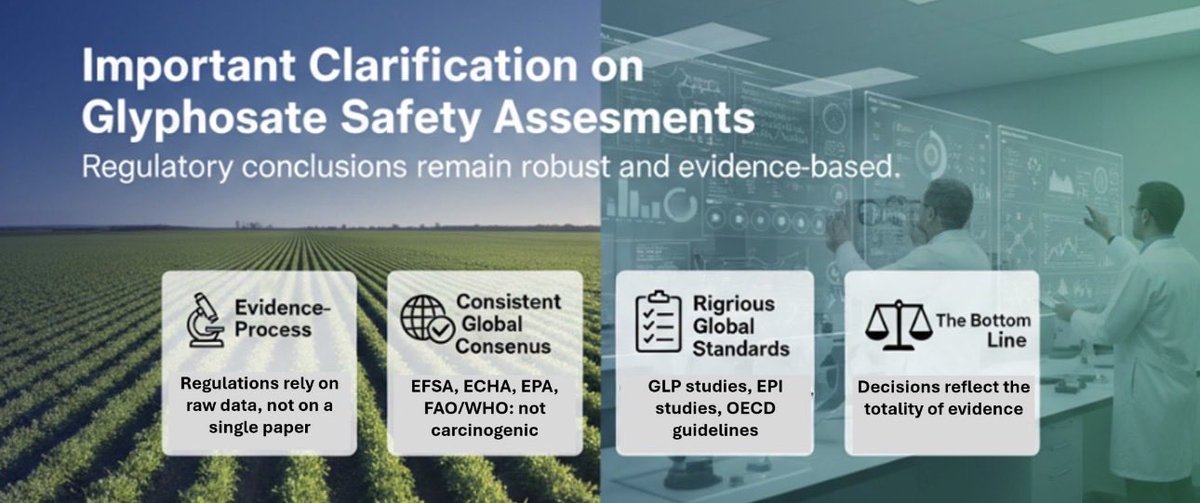
One glyphosate paper was retracted.
Some claimed the science collapsed.
Except regulators never relied on that paper. They evaluated hundreds of studies and full toxicology datasets.
Remove one citation. The conclusion doesn't change. That's how evidence-based regulation works.
Remember to stop trusting the experts. Have the cashier at Target fix your brakes. Let an Etsy witch do your financial planning. Have the kid bagging your groceries take out your appendix.
#MAHA
@jonathanstea@DrPlantel and if you need a good laugh, go to the comments on some of the ads and see the other RFK Jr. action figures commenters have created. My fave is the one with the toilet and bag of coke as accessories.