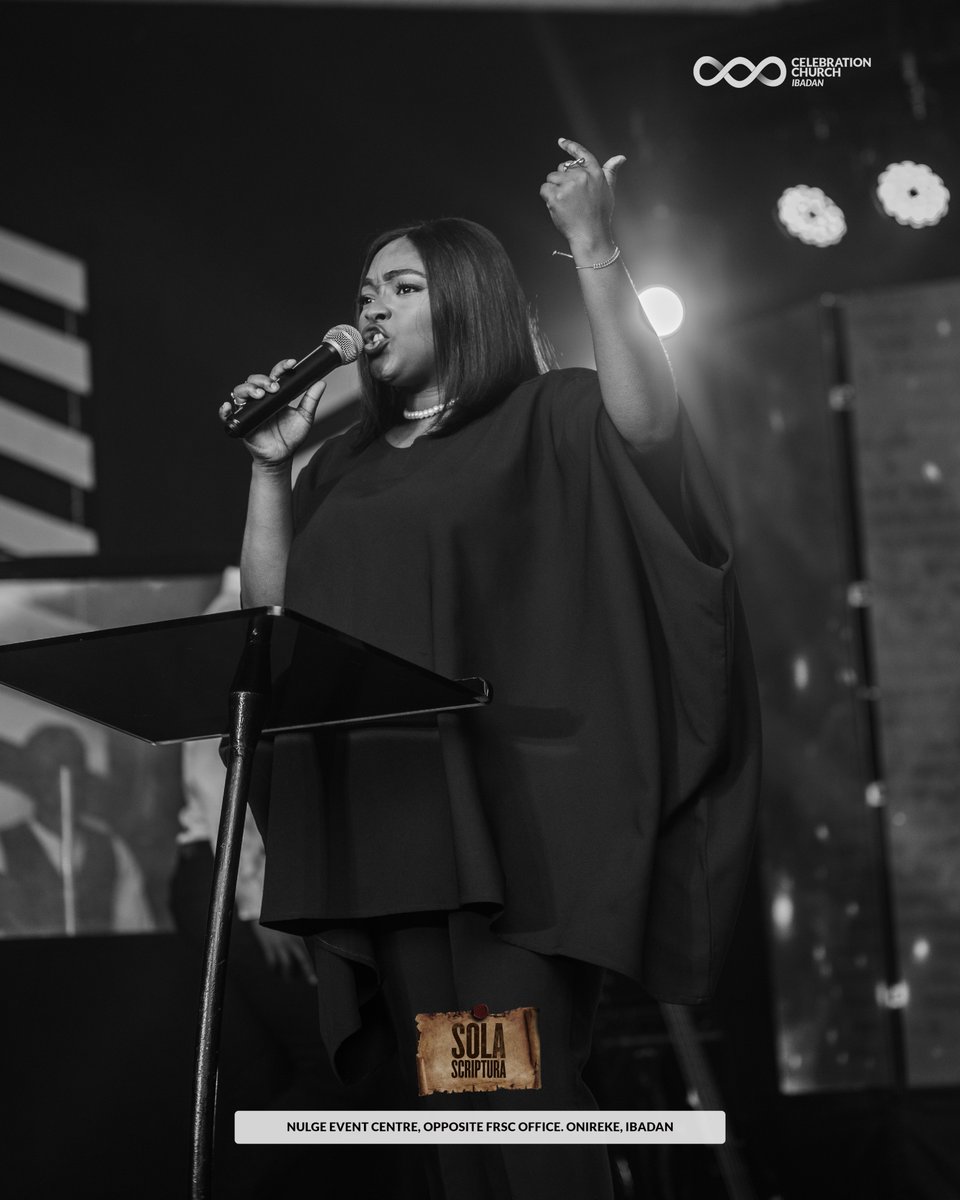
Every believer must hold the word of God in high regard and honour it above all else.
Encounters and experiences are nice, but they do not override God’s word.
All Scripture is profitable for doctrine, so all doctrine must be founded upon Scripture.
Don't watch porn in the name of adult movie
Don't read porn in the name of romance novel
Don't hear porn in the name of music
Jesus lives in you. You carry God's holiness.
You are a believer. You are separated. Called out.
Live like that.
I first met pastor Wale about 4years ago and I was like who is this Pastor that can preach so well. ( Pastor Wale is worded no be today )
Thank you so much Pastor!
I am so glad God is using pastor Wale to raise God’s seeds that understand and apply the word.
JOSEPH AYO BABALOLA AND THE 1930 REVIVAL!
As we approach the centenary of the first significant revival that ignited in Nigeria, the 1930 revival led by Joseph Ayo Babalola, a profound nostalgia envelops us. It beckons us to reflect upon those memorable days when the Spirit of God moved mightily, witnessing mass conversions, fervent prayers, and the tangible touch of divine healing. Let us embrace this historic milestone with gratitude, seeking to understand and embody the purposes of God in our generation so that the flame ignited by the 1930 revival may continue to illuminate our path towards a vibrant and transformative faith.
Dele Osunmakinde
'A 'prophet' is said to have put up an appearance in ilesa, whose power of healing by prayer has been testified by many who had been healed. Two well-known figures in Ibadan who have nearly lost their sights have completely recovered; pilgrims mostly consisting of lames, blinds,deafs and all kinds of invalidate crossing ilesa every day by motors to receive this wonderful healing.'
Nigeria Daily Times, August 28th, 1930
The Resurgence of 1930: A Nostalgic Reflection
Let us embark on a journey to capture the essence of the remarkable events that adorned the landscape of the 1930 revival, which holds a special place in the annals of Nigerian church history.
1. Born in 1904, Babalola hailed from the vicinity of Odo Owa, near Ilofa. His formal education lasted four years, and he discontinued schooling at the fourth standard. By 1928, he toiled as a steamroller driver for the public works department in Osogbo. While maneuvering the steamroller along the Igbara Oke road construction site, he encountered the divine during this period. The Lord spoke audibly to him, compelling him to resign from his job and embark on a six-day fast.
Subsequently, a series of supernatural encounters and angelic visitations accompanied Babalola's life, punctuated by seasons of intense fasting. These extraordinary experiences led to the commencement of his ministry in his hometown of Illofa, accompanied by extraordinary displays of the supernatural. Astonishingly, he was a mere twenty-four years old at the time.
2 In July 1930, at the age of twenty-six, Babalola received an invitation from Odubanjo to attend a congress of Faith Tabernacle leaders. Until then, neither Babalola nor Odubanjo was associated with the Christ Apostolic Church, as they were both members of the Faith Tabernacle Church. It was in 1929 that Babalola was introduced to Odubanjo and the other leaders of Faith Tabernacle Church.
During the congress, Babalola excused himself from one of the sessions to pray for a deceased boy. He noticed a burial procession near the venue and was moved to intercede. After approximately ten minutes of prayer, the lifeless boy was miraculously revived. News of this remarkable miracle spread like wildfire, and sick individuals began flocking to Babalola, seeking prayers and healing. Around two hundred people gathered within the first week, and many returned to testify of their miraculous recoveries. The word rapidly spread, attracting an even larger crowd.
3 By the third week, approximately one hundred lepers, sixty blind people, fifty disabled individuals, and numerous others had been healed—though many more went unrecorded. A revival had ignited in Ilesa, earning the title of the 1930 revival. The initial meetings took place adjacent to a house but had to be relocated to a more spacious open space near a hill called Oke Oye on the outskirts of Ilesa. This site became synonymous with the revival and was called the "Oke Oye Revival." People from all corners of colonial Nigeria began pouring into Ilesa, causing significant disruptions in transportation and food supplies, which did not escape the notice of colonial authorities.
4 The crux of Babalola's message centred on repentance and divine healing. Revival meetings were held twice daily, from Monday to Friday. The attendance swelled to approximately three thousand daily within weeks, and by September, a mere three months into the revival, it exceeded forty thousand people. Over eight thousand individuals were baptised in less than three months. Babalola emphasised that his ministry was an embodiment of the purpose and reality of Christianity, asserting that Christ was not a mere historical figure but could be experienced in the present.
5 The British Assistant District Officer in Ilesa reported, "Huge crowds of people... from all surrounding countries and as far as Ife and Ekiti; clerks and bushmen; Muslims and pagans, as well as Christians, had besieged Ilesa." The authorities were taken aback as the influx of crowds from distant places escalated. The price of containers, such as beer bottles, Kegs and tins used to carry water, skyrocketed. Bottle shops emerged, and railway lines and stations teemed with pilgrims journeying to Ilesa, leading to inflation in the prices of goods and services. The regular churches were forsaken as their adherents flocked to the revival meetings. The nearby brook was incessantly tapped for water until it ran dry.
6 Babalola remained humble, simple, and cheerful despite these extraordinary circumstances. Each meeting commenced with joyous choruses, followed by Babalola's preaching and prayers. As he prayed and gently rang his bell, instant healing would transpire. Idol worshippers surrendered their images, and charms were brought in abundance to be destroyed—over a thousand Items were burned. One of the defining features of the revival was the massive conversion of Muslims, with imams and their students embracing Christianity.
7 Another consequence of the revival was the mass abandonment of government and mission hospitals, as patients left their beds to attend the meetings. Babalola faced accusations of obstructing medical officers from fulfilling their duties.
From Ilesa, the revival permeated other regions of the country, with Ibadan serving as a significant base. Orekoya, a pivotal figure in Ibadan, received instruction from the Holy Spirit to travel to Ilesa, where he became a prominent figure in the revival, often standing in for Babalola. After a few days, the Spirit directed him to return to Ibadan. The revival spread far and wide from his base at Oke Bola in Ibadan. Orekoya held significant gospel campaigns in Abeokuta, Sapele, Warri, Ijebu Ode, and Owo and jointly conducted revival meetings with Babalola between 1930 and 1931. Tragically, while conducting meetings in Warri, Orekoya sustained severe injuries in a gas lamp explosion and later passed away in his hometown, Ijebu Ode.
8 Babalola and Orekoya served as the vanguards of the 1930 revival alongside numerous other prominent evangelists such as Peter Olatunji, Emmanuel Omotunde, David Babajide, and Elijah Goke. As the revival spread, it infused a new spiritual capital into churches throughout the region, particularly the Faith Tabernacle Churches, strengthening their foundations and giving rise to new leaders. The arrival of this spiritual force reshaped Christianity in colonial Nigeria. Additionally, there was an unprecedented demand for Bibles, overwhelming the bookshops of the time.
9 Fasting and prayer became ubiquitous among Christians, inspired by Babalola, whose life embodied these practices. Babalola would often spend hours in prayer, and once he commenced, he seemed to continue indefinitely. Akinyele, who later became the Olubadan of Ibadan, recollected an occasion when Babalola spent the night at home, praying continuously. It felt as though a hundred people were praying simultaneously. Akinyele testified that with an experience like that, Babalola was destined to achieve great things for God.
10 During my conversation with one of Babalola's surviving daughters, whom I met in Ilesa at the request of my friend, Pastor Segun Oduyebo, she shared that when Babalola prayed in the house, the entire dwelling would vibrate, and he could go on for hours or even days.
11 Another characteristic of the revival was the newfound boldness among Christians. Through Babalola's teachings, they became aware of their authority over the forces of darkness and lost their fear of gods and demons. They composed songs that defied demonic powers and exuded constant joy and excitement. Christian songwriters and instrumentalists, particularly accordion players, rose to prominence, becoming synonymous with the revival.
12 Problems arose as the revival expanded, with regular mission churches expressing scepticism and viewing the revival as a loss due to the depletion of their ranks. They held the untrained and illiterate clergy leading the revival in contempt and disapproved of the use of holy water, leading to opposition against the revival.
13 The colonial government, already suspicious of the revival due to charlatans exploiting Babalola's reputation, sought to suppress what they perceived as excesses. 1932 Babalola was imprisoned in Benin for six months after a woman in Otuo accused him of labelling her a witch and forcing her to drink a potion for confession. However, this allegation was baseless, giving the government an excuse to act against the revival.
14 Upon his release from prison, one notable action Babalola took was leading a hundred preachers into the jungle to seek complete restoration of biblical blessings and benefits. This endeavour was followed by a period of intense persecution throughout the 1930s. Another crisis occurred when Babalola and his companions parted ways with The Apostolic Church, leading to the formation of the Christ Apostolic Church, jointly founded by Odubanjo, Babalola, Akinyele, Adegboyega, Babajide, and others. CAC has no single founder; it was a collective effort.
No prayer is wasted
Even if it seems as though the answers are not coming.
As long as you are praying according to God’s will and in faith
Don't stop praying.
The prayers of saints are stored as incense unto God.
It may tarry but it will definitely come to pass Be encouraged!
Here is something you can do,
Find songs that express what you want your walk with God to be like.
Soak in
Listen to them in the bus as you go to school or work.
And see how your walk with God would be transformed.
Music is so powerful,
Do you remember you learnt the Alphabet through song... A B C
You can pick up a lot from music.
I remember how my walk with God became more intimate as I soak in songs that align with my faith in Jesus.
I literally carried the song everywhere...
‘You are Good, You are Kind, You are more than these...’
‘I know a God who is merciful and kind, faithful and gracious’
It’s not enough to “avoid sin”
You must build yourself up in the spirit, for the battle is a daily one and mere avoidance can’t save you.
Be intentional about feeding your spirit right and growing ✨
The Church is God’s strategy to ensure the believer is disciplined.
You are better of when you in the company of believers than alone.
The church is God’s strategy to strengthen the believer.