#OTD June 17, 362:
Julian the Apostate issued an edict regulating teachers throughout the Roman Empire. By requiring instructors to be approved by civic authorities and to teach in harmony with classical pagan texts, the measure effectively excluded many Christians from the teaching profession. Part of Julian’s broader effort to revive paganism, the policy aimed to curb Christian influence over the rising generation.
#OTD June 16, 1539:
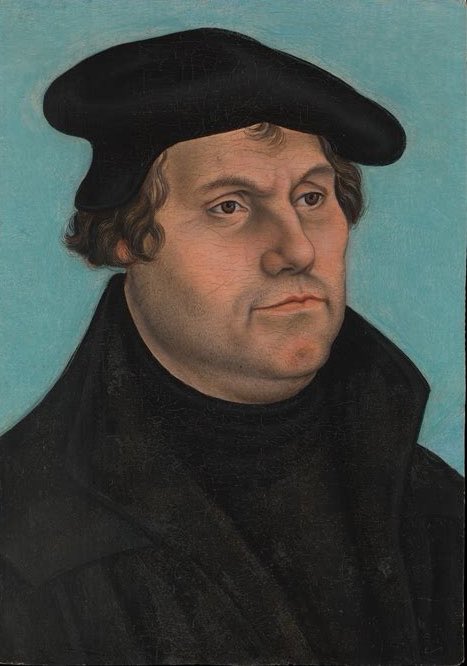
During an ordination exam in Wittenberg, Martin Luther was confronted with the claim: “Faith justifies; faith is a work; therefore works justify.”
He responded:
“Faith justifies not as a work, nor as a quality, nor as knowledge, but as assent of the will and firm confidence in the mercy of God. For if faith were only knowledge, then the devil would certainly be saved… Accordingly faith must be understood otherwise than as knowledge. In part, however, it is assent.”
Luther, Table Talk No. 4655 (June 16, 1539), LW 54:359–360
#OTD June 15, 1520:
In the papal encyclical Exsurge Domine, Leo X condemns Martin Luther on 41 of counts of heresy, branding him an enemy of the Roman Catholic Church. After the encyclical, Luther's works were burned in Rome.
#OTD June 14, 1936:
Death of English apologist, poet, and writer G.K. Chesterton. He loved paradoxes, which he called "supreme assertions of truth," and used them often in his writing. Poet T.S. Eliot credited him with doing "more than any man in his time … to maintain the existence of the [Christian] minority in the modern world."
Chesterton converted from Anglicanism to Roman Catholicism in 1922.
13 de junho de 1525:
O reformador alemão Martinho Lutero, anteriormente monge, casou-se com Catarina von Bora, uma ex-freira que havia fugido de seu convento escondida em um barril de peixe. Seu casamento foi uma ousada rejeição pública ao celibato clerical obrigatório.
#OTD June 13, 1525:
German reformer Martin Luther, formerly a monk, married Katherine von Bora, a former nun who had escaped from her convent in a fish barrel. Their marriage was a bold public rejection of mandatory clerical celibacy.
Ludwigskirche in Saarbrücken, Germany.
The Ludwigskirche is the principal Lutheran church of Saarbrücken. Commissioned in the 18th century by Prince William Henry of Nassau-Saarbrücken, it stands as one of Germany's great Protestant Baroque landmarks and belongs today to the Evangelical Church in Germany.
Marktkirche in Hanover, Germany.
Marktkirche is Hanover's main Lutheran church. Built in the 14th century, it is dedicated to St. James the Elder and St. George. Originally a Roman church, it became Lutheran during the Reformation, and is apart of the Evangelical Church in Germany.




![HistoricalRook's tweet photo. #OTD June 14, 1936:
Death of English apologist, poet, and writer G.K. Chesterton. He loved paradoxes, which he called "supreme assertions of truth," and used them often in his writing. Poet T.S. Eliot credited him with doing "more than any man in his time … to maintain the existence of the [Christian] minority in the modern world."
Chesterton converted from Anglicanism to Roman Catholicism in 1922.](https://pbs.twimg.com/media/HKxWEGaW4AAPeN7.jpg)