Here are the highlights from the recent commissioning of CEC PLC’s 136MW Itimpi II Solar PV Power Plant, Zambia’s largest solar PV facility - a landmark project advancing reliable, diversified, and sustainable energy for Zambia’s future.
#ItimpiII#RenewableEnergy #CECAddingValue
Yesterday I listened to @ssishuwa’s Harvard presentation, where he’s a Visiting Scholar. In his chapter on Democracy, he calmly shows how Southern African regimes weaken democracy to entrench power, using the PF as a case study. Looking forward to this material. #ZambiaKuChalo
Kenya's President, William Ruto, warns that the African Union #AU is "not fit for purpose" and cannot steer the "continent into the future".
“I can tell you without an iota of doubt that the African Union, as it is today, is not fit to provide the leadership that this continent needs going into the future. Therefore, there's need for the reforms of the African Union”.
President Ruto address to the UN General Assembly:
“Africa deserves two permanent seats with full rights, including the veto, and two additional non-permanent seats on the UN Security Council.”
So damn friggen in love with trading. No better feeling than when that payout hits when you wake up with your healthy kiddos in bed from a long ass nights of cuddles.
Try and change my mind.
It is much easier to give up on Zambia than to fight for her
By Sishuwa Sishuwa
It is ironic that University of Zambia law lecturer O’Brien Kaaba, who had claimed that Solicitor General Marshal Muchende is corrupt and had evidence of this corruption that he was looking forward to presenting in court, has now joined President Hichilema in protecting the very person Kaaba had told Zambians was corrupt. Why has Kaaba struck a deal with someone he branded corrupt? Having criticised consent judgement as a form of legal corruption, Kaaba has now signed one himself to protect someone he told Zambians was receiving kickbacks.
Moreover, the consent judgement was unnecessary. If Marshal wanted, for whatever reason, to discontinue the suit, he could have done so without Kaaba’s consent. Kaaba could have simply insisted that he had evidence to prove his assertions and left it to Muchende to discontinue the matter on his own volition. This way, the public would have concluded that the defamation case that Marshal brought against Kaaba was nothing more than an intimidation tactic. By agreeing to end the matter through a dubious consent judgement, Kaaba has called into question his own character.
The implication of what Kaaba has done is that he either (i) did not have evidence of corruption against Marshal and was simply being malicious; (ii) was talked out of the issue of exposing Marshal’s corruption by Marshal himself, Hichilema, or/and other senior leaders who may have felt that a court trial would expose the extent of the rot and embarrass the President, government, or the ruling party, (iii) has been intimidated by Hichilema who has shown extraordinary determination to protect the Solicitor General, or (iv) has finally been compromised and co-opted into the corrupt network so that he, too, can eat with the group. Whatever it is, neither reflects very well on Kaaba’s character. This outcome presents him as an unprincipled person and a coward who trembles in the face of intimidation or pressure.
It is fair to assume that we will not hear Kaaba strongly criticising the government anytime soon. He is more likely to withdraw into silence to win the support of those he nearly estranged himself from by criticising their wrongs. It is worth noting that the decision by Kaaba – who, like Marshal and Hichilema, is a Tonga speaker – to strike a consent judgement with an official he had only days earlier insisted was corrupt may also be interpreted by some people as motivated by ethnic considerations. In the book It’s Our Turn To Eat: The Story of a Kenyan Whistleblower, Michela Wrong shows that corruption, despite its destructive impact, is harder to eradicate in multi-ethnic African societies because many people, both in government and outside it, have found it easy to reduce decision-making to the self-serving calculation of which tribes gets to ‘eat’.
Set in Kenya, the book tells the story of John Githongo, a member of the Kikuyu ethnic group to which then President Mwai Kibaki also belonged, who took on an official government position to fight corruption. When Githongo discovered that corruption under Kibaki was as rife as it was under his predecessor, Daniel Arap Moi who came from the Kalenjin group, he exposed it. Githongo’s anti-corruption efforts attracted outrage from (mainly the corrupt) Kikuyu government officials who felt disappointed that a member of their ethnic group was 'betraying the tribe’ and effectively undermining the ruling party’s stay in power at a time when they (ethnic Kikuyus) should unite to eat, as those they had ousted from power, the Kalenjin, had done.
Considered from this perspective, it is reasonable to assume that Hichilema, Marshal, or other Tonga elders may have sat Kaaba down and reproached him for "betraying the tribe and effectively undermining the ruling party’s stay in power at a time when they…should unite to eat, as those they had ousted from power…had done.” For those who place narrow ethnic considerations above wider national interests, the pressure of ethnic-regional cabals is almost unbearable, and weak souls are more likely to bend to their will. In fact, I won’t be surprised to hear next that Kaaba has entered into another consent judgement with, or issued an apology to, ex-ACC Director General Thom Shamakamba and retracted the assertions he intentionally made to the Daily Revelation newspaper that Thom was also receiving kickbacks! Politics can reveal the truest character of people we had some respect for at a distant.
Here is my unsolicited advice to Kaaba. If you are not consistent in your beliefs; if you are not prepared to risk everything – including your very life – to live the dictates of your conscience and give full expression to the courage of your convictions, please stick to supporting Hichilema and the UPND or consider withdrawing from public commentary to lead a quiet life until Zambia has a different, non-ethnic Tonga, leadership. It is the easy way out, provided one is prepared to ignore the answer to this haunting question, which will likely be posed by future generations: ‘When these things were happening to Zambia, when those in power were destroying the country this way, what did you do?’ The price of dissenting, of challenging the government, of being in the minority, is very high. I know this from personal experience under this administration and previous governments. It is much easier to give up on Zambia than to fight for her.
Speaking truth to power is a lonely undertaking, but someone must take the mantle and sacrifice. If there is anything that I have learnt from this path, it is that sometimes, in acting our beliefs and being loyal to principle or our convictions, we lose friends and end up lonely. I do understand though – and I am even sympathetic to – the primary impulses that are causing individuals including those in civil society today to betray public interest and identify themselves with the ruling elite. In an impoverished country like Zambia, where the state is the dominant employer, the ability to stay alive requires association with the government of the moment.
I believe, however, that there must be others among us who should do what is right and work towards the promotion of the common good. Some among us must hold our leaders to account, irrespective of the consequence that may come our way. It would be nice to have more people, especially from the region where I come (since the leaders now dividing Zambia hail from there), who genuinely oppose corruption, defend democracy, speak truth to power and campaign against the erosion of democratic institutions. But even if there are only one or two of us, we must find comfort in the fact that we are enough. We are enough because at its core, our job is very simple. It is to be the pinhead of the needle of justice and clean governance. Our job is to give courage to those who are scared. We do not have to be too many for that; we are enough. The cowards will join eventually; they always do.
This is a very historic and difficult period for Zambia we are witnessing and passing through. Many, including those we looked up to only yesterday, have now sold out and those in power have supporters that are so loud against the few remaining independent voices that it is very easy to feel overwhelmed, shuttered and to either break down or bow down to defeat. Mistakes are inevitable too, sometimes very grievous ones. It is vital to learn lessons from all of them, quickly and effectively, and to soldier on: because victory is certain for those who are steadfastly on the right side of history and consistently fight for justice: it truly is very dark before true dawn. As always, I choose to fight on, on all fronts, whatever the odds, till death or victory, whichever comes first.
We learn and grow every day, and our ability to fight never stops developing and growing. On the face of it, we appear to be in the minority. Actually, we are in the majority; it is just that many are cowards who know and understand the truth and the just path, but are prisoners of fear, fear of many things. When the time is right and their fear can be overcome by numbers, they will support the cause of justice. It has always been like this, historically.
I am really worried about the health of Zambia’s democracy, and the direction of political life. “Sometimes, democracy dies with a bang. But more often, democracies die slowly. In plain sight, at the hands of elected officials. Through the gradual erosion of political norms and institutions”, wrote Steven Levitsky and Daniel Ziblatt in their book, How Democracies Die. I see this process steadily playing out in Zambia, and I recently explained how in the article on the link below.
https://t.co/CxqxY1wlgy
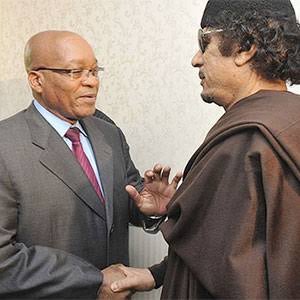
How Zuma and Gadaffi got outwitted by Bush,Blair,Hillary,and Obama.
1. In 2003, Tony Blair and Bush convinced Colonel Gadaffi to give up nuclear program and give up weapons of mass destruction in exchange for the West ending isolation of Libya and lifting sanctions.
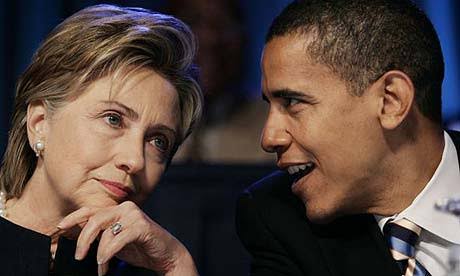
2. In 2011 Hillary and Obama lobbied the current Anglogold Ashanti Senior VP, then SA permanent representative to the UN @BSangqu to vote for NATO military intervention in Libya. Obama confided in Zuma that the intervention is only going to be limited to protecting civilian lives. At face value it seemed like the last resort to achieve peace. The West had already thwarted the African Union led by Zuma to solution which Gaddafi had accepted. The leader of the western sponsored rebels,Mahmoud Jibril wanted Gaddafi gone, denounced Zuma, and refused the AU proposal. He is also the source of lies about billions of Libyan dollars belonging to Gaddafi being stashed in Zuma's house. In all this , Zuma was the stumbling block. Even in voting the way it did, the SA team explained why it was voting for the intervention based , little did they know all the USA needed was a vote to allow intervention, from there onwards it was going to be all in NATO's hands to achieve the mission of ,not of protecting civilians but killing Gaddafi. Hillary Clinton is popular for her "we came, we saw ,he died".
3. The USA made sure it did not end with the elimination of Gaddafi but moved on to a process of smearing Zuma. It was at the beginning of his second term that the western sponsored political tide began turning against Zuma. The western elements had already put their succession plan in motion by placing Cyril Ramaphosa as Deputy President. Manufactured scandals against Zuma began to surface, Soros funded civic organisations to apply pressure, courts were used to deal with the man to the extent that some of his powers were being clipped by the Constitutional Court. Opposition political parties all got drummed up to deal with Zuma in parliament leading to 9 different motions of No Confidence votes against the man. When all these failed, a secret ballot vote was introduced in parliament to impeach President Zuma, the liberal elements of the ANC were now more emboldened and at the forefront of calling for Zuma to resign. He was not going to survive the impeachment vote, so he resigned. BUT that was not to be the end, the chasing continued until they imprisoned him - the end goal has always been his total elimination just like Gaddafi.
So , you must understand this is the reason why the ANC is attacking President Zuma for joining MK. There is now a court case where the ANC wants the IEC to deregister MK. They preferred Zuma isolated within the ANC , now they have 'lost' control of him BUT that doesn't mean their western sponsored philosophy of " a living Zuma is a dangerous Zuma" has changed.
Some people want to know who is funding MK, well i don't know BUT if Gaddafi were alive the mainstream media will be telling you that it is Libya. I wonder why they are not telling us the party is run using " Gaddafi millions stashed in Nkandla".
What remains is that if it weren't for the elimination of Gaddafi, the South African, and African overall political landscape would be different to what it is now. President Zuma might have survived some persecutions he went through.
After Zuma, it is Julius Malema that is going to be managed at all costs. Just because he has been useful to them does not mean they are for him.
I do think that our systems are still colonized. And successive governments including the UPND enjoy the colonialistic nature of our systems. What do I mean?
So on Thursday I meet someone, a person we all know is an intelligent Zambia and we all don't have any doubt he loves this country. I won't mention his name because we all know him. He laments how the systems just make it so difficult to do business and especially new ideas and that his project would actually make the government look good.
I agree with him from experience with a lot of my stuff. Its just practically impossible in Zambia to flourish with new ideas more especially when a there is a dotted involvement by the government. Not bold but dotted. Thats what I mean the systems are colonialistic in nature. There is so much control by the government on new ideas flourishing.
The people who bring new ideas are those with big capitals and overrun Zambians. Thats what happens. You can't imagine an Elon Musk flourishing with Space X a project never ever undertaken by an individual but governments in an environment like ours. Bad example of course but you get the gist?
A lot of us Zambians have brilliant ideas that can help this country and a lot of unemployed youths but the colonialistic rigidity of government systems makes it very hard especially for local Zambians to flourish. Thats why majority of local rich people in Zambia I could be wrong, they must have somehow done business with government or been tenderpreneurs in one way or the other even if today their businesses maybe detached from government. To make it you need wear an everlasting smile for the government somehow even in that case it's very difficult.
I think the top 100 companies plus in America don't make their money by doing business with government but by creating solutions for consumers in one way or the other. And these companies almost all of them were just brilliant new ideas by individuals working in an environment where if your idea is good enough you will be a billionaire guaranteed.
We need an environment where there is a very thin control of what the government does to control ideas from flourishing. We need to sit and build a space for new ideas to flourish if we want to see meaning change in our society. The government must not be a control freak but an enabler of an environment that makes new ideas flurish.
Thats why I say we need a platform of ideas because a lot of Zambians have a lot of good ideas. We need our own Silicon Valley kind of stuff. I can assure you with new technology in various sectors people have solutions for the manufacturing, energy crisis, financial services, agriculture etc. But most ideas must go to the black colonialists in government with a mentality of this can't happen and that's how most ideas die.
We can do it if we want to.