💸 MoneyGram se une a Google Cloud y Vodafone como nodo fundador de la red Midnight de Cardano, enfocada en privacidad. La iniciativa busca integrar stablecoins en pagos internacionales y operar bajo un modelo federado para garantizar estabilidad y cumplimiento regulatorio.
Caso hipotético (o no): una empresa se constituye en marzo de 2019. Cero empleados, cero web, cero historial. A los seis meses se lleva un contrato público de 400K€ como único licitador. A los tres meses se disuelve.
Plot twist: su administrador es el mismo que el de otras dos sociedades que licitan al mismo organismo. Misma dirección fiscal las tres.
Hasta ahora no había forma automatizada de detectarlo cruzando fuentes públicas.
Me he descargado ∼64.000 pdf (2001-2026) del BORME para cruzar el Registro Mercantil con la contratación pública española.
El objetivo es construir un grafo real de relaciones societarias y detectar patrones que hoy pasan desapercibidos. Detectar empresas vinculadas dependía de heurísticas: fuzzy matching por nombre similar o NIFs consecutivos.
Pasamos de "estas dos empresas se llaman parecido" a "estas dos empresas comparten administrador y se constituyeron con tres días de diferencia".
Os subiré el scraper y el parser cuando los tenga afinados.
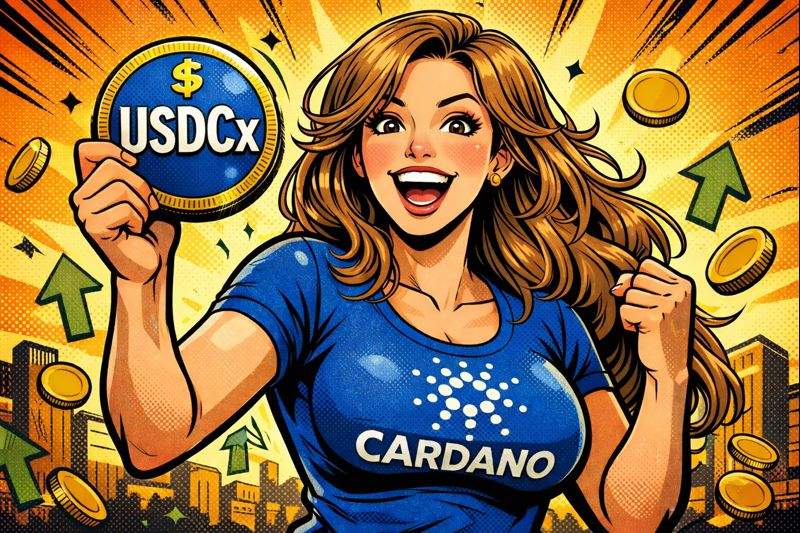
USDC might be better for Cardano than USDCx, but it’s certainly a good start.
USDC is a fiat-backed stablecoin that is widely recognized, liquid, and supported across wallets, exchanges, and protocols.
It’s natively issued on over 30 blockchains (mostly EVM chains) with a supply of $70B.
USDCx is a derivative/wrapper of USDC.
USDCx is a Circle-issued, 1:1 USDC-backed variant that enables USDC functionality on chains where canonical USDC is not yet available, such as Cardano.
USDCx incorporates ZK proofs for banking-level privacy in transactions, shielding details while remaining compliant.
Standard USDC lacks this built-in privacy.
USDC is globally understood and adopted. It is the second most widely used stablecoin after USDT (with a supply of $185B).
USDCx will require extra explanation to users and extra steps for integration. It may be more difficult to bootstrap liquidity.
USDCx does not require third-party bridges for deployment on Cardano.
It's directly backed 1:1 by USDC reserves held in Circle's xReserve smart contracts. xReserve is a protocol deployed and managed by Circle.
USDCx will be a Cardano Native Token but functions as a 1:1 representation of USDC.
The great thing is that, unlike some USDC implementations, USDCx cannot be frozen by Circle, aligning with Cardano's principles.
USDCx isn't widely listed on CEXs yet, so direct deposits and withdrawals might be limited. Moreover, support for CNTs is also limited.
However, it will be possible to hold USDCx on Cardano and deposit USDC on CEXs through a web application (or perhaps wallet integration) that will convert USDCx to USDC in the background. It will work in one click.
If I understand correctly, minting will be done by users depositing USDC into the xReserve contract on the source chain. This triggers minting of an equivalent amount of USDCx on Cardano via Circle's attestation service.
Burning and redemption will be done analogously. First, USDCx is burned on Cardano. Then xReserve releases the backing USDC on the source chain after verification.
For the record, the supply overview of Cardano stablecoins:
- USDM: 14.4M
- USDA: 11.7M
The success of the USDCx integration will depend primarily on liquidity.
The active proposal requesting 50M ADA to inject stablecoins into Cardano DeFi should consider USDCx.
The team should probably ask the community and DReps which stablecoin they want to support.
Given the current low price of ADA, it is necessary to think about how many stablecoins to support.
I estimate that currently, only about $10M worth of stablecoins could be minted. Market conditions may change. This is a challenge.
I am glad that Pentad delivered.
The specific terms of the agreement have not been disclosed, so I do not know whether native USDC could have been delivered or whether USDCx represents the most feasible option.
Congratulations to the Pentad team on this deal.
1⃣ Parece una calle cualquiera, pero el número 35 del Carrer de l'Avenir de Barcelona —concretamente la 2ª puerta de la planta 6ª— es el domicilio más mencionado en el Boletín Oficial del Registro Mercantil (BORME) durante los últimos 20 años. Sale en 2.196 ocasiones.
¿Por qué?
Finance is moving onchain. Vaults are a key part of that, offering investors a transparent way to earn digital yield on their assets.
Today, we’re excited to announce that Bitwise is launching non-custodial vault strategies as a curator on @Morpho.
The quick details:
- Bitwise’s first strategy on Morpho currently targets 6% APY, investing in overcollateralized lending pools.
- Vault curation, strategy, and risk management will be led by Bitwise’s Portfolio Manager & Head of Multi-Strategy Solutions, Jonathan Man, CFA.
- The offering leverages Bitwise’s 140-person team of professionals and more than eight-year track record as a crypto specialist.
We believe the future is onchain, and we’re delighted to help sophisticated investors participate in the opportunities vaults provide.
More to come. Feel free to reach out—input welcome.
HAS ESTADO BLOQUEANDO LAS LLAMADAS SPAM MAL TODO ESTE TIEMPO.
Cada vez que rechazas una llamada, confirmas que tu número está activo.
Las llamadas se multiplican.
Esto es lo que sí funciona de verdad:
My take, y no es consejo de inversion: Fintechs con productos que combinen DeFi con servicios financieros, y si encima piden licencia bancaria, mejor. Que estén reguladas en algún sitio.
📉 POWELL ACABA DE CAMBIAR EL JUEGO… Y CRYPTO LO VA A SENTIR
La Fed acaba de hablar, y lo que dijo Powell es mucho más importante de lo que la mayoría entiende.
Los recortes de tipos se PAUSAN.
La inflación sigue alta.
El dólar se mantiene fuerte.
Y eso mete presión a todo el mercado crypto.
Pero aquí viene lo que nadie está diciendo:
👉 A partir del 12 de diciembre, la Fed va a inyectar 40 BILLONES al mes en Treasury Bills.
Es decir: liquidez real entrando al sistema.
Estamos en el escenario más confuso del año:
hawkish en tipos, dovish en liquidez.
Un cóctel raro que puede mover a Bitcoin en cualquier dirección.
A corto plazo: más volatilidad.
A medio plazo: la liquidez puede cambiarlo todo.
2026 puede ser un año explosivo… o un año lateral.
Depende de dos cosas:
Si la inflación baja
Si llega un nuevo catalizador para crypto.
Y ahora quiero saber tu opinión 👇
¿Cómo ves 2026? Alcista, bajista o lateral?
💬 Te leemos en los comentarios
Si te interesan las stablecoins, las nuevas formas de pago con EMTs o como es ya el presente de las infraestructuras para mover dinero, acabo de publicar en abierto.