You can own an LLC and keep your name off the public filing. Wyoming, Delaware, Nevada and South Dakota allow attorney-client privilege on formation, so the attorney's name shows, not yours. Privacy is a structure, not a secret.
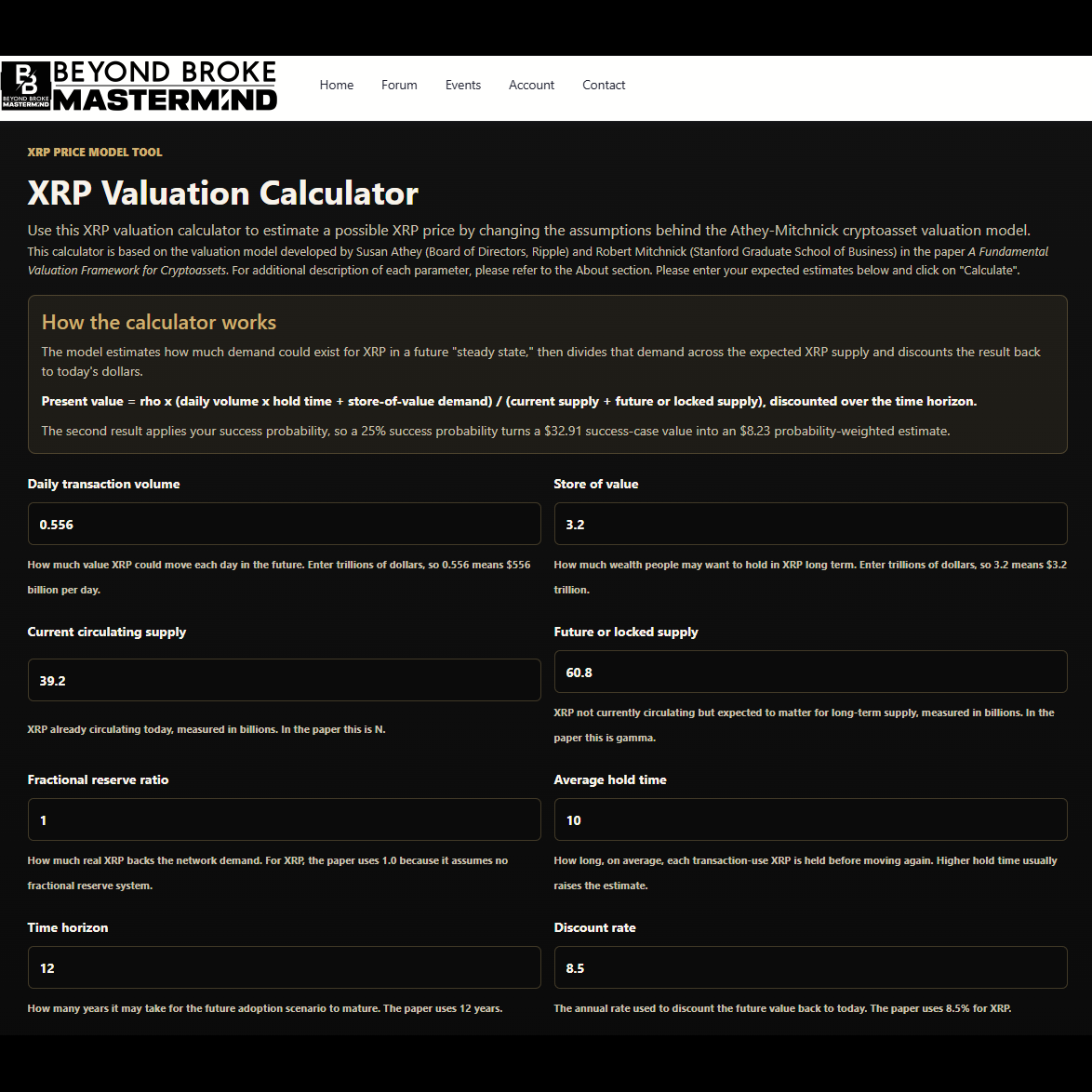
We recreated Robbie Mitchnick's XRP valuation calculator on the BBMM site:
https://t.co/qCCeImDGit
Try this XRP valuation calculator to estimate a possible XRP price by changing the assumptions behind the Athey-Mitchnick cryptoasset valuation model
Most CPAs structure your crypto LLC wrong. They default you into a 'trading company', fine if you trade, brutal if you hold, because every sale gets taxed as short-term gains forever. If you're long-term you want a holding structure. Ask before you file.
A couple million won't retire you the way you think. At a safe rate you're still eating into principal over a long life. The number where the math actually works sits closer to $10M, roughly $500k a year without touching the base. What's your real number?
Tired of guessing how to legally hold and protect your crypto?
Grab a free copy of The Crypto LLC Briefing here: https://t.co/JtnxFbfRla
It breaks down how a Crypto LLC can help with entity setup, asset protection, tax efficiency, and long-term wealth structuring for digital assets.
Clear, practical, and worth reading if you’re serious about building in crypto the right way.
How the wealthy actually use debt: borrow against an asset, put the cash into something yielding more than the interest. The spread services the loan. You never sell, never trigger the tax, and the underlying keeps compounding. Debt as a tool, not a trap.
The '80 types of trusts' marketing is noise. A trust isn't bought off a shelf, it's a set of clauses woven to fit your family. Spendthrift, dynasty, charitable remainder: just bundles of language. A real estate planner builds yours from scratch.
The wealthiest families of the last century didn't become rich because they consumed oil.
They became rich because they owned the asset and infrastructure the world depended on.
John D. Rockefeller didn't get wealthy by driving more carriages or burning more kerosene than everyone else. He built an empire around the asset that powered the industrial age.
As oil became the lifeblood of the global economy, the value of owning oil fields, pipelines, refineries, and energy companies compounded for generations.
Today, we are watching the digitization of value itself.
If oil was the asset that moved the world in the 20th century, what becomes the asset that moves money in the 21st?
The biggest fortunes are often built by owning the infrastructure behind a global trend long before the rest of the world recognizes its importance.
The Rockefellers understood oil.
The next generation of wealth may be built around understanding the movement of value.
Great to attend Hamptons Tech Week Fintech and Digital Asset Forum out at Montauk Yacht Club where I spoke on a panel with Philippe Naegeli, Giuliano Celle, Pete Casella, and Zac Atkins talking through where fintech and digital assets are heading
Thanks to Overheard On Wall St for putting this together. These are the rooms where the good ideas take shape
Rich people don't have 'a trust.' They run seven to nine at once. US contract law has 80+ types, each a different tool, some defer taxes, some shield assets, some control how heirs inherit. A trust isn't a product. It's a toolkit.
Having too much money is a real problem. Warren Buffett sits on $400B with almost nowhere to put it but Treasuries. The bigger the pile, the harder it is to earn a real return on all of it. The small investor edge nobody talks about. Where would you park $400B?
Taxes are the single largest expense of your life. Bigger than the house, the cars, the tuition. The wealthy don't sell assets and hand a third to capital gains. They borrow against them and let the asset keep compounding. You're supposed to only get rich once.