APL Apollo × Tata Steel - Smart Deal for Tata, Costly for Minority Shareholders?
Here's what makes this transaction particularly interesting!
Tata Steel is selling its tubes & colour coated steel businesses to APL Apollo for 28,000 Cr while simultaneously acquiring control of APL Apollo!
Essentially, APL Apollo raises debt to purchase Tata Steel's assets, and Tata uses the proceeds towards acquiring a controlling stake in APL Apollo!
Now look at the implications!
- APL Apollo's promoters walk away with a cool 15,510 Cr from their stake sale!
- Tata Steel could acquire up to 52% of APL Apollo for approx 32,266 Cr, translating into a net cash outlay of just 4,266 Cr after adjusting for the 28,000 Cr asset sale proceeds!
- APL Apollo's minority shareholders face the burden of additional debt, potential equity dilution & uncertainty!
One of the most interesting examples of financial engineering in recent times!
After four decades of being in the Investment Banking space, am a seeing a deal that's so universally panned and slaughtered like this apology of a governance package, called the Tata Steel APL deal!
It's so patently arbitrary and positively hostile to shareholder interest (1/n)
@soicfinance What about the other uncomfortable conclusion? That the stock was so expensive and prospects not worth the valuations - it’s better to sell to large player who will grow in line with nominal gdp?
Intelligent article pandering to intelligentsia:-) . Corporates don’t care a damn .
Policy , it’s execution & measurement of policy action are the only solutions to a self inflicted mess !
Stop hoarding profits, start creating jobs
By Prabhuchawla
No generation of Indian industrialists has been pampered as this one has. It must not betray the government that believed in it.
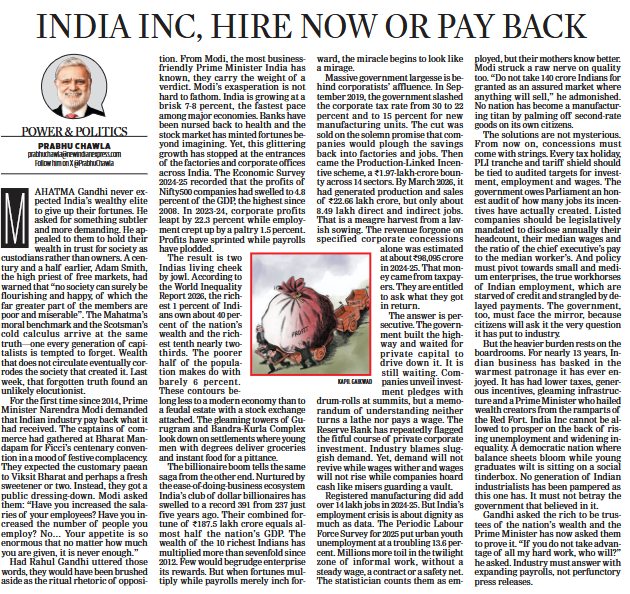
Mahatma Gandhi never expected India’s wealthy elite to give up their fortunes. He asked for something subtler and more demanding. He appealed to them to hold their wealth in trust for society as custodians rather than owners. A century and a half earlier, Adam Smith, the high priest of free markets, had warned that “no society can surely be flourishing and happy, of which the far greater part of the members are poor and miserable”. The Mahatma’s moral benchmark and the Scotsman’s cold calculus arrive at the same truth—one every generation of capitalists is tempted to forget. Wealth that does not circulate eventually corrodes the society that created it. Last week, that forgotten truth found an unlikely elocutionist.
For the first time since 2014, Prime Minister Narendra Modi demanded that Indian industry pay back what it had received. The captains of commerce had gathered at Bharat Mandapam for Ficci’s centenary convention in a mood of festive complacency. They expected the customary paean to Viksit Bharat and perhaps a fresh sweetener or two. Instead, they got a public dressing-down. Modi asked them: “Have you increased the salaries of your employees? Have you increased the number of people you employ? No… Your appetite is so enormous that no matter how much you are given, it is never enough.”
Had Rahul Gandhi uttered those words, they would have been brushed aside as the ritual rhetoric of opposition. From Modi, the most business-friendly Prime Minister India has known, they carry the weight of a verdict. Modi’s exasperation is not hard to fathom. India is growing at a brisk 7-8 percent, the fastest pace among major economies.
Banks have been nursed back to health and the stock market has minted fortunes beyond imagining. Yet, this glittering growth has stopped at the entrances of the factories and corporate offices across India. The Economic Survey 2024-25 recorded that the profits of Nifty500 companies had swelled to 4.8 percent of the GDP, the highest since 2008. In 2023-24, corporate profits leapt by 22.3 percent while employment crept up by a paltry 1.5 percent. Profits have sprinted while payrolls have plodded.
The result is two Indias living cheek by jowl. According to the World Inequality Report 2026, the richest 1 percent of Indians own about 40 percent of the nation’s wealth and the richest tenth nearly two-thirds. The poorer half of the population makes do with barely 6 percent. These contours belong less to a modern economy than to a feudal estate with a stock exchange attached. The gleaming towers of Gurugram and Bandra-Kurla Complex look down on settlements where young men with degrees deliver groceries and instant food for a pittance.
The billionaire boom tells the same saga from the other end. Nurtured by the ease-of-doing-business ecosystem India’s club of dollar billionaires has swelled to a record 391 from 237 just five years ago. Their combined fortune of Rs 187.5 lakh crore equals almost half the nation’s GDP. The wealth of the 10 richest Indians has multiplied more than sevenfold since 2012. Few would begrudge enterprise its rewards. But when fortunes multiply while payrolls merely inch forward, the miracle begins to look like a mirage.
Massive government largesse is behind corporatists’ affluence. In September 2019, the government slashed the corporate tax rate from 30 to 22 percent and to 15 percent for new manufacturing units. The cut was sold on the solemn promise that companies would plough the savings back into factories and jobs.
Then came the Production-Linked Incentive scheme, a Rs 1.97-lakh-crore bounty across 14 sectors. By March 2026, it had generated production and sales of Rs 22.66 lakh crore, but only about 8.49 lakh direct and indirect jobs. That is a meagre harvest from a lavish sowing. The revenue forgone on specified corporate concessions alone was estimated at about Rs 98,095 crore in 2024-25. That money came from taxpayers. They are entitled to ask what they got in return.
The answer is persecutive. The government built the highway and waited for private capital to drive down it. It is still waiting. Companies unveil investment pledges with drum-rolls at summits, but a memorandum of understanding neither turns a lathe nor pays a wage. The Reserve Bank has repeatedly flagged the fitful course of private corporate investment. Industry blames sluggish demand. Yet, demand will not revive while wages wither and wages will not rise while companies hoard cash like misers guarding a vault.
Registered manufacturing did add over 14 lakh jobs in 2024-25. But India’s employment crisis is about dignity as much as data. The Periodic Labour Force Survey for 2025 put urban youth unemployment at a troubling 13.6 percent. Millions more toil in the twilight zone of informal work, without a steady wage, a contract or a safety net. The statistician counts them as employed, but their mothers know better. Modi struck a raw nerve on quality too. “Do not take 140 crore Indians for granted as an assured market where anything will sell,” he admonished. No nation has become a manufacturing titan by palming off second-rate goods on its own citizens.
The solutions are not mysterious. From now on, concessions must come with strings. Every tax holiday, PLI tranche and tariff shield should be tied to audited targets for investment, employment and wages. The government owes Parliament an honest audit of how many jobs its incentives have actually created.
Listed companies should be legislatively mandated to disclose annually their headcount, their median wages and the ratio of the chief executive’s pay to the median worker’s. And policy must pivot towards small and medium enterprises, the true workhorses of Indian employment, which are starved of credit and strangled by delayed payments. The government, too, must face the mirror, because citizens will ask it the very question it has put to industry.
But the heavier burden rests on the boardrooms. For nearly 13 years, Indian business has basked in the warmest patronage it has ever enjoyed. It has had lower taxes, generous incentives, gleaming infrastructure and a Prime Minister who hailed wealth creators from the ramparts of the Red Fort. India Inc cannot be allowed to prosper on the back of rising unemployment and widening inequality.
A democratic nation where balance sheets bloom while young graduates wilt is sitting on a social tinderbox. No generation of Indian industrialists has been pampered as this one has. It must not betray the government that believed in it.
Gandhi asked the rich to be trustees of the nation’s wealth and the Prime Minister has now asked them to prove it. “If you do not take advantage of all my hard work, who will?” he asked. Industry must answer with expanding payrolls, not perfunctory press releases.
Now, Class, repeat after me. I will never buy cyclicals at low PEs and record earnings. Say it again. I will never buy cyclicals at low PEs and record earnings.
This sell-off has been driven by a perfect storm created by: 1) The Blue Tidal Wave win and fears about an anti-AI/anti-datacenter DC, 2) losing the global leader of the AI Revolution Jensen in his black eye moment, 3) China driven regulatory concerns across the rest of semis/memory stocks (e.g. AMD short report yesterday), 4) multiple market clearing events which have just led to more selling, 5)Anthropic IPO being a massive success but marginally reducing liquidity from other tech names, 6) significant fund P&L pain diminishing buying power, and 7) sticky inflation and hawkish Fed speak with concerns around more hikes and constricting financial conditions….The $4 trillion AI buildout is still happening and our tech thesis into 2027 remains.
A corporates responsibility is to pay taxes honestly , follow laws and increase share holder profits . GOI is accountable for competition laws , industrial policy , etc
Such statements don’t work - wages are a function of supply & demand . Corporates will be driven by shareholders- taxation and a friendly positive industrial policy is the governments remit and that should be it’s sole focus !
Risks to market cycles are always unique - the sudden implosion of Nvidia management & swift turnarounds in oil - makes you realise that humility is an essential virtue in investing.
Indians love debating which state is better. And everyone has their favourite.
The problem is, most arguments here are based on perceptions. Rarely on data
So I thought, why not try & change that?
Introducing a new way to settle state vs state debates
https://t.co/vUypJJIIfU
Today we’re launching the first AI modeling agency 💅 right inside Glif.
Cast hundreds of real AI models, drop your product, idea or brief and let Glif create super compelling content for you end to end.
If you still think AI models aren’t ready for real work, watch this 👇
A ‘hello world’ milestone for Project Suncatcher 🚀
After launching our prototype satellite a few weeks ago, we’ve now successfully sent a command up to orbit, booted up the TPU, ran the prompt, and received our first complete response back on earth - a haiku!