10 database questions before going to production
1. What are the indexes?
2. What are the slow queries?
3. What happens at 10× data?
4. Are transactions small?
5. Are constraints enforced?
6. Is pagination efficient?
7. What happens during locks?
8. Are backups tested?
9. Can migrations roll back?
10. What happens when the DB is unavailable?
Researchers at Oxford argue that LLMs can't invent anything.
It's impossible mathematically.
The paper is called "Theory Is All You Need."
Teppo Felin and Matthias Holweg take the famous "Attention Is All You Need" title and flip it. Their argument is that AI predicts from the past, while humans reason forward into the future, and those are two different kinds of thinking.
Start with the numbers. The authors estimate a large language model trains on roughly 13 trillion tokens. A human reading at 150 words a minute would need about 164,000 years to get through that. A child hears around 20,000 words a day and roughly 36.5 million words in their first five years. It's the same task with wildly different data, and the child still ends up with language that goes far beyond anything they heard.
Their point is that the model learns which words tend to follow other words. It becomes a mirror of what people have already written. It doesn't build a theory of how the world works, so it can't step outside its training data.
The paper's sharpest thought experiment makes this painful. Imagine an LLM trained in 1633 on every scientific text ever written up to that point. Ask it about Galileo and heliocentrism. Thousands of years of geocentric texts would swamp Galileo's ideas, so the model would tell you he's wrong. It would also rate Tycho Brahe's astrology as more credible than the idea that the Earth moves, because more people had written about astrology.
Then there's flight. In 1888 the scientist Joseph LeConte looked at bird data, noted that no bird above 50 pounds could fly, and concluded humans couldn't either. Lord Kelvin, then president of the Royal Society, said he had not the smallest molecule of faith in aerial navigation.
The New York Times estimated in 1903 that flight was one to ten million years away.
Nine weeks later the Wright brothers flew.
The Wrights didn't have better data. They had a theory. They broke flight into three problems, lift, propulsion, and steering, built their own wind tunnels, and generated the data that didn't exist yet.
Wilbur wrote in 1900 that he had been "afflicted with the belief that flight is possible to man."
Every prediction machine on Earth would have told him no.
The authors call this the data belief asymmetry. Every real breakthrough starts with someone believing something the existing data says is wrong. A system trained to minimize surprise can't do that by design.
They're not anti AI. They say AI will win at routine, repetitive decisions that extrapolate from the past, which is most decisions. They're just pushing back on the idea that you should replace humans with algorithms whenever possible, which is a direct quote from Kahneman.
I use these models every day and this matches what I see. The new stuff comes from the human at the keyboard who decides the data is wrong.
LLMs don't think, you do!
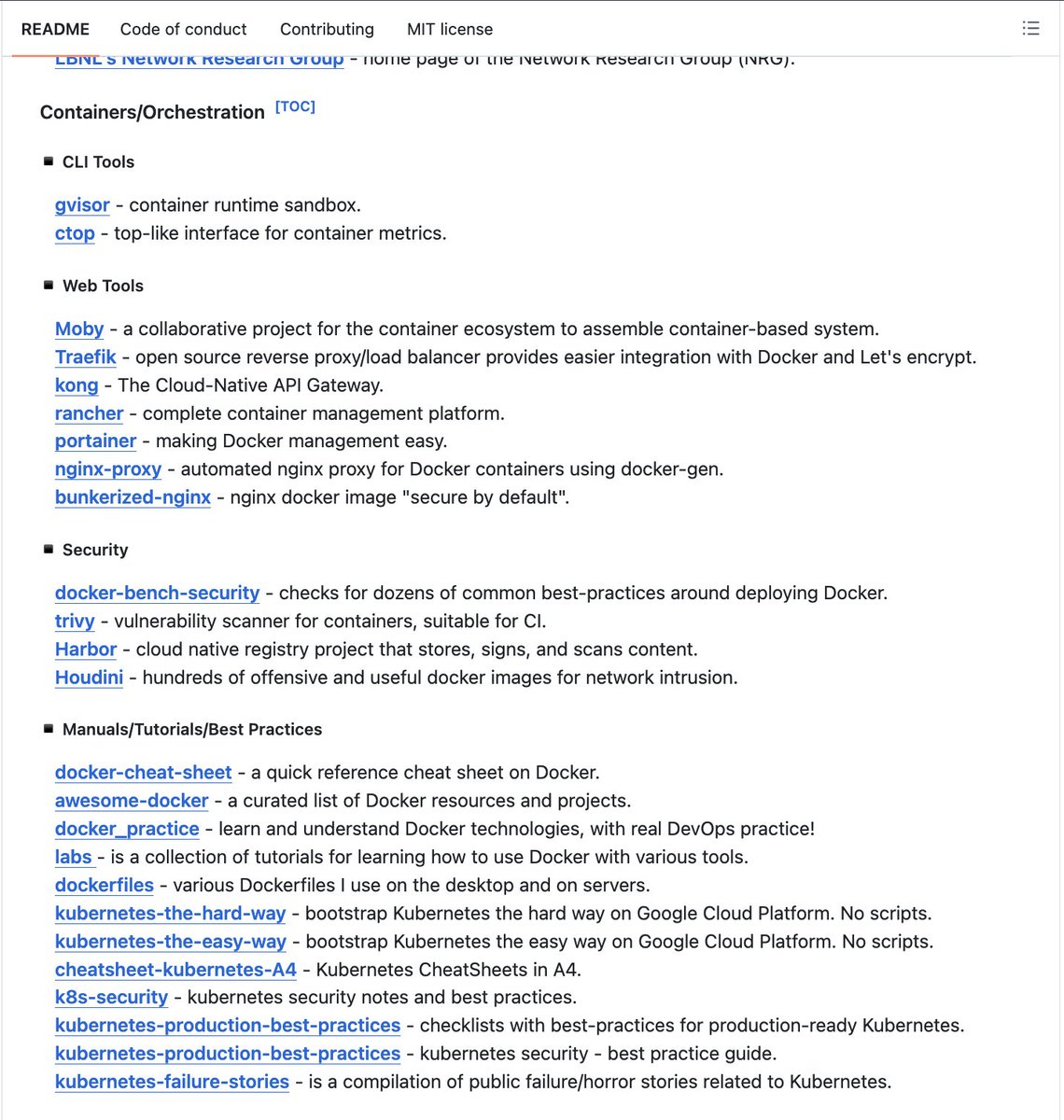
Trust me, learning system is not hard. If you want to get GOAT-level good, start from these fundamental concepts:
This formed the foundations of the concepts I applied when I appeared for system design rounds at companies like: Amazon, Atlassian, Walmart, Saleforce, and Deliveroo.
1) Load Balancing: https://t.co/IytjJseO11
2) CDN: https://t.co/xxzUuwV5GD
3) Caching: https://t.co/QvyGIyKNHM
4) Cache Invalidation: https://t.co/FyDLJWZVOE
5) Rate Limiting: https://t.co/auDKgPpLeA
6) API Gateway: https://t.co/H1y0htWDub
7) CAP Theorem: https://t.co/AglSd993oa
8) Sharding: https://t.co/HT316hgoEr
9) Replication: https://t.co/NXessCjYp4
10) Partitioning: https://t.co/01bpFCZBhZ
11) Queues: https://t.co/Lenx1Pfw95
12) Microservices: https://t.co/Hx9Yn2yRBw
13) Microservices Vs Monoliths: https://t.co/g9lGFHydVj
14) Fault Tolerance: https://t.co/jCJk6d52z2
15) Database Scaling: https://t.co/h7pYha8x6x
16) Service Discovery: https://t.co/vEDMvhWYj5
17) Consistency models: https://t.co/cb3zNtdZNA
18) Eventual Consistency: https://t.co/aFjL3flHNY
19) Distributed Transactions: https://t.co/s0ZWdtTqiW
20) Leader Election: https://t.co/IxrWO9AvB3
21) Horizontal vs Vertical Scaling: https://t.co/I8CH64dL5l
22) Back of the Envelope Estimation: https://t.co/gyatcqpaqO
23) Idempotency, Data Latency & Finale: https://t.co/fNArLx4MrW
this paper is f*cking insane
it shows how easy it is to “discover alpha” that never existed
the paper simulated 10,000 random strategies and found that even pure noise can produce backtests with Sharpe ratios that look genuinely impressive
the framework is brutal:
test out-of-sample
add real costs
check multiple testing
stress different regimes
assume the backtest is guilty first
the crazy part is what happens after validation
strategies with 1.8–2.1 Sharpe in-sample collapse toward 0 once fresh data and friction hit
the more strategies you test, the more likely you are to find a winner by accident
most traders optimize for the highest Sharpe
real quants optimize for what survives
bookmark this before your next backtest convinces you you’re a genius
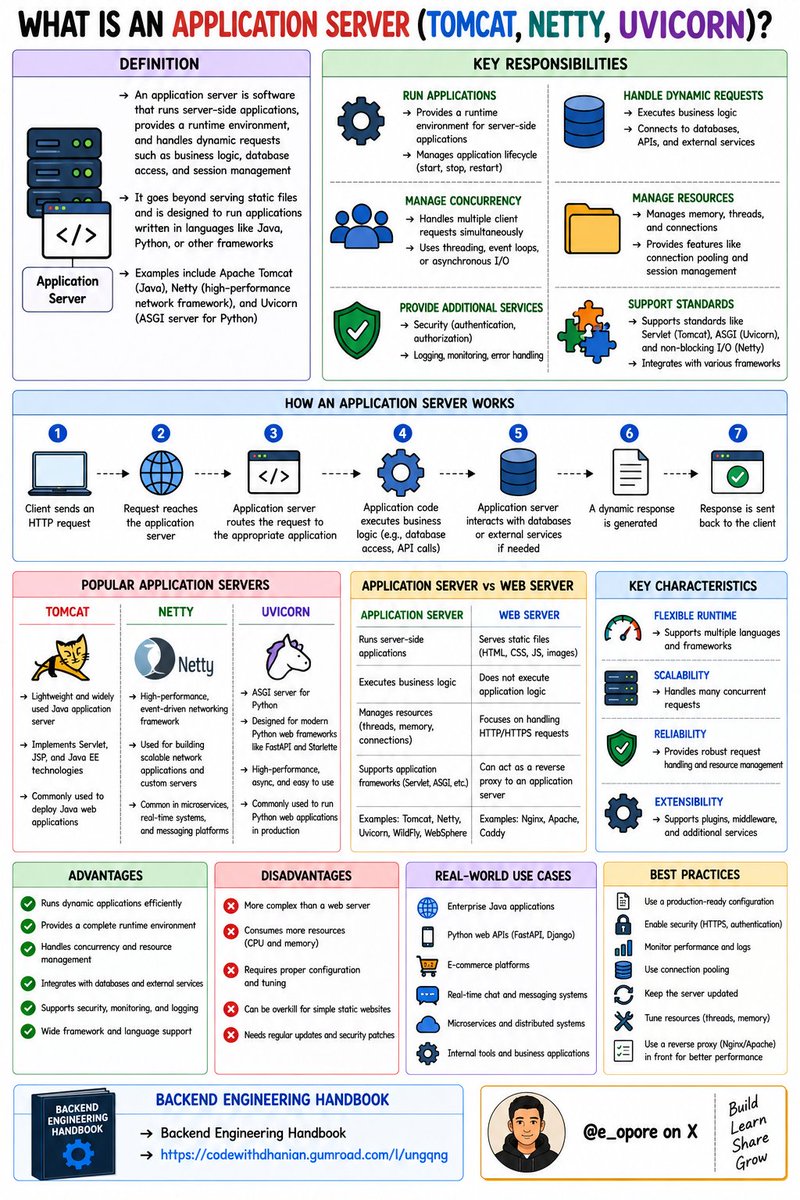
𝐖𝐇𝐀𝐓 𝐈𝐒 𝐀𝐍 𝐀𝐏𝐏𝐋𝐈𝐂𝐀𝐓𝐈𝐎𝐍 𝐒𝐄𝐑𝐕𝐄𝐑 (𝐓𝐎𝐌𝐂𝐀𝐓, 𝐍𝐄𝐓𝐓𝐘, 𝐔𝐕𝐈𝐂𝐎𝐑𝐍)?
DEFINITION
-> An Application Server is software that runs and manages server-side application code
-> It provides a runtime environment for executing application logic and handling dynamic requests
-> It can communicate with databases, APIs, message queues, and other services
-> Examples include Tomcat, Netty, and Uvicorn
CORE RESPONSIBILITIES
RUN APPLICATION CODE
-> Executes server-side application logic
-> Provides a runtime environment for applications
HANDLE DYNAMIC REQUESTS
-> Processes business logic
-> Interacts with databases, APIs, and external services
MANAGE RESOURCES
-> Manages threads, memory, and network connections
-> Handles connection pooling and session management
PROVIDE APPLICATION FEATURES
-> Supports authentication, authorization, logging, and monitoring
-> Integrates applications with other services
HOW AN APPLICATION SERVER WORKS
-> Client sends an HTTP/HTTPS request
-> Web server or proxy forwards the request to the application server
-> Application server receives and routes the request
-> Application code executes the required business logic
-> Application server interacts with databases or external services if needed
-> A dynamic response is generated
-> Response is returned to the client
POPULAR APPLICATION SERVERS
TOMCAT
-> Lightweight, open-source Java application server
-> Implements Jakarta Servlet and related specifications
-> Commonly used to deploy Java web applications
NETTY
-> High-performance, event-driven networking framework for Java
-> Provides asynchronous and non-blocking networking APIs
-> Commonly used for real-time systems, microservices, and custom network applications
UVICORN
-> Lightning-fast ASGI server for Python
-> Designed for asynchronous Python web applications
-> Commonly used with FastAPI and other ASGI frameworks
KEY CHARACTERISTICS
-> APPLICATION EXECUTION
-> Runs server-side application code and processes dynamic content
-> CONCURRENCY
-> Handles multiple client requests simultaneously
-> SCALABILITY
-> Supports applications that need to handle increasing traffic
-> INTEGRATION
-> Connects applications with databases, APIs, queues, and other services
ADVANTAGES
-> Runs dynamic application code efficiently
-> Provides a runtime environment for applications
-> Handles concurrent requests
-> Supports enterprise application features
-> Works with different frameworks and languages
-> Enables scalable and reliable applications
DISADVANTAGES
-> More complex than a simple web server
-> Can consume significant CPU and memory
-> Requires proper configuration and management
-> Can be unnecessary for simple static websites
APPLICATION SERVER VS WEB SERVER
-> Application Server runs application code and handles dynamic requests
-> Web Server primarily serves static files and handles HTTP/HTTPS traffic
-> Application Server executes business logic
-> Web Server commonly acts as a reverse proxy for application servers
-> Application Servers include Tomcat, Netty, and Uvicorn
-> Web Servers include Nginx, Apache, and Caddy
REAL-WORLD USE CASES
-> Java web applications (Tomcat)
-> Real-time communication systems (Netty)
-> Python web APIs (Uvicorn)
-> E-commerce platforms
-> Enterprise applications
-> Microservices and cloud-native applications
-> Custom networking services
BEST PRACTICES
-> Use a web server or reverse proxy when appropriate
-> Enable HTTPS and security features
-> Optimize application server configuration
-> Monitor logs, metrics, and application performance
-> Use connection pooling and resource management
-> Keep the application server updated
-> Follow framework-specific production best practices
BACKEND ENGINEERING HANDBOOK
-> Backend Engineering Handbook
-> https://t.co/t9mqUuRbjx
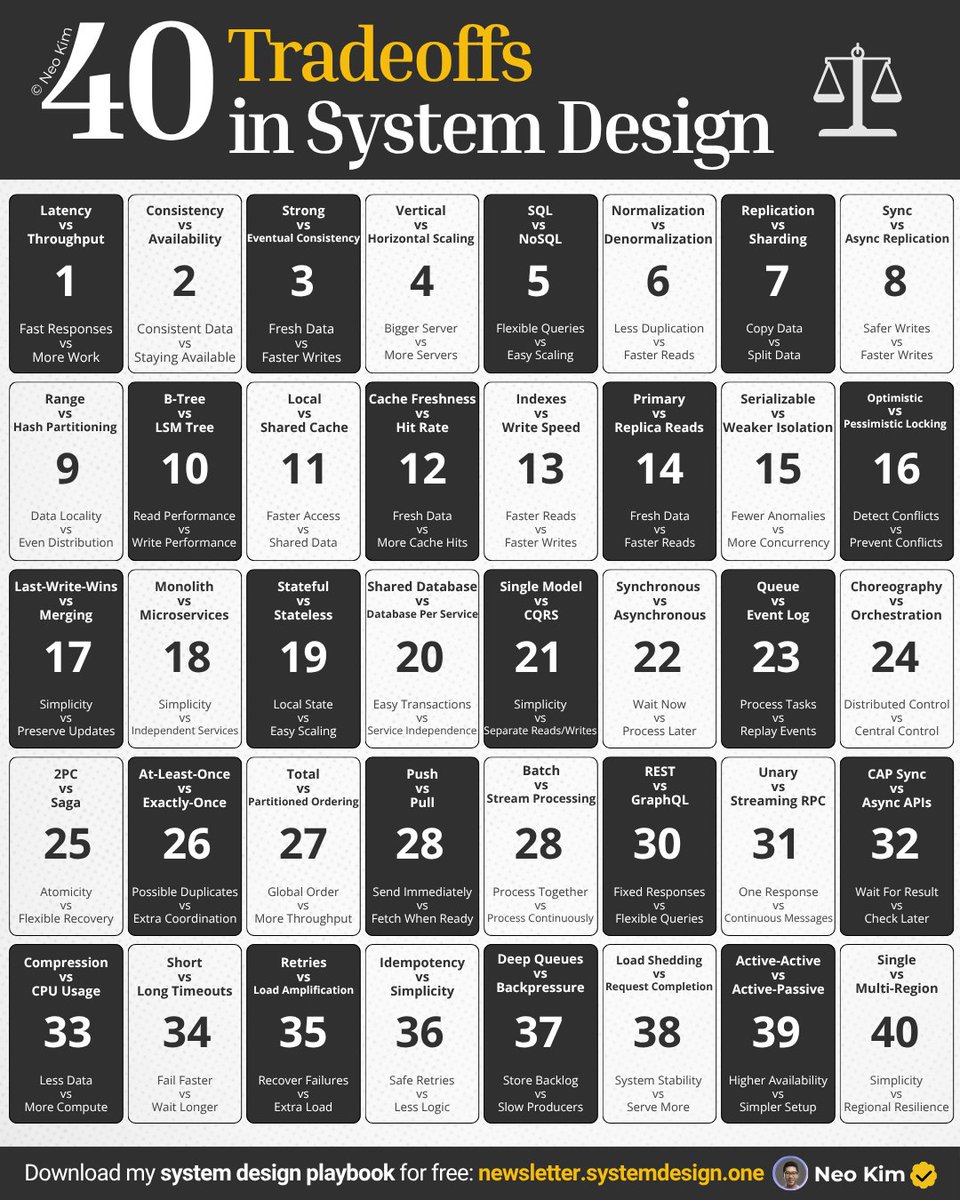
If I had to design a system, here are 40 tradeoffs I'd consider (save now):
1 Latency vs Throughput
2 Consistency vs Availability
3 Strong vs Eventual Consistency
4 Vertical vs Horizontal Scaling
5 SQL vs NoSQL
6 Normalization vs Denormalization
7 Replication vs Sharding
8 Sync vs Async Replication
9 Range vs Hash Partitioning
10 B-Tree vs LSM Tree
11 Local vs Shared Cache
12 Cache Freshness vs Hit Rate
13 Indexes vs Write Speed
14 Primary vs Replica Reads
15 Serializable vs Weaker Isolation
16 Optimistic vs Pessimistic Locking
17 Last-Write-Wins vs Merging
18 Monolith vs Microservices
19 Stateful vs Stateless
20 Shared Database vs Database Per Service
21 Single Model vs CQRS
22 Synchronous vs Asynchronous
23 Queue vs Event Log
24 Choreography vs Orchestration
25 2PC vs Saga
26 At-Least-Once vs Exactly-Once
27 Total vs Partitioned Ordering
28 Push vs Pull
29 Batch vs Stream Processing
30 REST vs GraphQL
31 Unary vs Streaming RPC
32 Sync vs Async APIs
33 Compression vs CPU Usage
34 Short vs Long Timeouts
35 Retries vs Load Amplification
36 Idempotency vs Simplicity
37 Deep Queues vs Backpressure
38 Load Shedding vs Request Completion
39 Active-Active vs Active-Passive
40 Single vs Multi-Region
Learn which tradeoffs your workload can afford, not just know that they exist...
What else should make this list?
===
👋 PS - Want a detailed breakdown of system design tradeoffs?
Read right now:
→ https://t.co/LcHXHQCijC
===
♻ RT to help others become good at system design.
👤 Follow @systemdesignone + turn on notifications.
DevOps looks easy until the interviewer goes DEEP.
- You can run Docker.
- You can deploy to Kubernetes.
- You can build CI/CD pipelines.
But then the interviewer asks:
“What happens internally?”
Here are 20 DevOps interview questions that test whether you actually understand what’s happening under the hood:
1. How does Kubernetes decide which node to schedule a Pod on?
2. What happens internally when you run `kubectl apply`?
3. How does Kubernetes Service Discovery work?
4. What is the difference between readiness and liveness probes internally?
5. How does HPA make scaling decisions?
6. What happens internally when you run `docker run`?
7. How does Docker layer caching work?
8. How does Terraform’s dependency graph (DAG) work internally?
9. How does Terraform handle state locking and consistency?
10. What happens internally in a CI/CD pipeline from commit → deploy?
11. How does a pipeline handle parallel jobs and dependencies?
12. How does an AWS Load Balancer route traffic?
13. What happens internally when you hit a CloudFront URL?
14. How does DNS resolution work step by step?
15. How do Git merge and rebase differ internally?
16. How does Kubernetes handle Pod failures and self-healing?
17. What happens during a rolling deployment in Kubernetes?
18. How do logs, metrics, and traces work together in observability?
19. Your production system goes down. How do you approach troubleshooting?
20. What are the most common production mistakes in DevOps setups?
Knowing the commands makes you a user.Understanding what happens underneath makes you an engineer.
Save this for your next DevOps interview.
Most DevOps work in 2026 is still fundamentals. If you can do these 10 things, you can run real systems.
1) SLIs/SLOs + error budgets
If you can’t name p95 latency, availability, and allowed burn rate, you’re just chasing alerts.
2) Capacity math
CPU, memory, disk IOPS, network, and queue depth. Know your headroom and how fast you eat it during a spike.
3) Deploy safety
Small batches, canaries, fast rollback, feature flags. Shipping less per deploy beats heroic incident response.
4) Infra as code with state discipline
Terraform is easy until state drifts. Locking, reviews, and least-privileged apply roles prevent 2am surprises.
5) Containers and scheduling basics
Requests vs limits, OOMKilled vs throttling, node pressure. Most “Kubernetes issues” are resource math issues.
6) Networking you can debug
DNS, TLS, MTU, NAT, timeouts, retries. Half the outages are a 30s client timeout plus a 60s load balancer idle.
7) Observability that answers why
Metrics for saturation, logs with correlation IDs, traces for fanout. If you can’t follow one request end-to-end, you’re blind.
8) Incident handling muscle
Triage by impact, stop the bleed, then learn. No Slack archaeology: timeline, owner, mitigations, follow-ups.
9) Security as plumbing
Secrets in a manager, short-lived creds, patch cadence, audit logs. The common mistake is long-lived tokens in CI.
10) Backups + restores you actually test
Backups without a restore drill are theater. Measure RPO/RTO and practice restoring prod-like data to a new cluster.
Dennis Ritchie created C in the early 1970s without Google, Stack Overflow, GitHub, or any AI ( Claude, Cursor, Codex) assistant.
- No VC funding.
- No viral launch.
- No TED talk.
- Just two engineers at Bell Labs. A terminal. And a problem to solve.
He built a language that fit in kilobytes.
50 years later, it runs everything.
Linux kernel. Windows. macOS.
Every iPhone. Every Android.
NASA’s deep space probes.
The International Space Station.
> Python borrowed from it.
> Java borrowed from it.
> JavaScript borrowed from it.
If you have ever written a single line of code in any language, you did it in Dennis Ritchie’s shadow.
He died in 2011.
The same week as Steve Jobs.
Jobs got the front pages.
Ritchie got silence.
This Legend deserves to be celebrated.
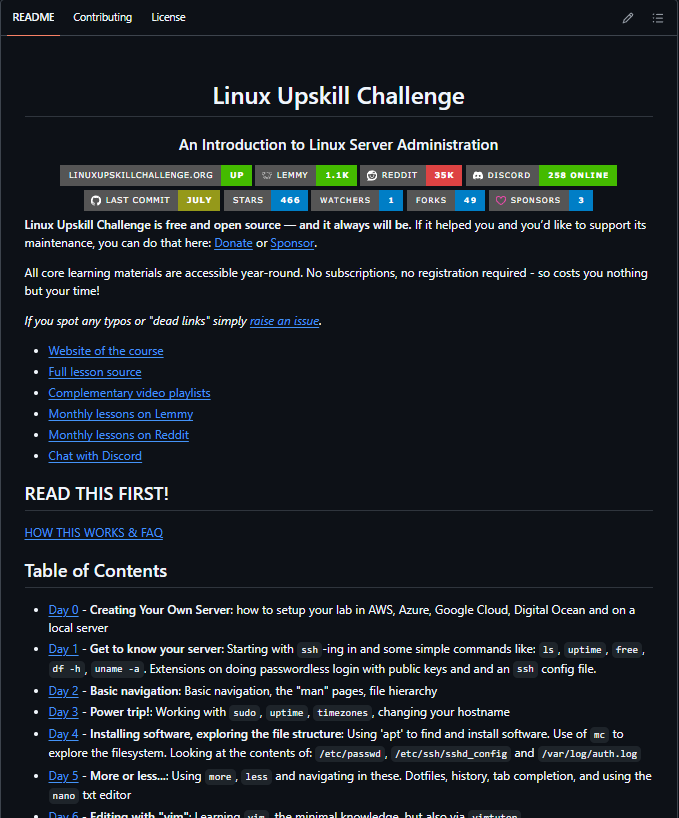
STOP WATCHING LINUX TUTORIALS. START BREAKING SERVERS.
I found a FREE open-source challenge that teaches Linux by making you actually manage a real server.
No 40-hour course.
No boring lectures.
No “memorize these 50 commands.”
Just 20 days of hands-on Linux.
→ Day 0: Create your own server
→ SSH into it
→ Navigate the filesystem
→ Create users & manage permissions
→ Control processes & services
→ Configure networking
→ Read logs
→ Harden security
→ Actually manage a Linux server
You spend just 1–2 hours a day doing real tasks from the terminal.
And it works with:
→ Ubuntu Server
→ AWS
→ Azure
→ GCP
→ DigitalOcean
→ Hostinger
→ Or a local VM
100% free.
100% open source.
Learn at your own pace.
The goal isn't to “learn Linux commands.”
It's to finish the challenge and think:
“Yeah, I can actually manage a Linux server now.”
If you're learning DevOps, Cloud, Cybersecurity, or Backend…
SAVE THIS. You’ll thank yourself later.
REPOOO 👇
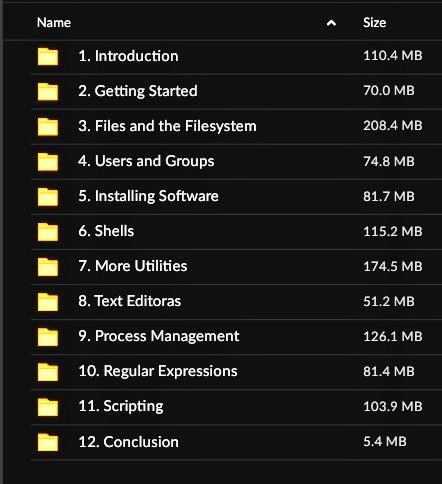
Free Linux Course for Beginners.
Linux is important for System Administrators، and software developers to know because it is used for a wide variety of applications in technology.
Download link:
https://t.co/YsN9LJ7kwG
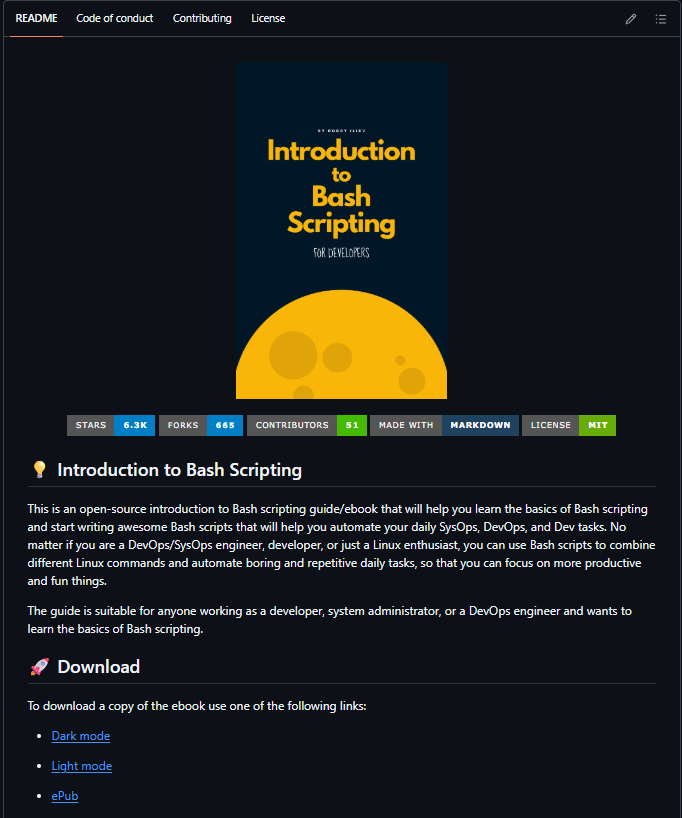
Most developers use Bash every day.
But very few actually know how to use it properly.
This open-source Bash scripting guide changes that.
You’ll go from:
→ Variables & loops
→ Functions & debugging
→ Custom commands
→ JSON parsing
→ API integrations
→ Real DevOps & SysOps automation
No boring theory.
Just practical Bash skills you can use to automate the repetitive work you do every single day.
And it’s completely FREE.
One GitHub repo worth bookmarking:
Your terminal is way more powerful than you think.
Don't waste 2 years learning to build LLMs like Claude & ChatGPT.
Stanford just dropped a 2 hour course on how to build LLMs from scratch.
• 00:00 - LLM tokenization
• 25:44 - how LLMs decode user prompts
• 35:40 - training pipeline of LLMs
• 1:16:47 - LLM architecture from scratch
Anthropic pays $750,000/year to engineers who understand this exact knowledge of LLMs.
Bookmark this & give 2 hours today, no matter what. Then read the article below.
MIT filmed a calculus course in black and white decades ago and it still teaches better than most of what shipped this year. Almost nobody watches it.
This is Calculus Revisited, Unit 1, Lecture 1, taught by Herb Gross. Analytic geometry from the ground up, chalk on a board, 1 camera locked in place.
Gross built the course for adults returning to math after years away. No prerequisites assumed. Every idea earned in front of you instead of quoted from a textbook.
The opening move is simple division written on the board. From there he shows why coordinates work at all, the thing most courses skip and every student silently fakes.
Watch how slowly he goes. Each step spoken out loud, nothing left implicit, the pace of someone who expects you to actually follow.
A backend engineer I know rewatched Unit 1 twice before touching linear algebra and said it fixed a gap he'd carried for 12 years.
MIT put the whole course online free under Creative Commons.
Production value aged badly. The teaching didn't.