This is my edit page article in today’s The Hindu on what is wrong with our higher education institutions and universities and why we as academic administrators and not students are to be blamed for this mess.
How Feelings and Culture Fuel Hindutva's Dominance in Today’s India.
Do read this important book review by @NilanjanUdwin https://t.co/kEi8aMZ1Ms via @thewire_In
The life of an average young person in India, and South Asia, is like of the countryman in Kafka's The Trial, endless waiting to enter some formal employment. Most of them do not make it. Sometimes they get crushed to death like in Delhi.
Wrote about it
https://t.co/aFpQA4vbUw
Swatantra Bhardwaj is revealing of the making of a deeper state in India. A whole ecosystem has been created by Hindu vigilantes with the help of the official state. My take on this transformation of the Indian polity.
https://t.co/zNB9PtRUPg
@CERI_SciencesPo@KingsIndiaInst
I am appalled by how the smallest, most ordinary acts of politicians are enough for us to write volumes of praise about them.
A politician carries their own luggage. Stands in a queue. Travels in public transport. Behaves with humility. And suddenly we celebrate them as if they have performed some extraordinary act.
It is this very attitude of ours that has given politicians their sense of entitlement. We have normalised treating them as non biological beings, as if they are somehow above ordinary citizens.
Let me tell you something. It is not uncommon for politicians to carry their own luggage, stand in queues, travel by public transport, or simply behave like ordinary human beings.
There is nothing extraordinary about it.
By making the ordinary extraordinary, we are not elevating our politicians. We are lowering our expectations of them.
And in doing so, we are destroying our political culture and, ultimately, our democracy.
We create the monsters we then complain about.
Even though the article isn't about protein as a nutritional category (misleading headline; more about chicken/poultry as an agricultural and economic commodity), I do wonder what would be India's favorite protein! Chicken only? Or paneer? Or Lentils?
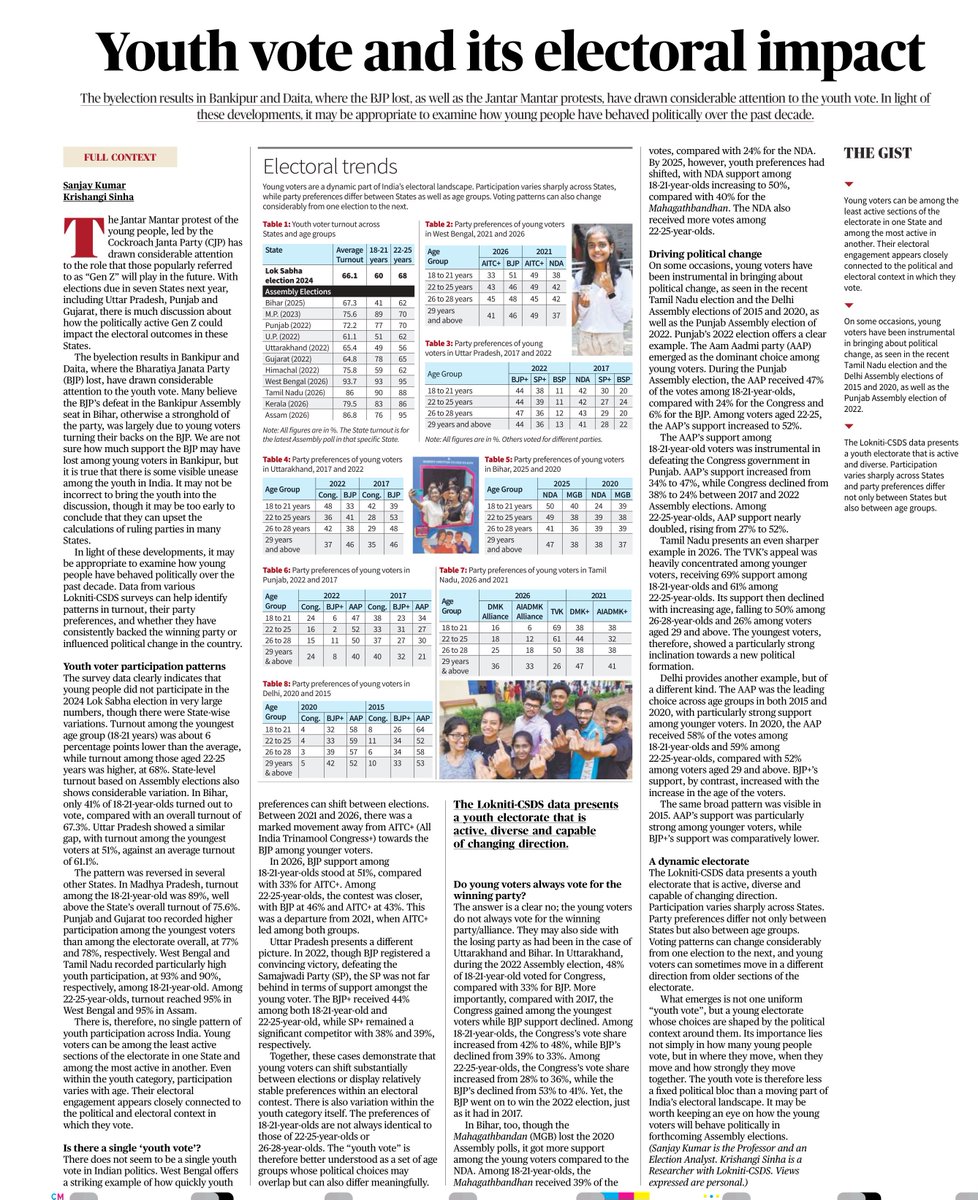
My article with Krishangi Sinha, @the_hindu August 26,2026
Using data we have tried to look at various aspects of Youths Electoral participation. Trying to answer if youth vote in large numbers or not? Do they vote for winning party and if Youths bring about political change.
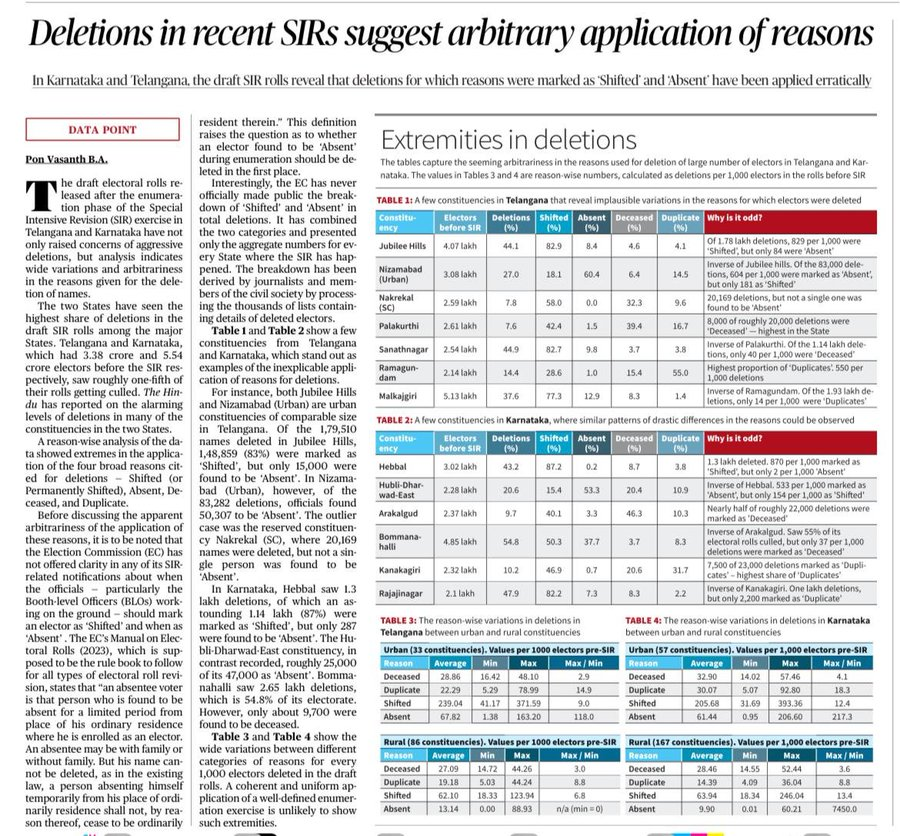
Practically, every state that is undergoing SIR is a case of exclusion overriding inclusion. Therefore, I argue that in failing to reign in the ECI, the Court has been in error.. ..
At a time when the country is once again witnessing debates and protests around reservation, I find myself returning to something I wrote earlier: “Reservation is Oxygen.”
We must realise how caste is embedded in our lives and how deeply entrenched it is in our consciousness.
We must seek answers to why all the ragpickers and sanitation workers invariably belong to one caste and why the judiciary belongs to descendants of a few castes or families before we start to question reservation — the only line of defence for the marginalised sections of our society.
It is because of reservation that we find Dalits, STs and OBCs’ names on the houses along Lutyens. Unfortunately, you would rarely find surnames belonging to lower castes when walking the lanes of posh societies in New Delhi.
We must also not underpin access to reservation with the economic status of the beneficiary, because reservations are not poverty alleviation programmes. Perhaps societies would have been much simpler had reservation only been based on economic status, with a level playing field for each of us to make a living based on equal opportunity. Sadly, that is not the case. #ReservationSystem #reservationdebate #reservation_reform #ReservationReformआंदोलन
The coarsening of public discourse, the lowering of intellectual standards, the heightening of hatred and division, the dilution of integrity, the propagation of nonsense, the pampering of violence, the subjugation of law, the disregard for Constitutional norms, the unwavering belief in and commitment to propaganda, the twisting of history, the weakening of educational institutions and standards, the protection of the criminals, the fattening of the cronies, the fudging of the data, the erasure of voters, the normalisation of corruption... difficult to say which of these will turn out to be the most damaging.
Madhavi Ravikumar offers a deeply ethical media critique, balancing academic accountability, human dignity, evidentiary rigour and responsible journalism with exceptional nuance.
📰 “Cambridge professor’s death is a life lesson” — UPSC Mains Enrichment
🔴 CORE ARGUMENT
The article draws a crucial distinction between legitimate public scrutiny and destructive media persecution: investigation is necessary, but humiliation is never accountability.
📊 IMPORTANT FACTS
Professor Jason Arday, aged 41, died in August 2026; authorities considered the death unexpected but not suspicious.
His family attributed his deteriorating condition partly to sustained abuse and misinformation.
NewsCord: approximately 249 articles appeared across British national outlets in 22 days; nearly 190 appeared after his resignation.
Coverage expanded from legitimate academic allegations into scrutiny of childhood, private life and personal vulnerabilities.
Social media amplified the controversy through memes, clips, commentary and decontextualised content.
The article invokes parallels with Lucy Meadows, Caroline Flack and Sushant Singh Rajput to demonstrate the wider problem of media trials and online hostility.
⚖️ CENTRAL ETHICAL DISTINCTION
Right to investigate ≠ right to destroy.
Legitimate:
Evidence-based scrutiny
Institutional accountability
Public-interest journalism
Academic verification
Unethical:
Character assassination
Trial by media
Digital mobbing
Sensationalism
Decontextualisation
Personalised harassment
🧠 KEY INSIGHTS
1. Public interest ≠ public curiosity.
2. Academic allegations require institutional, evidence-based examination, not social-media adjudication.
3. Freedom of expression carries ethical responsibility.
4. Digital platforms can convert complex disputes into simplified, viral judgments.
5. Volume of coverage does not establish truth.
6. Journalism must preserve context, proportionality and human dignity.
7. Mental-health vulnerability makes responsible communication particularly important.
🌐 WAY FORWARD
Independent fact-checking | Editorial accountability | Privacy safeguards | Digital-media literacy | Evidence-based reporting | Platform responsibility | Ethical journalism | Grievance mechanisms
⚖️ ETHICAL KEYWORDS
Dignity | Compassion | Empathy | Proportionality | Integrity | Responsibility | Accountability | Truthfulness | Non-maleficence | Justice | Privacy | Constitutional morality
🔑 UPSC Mains Line
> “A democratic society needs fearless journalism, but fearless journalism must remain evidence-based, proportionate and humane.”
#MediaEthics #Journalism #FreedomOfPress #DigitalEthics #MentalHealthAwareness #HumanDignity #Accountability #Ethics #UPSC #UPSCMains #GS4 #Essay #Governance #DigitalIndia #SocialMedia #ResponsibleJournalism #CivilServices #Democracy #ConstitutionalValues #GlobalEthics