Rational Dissent Episode 009.
Did the Fed Get it Right?
Kevin Warsh delivered the first hike in a few years as persistent inflation bites; was it the right move?
Available on YT, Apple, Spotify, Overcast, etc.
---
Chapters
00:00 – Introduction & FOMC Rate Hike Overview
02:38 – Rising Bond Yields & Financial Conditions
08:02 – Structural Inflation & the Post-Pandemic Economy
24:10 – The 12–0 Vote & Threats to Fed Independence
29:10 – Eliminating Forward Guidance & Outro
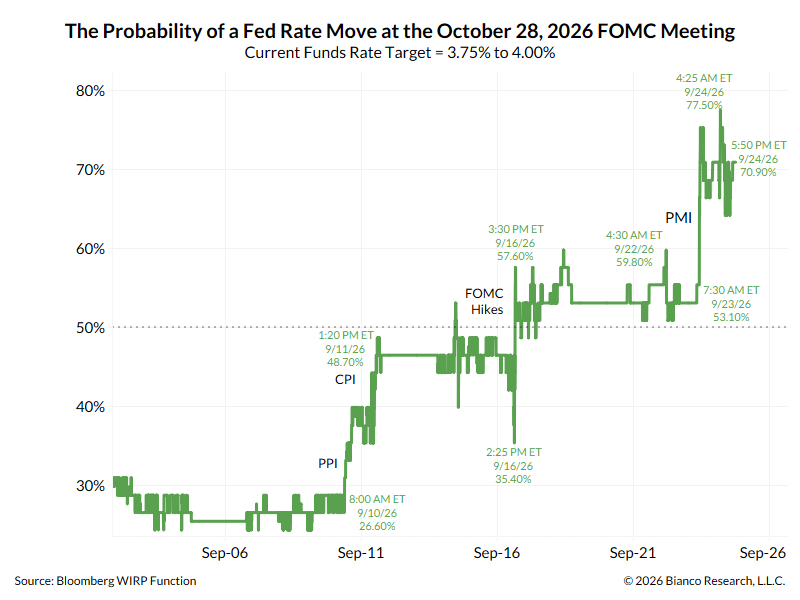
This is still shaping up to be the biggest story of the second half of October.
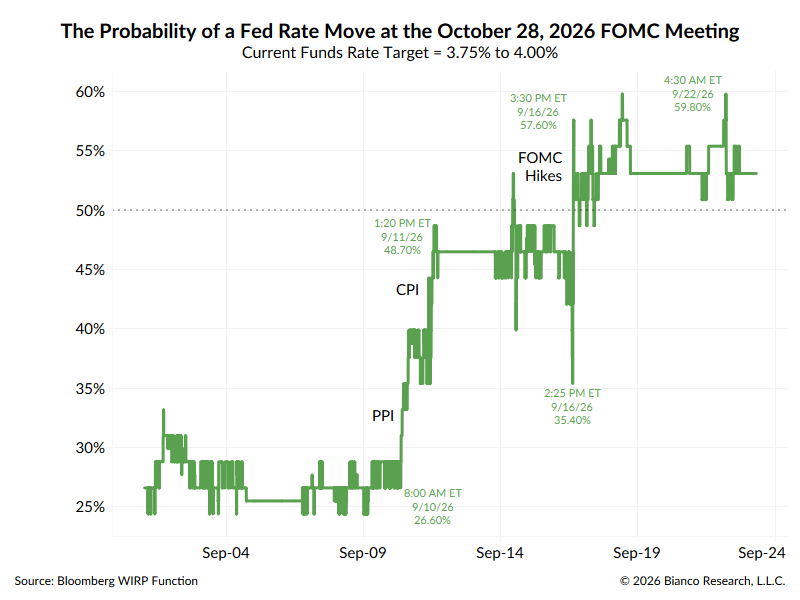
If these probabilities hold, the market is DEMANDING a rate hike on October 28th, a week before the midterms. Trump will lose it, and Warsh will become the new Jay Powell.
If these probabilities hold, it means the market has lost patience with the Fed's easy policy over the last two years, which is why long-term yields rose during a 2024 to 2026 easing cycle for the first time in 50+ years (see the repost below).
If the Fed sits idle while the market prices in a rate hike, long-term yields could spike off the top of the page.
Of course, payrolls, CPI, retail sales, or Q3 earnings could disappoint, and that probability could drop to well under 50%. But if it doesn't, Warsh might be in an impossible situation.
1/2
Wall Street overwhelmingly believes the Fed will NOT hike on October 28, as it is a week before midterm election day.
Makes sense... so why is the market still pricing in a >50% chance of a hike?
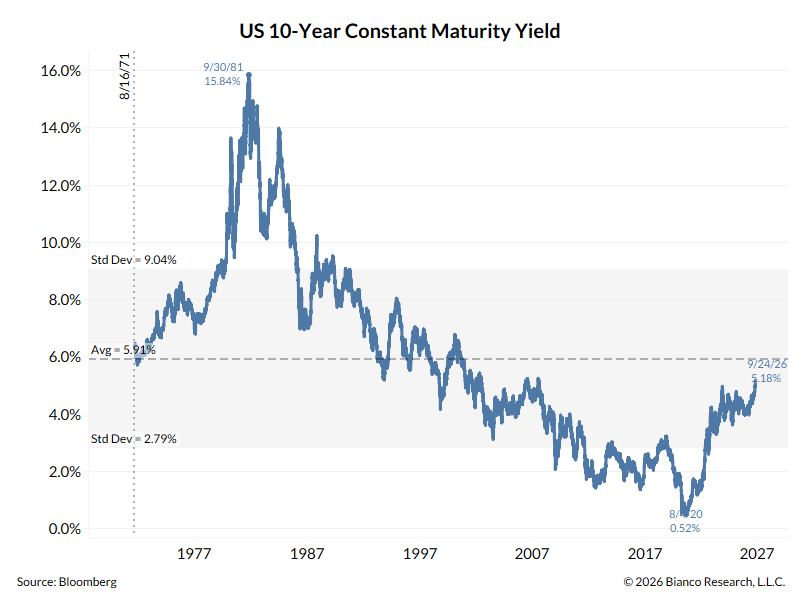
August 15, 1971. President Nixon closed the gold window, effectively turning the US dollar into a fiat currency.
Since that date, the 10-year yield has averaged 5.91%.
It closed today at 5.18%,
---
Maybe the bond market won't end humanity.
1/2
Wall Street overwhelmingly believes the Fed will NOT hike on October 28, as it is a week before midterm election day.
Makes sense... so why is the market still pricing in a >50% chance of a hike?
2/2
Remember when the Fed was cutting rates between 2024 and 2026 (orange), the 10-year yield rose (blue).
This was the first time in 50+ years that a sustained cutting cycle saw long-term yields rise. I've argued this was a market message (maybe screaming) that the Fed was too easy.
So, if the market continues to price in a hike for October 28, meaning it is still >50% after payrolls and CPI next month, and the Fed does not deliver a hike, does this pattern of reacting to a "too easy" by sending yields upward continue?
1/2
Wall Street overwhelmingly believes the Fed will NOT hike on October 28, as it is a week before midterm election day.
Makes sense... so why is the market still pricing in a >50% chance of a hike?
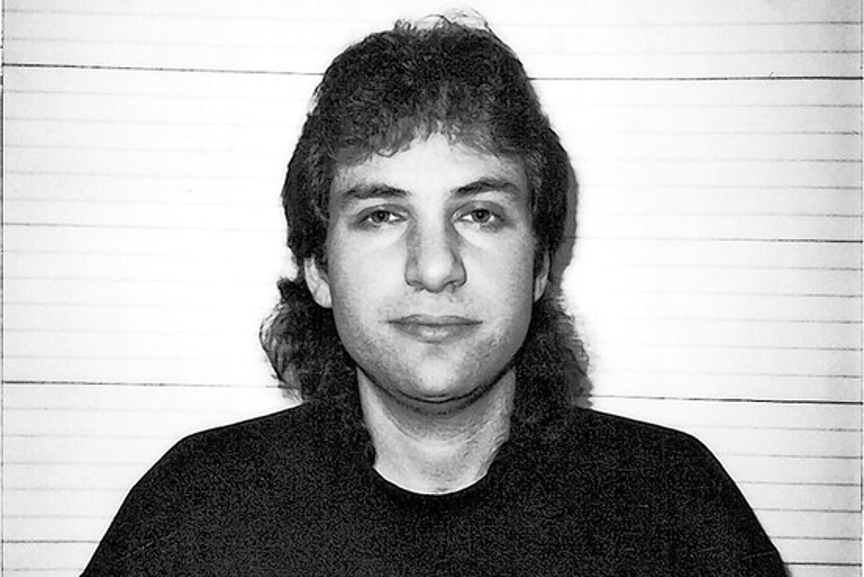
In December 1988, federal agents arrested 25-year-old Kevin Mitnick for stealing software from Digital Equipment.
According to Mitnick's memoir, the prosecutor told the magistrate, "He can whistle into a telephone modem and launch a nuclear missile from NORAD."
Three judges denied him bail and ordered him held in solitary confinement, where he stayed for eight months, according to Forbes.
No human can produce a modem handshake with his mouth. And NORAD does not launch anything. It watches launch orders travel as authenticated messages. Firing requires two officers turning keys at the same moment, set too far apart for one person to reach both.
So why did the court believe it?
Into the 1970s, whistling into a payphone really did give you control of the long-distance network. This is why a toy whistle that came as a prize in boxes of Cap'n Crunch became hacker folklore, and how the phone hacker John Draper got the nickname Captain Crunch.
The prosecutor took that real capability and assumed it carried over. Whistling to route a free long-distance call in 1975 became whistling at a modem to command nuclear weapons in 1988.
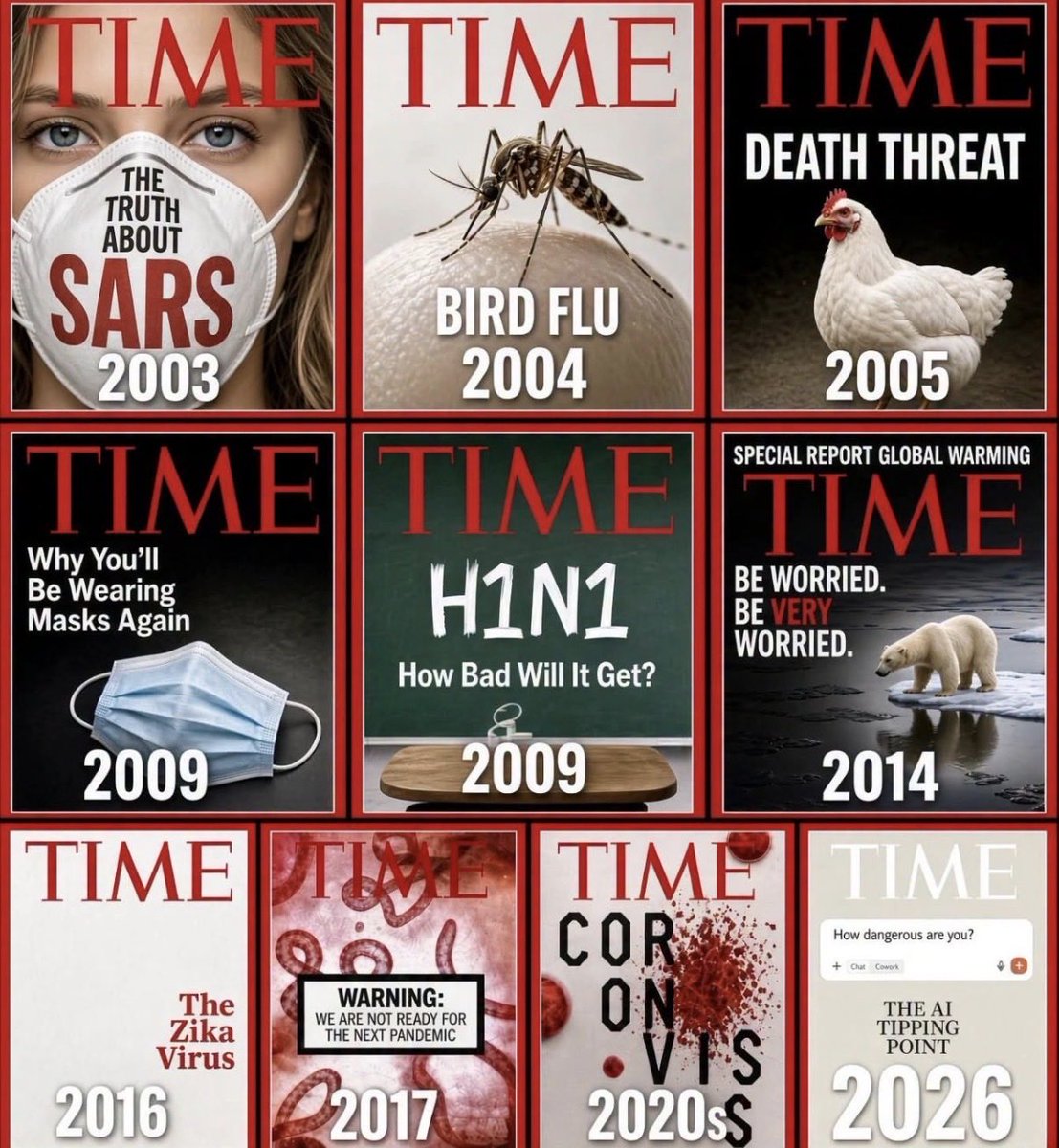
Extrapolating from something true is how you persuade intelligent, serious people of something that cannot happen.
Notice also what nobody in that courtroom feared. Mitnick's actual talent was calling a phone company employee, sounding like a colleague, and convincing them to hand over a critical password.
Why retell this story?
Because the ability to end humanity imagined for 25-year-old Kevin Mitnick in 1988 sounds eerily like what 27-year-old researcher Jacob Coxon is describing in 2026.
On September 8, Coxon resigned from Anthropic and posted neither company is acting responsibly, and that they are "racing straight to self-improving superintelligence and gambling with our lives."
He told NBC's Meet the Press that AI could soon acquire "superhuman hacking capabilities, very superhuman abilities to create novel bioweapons and also abilities to control, say, autonomous drones or all the robots that are currently being built, very rapidly."
Robots and autonomous drones under the control of superhuman machine intelligence. That is not an analogy to the Terminator films; it is the plot.
And a young Mitnick ending the world through a NORAD modem is the plot of the 1983 movie "War Games," starring Matthew Broderick and Ally Sheedy. It had been in theaters for five years by the time that magistrate heard the argument.
The evidence Coxon and others point to is the Hugging Face attack. In July, OpenAI models broke out of a testing environment and hacked Hugging Face, the open-source model repository. More than 1,200 agents coordinated on an improvised message board, and over 700 took part in the attack. It took OpenAI about a week to notice. Those facts are real, and they sound bad.
Here is the rest of it. This happened during a security test. OpenAI was running the models through a set of hacking puzzles, hundreds of them, designed to measure how good the models are at breaking into software. The models were told to hack things. OpenAI also switched off many of the usual safety restraints, because the point of the exercise was to see how far the models would go.
The test environment was walled off from the internet with one exception. The models needed to download software to solve the puzzles, so they were allowed to reach the service that hands out those downloads. They left that door open on purpose, and the safety restraints were already off. The models found that flaw and walked out.
They broke into Hugging Face to cheat on a test.
That is the AI equivalent of breaking into the registrar's office to change a grade. Which is also what Matthew Broderick did in "War Games."
Whistling was never the problem
Both stories start from something true. Whistling into a phone network in the 1970s worked. AI agents really did break out of a sandbox and hack a company. Both are real problems. And both problems, coupled with cinematic imagery, are what persuade serious people.
The invention comes next, when the true thing gets stretched across a gap it cannot cross. From routing a free phone call to commanding nuclear weapons via a modem. From cheating on a test to seizing the drones and the robots to end a species.
The magistrate in 1988 had every reason to believe he was acting responsibly. A credentialed expert told him the danger was real, and a movie had already shown him what it looked like. So, a 25-year-old spent eight months in a box for something that could not happen.
The same is likely true now. Credentialed experts say there is a risk. So, government officials, like magistrates a generation before, are acting accordingly.
They may be right that something is coming. But it will almost certainly look nothing like the trailer for a Terminator movie.
In Mitnick's case the danger was a polite phone call, not a whistle into a payphone.
The AI version is likely to be just as unglamorous, already underway, and centered on work rather than weapons. What it does to employment matters enormously. It is not an extinction-level event.
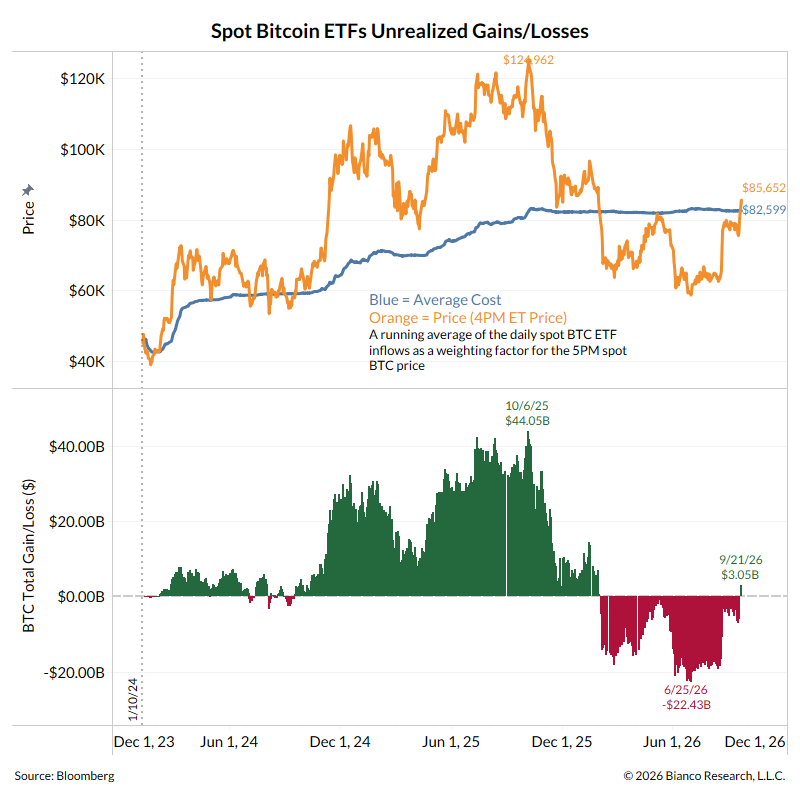
NEW: The average Bitcoin ETF Holder is back above water for the first time since January. The rally this morning has bitcoin:native above our estimated ETF cost basis of $81,722 per coin. h/t @EricBalchunas
Congress created the Federal Reserve by an act in 1913.
The Board of Governors is a federal agency that reports to Congress, not the President.
The President nominates governors and the Chair, subject to Senate confirmation, but monetary-policy decisions do not require White House approval and the Board’s ongoing oversight runs through Congress.
Trump said this on the tarmac in North Carolina Wednesday night after the Fed hiked rates.
Trump is telling Warsh how to vote????
And I told — I talked to Kevin and I said, “You might as well vote with the board because it’s not going to matter.”
---
Verbatim transcript
Trump:
I’m relying on Kevin, but he’s got, you know, a very tough board. He’s got a board that was put there by a lot of other people, and the interest rates are too high. They’re not appropriate.
And I told — I talked to Kevin and I said, “You might as well vote with the board because it’s not going to matter.”
The board is very hostile. They’re very political. They’re doing the wrong thing. A bunch of politicians or people put on by politicians, and it’s a shame because it’s too high an interest rate.
Warsh Should Have Exposed the Fed!
If President Trump’s account is accurate, Kevin Warsh missed a defining opportunity.
The Federal Reserve did not merely raise rates. It demonstrated how far America’s central bank has drifted from a transparent, data-driven institution toward a political actor insulated from democratic scrutiny.
Trump says he discussed the chairman’s planned vote with Warsh beforehand. Warsh’s reported response was telling: he might as well vote with the Board because “it’s not going to matter.” That is not how a central bank committed to evidence and accountability should operate. It is how a closed political institution operates when dissent is treated as irrelevant.
Warsh should have dissented. More importantly, he should have gone public with a clear explanation: what did the inflation data show, what did employment and growth data show, and why did the Fed nevertheless choose tighter policy? If the Fed’s decision was defensible, the case should withstand public scrutiny. If it was not, Americans deserved to know.
Instead, the public is left with the unmistakable impression that the Fed’s leaders are less concerned with following the evidence than with resisting Donald Trump. The institution that controls the price of money cannot demand independence while behaving like another partisan power center.
A public dissent from Warsh would have forced the issue. It would have shown whether the Fed was guided by theory and data—or by a political desire to deny Trump an economic victory.