Smart contracts handle real value. If the math is wrong, the money vanishes.
Most tutorials teach you syntax. They don't teach you solvency.
I spent the last few weeks building a decentralized, algorithmic stablecoin from scratch.
Here is the engineering journey behind the code. 👇
For those who prefer reading over trying to ignore my background noise, I wrote a full technical breakdown of this exact workflow here:
https://t.co/bGR5Tikwcu
@NeeleshW3
Recently, I have been using the @contractdotdev workflow to test my smart contracts against live mainnet state.
It completely removes the usual infrastructure friction, and this quick demo video explains exactly how it works.
https://t.co/vXMCNw9Opj
@kenny_io
PS: There is some background noise in the video, and my editing skills are... let's just say I'm much better at writing Solidity. 😄
Go ahead and enjoy the video.
For those who prefer reading over trying to ignore my background noise, I wrote a full technical breakdown of this exact workflow here: https://t.co/bGR5Tikwcu
PS: There is some background noise in the video, and my editing skills are... let's just say I'm much better at writing Solidity. 😄
Go ahead and enjoy the video.
If you spend enough time in the tech space, you will eventually hear the word "DevRel".
They speak at conferences, write tutorials, and the community usually seems to love them.
But what exactly do they do? Is it just marketing for coders? Is it just customer support?
👇🏾
I don't want you to just take my word for it.
I wrote a full technical breakdown on how to adopt this workflow and instantly improve your development lifecycle.
Stop fighting infrastructure. Read the full journey here:
🔗 https://t.co/bGR5Tikwcu
Smart contracts turned the blockchain into a trust-minimized execution layer. We write them with extreme care because immutability is unforgiving.
But writing secure code is only half the battle. The other half? Fighting your testing infrastructure. 🧵👇
What if there was a workflow that completely eliminated this friction?
✅ Zero Faucet fatigue
✅ Zero 3rd-party RPC setups
✅ Zero mock contract simulations
✅ Seamless mainnet state & Chainlink integration
It sounds too good to be true.
...the system must never accept the same payment twice
and it must never move funds without enough approvals
Invariant testing is me trying to break those rules on purpose
from every angle possible
to prove that they cannot be broken
A few days ago, I thought about something simple:
If three people count money together, you trust the result more than if one person counts it alone.
Not because people are perfect but because agreement reduces error.
That idea shaped my work this week. 🧵
Now that the foundation is built and unit tests are done, the next step is invariant testing.
In simple terms
an invariant is a rule that must always stay true no matter what happens
For example
no matter how many times people confirm payments
no matter the order they sign
I published the entire engineering process in a five-part series.
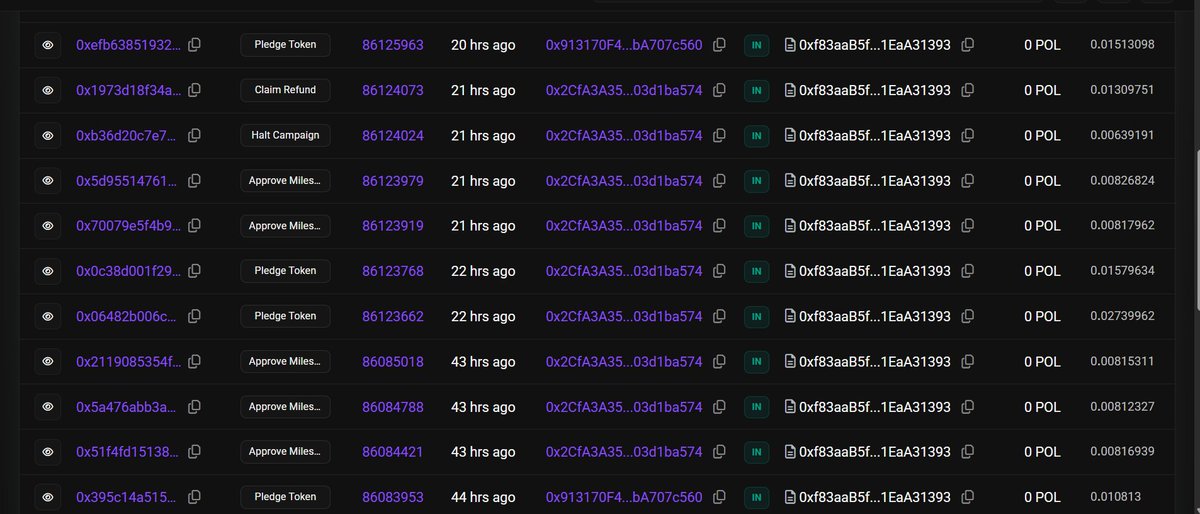
From UUPS proxies to audit-ready threat models. The contract is deployed and verified on Polygon mainnet.
The full five-part engineering breakdown is on https://t.co/yaMVEnDAlu: https://t.co/2KjofNUAv8
I published the entire engineering process in a five-part series.
From UUPS proxies to audit-ready threat models. The contract is deployed and verified on Polygon mainnet.
The full five-part engineering breakdown is on https://t.co/yaMVEnDAlu: https://t.co/2KjofNUAv8
A green test suite on a broken smart contract is worse than no tests at all.
It gives you false confidence while holding real money.
Most tutorials teach you to write isolated functions.
A vulnerable kiosk dispenses cash before marking the receipt as used. Reentrancy works the same way.
If you understand the "refund kiosk glitch", you know why updating your database before dispensing the cash is the only way to prevent reentrancy attacks.