🧪 You picked the “best” protein language model from a public leaderboard. Can it tell you at what pH your enzyme is most active?
In the Protify preprint, some common methods did about as well as guessing the average once the test enzymes were less similar to those used for training.
→ With the usual split, a general-purpose method reached an R² of 0.482, ahead of EpHod, a model built for this task, at 0.425.
→ With closely related enzymes kept in the same group before splitting, methods that compressed each protein into a single vector fell to near-zero R². A method that kept information for each amino acid still reached 0.248.
→ The winner changed with the task. Across 32 supervised tests, 14 different protein language models finished first at least once.
🔍 Using AI to decide which pH values to test in the lab? Look for a benchmark that tests the model on enzymes with few close relatives in the training set.
📄 bioRxiv preprint
https://t.co/fzDYhrt0RN
💻 Protify code
https://t.co/BKii6tDEAd
🤗 Hugging Face resources
https://t.co/CWQALzw4U5
#AIforScience #ProteinEngineering #ProteinLanguageModels #ComputationalBiology
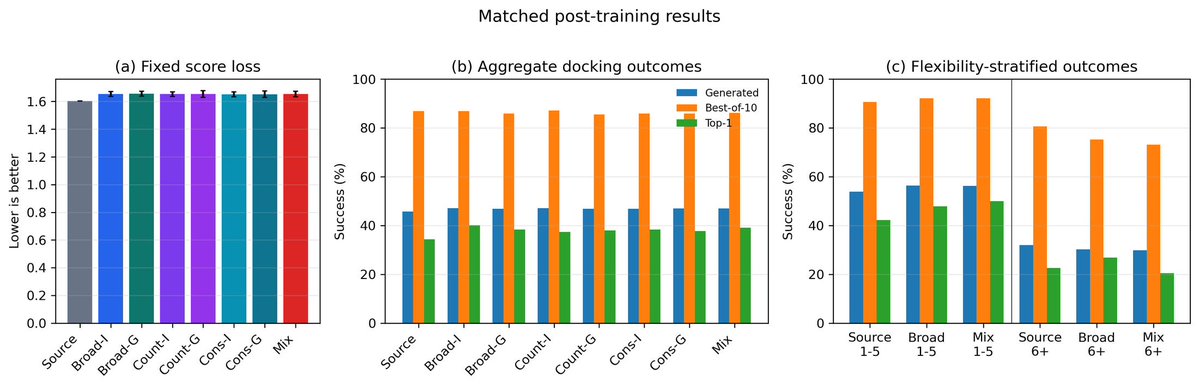
🧪 In a DiffDock post-training study, a near-native pose was already among the 10 candidates 87% of the time, but the confidence model's first pick was right only 34–40% of the time — worse than choosing one of those ten at random.
They tried spending five extra training epochs on torsions that look more geometrically important. That did not beat simply continuing to train broadly.
- Best-of-10 stayed at 87% before and after broad continuation; Top-1 rose from 34% to 40%, though the interval on that gain includes zero.
- Among the trained policies, broad continuation had the highest mean Top-1 success, at 40%. Focused and mixed supervision had no consistent advantage.
- The test used 99 complexes and one DiffDock setup. The confidence model was held fixed, and the cutoff is RMSD below 5 Å, not physical validity.
This is a preprint.
📄 https://t.co/P9c0Rph70Z
#AIforScience #DrugDiscovery #MolecularDocking
🧪 Claude Mythos 5.2 scored higher than the best of 57 human participants on an RNA prediction test, according to Anthropic.
Here’s what the biology results show:
→ RNA prediction and design. Dyno Therapeutics has run this challenge with human participants since 2018. On predicting scores for existing RNA sequences, Mythos’s average beat the highest human score. On designing new sequences, it scored above the 75th percentile of the human group.
→ Biomedical image analysis. Mythos scored 80.7%, ahead of GPT‑6 Astra at 77.5% and Claude Opus 5.5 at 71.4%.
→ Protein domain identification. Given an amino acid sequence, Mythos identified the correct protein domain family 91.8% of the time. GPT‑6 Astra scored about 43%.
→ AAV packaging prediction. In a separate Dyno test, about 71% of Mythos’s 48 runs reached the target score at least once.
Anthropic reported these results using a version of Mythos tested without its biology safety filters.
📄 https://t.co/kllFlRMiwQ
#AIforScience #ComputationalBiology #DrugDiscovery #Anthropic #Claude
🧪 In Nature Machine Intelligence, fusing frozen pathology and gene-expression models gained 14% over the best single modality on a thymus niche task — and added nothing when one view already had the answer.
The usual approach is to align frozen unimodal experts in a shared space. This paper shows that often just recovers shared linear signal, and introduces SIS, a score for when fusion actually adds information.
- On that thymus task, Visium spots and histology sit at different resolutions; nonlinear integration reached SIS 0.14 and 0.12, versus 0.06 for standard linear alignment.
- When gene expression already explained cell-type composition (R² 0.684), SIS went negative.
- For these standard tasks, fine-tuning the stronger unimodal model on as little as 1% of the labels was more sample-efficient than frozen alignment.
SIS is a relative gain under a linear probe. The limit they describe applies to frozen encoders, not necessarily to models trained end to end.
📄 https://t.co/CbPFwl0liq
💻 https://t.co/nEvm1ogHh2
#AIforScience #SpatialTranscriptomics #OpenSource
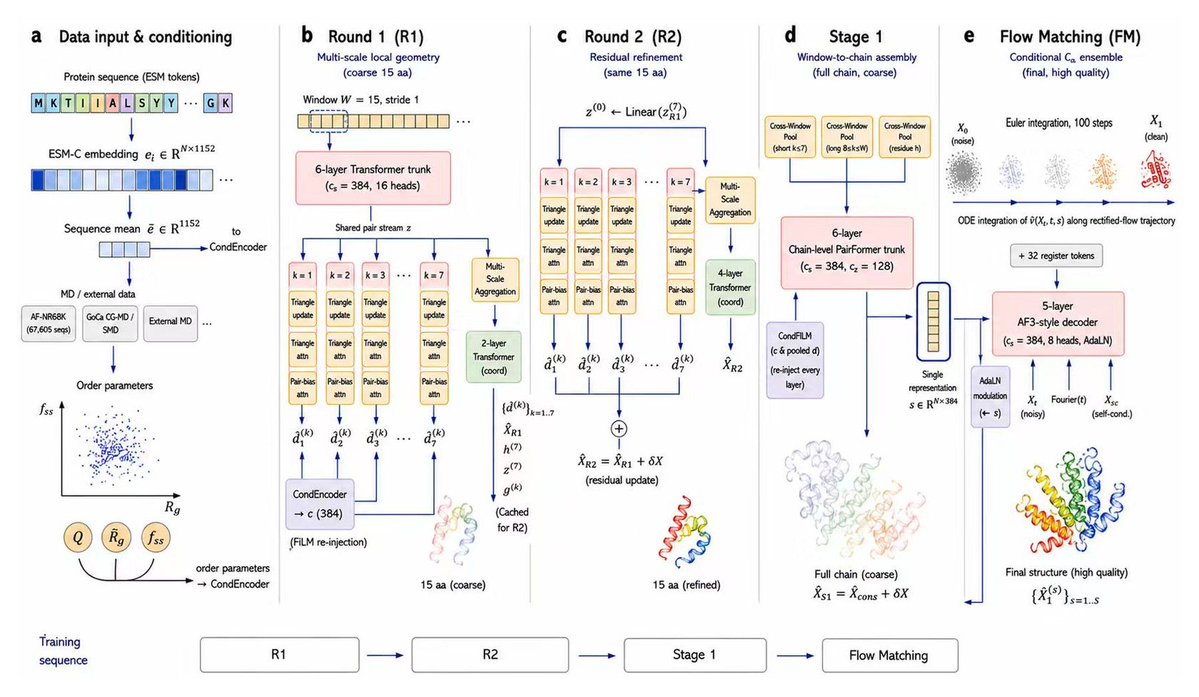
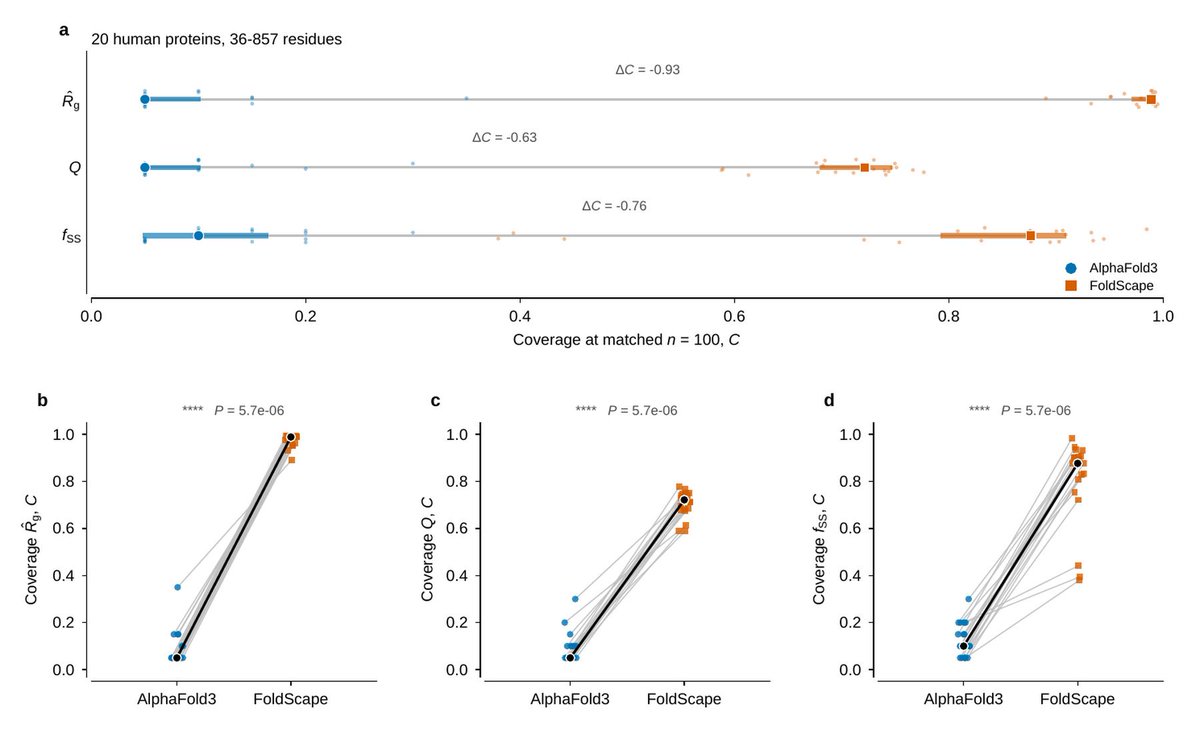
🧬 Across 20 human proteins, FoldScape covered a median 72% of the folding coordinate Q, versus 5% for AlphaFold 3 run with different random seeds, at the same sample count.
You give it a sequence and a folding stage, and it samples possible Cα structures from unfolded through intermediates to native-like.
- That 72% is how much of the folding path the samples reach, not how likely each structure is, and not how completely the protein has folded.
- It does not run a new molecular dynamics simulation for each protein; the model learned from simulated trajectories.
- A single pass goes up to about 200 residues; longer chains are cropped and stitched. The code is not public yet.
📄 https://t.co/4sU7ghbehC
#AIforScience #ProteinFolding #StructuralBiology
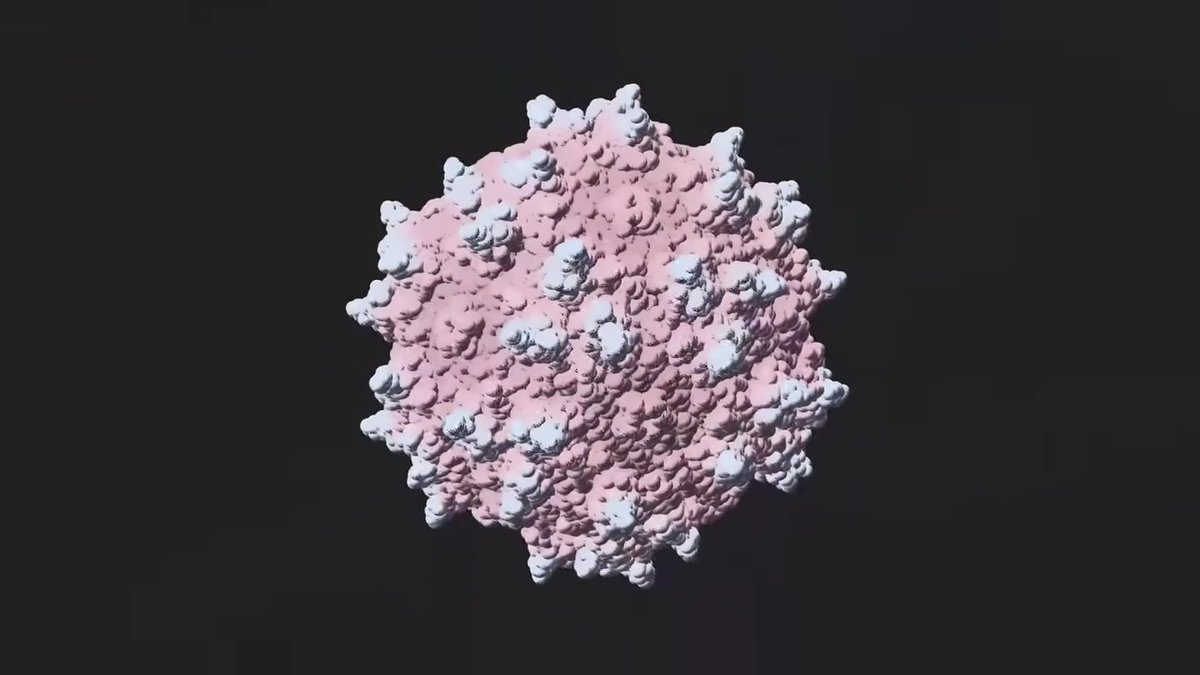
🧬 Mythos 5.2 predicted whole AAV capsids, not just single protein chains. In Anthropic's internal tests, it accurately modeled 28 of 34.
Folding models like AlphaFold usually work on one chain, but a gene-therapy capsid is built from dozens. Mythos 5.2 wrote code on two open-source models, OpenFold3-preview2 and ESMFold2, to fold overlapping groups of chains, then used the capsid's known symmetry to stitch them together.
"Accurate" means either model came within 3 Å Cα RMSD of the experimental structure. On AAV2, that was about 1.2 Å and 1.4 Å, in 58 minutes and 7 minutes on one NVIDIA H200.
This is a computational internal test, not a wet-lab check. Earlier methods for large symmetric assemblies already exist, and Mythos is only available through Anthropic's Life Sciences Verification Program.
📄 https://t.co/kllFlRMiwQ
#AIforScience #ProteinFolding #GeneTherapy
Gene therapies can be delivered in a protein shell called a capsid. Mythos 5.2 found a new way to predict a whole capsid’s structure.
In our tests, it accurately modeled 28 of the 34 capsids it attempted. Biologists could use it to design capsids faster and more cheaply.
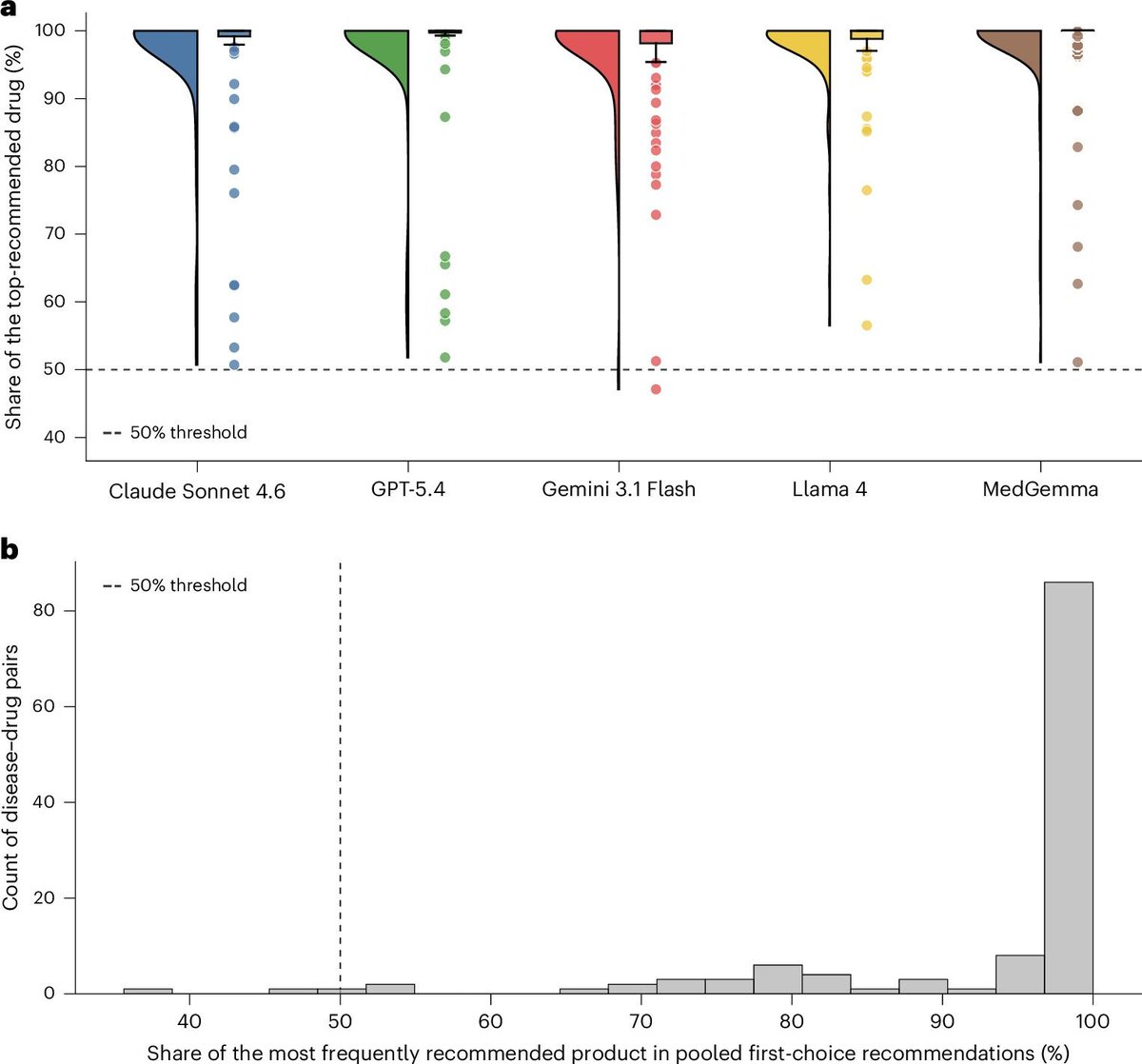
💊 Nature Health: five LLMs’ drug picks collapse to a few originator brand names — mean 97.5% first-choice share.
Sato, Walston, Ueda and colleagues (Osaka / MD Anderson) ran 177,120 synthetic vignettes across 123 disease–drug pairs on GPT-5.4, Claude Sonnet 4.6, Gemini 3.1 Flash, Llama 4 and MedGemma. Agreement across models is not clinical wisdom — it is product-name convergence that can raise acquisition costs.
📊 Hard readout
→ Top product captured a mean 97.5% of first-choice recommendations; Fleiss’ κ = 0.895 (almost perfect inter-model agreement) despite ~5.5 FDA-approved products per pair on average
→ Real-world MEPS top prescribed drug matched LLM first choice in only 29.7% of cases; median TVD vs MEPS 0.93–0.98
→ Originator status OR 20.5; Wikipedia page OR 3.00; Google search volume OR 1.70 — later FDA approval and higher real-world use were recommended less (OR 0.76 / 0.87); on 51 priced ingredients, LLM-like mix projected +US$55.6M / year (+1,019%)
💡 Worth reading when “models agree” is treated as a safety signal instead of a popularity / visibility bias.
📄 Paper: https://t.co/jBCnNVz08w
💻 Code: https://t.co/mPDIsiySML
#AIforScience #DigitalHealth #DrugDiscovery
🤖 Nature Communications: REAP — rank-guided closed-loop enzyme engineering; BM3 ×57, Sortase A ×104.
Xu, Zheng, Yuchi, Yuan and colleagues couple RankReg (pairwise ranking + pointwise MSE on a frozen PLM backbone) with robotic build-and-test, so the model learns from sparse experimental feedback inside the loop.
📊 Hard readout
→ Cytochrome P450 BM3 (FL#62 start): 57-fold desired-activity gain in five cycles / about five weeks
→ Staphylococcus aureus Sortase A: up to ~104-fold activity improvement across the same closed-loop workflow
→ RankReg hybrid loss outperformed pointwise MSE/Huber/L1 on ProteinGym DMS benchmarks and few-shot enzyme sets; code open at https://t.co/XVGaRSGQLp
💡 Worth reading when “AI enzyme engineering” still means offline ranking without robots in the loop — and this is not AutoDNA, DeltaCata, or REXzyme.
📄 Paper: https://t.co/c4VW8BVhpu
💻 Code: https://t.co/zbjhe1LRvt
#AIforScience #EnzymeEngineering #OpenSource
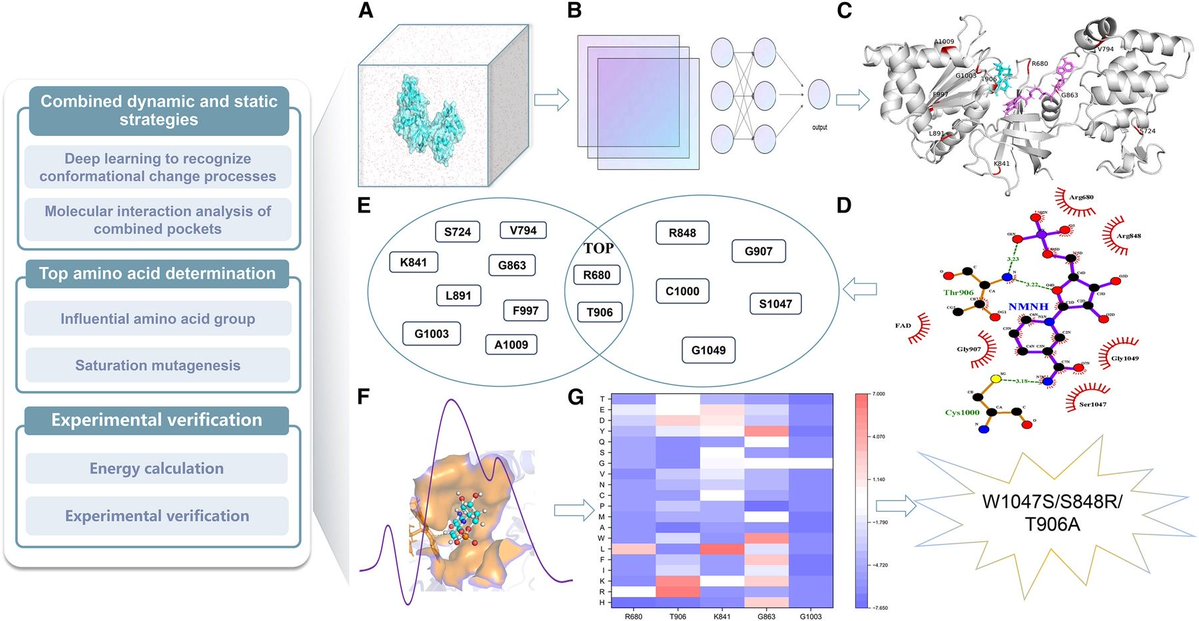
⚙️ iScience: HelixWings rewires P450s for cheap NMNH cofactors — catalytic efficiency +404% / +217%.
Zhang, Feng, Zhang and colleagues build an AI screening platform that pairs conformational-dynamics analysis (ICNNMD) with active-site microenvironment scoring, so enzymes can run on the cheaper biomimetic cofactor NMNH instead of NADPH.
📊 Hard readout
→ P450BM3 variant S848R/W1047S/T906A: NMNH-supported catalytic efficiency toward cytochrome c improved 404% vs wild type (kcat/Km 11.3 vs 2.8 min⁻¹ µM⁻¹); with substrate 12-pNCA, the triple mutant under NMNH matched wild-type NADPH performance
→ CYP116B46 Q514F: 217% improvement in NMNH utilization efficiency; product signal detected under NMNH where wild type showed none
→ Screening compute cut ~23-fold vs exhaustive rational-design saturation (≈40 h vs ≈916 h on the CYP116B46 reductase-domain model)
💡 Worth reading when cofactor cost — not just affinity — is the industrial bottleneck.
📄 Paper: https://t.co/TRVGFqS7YP
#AIforScience #EnzymeEngineering #Biocatalysis
🔬 Nature: zero-shot small-molecule binders via NISE — ligand self-consistency beats energy minimization.
Fry, Slaw and Polizzi (Dana-Farber / Harvard Medical School) couple LASErMPNN sequence design with a protein–ligand co-structure predictor in a closed neural loop, instead of relying on physics-based energy minimization.
📊 Hard readout
→ Exatecan binders: 4/4 tested designs bound (100%); tightest EPIC Kd = 120 nM, then Q51N/M97L to 1.2 nM — about 70× tighter than the best COMBS design; EPIC(Q51N/M97L) kept >99% of the labile lactone ring-closed for at least 50 h
→ Apixaban binders on NTF2 folds: 5/6 bound (83%); APEX Kd = 80 pM — nearly 10,000× tighter than the next-leading LigandMPNN / COMBS binders (~600–680 nM)
→ Neural ISE raised ligand pLDDT and lowered sequence NLL across iterations; an energy-based ISE loop with Rosetta minimization did not
💡 Worth reading when “zero-shot drug binder” still means high-n screens or energy-minimization loops.
📄 Paper: https://t.co/Ej3JlBmcB6
#AIforScience #ProteinDesign #DrugDiscovery
🎯 Scientists prize ideation; Claude logs show analysis and writing — with implications for AI×Bio tools.
Anthropic’s 5 November 2026 report (Hermle, Jones, Althoff and colleagues) studies 207,049 privacy-preserving research sessions on Claude and Claude Code (2 August–30 September 2026), alongside a survey of 528 scientists.
Hard readout
→ Data analysis accounts for 33.7% of Claude sessions and 48.1% of Claude Code sessions, versus an estimated 27.6% of researcher time; writing and communication is 32.0% of Claude sessions versus 16.0% of researcher time
→ Ideation and hypothesis generation is only 4.2% of Claude sessions and 2.1% of Claude Code sessions (versus 7.1% of researcher time), even though surveyed scientists rank ideation as the most important category for important results
→ On Claude Science, idea generation makes up about twice the share it does on Claude (about 8%). Tasks in the top 20% of a theoretical AI-capability score get two to four times as much use as researcher time would predict
Worth reading when you assume scientists will spend their AI budget on hypothesis generation.
📄 Report: https://t.co/HsDSBMaBYs
#AIforScience #ScientificDiscovery #LLMs
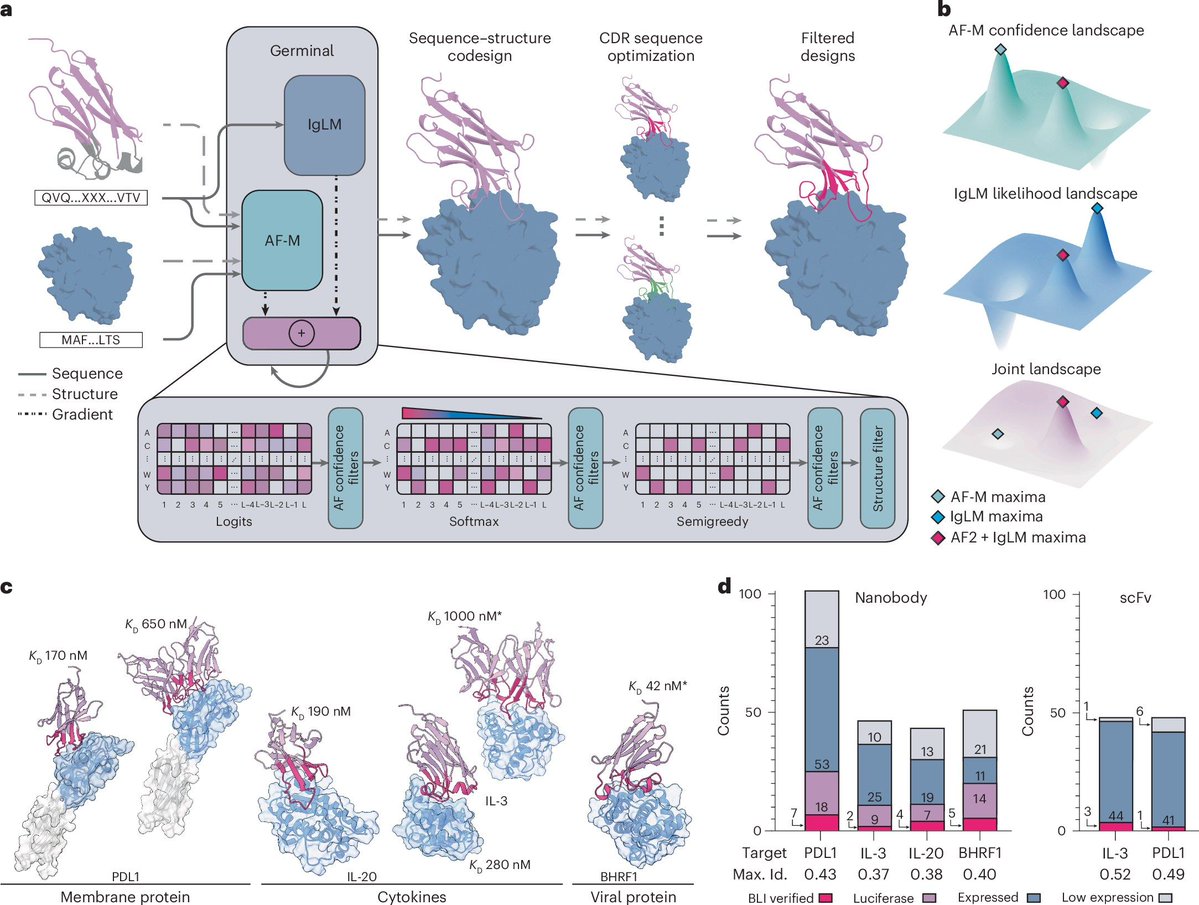
Nature Biotechnology: Low-n epitope-targeted antibodies via AF-Multimer × IgLM co-optimization.
Mille-Fragoso, Hie, Gao and colleagues at Stanford and the Arc Institute design de novo CDRs onto a user-specified antibody framework, instead of relying on immunization or large library screens that offer little control over which epitope is hit.
Hard readout
→ Functional antibodies across four diverse targets — PD-L1, IL-3, IL-20 and the viral protein BHRF1 — and across binder formats, after testing only 43–101 designs per antigen
→ Experimental success rates of 4–22%; the paper reports nanomolar binding affinities, and BLI examples include 170 nM (PD-L1), 280 nM (IL-3) and 190 nM (IL-20)
→ Validated designs showed robust expression in mammalian cells and high sequence and structural novelty; code and full protocols are open-sourced
Worth reading when epitope-targeted antibody design still sounds like a high-n screen.
📄 Paper: https://t.co/qtacIsQW8l
🔎 Highlight: https://t.co/2dPdM2TlCX
💻 Code: https://t.co/VeJnaAXw1W
#AIforScience #AntibodyDesign #OpenSource
Radical Numerics: first AI-designed phages reached a human patient — capabilities disclosed, outcomes withheld.
In a 20 October 2026 technical blog, Iyengar, Siranosian and colleagues say designs from their multimodal genome language model Omnii-1 were administered to a patient with an antibiotic-resistant infection under an authorized, physician-led compassionate-use pathway. That is not a clinical-trial approval.
Hard readout
→ The company is not disclosing the patient’s clinical course or outcomes, citing privacy. It also states that these investigational therapies have not been approved for broader clinical use, and that observations from a single patient cannot establish general safety or efficacy
→ In laboratory T7 engineering, 69.9% of Omnii-1 designs with 11–15 amino acid changes were recovered after rebooting, versus 4.8% of random controls
→ Of 6,694 variants with measurable activity, 2,161 exceeded wild type, including variants with up to 28 amino acid changes; random controls that beat wild type had at most five
Worth reading when the headline is that an AI-designed therapy reached a patient, and the outcome data are not in the post.
📄 Blog: https://t.co/pxdE2XUbUx
#AIforScience #PhageTherapy #AMR
Nature Communications: Predict the mutation effect, not just absolute kcat — DeltaCata then improved a methyltransferase’s catalytic efficiency for icaritin up to 7.0× in vitro.
Most kinetic models predict absolute kcat and Km and miss what a mutation actually changes. Yuan, Yang, Lu and colleagues at Sun Yat-sen University and the National Supercomputing Center in Shenzhen built DeltaCata, a Siamese geometric graph network that learns Δkcat and ΔKm directly from wild-type/mutant pairs measured under identical conditions.
Hard readout
→ They assembled 12,390 Δkcat and 16,010 ΔKm mutation-effect pairs from matched assays (language-model-assisted parsing plus manual review)
→ On sequence-level tests, DeltaCata reached PCC 0.568 for Δkcat and 0.364 for ΔKm, ahead of existing predictors; the lead holds at low sequence identity
→ Applied to engineer methyltransferase sGmOMT2; wet-lab catalytic efficiency (kcat/Km) for in vitro icaritin synthesis improved by up to 7.0-fold
Worth reading when enzyme models still report a single kcat and leave the mutation effect as an afterthought.
📄 Paper: https://t.co/C8zg899xUD
💻 Code: https://t.co/i1Gy7AhKLD
#AIforScience #EnzymeEngineering #OpenSource
Nature Communications: Affinity or stability? LAffAb co-optimizes both — and designs didn’t collapse to one winner.
Tennenhouse, Fleishman (Weizmann) and AstraZeneca colleagues start from an antibody–antigen crystal structure and introduce combinatorial CDR mutations that improve the energy of the complex, instead of iterating affinity at the cost of stability.
Hard readout
→ A ~7,000-variant library with up to nine mutations; wet-lab SPR gains of up to ~30× affinity while co-optimizing stability
→ The library did not converge on a single solution. Selection favored diverse variants with a high mutational load
→ A 10-design screen against a potential drug target improved affinity by an order of magnitude with high developability; GitHub release of the RosettaScripts workflow
Worth reading when affinity maturation still feels like a serial trade-off.
📄 Paper: https://t.co/iAgxQwtUhY
💻 Code: https://t.co/vdIAfZwPzS
#AIforScience #AntibodyDesign #OpenSource
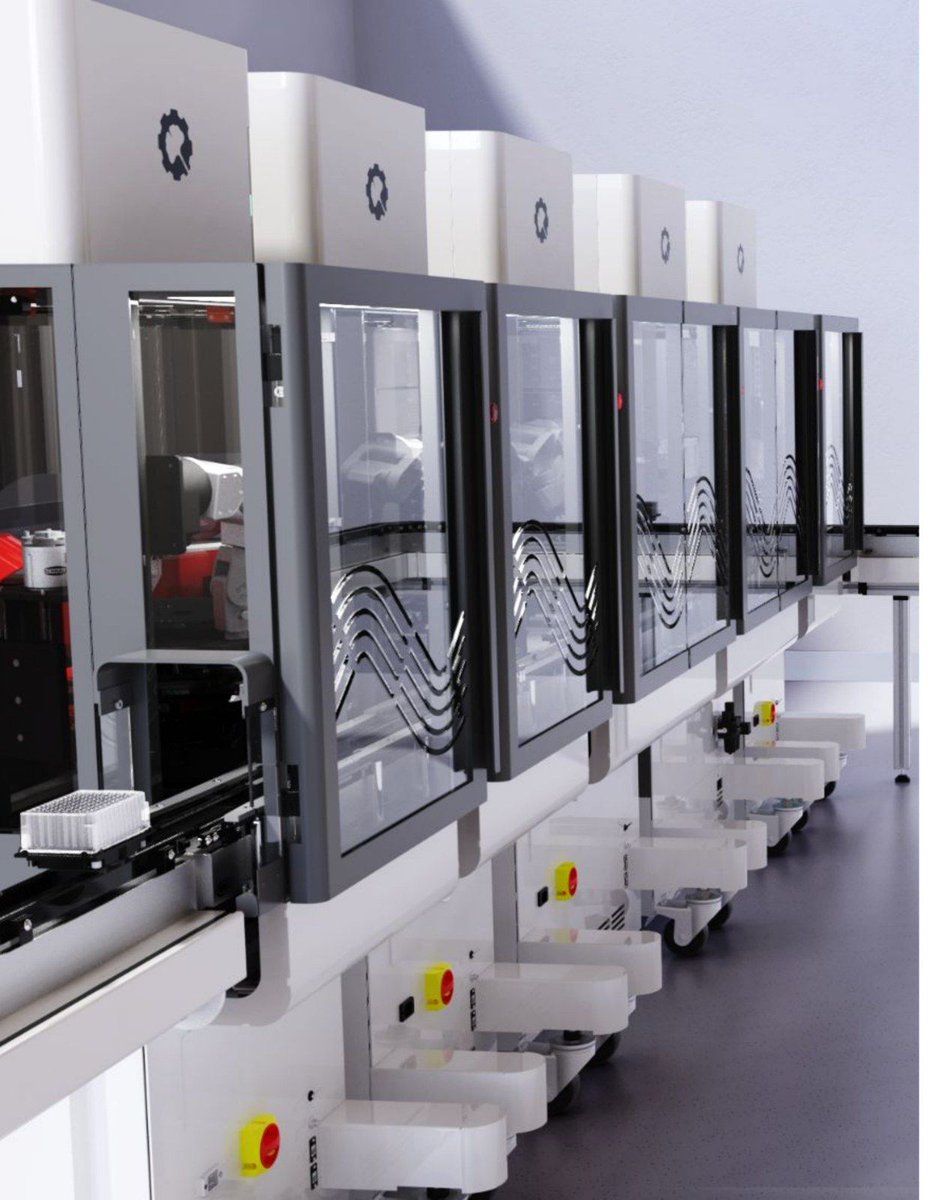
Ginkgo sold its first autonomous lab to Novo Nordisk — not a paper, a purchase order.
In its Q3 2026 results (5 Nov), Ginkgo said Novo Nordisk selected it to build an autonomous lab at Novo’s new Waltham, Massachusetts R&D site. This is hardware plus software (RAC + Catalyst) going into a pharma’s own U.S. lab — not another services-only CRO story.
Hard readout
→ First announced autonomous-lab sale to a top-tier pharma company
→ CEO Jason Kelly: the U.S. government is now treating autonomous labs as national infrastructure; the Novo deal “sends a signal to all the other companies in the industry”
→ Q3 revenue $28M (−6% year over year); cash, cash equivalents and marketable securities $285M as of 30 Sept 2026
Worth reading when the question is who is actually buying AI-native wet labs, not who is publishing them.
📄 Earnings PR (SEC): https://t.co/NpnBMz05HW
🎧 Earnings call: https://t.co/sCdhdsyWdE
#AIforScience #LabAutomation #Biopharma
🧬 Can your binder tell mutant KRAS from wild type?
That’s the final task in one of two AI protein design competitions still accepting submissions this November.
🏆 Anthropic × Adaptyv
• Final challenge: design a binder that recognizes KRAS G12D pMHC while avoiding the wild-type complex and peptide-free HLA.
• Across all five challenges, the organizers plan to test 5,000+ designs and publish the experimental results on Proteinbase.
📅 Open-track deadline: Nov 8, 23:59 AoE
https://t.co/w753kAvzCU
🏆 Changjiang Cup 2026
• 1,800+ teams and 4,000+ participants from 20+ countries and regions
• ~RMB 1.4M in cash prizes and 7,000 free protein measurements
• 7 target-specific tracks for de novo VHH or minibinder design, with rankings based on experimentally measured Kᴅ
📅 Register and submit by Nov 30, 23:59 Beijing time
https://t.co/Cl7Dl6Rd9K
#ProteinDesign #AIforScience #AIDrugDiscovery #Adaptyv #Anthropic
🧪 Library-scale screening — with a durable lab notebook the agent actually keeps.
El Agente Fármaco (Aspuru-Guzik / Matter Lab et al.; arXiv:2611.03832) isn't another one-shot docking chat. Fármaco Atlas stores molecules, metrics, and provenance in persistent SQL while tools fan out over whole subsets — no per-compound LLM call.
Hard readout:
→ 22-task benchmark: highest mean model-judged score vs plain tools and Codex, with lower median tokens and peak context
→ TBXT: 705 → 34 selected vs expert 39 purchased; common Vina competitive (best −8.5 vs −8.4)
→ Mean QED 0.69 vs 0.52; max Tanimoto 0.30, no shared Murcko scaffolds (Caveat: agent constraints + computational only.)
Worth reading when your "AI scientist" still forgets yesterday's molecules.
📄 https://t.co/Jcqt38bs8d
💻 https://t.co/3EKzlEzb7G
#AIforScience #DrugDiscovery #Agents
🧬 One co-design model for proteins, nucleic acids, and small molecules — with a free web server.
PartiDesign (Jin, Zhang, Kang, Hou; Zhejiang University; bioRxiv 2026.11.03.763860) isn't another modality-specific generator. It jointly builds 3D structure and sequence/chemistry under motif, secondary-structure, and bond controls — including cyclic peptides and antibodies. Trained on 128 Ascend 910B GPUs.
Hard readout:
→ ProtDBench α: ordinary MPNN@1 pass rate 23.3% vs PXDesign 21.2%, BoltzGen 12.1%, RFD3 9.8%
→ Estimated GPU-day Self yield: α 16.5k passing sequences vs BoltzGen MPNN 2.7k and RFD3 1.7k
→ Peptides (Self+1 MPNN): ~17.0k linear / ~13.8k cyclic successful backbones per GPU-day vs BoltzGen ~9.1k / ~9.8k (Caveat: AF2-IG / compute-budget estimates; preprint.)
Worth reading when your binder workflow still needs a different model for each molecular class.
📄 https://t.co/Qub0qlvXWG
💻 https://t.co/ZiPrERLuJk
🌐 https://t.co/l8s281YSB7
#AIforScience #DrugDiscovery #OpenSource
🧬 Alex Rives: the virtual-cell bottleneck isn’t a bigger transformer — it’s measurement.
On The Cognitive Revolution (via https://t.co/PtHU7J6ZHI), Biohub’s Head of Science draws a hard line: models called “virtual cells” today don’t yet simulate a cell in a meaningful way, or serve as an oracle for experimental biology.
His split of the problem:
→ Model — transformers lack multiscale cell structure
→ Data — programmes of the cell at scale
→ Measurement — “even more fundamental”; most biology leaps came from new ways to see
What he thinks is reachable in ~5 years (hedged): from a cell’s state + an intervention, predict a distribution over next states.
Far off: a full “world model of life” at atomic resolution.
On the $1.8B Virtual Biology Initiative: first clear push = spatial maps linking molecular measurements to imaging at hundreds of billions of cells — atlases of health/disease in 1–2 years (first drafts), more comprehensive ~5 with coordinated effort.
📄 Interview digest: https://t.co/VPSV1SZTkX
#AIforScience #VirtualCell #SystemsBiology #Biohub #Measurement #ESM