The first biosimilar breaks the ice, but the second triggers the price drop📉
Data shows a 2nd biosimilar launched within 3 years nearly doubles ASP pressure (dropping from -23% to -40% by Year 3).
While 3+ entrants drive prices down to -48%, marginal returns decline after #2.
The first biosimilar breaks the ice, but the second triggers the price drop📉
Data shows a 2nd biosimilar launched within 3 years nearly doubles ASP pressure (dropping from -23% to -40% by Year 3).
While 3+ entrants drive prices down to -48%, marginal returns decline after #2.
I believe the above picture is a good overview of what happens. Prices drop about 48% after more than 2 biosimilars come to market. I don’t believe it makes sense for anyone else to enter the market after that. Takes about 6-7 years to make a biosim, cost 100-300m
Interest stat I came across
$ISRG does 60k procedures a week
It’s competitors do 50k procedures a year combined.
I believe that sums up who is the leader and how far ahead they are.
Read our full deep dive on $ISRG here -
https://t.co/mZsni2cKRs
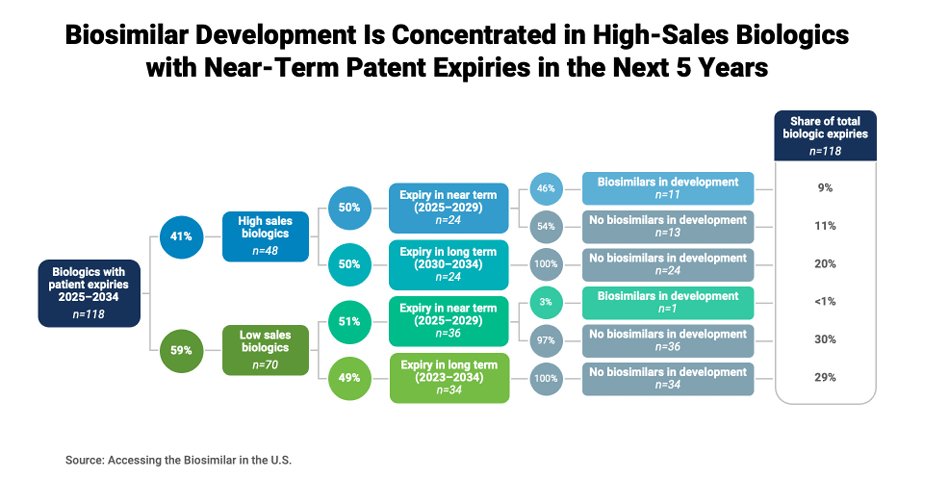
Despite the upcoming "patent cliff" (118 biologic expiries until 2034), biologic originators might be safer than expected. Only ~10% of expiring biologics (12/118) currently have biosimilars in development!
High entry barriers = longer commercial tail for pharma originators
Conclusion: $EW isn't "cheap" on a vanilla DCF. You just need real conviction in a specific combination of duration, margin, and risk-premium assumptions to own it here.
Full model + reverse DCF breakdown in the https://t.co/qUlMwaJewR
What's your read?
Built a full DCF on Edwards Lifesciences ($EW). Base case fair value: $52. Stock price: $91.60.
So, I reverse-engineered the model to find out what the market has to believe to justify $91.60. 🧵
Read the deep dive and find the model here: https://t.co/qUlMwaJewR
Despite the upcoming "patent cliff" (118 biologic expiries until 2034), biologic originators might be safer than expected. Only ~10% of expiring biologics (12/118) currently have biosimilars in development!
High entry barriers = longer commercial tail for pharma originators
Interest stat I came across
$ISRG does 60k procedures a week
It’s competitors do 50k procedures a year combined.
I believe that sums up who is the leader and how far ahead they are.
Read our full deep dive on $ISRG here -
https://t.co/mZsni2cKRs
Severe aortic stenosis affects >10% of people over 80.
The global population over 80 is projected to triple by 2050 — from 143M to 426M people.
Edwards doesn't need to grow market share.
The market is growing towards it.
Full $EW deep dive → https://t.co/kXogpeiAc9
In 1958, an engineer and surgeon's said: "Let's build an artificial heart valve." The medical community thought it was preposterous
First human implant: 1960. Patient survived
65 yrs later, that same focus has built one of the most defensible franchises
https://t.co/MmFTr2fr5l
Conclusion: $EW isn't "cheap" on a vanilla DCF. You just need real conviction in a specific combination of duration, margin, and risk-premium assumptions to own it here.
Full model + reverse DCF breakdown in the https://t.co/qUlMwaJewR
What's your read?
Built a full DCF on Edwards Lifesciences ($EW). Base case fair value: $52. Stock price: $91.60.
So, I reverse-engineered the model to find out what the market has to believe to justify $91.60. 🧵
Read the deep dive and find the model here: https://t.co/qUlMwaJewR
There's also an unpriced call option: Edwards' Heart Failure platform (still pre-revenue). Even generous assumptions there only add ~$0.15/share right now. Maybe it's too early to matter, but it's the kind of thing that rewrote TMTT's story a few years ago.