Our mission is to learn from evolution and redefine computing, using living neurons to make silicon-based AI models more stable, scalable and efficient.
How do we make AI models better without making them bigger?
At TBC, we study how neurons solve problems to make AI video models better, faster and cheaper.
See why we started and what we're building: https://t.co/M3vvID9ZlW
Can living brain cells make AI faster? 🧠
@BioComputingCo co-founders @AlexKsendzovsky and Jon Pomeraniec explain how studying lab-grown neurons is helping them develop faster, cheaper AI video generation, with potential applications in robotics and beyond.
📺 YouTube: https://t.co/jdbXeI6IfF
🎧 Spotify: https://t.co/2b57LsMcbu
🎙️ Apple Podcast: https://t.co/X9zjj6acZy
#BiologicalComputing #AIResearch #Neuroscience #GenerativeAI #TheNeuron
It’s about @TIME.
TBC has been named one of TIME's Best Inventions of 2026.
Real neurons. A new way to compute. And we're just getting started.
https://t.co/3FTVwDPoXv
#TIMEBestInventions
Neurotech is having a moment, and SF is right at the center of it.
Big shoutout to @naveen101 for bringing the community together at #SFTechWeek!
Meanwhile, @AlexKsendzovsky holding court on the future of biological computing.
Biological computing needs scientists and builders.
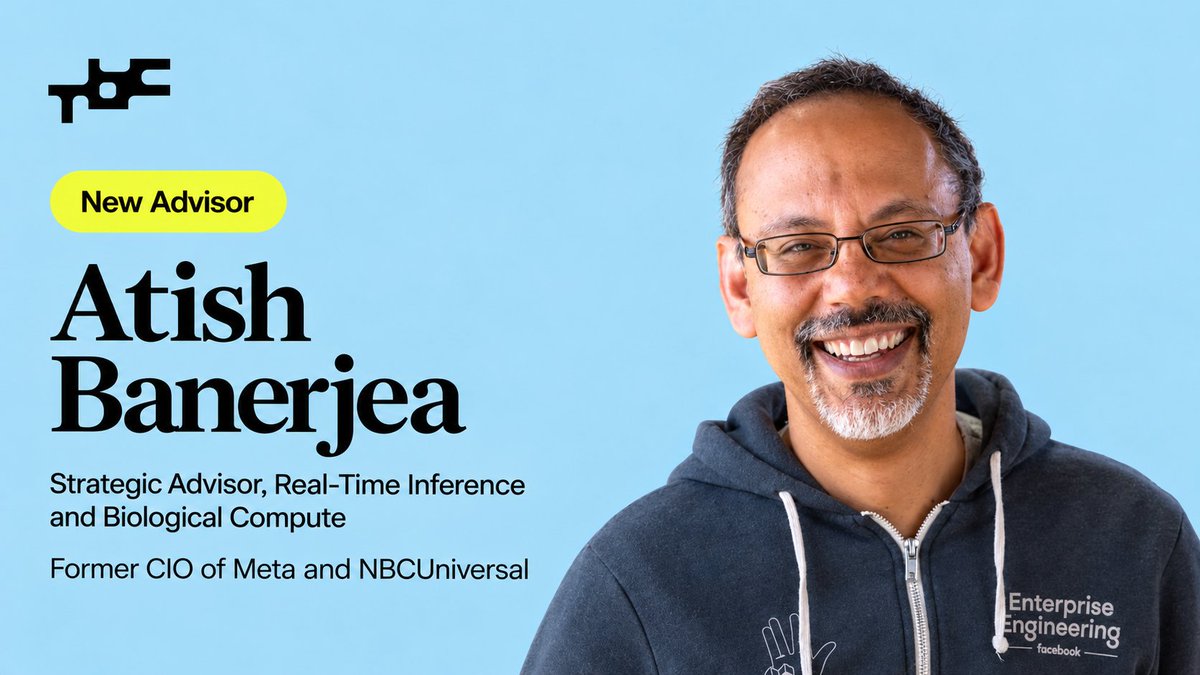
Former Meta and NBCUniversal CIO Atish Banerjea is joining TBC as an Advisor to help build the path to real-time biological compute.
Welcome to TBC, Atish.
Read the full announcement → https://t.co/9Q5kI5C5rl
I just tried @BioComputingCo neuron post trained video models 75% cost reduction and 10x faster with better quality is damn impressive!
https://t.co/wzUoQVHkI1 to try for yourself.
My results: https://t.co/QTCIVWOxuv
TBC's *brain-derived* AI model converted a baby picture of my son into a video of him driving a race car. Took me a couple of tries to get the prompt dialed... and then he took off! Upload your own pic and give it a shot!
https://t.co/RdxuNp29Ja
@BioComputingCo
Most of my early years went into trying to make things. Guitar, painting, videos. The question underneath was always how a mind turns experience into form.
Then five years at @Dolby on video compression and generation. What a latent can hold, and what a decoder can rebuild from it.
Now I do AI research at The Biological Computing Co., @BioComputingCo where living neurons grown on electrode arrays compute alongside silicon.
Handing it my own painting and watching it move was a good day.
It's free right now - try it out at https://t.co/qjiujE4Z0D
How do we make AI models better without making them bigger?
At TBC, we study how neurons solve problems to make AI video models better, faster and cheaper.
See why we started and what we're building: https://t.co/M3vvID9ZlW
Great question. No, a neuron being quiet or “resting” doesn’t break the computation. Higher and lower activity are both part of the signal. And because we record across a large population of neurons, we’re looking at the overall pattern of activity and not relying on any one neuron to fire continuously.
@_chipRH@AlexKsendzovsky We don't have any involvement. They just used our video model to create a video. Feel free to use the model as well; let your imagination run: https://t.co/crJwCbRjsS
Did you know you can learn interesting things from computations in real rat neurons? I love what @AlexKsendzovsky and team are doing at @BioComputingCo are doing.
🧠 @BioComputingCo records how living neurons process images and turns those patterns into AI software. The result is video generation that’s up to 5x faster and significantly cheaper to run, now available to select AWS customers.
@LaurenGoode reports for @WIRED: https://t.co/bo3QJFPp1X
The Biological Computing Company is bringing its AI tools to Amazon Web Services in a major boost for a once-fringe field that aims to marry nature with code. https://t.co/jdAPj7kJEo