Novel biological tools to reduce the ecological impact and restore the natural and agricultural ecosystems threatened by the quarantine plant pathogen Xf
El @GVAivia participa en II Encuentro Nacional de Asesores, organizado por @Phytoma:
🍊Patricia Chueca de @Agroing_IVIA trata la aplicación precisa y sostenible de fitosanitarios.
🪲César Monzó de #Entomología explica estrategias de gestión integrada de Scirtothrips aurantii.
Phages: Nature’s little allies in controlling outbreaks of Xylella fastidiosa
In Spain, researchers from the IVIA, and the I2SysBio (UV), are working together in a coordinated effort to find phages capable of targeting Xylella fastidiosa.
More Info: https://t.co/SSe3FlWNt1
Microfluidic chambers: Simulation of conditions inside the plant vessels
Using microfluidic chambers, researchers can monitor biofilm formation, bacterial movement, and interactions in real time, to get closer to understanding how to fight against Xf
Info https://t.co/abzn1HXDh7
Follow the Glow: Tracking beneficial bacteria
Key to designing well-balanced SynComs to protect crops. Understanding how beneficial microbes behave, researchers move one step closer to creating a microbial-based solutions against plant diseases as Xf
Info: https://t.co/59T13hvBpO
Genomics insights into bacteria from Xylella fastidiosa Host Plants and Vectors.
Sequencing the genomes of the bacteria associated with host plants and the insect vectors of Xf may provide critical insights.
More info: https://t.co/cA2vuD7Jgo
@IAS_CSIC
Safe and effective? Testing functionals peptides for phytotoxicity against Xf
Researchers at UdG are identifying peptides both effective against Xf and safe for the plant, as a vital step toward eco-friendly solutions to protect crops
More info: https://t.co/ZnfQRVlapP
Stem-Smash Science: Tracking Xylella fastidiosa vs. beneficial bacteria in olive plants
In the featured video, you’ll see olive stems homogenized in an extraction buffer.
More info: https://t.co/T0lK8y3KRl
The Valencian Institute of Agricultural Research (IVIA) shows how to inoculate forest plants in the biosafety greenhouse as part of the BioStop-Xf Project
The aim of this process is to monitor symptoms compatible with the presence of Xf
More info: https://t.co/5niUUsBNiH
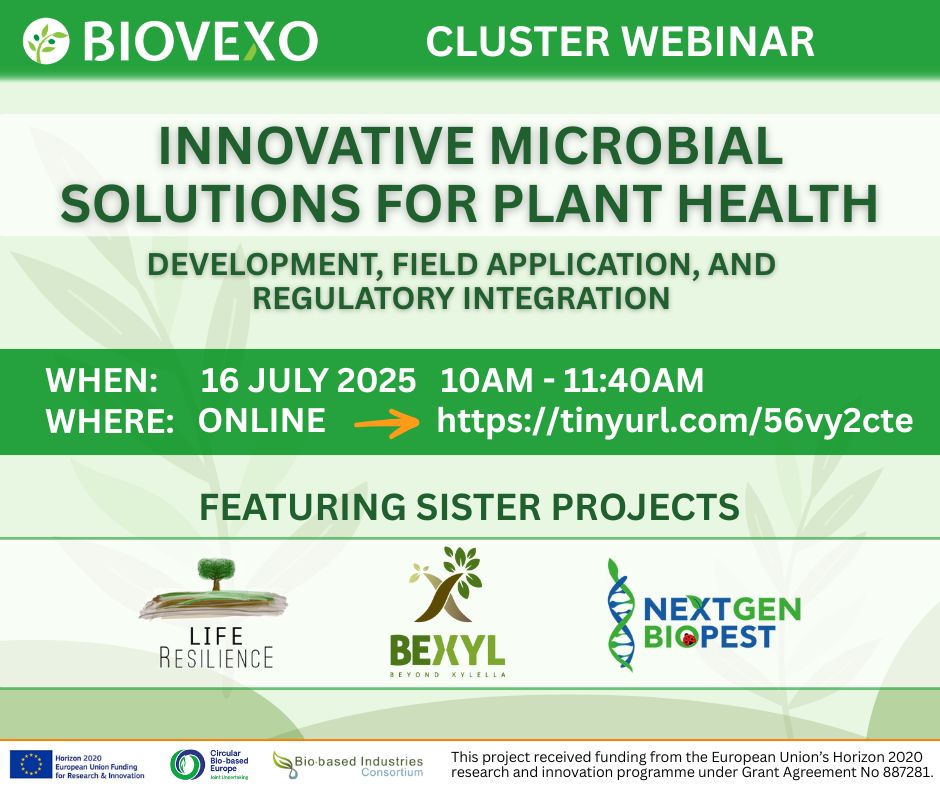
📅 Just one week to go!
Don’t miss the free @BiovexoProject webinar on July 16 (10:00–11:40 CEST) exploring cutting-edge #microbial solutions to protect plant health 🌱🫒
Join BIOVEXO, @Life_Resilience ,@NextGenBioPest & @BexylP for the latest updates.
📖 Learn more: https://t.co/Az33zfpE1n
🔗 To Join: https://t.co/RlpwTYoPHD
#BIOVEXO #Xylella #PlantHealth #AgriInnovation
📢 We have finished Xylella Seminar until summerbreak.
If you missed some, you can see them all on our website.
https://t.co/NwwwdNjtv4…
@BexylP@Plants_EFSA@AuburnU@REA_research
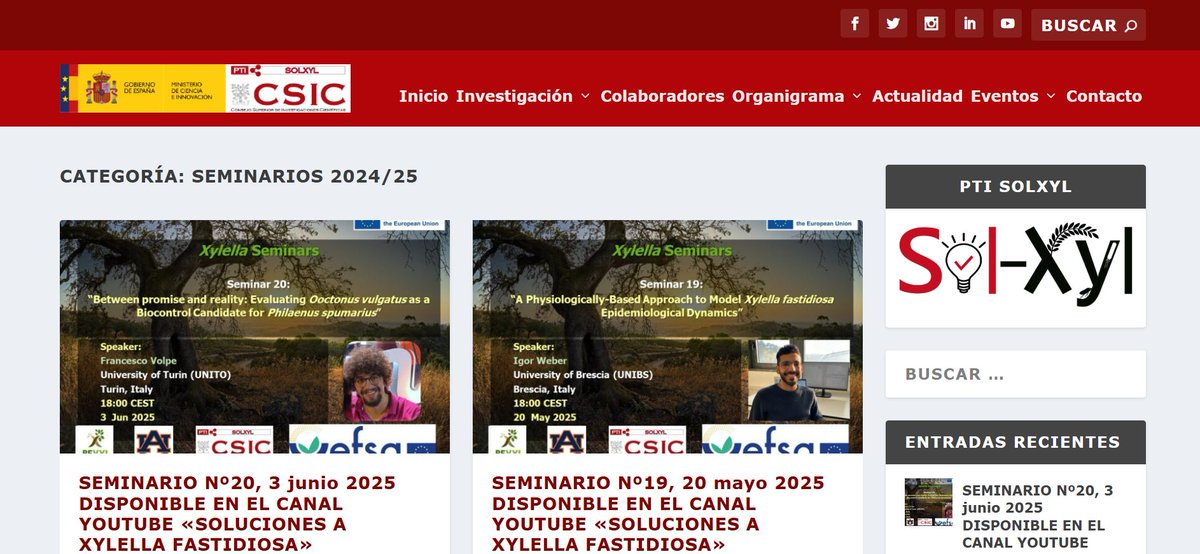
Don't miss the last seminar of the season!
On June the 3rd, Francesco Volpe from UNITO, will talk about "Between promise and reality: Evaluating Ooctonus vulgatus as a Biocontrol Candidate for P. spumarius"
Info at [email protected]@BexylP@Plants_EFSA@AuburnU
✨ We are pleased to share with you the link to the 19th seminar of the Xylella Seminar Series, jointly organised by the EU funded BeXyl project, EFSA (European Food Safety Authority) and Auburn University.
📼 The seminar recording is now available on the "Soluciones a Xylella fastidiosa" channel, thanks to the collaboration with the interdisciplinary thematic platform PTI Sol-Xyl of CSIC.
You can access the 19th seminar entitled: “A Physiologically-Based Approach to Model Xylella fastidiosa Epidemiological Dynamics” at the following link: 🔗
https://t.co/VyP41CVnjL
@CSIC@Food_EU@REA_research@AuburnU@Plants_EFSA@Sol_Xyl