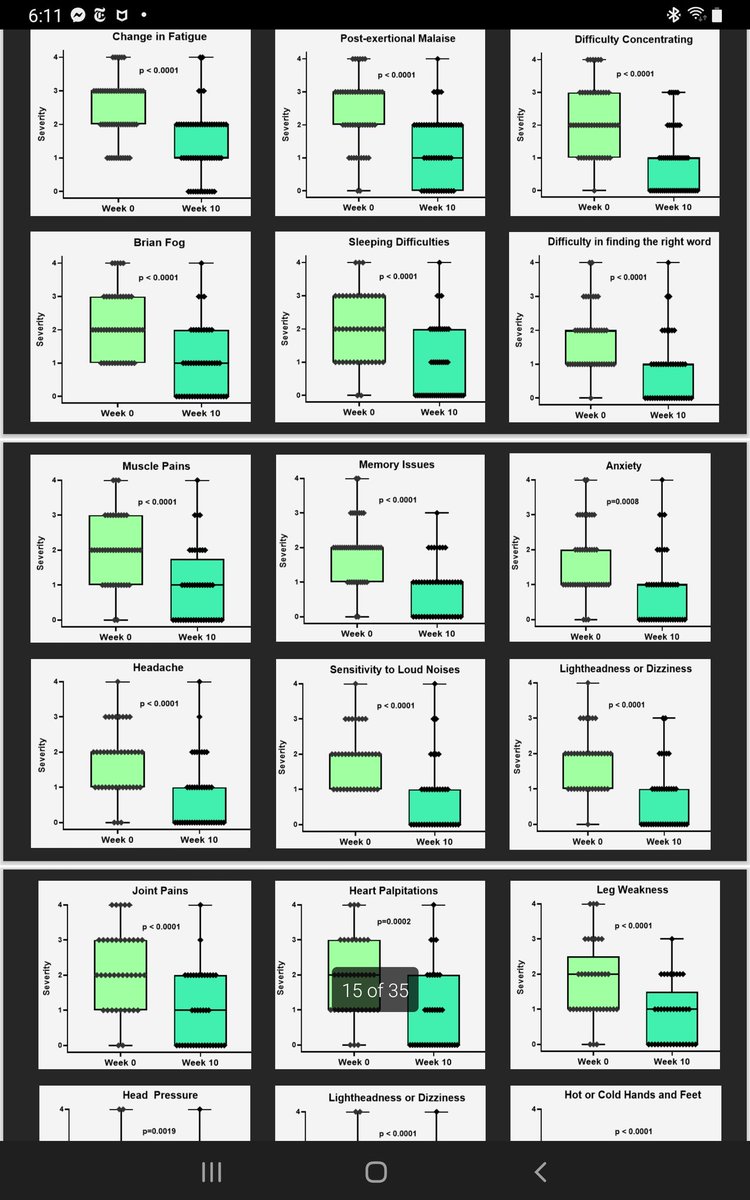
Pleased to share our positive #LongCOVID trial results. Jeff Novack PhD of PNWU opened doors, made key contributions and otherwise made this possible. A patient-friendly, low burden, all remote trial. And a big THANK-YOU to all the trial participants!
https://t.co/n2S9VeEDEt
@ZdenekVrozina This fits perfectly with my 'Verx hypothesis' that links viral persistence and the stimulation of innate immunity to #LongCovid symptom flare-ups. https://t.co/jEEe1dR1vd
Patients with hypermobile Ehlers-Danlos syndrome (hEDS) face nearly 3x the risk of developing Long COVID, according to a major U.S. nationwide study of 19+ million health records.
Despite similar COVID infection rates, the elevated risk of developing Long COVID was heavily concentrated in hEDS patients who were also diagnosed with:
- POTS
- MCAS
- ME/CFS
The study also found hEDS is far more common than previously thought (~1 in 800 people).
Better screening, earlier diagnosis, and integrated care are urgently needed for this underdiagnosed group.
#hEDS #LongCOVID #POTS #MCAS #EhlersDanlos
Read more: https://t.co/qdA4EOc8IO
@subversivepsych@Canal1point5 Medically a Herx is a sudden antibacterial immune reaction. I propose that a Verx is a sudden antiviral immune reaction in many Long COVID and other chronic illness patients
My Verx hypothesis: connecting viral persistence, the stimulation of innate immunity and transient flare-ups of #LongCovid symptoms. If true, this has implications for many current and future #PAIS clinical trials. Scientific research is needed to follow-up on this framework.
Today I saw another young long covid girl from
northern Europe.
One thing I worry we miss in children with Long COVID:
A child manages a full school day. The next day, they can barely get out of bed.
Was school “well tolerated”? Not at all.
PEM can appear 12–48 hours after physical or cognitive effort.
Therefore; this Instead of “Can you manage school?”, I ask: “What happens the next day?”
With PEM, pacing and school adjustments matter and this is part of routine asssessment in pediatric long covid or mecfs.
Clinicians and families: how do you spot delayed crashes?
to colleagues: this pattern is what easily distinguishes a child with LC or MECFS from a child who doesn’t want to do to school for any other reason
Could reactivated tick borne disease underlie neurological symptoms in a portion of Long COVID patients?
This research question is being pursued by Dr. Alessandra Luchini & colleagues at George Mason University via a new PolyBio-supported study. Using urinary extracellular vesicle (uEV) assays as a noninvasive platform to detect microbial and host-derived signals in Long COVID, the research team seeks to identify a potentially distinct subgroup of patients influenced by Borrelia infection and neuroimmune dysfunction.
Said Dr. Luchini, “The plan is to use immunoassays and mass spectrometry to study Lyme disease antigens and markers of organ injury or neural injury… astrocytic activation, blood-brain barrier dysfunction, and other markers.” Markers present on tissue-derived EVs may also indicate persistence of SARS-CoV-2 or its antigens.
We did it! We are so excited to announce we have received a prestigious R-01 grant from @NIH to further our research into mTOR’s role in #MECFS! This grant will deepen our findings about how mTOR activation is contributing to #PEM and help pinpoint mechanisms that are disrupted in #ME to better target treatments. Congratulations, @ggottschalkPhD@ProfAvikRoy and team! #Longcovid #POTS
In a recent episode of PolyBio’s “Lab Visits,” Dr. David Putrino outlined an ongoing Long COVID clinical trial of low-dose rapamycin, an mTOR inhibitor with numerous impacts on immune and mitochondrial function, taking place at Mt. Sinai’s CoRE clinic.
“Before starting this trial, not only did we speak with a lot of experts who had been trialing low-dose rapamycin in other populations, but we also spoke to patients who had figured it out on their own,” said Putrino. “That led us to very slowly tapering up the dose.”
@amymitchellart@surf4children Yes, all four Paxlovid trials for LC used ritonavir as the "placebo". It is a BIG assumption that it has no effect on LC symptoms.
@eitchan In our 10-week Intermittent Fasting clinical trial for #LongCovid and #LongVAX, the top-half of participants had an average 81% decrease in their symptom burden. Here is a 40 min video about the trial. https://t.co/1Z2tG9rokb
First, the results:
15 or 25 days of nirmatrelvir/ritonavir did not improve Long COVID compared with placebo in any of the three phenotypes tested: cognitive dysfunction, autonomic dysfunction, or exercise intolerance/PEM.
This was a large study with 959 participants. The investigators deliberately designed VITAL to address criticisms of STOP-PASC and PAX-LC that included small sample sizes, wide variation in symptoms among participants, and outcome measures that may have missed significant changes
2/
@CureLongCovid Yes, we need multiple effective antivirals to as we learned in HIV and Hepatitis to contain or hopefully clear persistent viral infection. And Intermittent Fasting is a candidate for a complimentary treatment.
@CureLongCovid This assumes that detection of viral antigen in the blood is a valid readout for tissue viral persistence. I don't think that is the case.
@vipintukur Pleased to share our positive #LongCOVID Intermittent Fasting trial results. The top half of participants saw a mean 81% decrease in their Long Covid symptom burden over 10 weeks.
https://t.co/wkGXo0g7dc