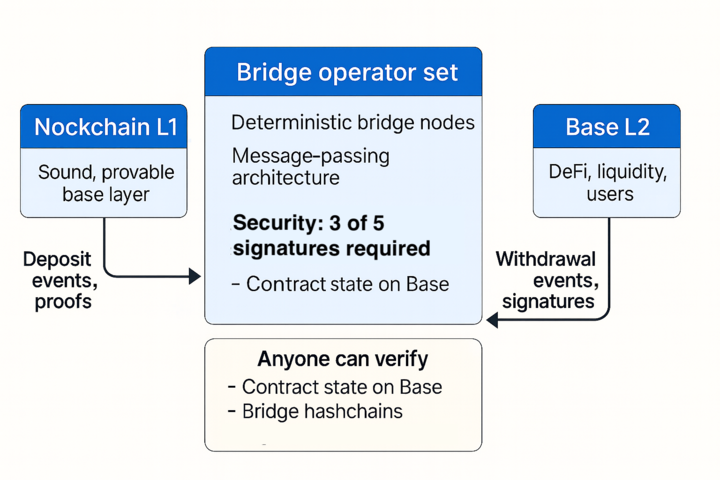
Update on our bridge to @base.
- We've finished writing and testing the Bridge contracts
- We've finished writing the Bridge nodes
- We're now finalizing and testing the Hoon state machine for the Bridge hashchains
So we're updating the target date for launch. We can't rush testing obviously. We expect it will be another week from Dec. 4. Thanks in advance for your patience on this. We'll keep you posted as always.
Here's a snapshot of the work for context.
brainstorming names for a new media network:
D-SPAN — Distributed-Sovereign Public Affairs Network
D-SPAN — Dark-Stream Public Affairs Network
X-SPAN — Exponential-Systems Public Affairs Network
X-SPAN — Xenopolitical Public Affairs Network
Z-SPAN — Zero-Knowledge Public Affairs Network
Z-SPAN — Ziggurat-Studio Public Affairs Network
A-SPAN — Asymmetric-Signal Public Affairs Network
M-SPAN — Mesh-Signal Public Affairs Network
V-SPAN — Verifiable-Signal Public Affairs Network
R-SPAN — Recursive-Signal Public Affairs Network
$NOCK : @nockchain
- @ZorpZK as the core developer (doxed founder @loganzorp) + a $NOCK treasury company, and the first one to build party applications in the ecosystem, which will be the bridge to institutional capital.
- Supply (~28% has been mined, with even fewer on the market) is very limited, only available on @safetrade or via OTC.
>Early project, RRR is really good.
>Much more inflow expected soon (EVM bridge), which will enable trading on platforms like Uniswap.
>Estimated time to halving is less than 30 days.
>Mining activity still relatively low,
A few people know of $NOCK, as mentioned, it’s not listed on any exchanges (decentralized or centralized) besides Safetrade, and it seems to be the key to solving the blockchain trilemma.
Looking at the blockchain trilemma, Bitcoin misses scalability, and that’s why I and many others think that @nockchain is basically what Bitcoin should’ve looked like if zero-knowledge cryptography had been practical in 2008.
Nockchain seems to solve the scalability issue through ZKPoW (zero-knowledge proof of work), with $NOCK being the digital asset for this ecosystem.
The difference here is that the work on Nockchain isn’t wasted. Miners generate a ZKP (zero-knowledge proof), proving the correct execution of transactions in a block.
—>
On $BTC, you solve a block, and no one can ‘’reuse’’ your work. When a miner mines a new block, every new node has to download and check every block and transaction back to the beginning.
In contrast, on Nockchain, each ZKP proves that the entire state transition from the previous block to the current one is correct.
And the interesting thing is what comes with this: once a miner improves NockVM (this is the ‘’tool’’ that creates the ZKP), the whole ecosystem benefits, since future blocks and apps can use the same updated ‘’tool’’.
And because only the quickest miner gets paid in $NOCK for the block, it incentivizes miners to optimize their performance, which in turn strengthens the entire ecosystem as it scales with more users.
The Nock ecosystem consists of three pillars that reinforce each other. Together, they create a secure, censorship-resistant platform for transacting, building, and flourishing.
1/ $NOCK
This is the digital asset for the ecosystem, scarce and hard money secured by zero-knowledge proofs on the Nockchain. It was fair-launched with no pre-mine in May 2025.
Unlike Bitcoin, $NOCK is more than just ‘’digital gold’’, It provides a store of value while also functioning as programmable money, similar to Ethereum.
The three features below are what make $NOCK a strong asset:
2/ Nockchain
The first L1 blockchain, built within the NockApp framework, powered by zero-knowledge proof-of-work, nodes secure the chain and produce blocks by mining zero-knowledge proofs in a PoW competition, as explained at the beginning. And since it’s built on the NockApp framework, it validates their claims about the framework’s stability and security, serving as a flagship proof of concept for future applications.
3/ NockApp
The NockApp is a framework for application-specific rollups, where the programmability is simple and scalable. These apps will deliver unprecedented security guarantees to users and scale alongside the rest of the ecosystem.
Rollups basically mean that execution happens off-chain (via L2s), in an environment that compiles down to NockVM, so there’s little to no risk of congestion on the mainchain.
In a nutshell, the triangle seems simple but is in-depth and effective. $NOCK powers NockApps and incentivizes miners. The quickest miner wins, so miners optimize NockVM. As ZKPs get cheaper and faster through NockVM, NockApps margins expand, unlocking new use cases --> driving more demand for the apps. These apps settle on Nockchain, which creates more demand for $NOCK, and the cycle repeats itself.
Still reeling that a former federal reserve guy told me to my face that the plan for solving plummeting TFR and family formation in the US was “loosening immigration policy to bring in young workers.”
bitcoin is doomed and nockchain is the only chain that has figured out how to make pow work long term by inventing useful pow (zkpow)
it's still early, but it won't take long for other people to figure this out
nockmilio.