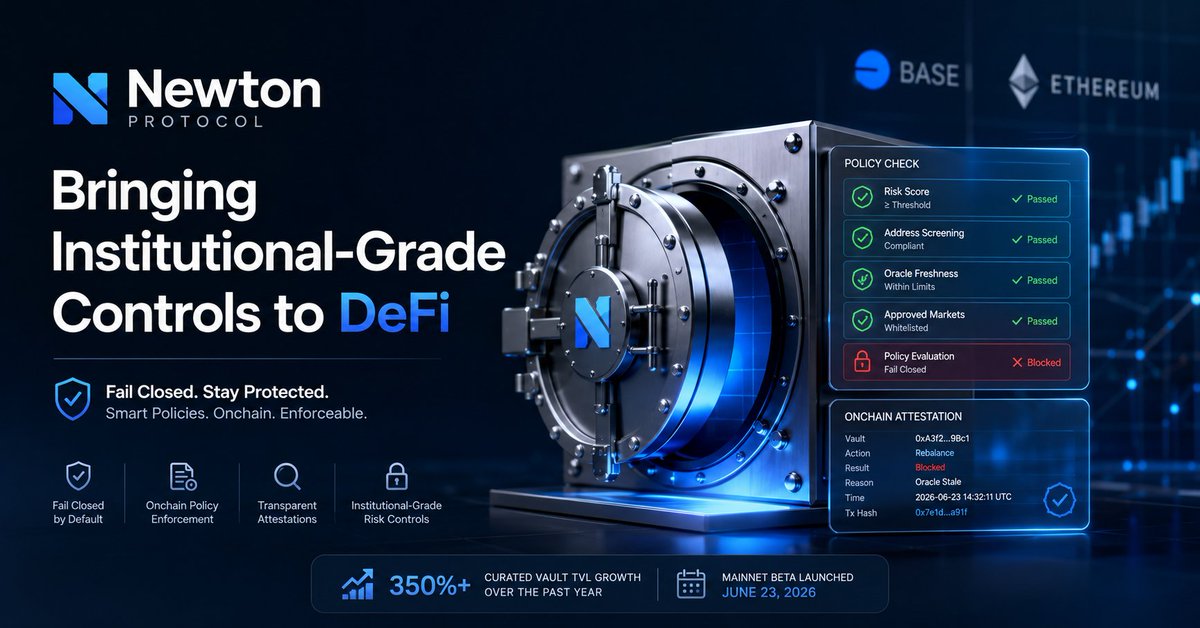
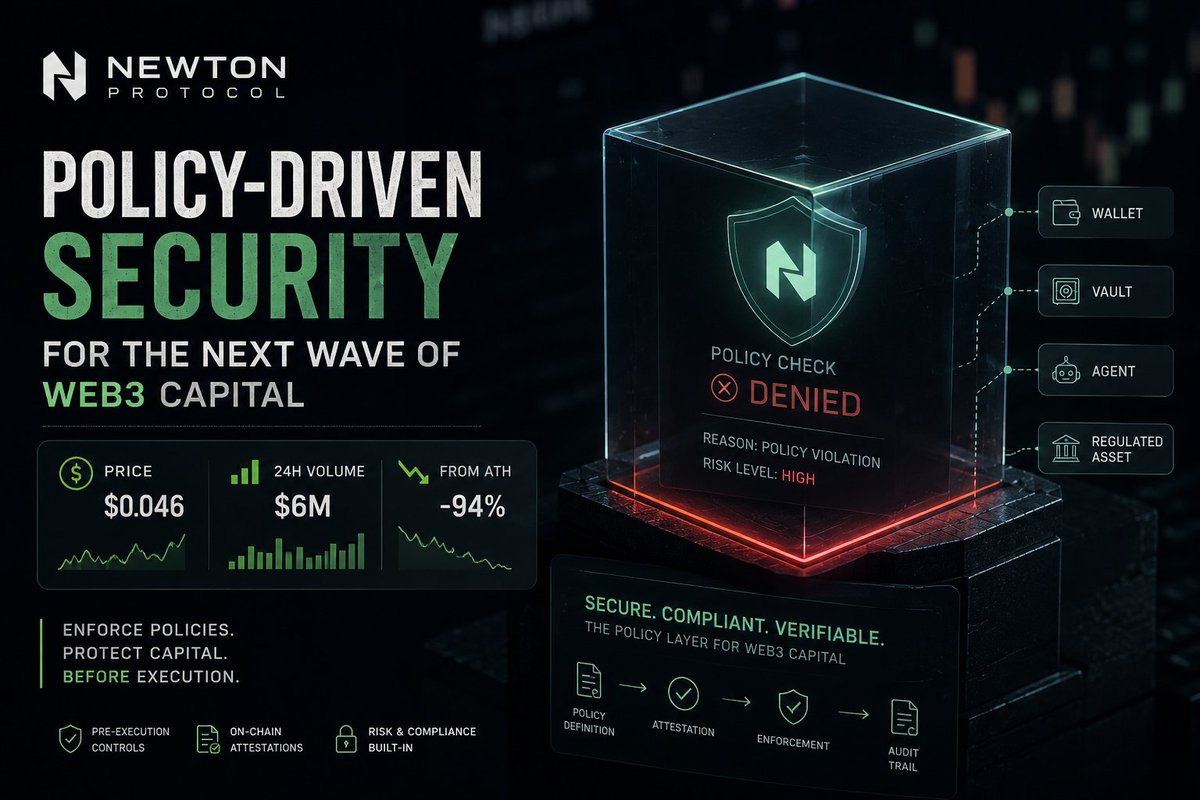
@newton_xyz real value shows up when it says “no.”
Its authorization layer checks whether a transaction follows pre-set rules before settlement.#Newt
That sounds simple, but the real friction appears when a valid-looking trade gets blocked because the policy, oracle, $NEWT
AI agents can trade, move funds, and interact with protocols but who $NEWT decides what they’re allowed to do?@newton_xyz is building an onchain authorization layer for q #Newt automated finance. The real challenge isn’t just enforcing rules. It’s making sure those rules are .
Blockchains can verify a transaction, but can they verify whether it should happen?@newton_xyz adds a programmable authorization layer for onchain finance, helping wallets, AI #Newt agents, and institutions follow defined policies before funds move. $NEWT
At first, I saw @newton_xyz as another automation layer for AI agents.
Then I noticed the policy layer.#Newt
The real value may not be helping agents act faster, but making sure they act within clear, verifiable rules.
$NEWT Automation executes. Policy decides what is allowed.
@newton_xyz is getting clearer, but NEWT’s value capture still isn’t.
VaultKit, policy checks, and onchain authorization make sense. The $NEWT missing piece is a visible link between real protocol usage and token demand.#Newt
That’s the part I’m watching. 👀
@newton_xyz rule was followed. It can’t prove the rule was smart.#Newt
A perfectly verified decision can still be a bad one if the threshold, risk model, or timing is wrong. $NEWT
“Verifiable” doesn’t automatically mean “safe.” That’s the part people may learn the hard way.
@newton_xyz test karte waqt ek cheez noticeable lagi: NEWT token ki market activity dekhna easy hai, lekin actual authorization activity verify karna abhi bhi difficult.#Newt For an “authorization layer,” approvals denials aur linked transactions zyada visible honi chahiye. $NEWT
@newton_xyz weirdest friction isn’t technical.
It’s that it tries to save users from bad permissions, bad agents, and bad decisions but the user still has to define what “safe” means before panic, greed, or FOMO kicks in.#Newt
$NEWT The policy engine may work. The user is still
@newton_xyz like the security layer I wish Web3 had earlier.
I’m tired of wallet popups that only make me guess faster. $NEWT
NEWT is interesting because it focuses on one simple thing: checking if a transaction should be authorized before the click becomes regret.#Newt
@newton_xyz agent finance feel less like “trust the bot” and more like “act, but stay inside these limits.#Newt
It’s not just about faster execution. It’s about verifiable control before a $NEWT transaction moves.
That small approval layer might matter more than people think.
The biggest challenge in onchain @newton_xyz automation isn't executionit's deciding what an agent should be allowed to do before it acts.
The permission layer may end up being more important than the automation itself. $NEWT
Worth thinking about. 👇#Newt
Spent some time exploring @newton_xyz and my biggest takeaway: $NEWT
The Gateway ends up shaping the user experience more than any other component. Great architecture behind the scenes, but what users feel matters just as much.#Newt
Everyone talks about successful transactions.@newton_xyz
The more interesting part is what happens when a protocol says "No."
With policy-driven security, the #Newt blocked transaction becomes part of the user experience not just the security model. $NEWT
I don't think the winner in AI x crypto will be the smartest agent.
$NEWT
It'll be the protocol that makes trust easy to manage without getting in the user's way.@newton_xyz
That's a much harder problem than building the agent itself . #Newt