What does it take to build a Bitcoin community that lasts?
At BitDevs Lagos, it takes more than a monthly meetup. It means helping members find direction, supporting their learning and creating opportunities for them to share what they know.
We spoke with @TChileta, lead organizer of @BitDevsLagos, about the community’s beginnings, the people who have grown alongside it and the support that helps members move from curiosity to contribution.
We had an insightful session with Sadiq @rsadiqra from BitDevs Mauritius @BitDevsMRU on Using AI in Bitcoin Development Exploring how AI can support the Bitcoin development process and new ways for builders to approach problems, and bring ideas to life. Thank you @rsadiqra
Missed @btcplusplus Seoul Privacy Edition, but these Fedimint stats speak volumes.
3 years. 80 federations. 463K transactions. 24K wallets holding ecash notes.
Incredible to see how far Fedimint has come. Huge respect to everyone building, contributing, and growing this ecosystem. The work speaks for itself. 🔥
Highlights from yesterday’s workshop: a day packed with productivity, first commits, new connections, and happy faces!
Students took their first steps into open source, explored Git and GitHub, and getting started with Bitcoin FOSS.
More contributors, more builders
NEW: 🇲🇺 BitDevs Mauritius, OS Guild, and GDG University of Mauritius Host Open-Source Workshop.
This hands-on format aligns with broader efforts by BitDevs chapters to move beyond discussion and help new contributors make meaningful first steps in technical Bitcoin projects.
Read More: https://t.co/uar1Uym0a2
What does it take to build on #Bitcoin core with AI without creating #Bitcoin slop code? 👀
Start with AI, but make sure YOU understand the code! 💻
This week, Sadiq Rabiu @rsadiqra, founder of @BitDevsMRU BitDevsMauritius, and OpenSourceGuild, joined the women of the Sovereign Stack Hackathon, @SatSisterCircle’s virtual #Bitcoin developer education program and hackathon for women across Africa.
He shared his approach to AI-assisted software development, exploring Bitcoin Core, Taproot, and how to get started building.
His #AI/#Bitcoin building playbook:
🔹 Use AI as a starting point not a substitute for understanding.
🔹 Own your code. You should be able to explain and defend what you’ve built.
🔹 Let AI help generate tests and summarize Bitcoin Improvement Proposals (BIPs), but verify its output. Hallucinations are real!
🔹 Working on a budget? Explore free, open-source AI models.
🔹 Build with care. Faster code generation doesn’t remove your responsibility to check the result.
The key takeaway? Bitcoin needs real people who understand what they’re building not just more AI-generated code. 🛠️
Thank you, Sadiq, for sharing your insights with our ladies! And thank you to @LNFlash and @TrezorAcademy for supporting our Hackathon event! 🙌
#BitcoinHackathon #SatoshiSisterCircle #WomenInBitcoin #BitcoinDeveloper
This October, we’re co-hosting an open-source workshop with GDG UoM at the University of Mauritius 🇲🇺
We’ll introduce students to Git, GitHub, responsible code contributions, avoiding AI slop, and building a pathway into Bitcoin open source.
More builders, less slop. 🛠️₿
For the first time, @fedimint -SDK 🔆 will have Dart-UniFFI.
I’ll be spending the next few weeks making this possible, opening up new possibilities for the Fedimint ecosystem and developers building native and cross-platform mobile apps with Flutter.
And with the recent release of the Android SDK, the timing couldn’t be better. Excited to see where this takes Fedimint. ⚡️
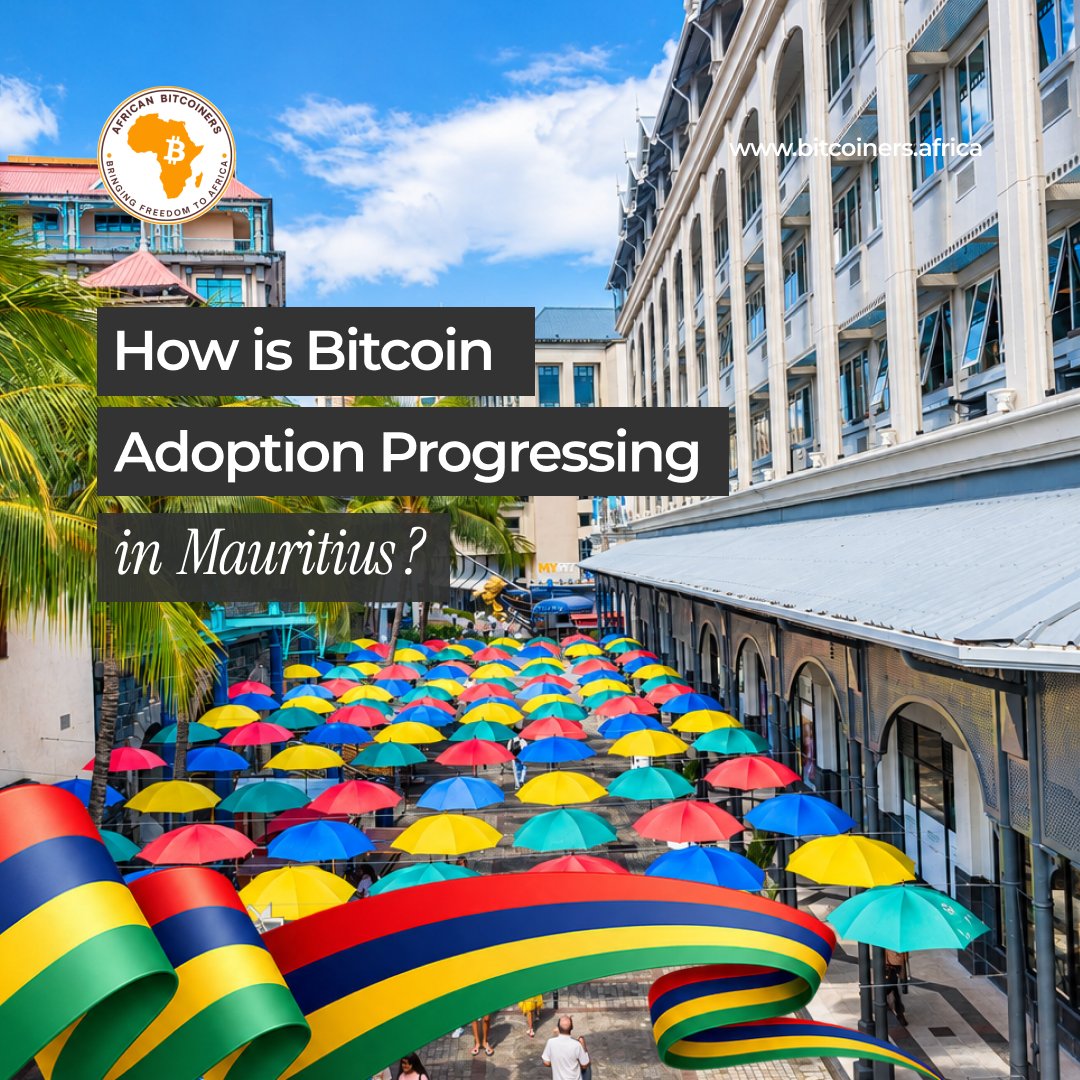
How is Bitcoin Adoption Progressing in Mauritius? 🇲🇺
Bitcoin adoption in Mauritius is steadily developing, supported by the country's position as a financial hub, an evolving regulatory environment, and growing grassroots efforts focused on education, development, and community building.
Key Drivers of Technical Adoption:
🔷 BitDevs Mauritius — A grassroots technical community advancing Bitcoin adoption through education, developer engagement, and community building. The initiative is part of the wider BitDevs Africa network supported by Btrust, which helps strengthen technical Bitcoin communities across the continent.
X: @BitDevsMRU
🔷 OSGuild — A structured pathway helping new developers enter the Bitcoin open-source ecosystem. Contributors learn by working on real-world, forked projects while receiving feedback and recognition for quality contributions. Its goal is to help turn beginners into capable and trusted open-source developers.
X: @OsguilHQ
Mauritius' financial ecosystem provides a strong foundation for Bitcoin development, while initiatives like BitDevs Mauritius and OSGuild are helping build the technical talent and open-source culture needed for deeper adoption.
👇 Explore the live directory for more African Bitcoin initiatives:
https://t.co/buthtpljav
⚡ BitDevs Mauritius - September Meetup
We’re continuing our Lightning Network series and diving into @fedimint exploring federated systems, community use cases, and Bitcoin’s evolving infrastructure.
Join us to learn, discuss, and build! 🇲🇺
Three more days until our next BitDevs meetup! We are collecting discussion topics, anything you'd love (or hate) to talk about on Thursday?
Sponsored by @cakewallet
https://t.co/4IxXMHwlLp
Building the Future of Bitcoin Payments Through Open Source.
At Genesis Workshop 1.0, @chuksagb introduced students to the Lightning Dev Kit (LDK) and the open-source technologies powering Bitcoin’s payment infrastructure.
As a software engineer and contributor to the Lightning Dev Kit (LDK) ecosystem, Chuks introduced participants to Lightning development and the technologies enabling faster, more flexible Bitcoin payments.
At The Genesis Workshop, students had the opportunity to learn directly from an active open-source contributor and explore how developers are building the next generation of Bitcoin infrastructure.
This is what Open source Guild is creating: connecting Mauritius🇲🇺 with contributors across Africa and building pathways into global open-source development.
Thank you to @btrustteam for supporting Genesis Workshop 1.0.
The future of Bitcoin development is open, collaborative, and global.
The Genesis Workshop 1.0, organized by Open Source Guild(OSGuild), we brought hands-on Bitcoin mining education to Mauritius 🇲🇺 university students, connecting them with real open source infrastructure.
@dzeg5 traveled all the way from Kenya 🇰🇪 to introduce participants to Bitcoin mining, Stratum V2,Bitaxe Gamma and Mujina the open-source, Linux-based mining firmware developed through the @256FOUNDATION open-source mining initiative.
Using Bitaxe Gamma kits from @SoloSatoshi, participants got to explore mining hardware firsthand. Some students even mined Bitcoin for the first time, turning technical concepts into a real experience.
This is what OSGuild,Genesis Workshop is about: creating opportunities for young developers to learn, experiment, and become contributors to the global Bitcoin open-source ecosystem.
From Kenya 🇰🇪 to Mauritius 🇲🇺, we're building connections, growing communities, and bringing open-source Bitcoin mining to the tropical island of Mauritius 🇲🇺.
Thank you to @btrustteam for supporting The Genesis Workshop 1.0.
The journey has started here in Mauritius.
Last month, we went through an incredible journey with the @TrezorAcademy program, designed to accelerate Bitcoin adoption through localized education and hands-on training.
The program gave young people in Mauritius 🇲🇺 the opportunity to learn about Bitcoin from the ground up not just what Bitcoin is, but why it matters, how money has evolved, how Bitcoin works, and how they can actually use it.
Mauritius 🇲🇺 is a small tropical island in the Indian Ocean, with a population of roughly 1.3–1.5 million people. It may not be a “Bitcoin country,” but there is a growing group of curious people who want to understand Bitcoin, challenge their assumptions about money, and explore what financial sovereignty could mean for them.
What surprised me most was seeing participants go from simply learning about Bitcoin to thinking about what they could build with it.
Some of these young participants have already started thinking about the possibility of building a Bitcoin circular economy within their own communities. To me, this is where education becomes something much more powerful when people move from “What is Bitcoin?” to “What can we build with it?”
That is how communities grow: one person learns, shares that knowledge with another, and eventually people start creating real-world networks around it.
A huge thank you to @JosefTetek and the entire @TrezorAcademy team for believing in localized Bitcoin education and giving us the opportunity to bring this experience to Mauritius.