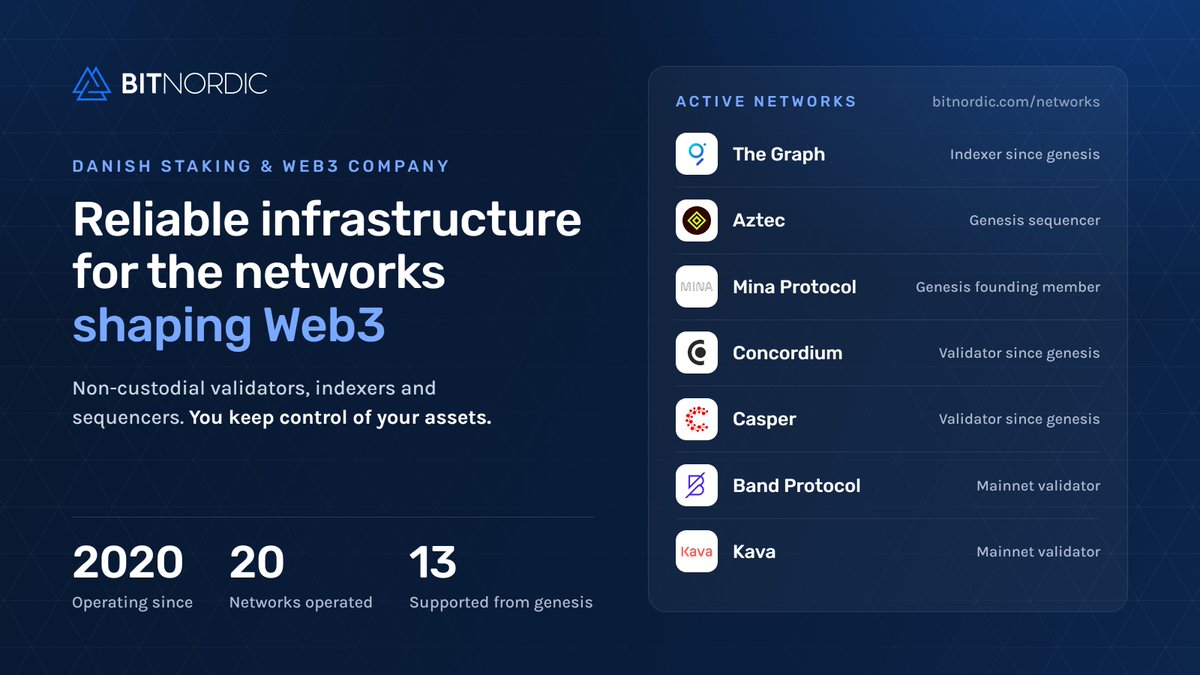
BitNordic is a Danish staking & Web3 infrastructure company.
Since 2020 we've run validators, indexers and sequencers on 20 networks, 13 from genesis. Always non-custodial.
Networks & delegation: https://t.co/DvkCgHK4qr
Chain dashboards: https://t.co/gIHtBhizkn
@Zac_Aztec Dark Forest is the cleanest demo of why hidden state matters: fog of war only works if nobody can read the map. Running it natively private on Aztec V6 is a real load test, and as a sequencer operator we're ready for the traffic 🌲
@aztecnetwork@P_Inference Separating who pays from what gets asked is the right split. Running infra, you learn that metadata leaks more than content: billing, IPs and timing can rebuild a person. Privacy that starts at the payment layer is the kind that holds up.
The Graph's curation burn is now 3% (was 1%).
What changes:
1. Burn on every signal deposit, withdrawals stay free
2. 2,000 GRT of signal now burns 60 GRT, not 20
3. Cycling signal to chase rewards costs 3x per move
4. Devs: still add 1,000+ GRT so several Indexers pick it up
@Zac_Aztec Can confirm from the operator side: V6 is live and we run a sequencer on it today. Stage 2 is the part worth repeating, since it means users don't have to trust any team, us included, to keep the rollup honest.
@Starknet Default voting with delegated stake works best when validator votes are easy to see. If each validator's position is public before a vote closes, delegators can check it and redirect their vote in time. Default turnout plus easy opt-out keeps both participation and control.
Cheaper attacks change the defaults. In validator ops that means signing keys kept off internet-facing hosts, hardware or remote signers, no single admin who can touch everything, and alerts tested before they're needed. AI raises the bar on the basics, not just the exotic stuff.
@injective@pentivhq Mortgages onchain are a long-lived data problem as much as a chain problem. Each loan carries payments, status changes and servicing events for decades, so indexing that history and making it queryable is what turns records into something auditors and investors can use.
@chainlink@UBS Structured notes are mostly lifecycle work: coupons, barrier checks and early redemptions, all driven by reference data on fixed dates. Automating that onchain makes the data and the workflow part of the product, and every payout traceable to the inputs that triggered it.
@NEARProtocol Confidential intents close the leak that remains when private coins go cross-chain: the swap itself. A shielded wallet is only as private as its exit path, so keeping the swap confidential end to end matters as much as the shielded pool it starts in.
@SuiNetwork Native BTC as collateral is a big unlock. The interesting part for operators is the plumbing: how the BTC is secured on the Bitcoin side, how its status is verified on Sui, and how fast price feeds reach liquidations. Getting those right is what lets 20+ partners build on it.
@edgeandnode Provenance is what turns onchain data into audit evidence. If every figure links back to the blocks it came from, an auditor checks the chain, not the vendor's dashboard, and a wrong number gets traced to its source in minutes, not weeks.
@aztecnetwork@xochi_fi Best MEV protection is having nothing to see. If an order never touches a public mempool, there's no signal to front-run, and solvers compete on fill quality instead of on who spotted it first. From the sequencer seat, that's a healthier market ⚡
@zksync That's the right bar. Regulators shouldn't need to learn a new workflow; the chain should fit theirs: named roles, approvals, audit trails and records that reconcile. The upside is that every step is also verifiable onchain, so the audit gets easier, not harder.
@CoinDesk@Visa Stablecoin prefunding fixes the slow part of cross-border payouts: money parked in local accounts days ahead. Funding on demand, around the clock, turns the chain underneath into treasury infrastructure, so finality and uptime become part of the payout SLA.
@arbitrum@FlutonIO Privacy on a general-purpose L2 lowers the switching cost: same wallets, same liquidity, nothing new to learn. The real test is the anonymity set. Private transfers only protect you when enough people use them, so an easy everyday flow matters as much as the cryptography.
@chainlink Four steps down to one removes the steps where users actually lose funds: wrong network, stale approval, bridging to the wrong address. The complexity doesn't vanish, it moves into cross-chain messaging, which is why the verification behind that one click matters most.
@aztecnetwork@zk_money An open source CLI is an underrated choice for private money: you can script deposits and payments, and anyone can read exactly what the tool does before trusting it with funds. Paylinks are the other half: the recipient needs no address and nothing installed to get paid.
A validator's genesis day:
1. Verify the genesis file hash
2. Keys made offline, never copied
3. Peers shared, tested early
4. Clocks synced, alerts dry-run
5. Node waits for genesis time
6. BFT chains: no block until 2/3 of stake is up
13 of our 20 networks started this way.
@cosmos Atomic PvP is what central banks care about: both currency legs settle or neither does, so there's no window where one side has paid and the other hasn't. IBC uses light clients that verify each ledger directly, so relayers carry packets without having to be trusted.