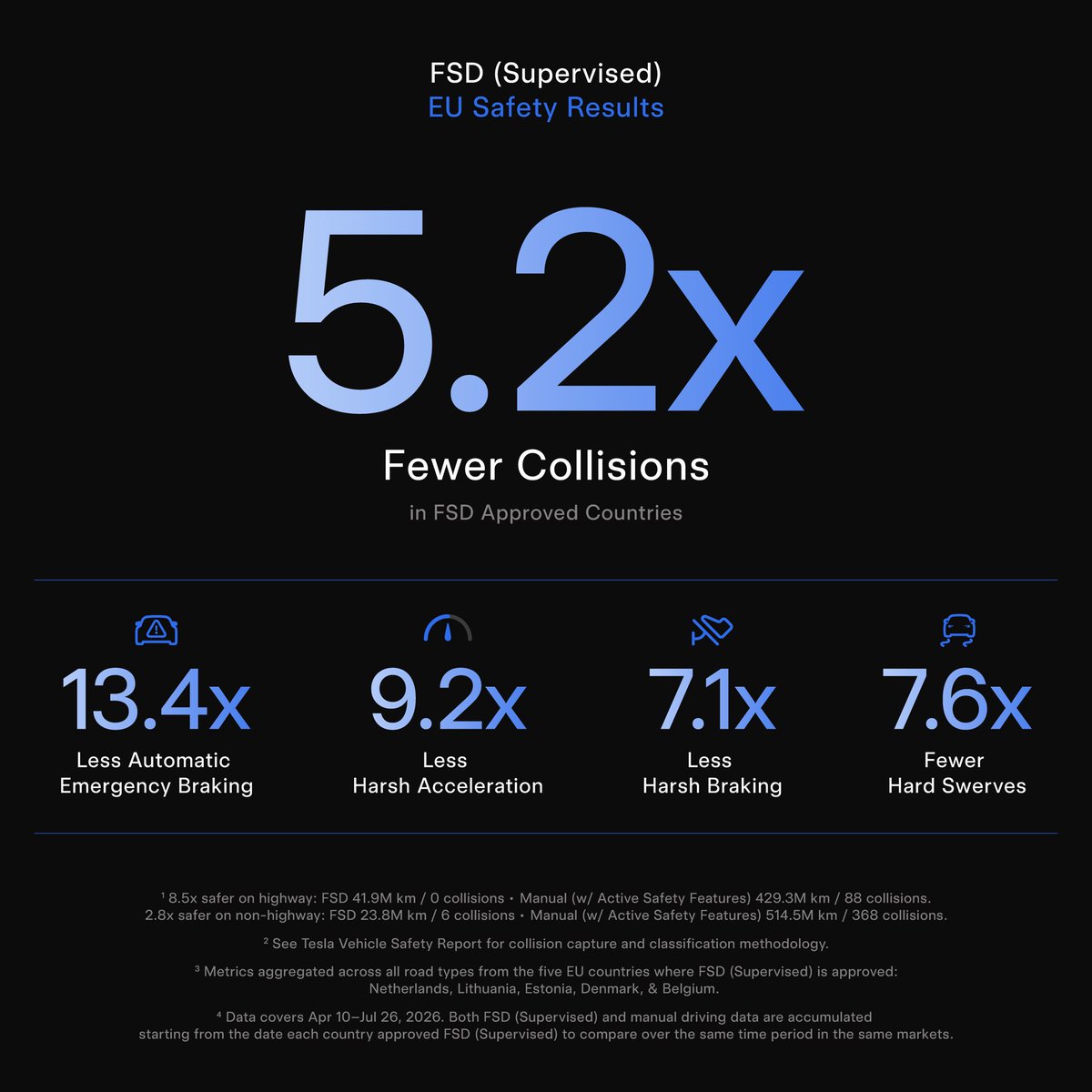
The more obvious it becomes that Self-Driving is solved, the more vicious the attacks against self-driving cars.
It's a $2 to $3 TRILLION dollar ecosystem in the US that self-driving cars will disrupt.
It's deadly obvious that the technology will win.
Self-driving cars literally save lives - they are far safer than humans, which cause 40,000 traffic deaths and a million injuries per year just in the US. That's a lot of $ going to lawyers.
Self-driving cars dramatically lower the cost of transportation by removing the largest cost per mile - the driver. It will make it cheaper (and easier) for people to leave their homes. Especially the elderly.
Self-driving cars render the use case for a car that you have to manually drive pretty much obsolete. Why would anyone spend money on a car that can't drive itself vs a car that can? Doesn't seem like something Legacy Auto would be happy about.
Self-driving cars render parking lots & parking meters completely obsolete. They render rideshare & taxis obsolete.
The list goes on and on.
This is an existential threat to trillions of dollars of wealth.
Another attempt at misinformation. I drive FSD in the Netherlands and can easily confirm it’s a better and more alert driver than I’ve ever been or will be.
Shame on the liars at Reuters for claiming Tesla Self-Driving is the biggest risk to road safety based on a "survey" of European regulators.
The biggest risk to road safety is humans. Not self-driving. Self-driving prevents crashes caused by humans, and the data is unequivocal that a human driving by themselves crashes several times more often than a human supervising a self-driving system.
This headline is based on a survey of "transportation experts in countries like France, Germany, Italy, the UK, China, India, Brazil, and Japan... none of which actually have FSD! How can you form an opinion on a technology that you haven't even allowed in your country?
I can see why they might have said that. Misuse of driver-assistance systems is a serious risk... with the previous generation of driver assistance systems. If you actually allowed the latest generation systems, you would see that the opposite is true. These systems are able to maintain safety even when the driver passes out or has a medical emergency. They will automatically pull over when they detect a driver is asleep. And they spot and react to dangers and vulnerable road users faster than a human.
When all is said and done, and we get to a world where road fatalities are extremely rare thanks to this kind of AI, let us remember all the organizations from Reuters to Uber that fought against it. This is like advocating against seatbelts and airbags. They absolutely have blood on their hands and do not care if their customers live or die.
Did a @Tesla drive in the Netherlands today for hours. Can’t believe how good FSD has gotten. Real door to door self driving. It’s not 100% there yet, but I feel confident saying it’s 98% there and 100% awesome
Elon Musk deserves to have his pay package approved by shareholders.
He is the greatest entrepreneur of our lifetime and he constantly embodies the definition of "paid for performance."
Most companies would be better off if their executives took a similar approach.
@Cointelegraph We should fight this with every breath we have. Europe is all about rules and control. We don’t want to hand over the keys to that incompetent and controlling bunch
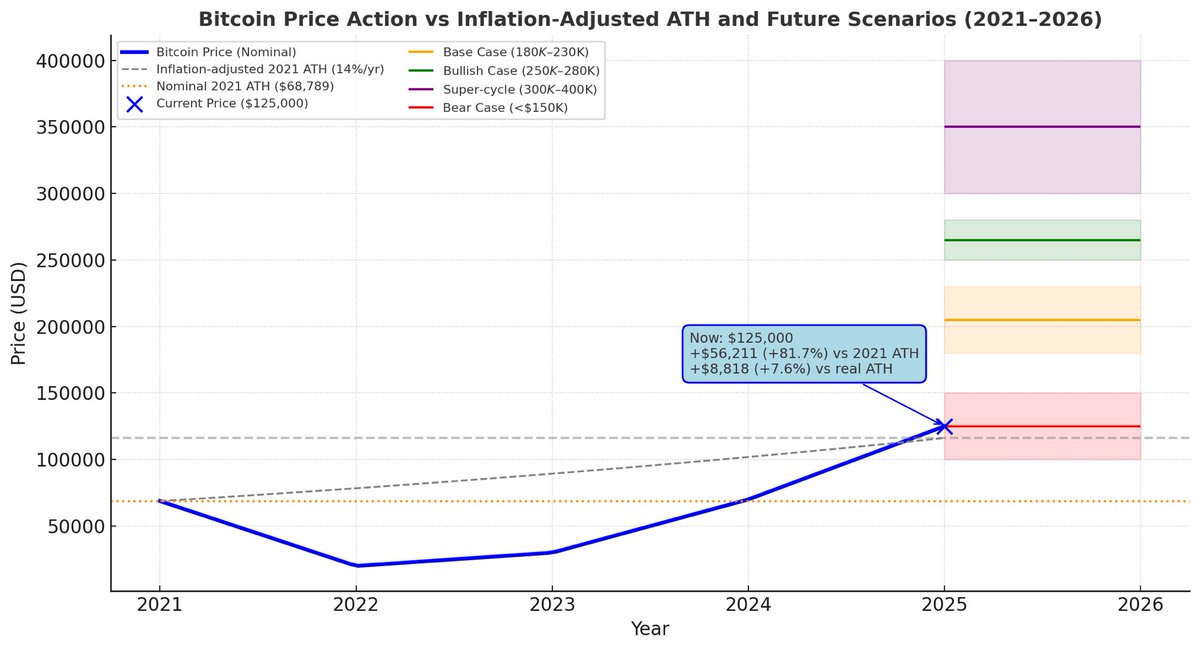
Bitcoin just reached a new ATH: $125,670. This is shy of $10k a the last cycle’s ATH in real terms (2021 dollars). So that’s just +7.6% change.
Considering quantitative easing, money printing / M2 surge , bond crisis, emergence of institutional investors in Bitcoin, ETFs, Bitcoin treasury companies, massive precious metals surge, favorable policy landscape, mining vs buying deficit, exchanges running low, I believe we have good reasons to be bullish for Bitcoin in the next couple quarters at least.
Bellow are some thoughts on the fundamentals. And I begin with scenarios:
🟠 Base Case ($180K–$230K, 45%)
🟢 Bullish Case ($250K–$280K, 35%)
🟣 Super-cycle ($300K–$400K, 13%)
Ⓜ️ Samson-Back case ($1M, 2%. I had to include those Legends. They could be right - supply crunch + US SBC + Trad-Fi black swan)
🔴 Bear Case (<$150K, 5%)
@Excellion@adam3us (sometimes the least probable is the most likely) @CernBasher@investanswers@Bitbull102@saylor
Fundamentals and analysis below.
📈 Bitcoin Price Landscape (2021–2025)
• 2021 ATH: $68,789
• Inflation-adjusted ATH (14 %/yr × 4 yrs): ≈ $116,000
• Current price (Oct 2025): ≈ $125,000 →
• +82 % above nominal 2021 ATH
• +7.6 % above inflation-adjusted ATH
• If this cycle repeated the 2020–21 gain (~18× from bottom): ≈ $280,000 projected peak
⸻
⚙️ Quantitative Context
• Last cycle (2020–21): $3,800 → $68,789 = 18× gain in 20 months
• Current cycle (2022–25): $15,500 → $125,000 = ~8× gain so far
→ Matching the 18× prior magnitude would imply ~$280 K, but timing and structure differ — full replication is less likely.
⸻
🏦 Market Structure & Fundamentals
• Post-halving supply: 3.125 BTC/block ≈ 450 BTC/day → ~$56 M/day at $125 K.
• ETF inflows: 2,000–3,000 BTC/day = $250–375 M/day → consistent net deficit of 1,000–2,000 BTC/day.
• Market cap at targets:
• $125 K → $2.45 T
• $250 K → $4.9 T
• $280 K → $5.5 T
→ Still only ~⅓ of gold’s ~$15 T cap, plausible with 2–3 % global wealth reallocation.
• Liquidity base: institutional, not retail. ETFs, corporates, and sovereigns now dominate inflows.
• Macro tailwinds:
• Global M2 +10–12 % YoY → ongoing fiat debasement.
• US debt > 120 % of GDP → long-term real yield suppression.
• Bitcoin increasingly viewed as a monetary hedge.
⸻
⚖️ Constraints & Risks
• Monetary tightening or liquidity shocks could cap upside.
• Regulatory pressure in major markets could slow ETF growth.
• Institutional rebalancing near $150–200 K could dampen momentum.
• Lower retail reflexivity = less euphoric overshoot than 2021.
⸻
🔮 Probable Outcomes (2025–26)
• Base case: $180 K – $230 K → steady ETF inflows, stable macro.
• Bullish case: $250 K – $280 K → ETF inflows accelerate + liquidity remains loose.
• Super-cycle case: $300 K – $400 K → global fiat or debt-confidence crisis.
• Bear case: < $150 K → regulation or liquidity squeeze.
⸻
💡 Bottom Line
• Bitcoin has already reached a real (inflation-adjusted) all-time high.
• A move to $250 K–$280 K is plausible but not baseline — it requires sustained ETF demand and supportive macro liquidity.
• The more conservative realistic range is $180 K–$230 K, while >$300 K would signal a true monetary regime shift or flight from fiat confidence.