TRANSFERABLE ≠ INTEROPERABLE
A token can move between wallets. But can different apps understand what it represents?
Transferability moves the asset.
Interoperability makes it usable across systems.
Digital ownership needs both.
1/ Upgrade done ✅ Our production node now runs Taproot Assets v0.8.5, 12 days ahead of the block 971,750 deadline.
923 Bitcoin Digital Objects migrated with an identical inventory fingerprint. New mints already land in the public Universe.
#Bitcoin#TaprootAssets
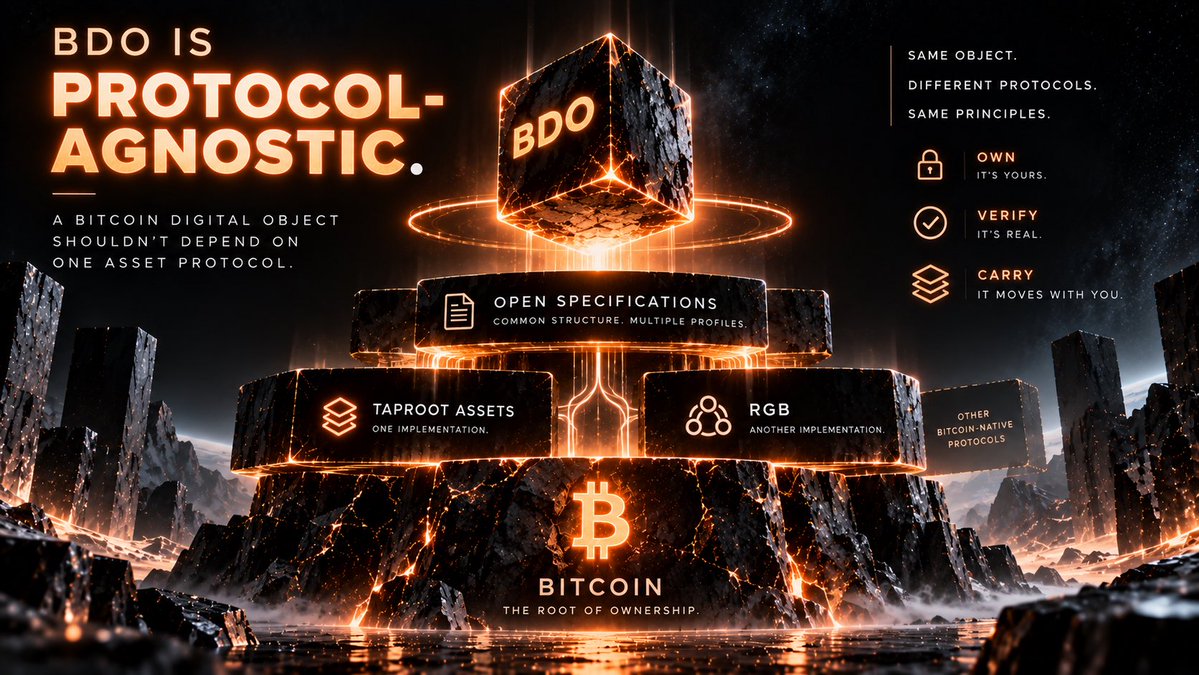
BDO is protocol-agnostic.
A Bitcoin Digital Object shouldn’t depend on one asset protocol.
Taproot Assets.
RGB.
Future Bitcoin-native protocols.
Different architectures. Same question:
Can the object be owned, independently verified and carried across applications?
Mañana empieza @Wo_Bitcoin y, con él, la búsqueda de 100 locos que quieran hacer historia en #Bitcoin⚡️
Ven a vernos, consigue tu SMV Card, canjea tu primer #BDO y conviértete en uno de los 100 primeros Founders de Supermultiverse.
Solo habrá 100.
¿Te apuntas? 👊
#HODL 👀
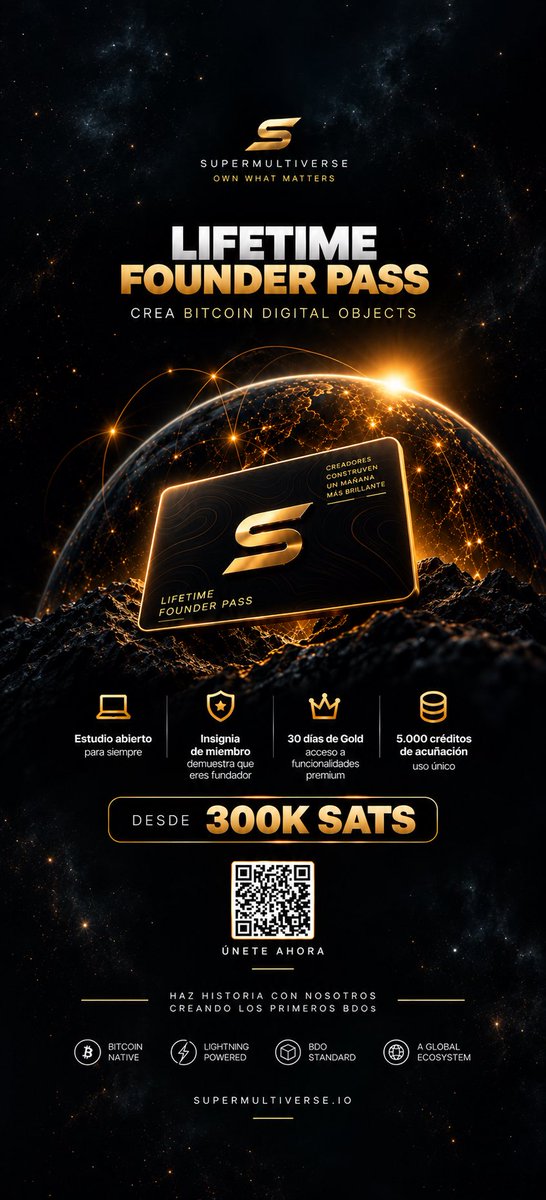
This weekend, find us at @Wo_Bitcoin 🚀
We’re bringing 100 Limited Lifetime Founder Passes.
We’re looking for 100 crazy builders ready to make history with Bitcoin Digital Objects ⚡️
Be one of the first 100.
Come get yours. 👊
@tonimoral23@BitcoinObjects
Meet STAS-01.
BDO defines what the object is.
STAS-01 defines a way to represent it.
An open specification designed so applications can create, interpret and verify Bitcoin Digital Objects using a common structure.
BDO = the category.
STAS-01 = the specification.
BDO is not a protocol.
Protocols define how systems work.
BDO defines what the object is.
An open category for digital ownership secured by Bitcoin.
Different applications can build around it.
Different specifications can represent it.
Own. Verify. Carry.
CARRY.
If you truly own a digital object, it shouldn’t end where an application ends.
A BDO is designed to travel with its owner.
One object.
Different applications.
No permission from the creator.
Your ownership moves with you.
Own. Verify. Carry.
VERIFY.
Ownership means little if authenticity depends on trusting a platform.
A BDO should be independently verifiable.
Who issued it?
Has it been altered?
Does the proof check out?
Don’t trust the application.
Verify the object.
Own. Verify. Carry.
OWN
If an application disappears tomorrow, do you still own the object?
That question is at the core of Bitcoin Digital Objects.
Applications can create experiences around ownership.
But the application should never be the owner.
Applications are temporary. Ownership is not.
2026. Bitcoin Digital Objects.
The missing layer wasn’t another blockchain.
It was a common language for digital ownership.
A BDO is a digital object whose ownership is secured by Bitcoin.
Own it. Verify it. Carry it.
Across applications. Without permission.
A new era.
2026. The missing layer.
Bitcoin can secure digital assets.
Taproot Assets can represent them.
Lightning can move them at scale.
But one question remains:
What is the object?
Technology gave us the infrastructure.
Now we need a common language for digital ownership.
2023–24. Taproot Assets.
Digital assets on Bitcoin learned to scale.
Taproot Assets anchors ownership to Bitcoin while keeping asset data and proofs off-chain.
Then came Lightning.
Fast. Low-cost. Global.
Bitcoin provides the security.
Lightning provides the scale.
A BDO @BitcoinObjects is a digital property right secured by #Bitcoin
Built with Taproot Assets
Designed to scale through Lightning⚡️
Own it. Verify it. Carry it.
Bitcoin provides the security.
Lightning provides the scale.
BDO is an open category for digital ownership.
2023. Ordinals.
Digital objects came back to Bitcoin.
Ordinal inscriptions made it possible to attach content directly to individual sats.
No sidechain.
No separate token.
The content lives on Bitcoin.
Images. Art. Collectibles. Code.
Bitcoin itself became a canvas for DO.
2021. NFTs go mainstream.
Digital ownership became a global phenomenon.
Art. Collectibles. Gaming. Music. Brands.
Millions of people started buying, selling and creating digital objects.
Billions of dollars followed.
Digital ownership had found its market.
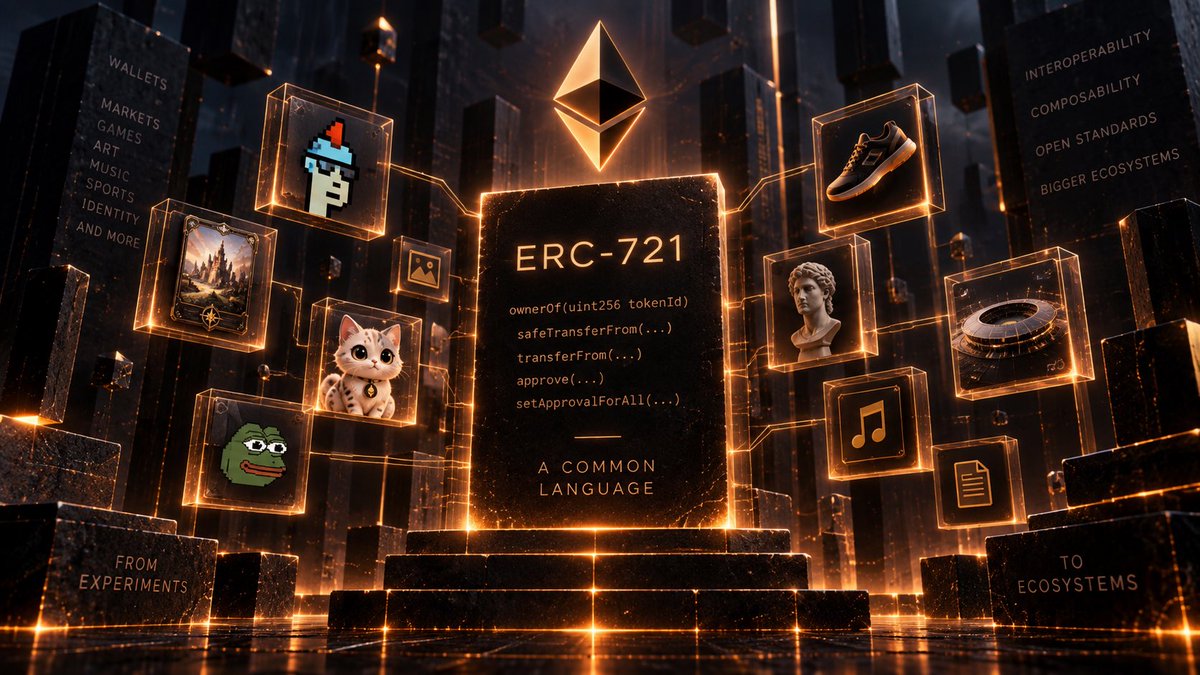
2018. ERC-721.
Digital ownership got a common language.
CryptoKitties had already shown what unique digital assets could become.
ERC-721 turned those ideas into a shared standard.
Wallets could recognize them.
Markets could trade them.
Apps could build around them.
2017. CryptoKitties.
Digital ownership became a consumer experience.
CryptoKitties turned unique blockchain assets into something anyone could understand: digital cats you could actually own.
The experiment became so popular that it put Ethereum itself under pressure.