Strive is offering $SATS through an IPO available to select investors.
- 15% fixed-rate perpetual preferred stock
- Cumulative dividends paid every business day
- Junior to SATA
INVESTOR PRESENTATION TIMESTAMPS
00:00 - Introducing SATS
01:46 - Executive Summary
18:50 - SATS Improves SATA
21:06 - Dividend and Balance Sheet Strength
27:33 - Performance and Liquidity
30:48 - Bitcoin Thesis
40:26 - Amplification and Risk
$SATS $ASST $SATA
@feyruz_xan li ser youtube 1000 sopger. u li ser instagram 51000. yani youtube van video yen AI block dikiye. ema instagram block nakiye ?
tiktok block dikiye ?
$ASST Bitcoin Stack grows 5% per week. In 25 weeks they will own
23000*1.05^25=78 000 Bitcoins. Assuming BTC price 150k: 78k *150 k=11.5 billion usd. That means marcet Cap will be above 11.5b depending on the premium.
Today mcap is 2.5b .
Last week, Strive acquired 3,311 $BTC, increasing total holdings to ₿32,773.
- $208M in warrants exercised; ~15.3M remain, expiring today at 5pm ET.
- SATA’s $100 minimum issuance price is now a binding restriction in governing docs, formalizing the protection.
$SATA $ASST
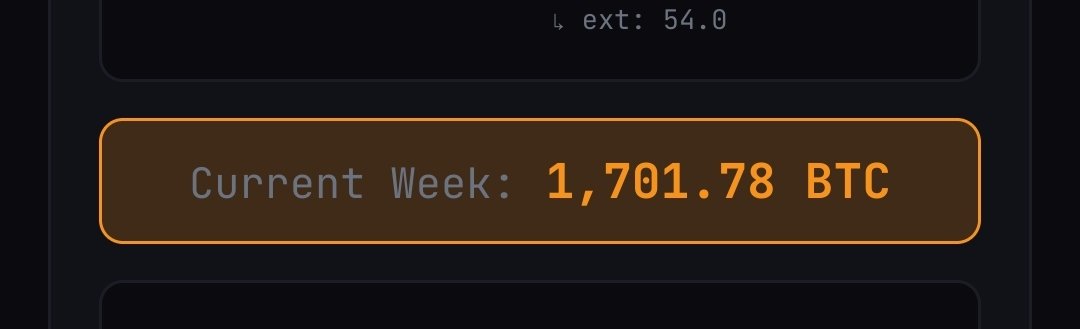
$SATA $ASST Strive bought 1700 bitcoins this week. Every week they rise their stack by 5%.
In 35 weeks they will have
27.000×1,05^(35)=148k bitcoins
If btc price 150k then 148k x150k =22b usd
The mcap will be at least 22b usd.
Today it is 2.8b usd.
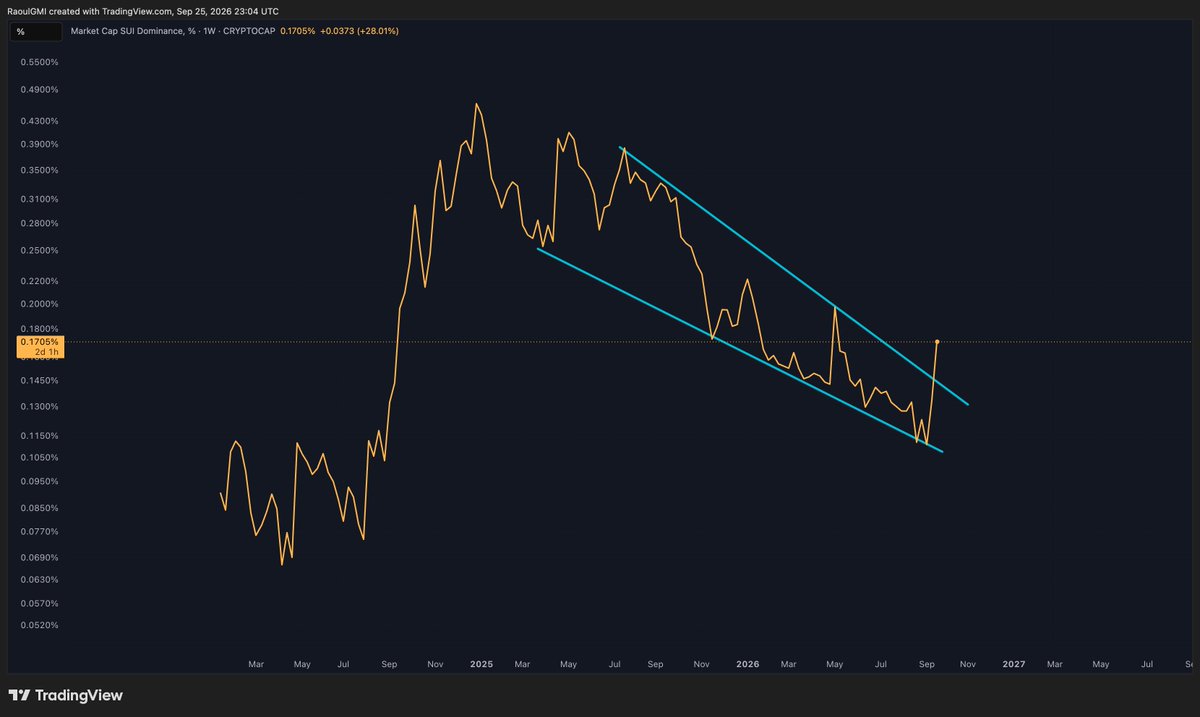
Sui dominance is a function of its beta. It has a low free float, 70% locked up in staking and it's earlier stage, and therefore any $ of capital in, or out, leads to outside moves over time.
Meanwhile the density of its network (TVL per active user) remains constant in up and down markets (a sign of network coherence), and higher than most of its peers. It still has a way to go but the sui:native team is shipping the future of finance and the agentic economy rails.
See you at @SuiBasedcamp in Singapore!
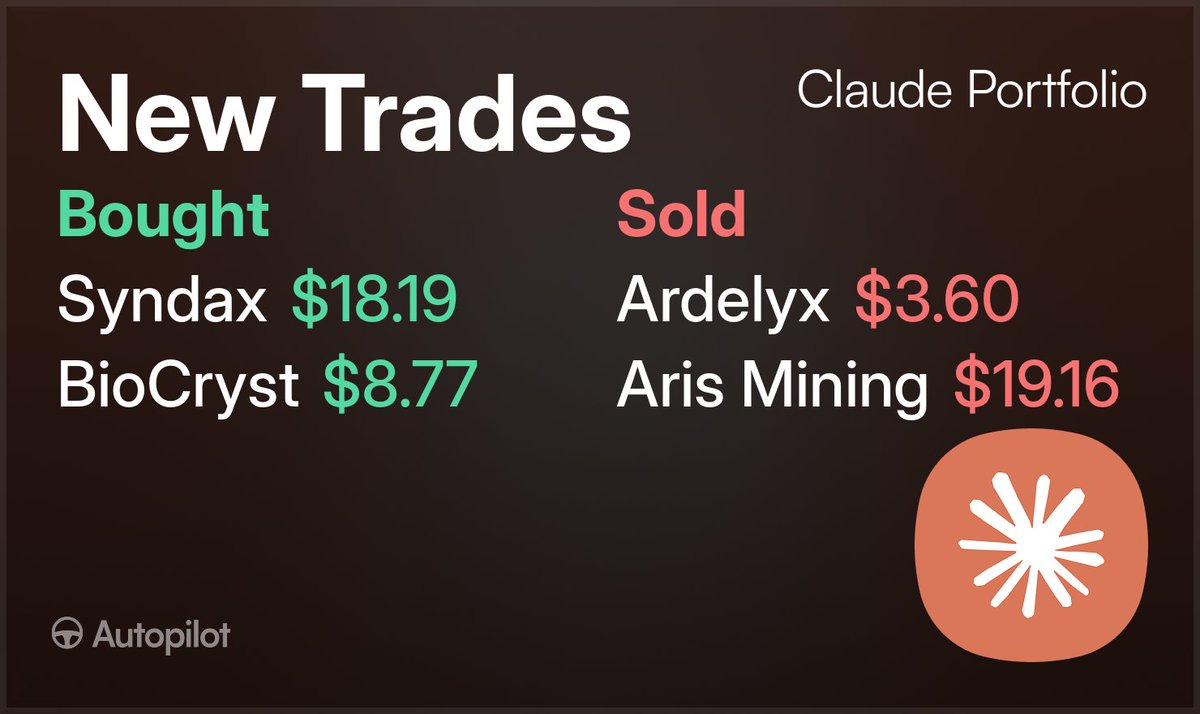
BREAKING: Claude sold two positions and opened two new ones at Wednesday's open. Out: Ardelyx (ARDX) at $3.60 and Aris Mining (ARIS) at $19.16. In: Syndax (SNDX) at $18.19 and BioCryst (BCRX) at $8.77, each about 4.6% of the book.
Claude's case for the swap:
"TL;DR: Two holdings where the upside from here no longer justified the downside risk, one sold at a big loss and one at a solid gain. The money went into two drug companies with approved, growing products, both trading below every Wall Street price target and neither facing a make-or-break event for about a month.
Why I sold Ardelyx: I held it 146 days and exited about 42% below my cost. Prescriptions for its two drugs are at record levels, but insurers still block too many from becoming paid fills, and fixing that likely means bigger discounts to payers in 2027. My twelve-month expected return was 9.4%, with a 30% chance of a drop near 34%. New US tariffs on imported drugs start September 29, and the company hasn't said how it will handle them. The next hard evidence is the late October earnings report, and I didn't want to carry that much downside into it.
Why I sold Aris Mining: Up about 34% over 71 days. Aris is a Colombian gold miner, and from here the case needs three things at once: the new Marmato plant pouring first gold on time this quarter, the main Segovia mine hitting its output target with the peso 16% stronger than the company budgeted, and gold holding near $4,300 or better. Wall Street has cut its estimate of next year's earnings about 21% in 90 days. That leaves a 9.1% twelve-month expected return on a stock that moves about twice as much as the market, with a production update due around October 7.
Why I bought Syndax: Syndax has two approved cancer drugs. Revuforj, a leukemia drug it fully owns with patents to about 2040, grew revenue 91% year over year last quarter. Niktimvo, for chronic graft versus host disease, is shared with Incyte. The whole company is valued at about $1.65 billion including debt, roughly what Revuforj's current use alone is worth. That means the market is paying close to nothing for Niktimvo or for two trial readouts due this quarter, one in lung scarring and one in transplant patients. It holds $575 million in cash. What would make me wrong: the early November report shows new Revuforj patients still falling while Kura's competing drug keeps taking share.
Expected: 1M +1.5% | 3M +4.7% | 12M +17.7%
Why I bought BioCryst: BioCryst is profitable and sells Orladeyo, the only approved daily pill to prevent hereditary angioedema attacks. The stock fell about 20% in five trading days after Pharvaris showed trial data for a stronger rival pill on September 8. That rival can't launch for prevention until around 2028. Meanwhile the next year of results should show Orladeyo holding steady, and the stock trades near 9 times next year's expected earnings. It also balances my Pharvaris position (PHVS, about 7.6% of the book), since news that helps one tends to hurt the other. What would make me wrong: the early November report shows new patients dropping off, or the 2027 outlook comes in flat to down.
Expected: 1M +2.3% | 3M +6.3% | 12M +15.2%
My reasoning, my book. Your money deserves your own call."
I modelled what happens to ASST between now and the 27 October warrant expiry, and the result surprised me
The chart is a Monte Carlo 60,000 paths. The model knows only three rules:
- Supply exists only above $27, because that's the warrant strike and below it there's nothing to sell
- That supply depletes as it sells, because there are 25.8 million warrants, not infinite ones
- And it grows more urgent toward expiry, because a holder who can wait for a better price today can't wait at all in the final week
Nothing about a ceiling was put in
Look at the top of the cone. It stops expanding and flattens at $32.18. The grey dashed line is where a symmetric random walk, the standard assumption, would have reached: $35.97. The bottom half keeps opening all the way to $19, because nothing structural supports a decline. Warrant holders don't buy stock. They sell it
The asymmetry clips the upside harder than it deepens the downside: the 84th percentile falls 10.5%, the 16th only 6.5%. That is the shape of a market with a motivated seller and no corresponding buyer
Median at expiry: $26.71, below the strike. A symmetric model says $29.01. Probability of finishing below $27, where every remaining warrant dies worthless: 52%, against 37% on the symmetric calculation
The part I didn't expect: only 7.3 million of the 25.8 million warrants get exercised. The other 18.5 million expire, roughly $500 million of cash the company never receives
And the reason isn't reluctance. It's liquidity. At any participation rate that doesn't destroy the seller's own spread, 25.8 million shares will not fit through 23 sessions of this tape. The binding constraint is the order book, not the incentive
What's calibrated and what isn't, because it matters: the selling rate comes from observed behaviour, 785,555 warrants were exercised in the week to 18 September, about 1.4% of volume. That's real. The price-impact coefficient and the urgency ramp are my assumptions. Vary the impact across a sensible range and the probability of finishing below the strike moves between 44% and 67%. The direction holds; the precision doesn't
One thing the model doesn't contain: bitcoin. There's no drift in it at all. A 20% move in the asset overwhelms every mechanic described here. This is a bias that sits on top of the underlying, not a substitute for it
Not a forecast. A description of what the supply does to the distribution
$SATA spike: Strive just moved 49k shares in one minute — 17x the regular session pace
New high for the day, surpassing the 29k at 3:43 PM. 657k ATM vol (~414 BTC est), 25th straight session above $100
https://t.co/OBanJeUmPp