The BRAM-ring bounty closed last night. Thank you to everyone who entered.
Five claims came in, every one of them bit-exact on all 8 vectors and on a fresh seed. That alone is a good sign for the spec: five independent implementations, zero disagreements.
@inkier35: unrolled gather chains, a 2% miss on the reference machine.
@sulla_alexander: three claims, scalar taps on CPU and a tiled-bank kernel on GPU. Big wins on your own hardware that didn't transfer, and the Downfall lesson is now in the README for posterity.
The winner: @AlexnderSmith04 with Prefetch32. An algebraic-normal-form cell evaluator plus a 32-lane deferred read-modify-write, +14% over the shipped CPU kernel, measured back to back on the 12700KF. No other claims were filed by the deadline, so the decision is final: 0.01 BTC, paid within 14 days of you posting a BTC address in this thread.
The 0.1 BTC goes unclaimed. Nobody showed non-FPGA hardware within 100× of 371 H/s per dollar, and the best CPU result after a month of public attack is 932 H/s, against 37,100 from a $40 chip. The little FPGA stays undefeated.
https://t.co/OFUbI8tTS7
@jQrgensn did an excellent job this evening and presented @NexaMoney and @BitcoinUnlimit in front of the Norwegian audience at the Oslo Blockchain Meetup 💪
@NexaMoney ‘s own hardware expert and chief scientist has got a challenge open to anyone:
He’s confident that his FPGAs can outperform the best GPUs on a dollar-cost basis by 100x - and he’s got BTC bounties to back it up!
Miners should have their eyes on nexacoin:native 👀🚀
This is exactly what we were pointing out 10 YEARS ago.
Fee income in blocks must substitute for decaying rewards, hence, layer-1 needs to be scalable. Otherwise, layer-2 solutions siphon fees away from miners who are reponsible for securing the blockchain for the full node network.
📒 Build on Nexa: AI-Assisted Development with David Thibodeau
Today the Nexa team wants to introduce you to a couple of tools we have created for our community to assist you with building applications on Nexa.
We know that some of you may be experienced developers, while others may be brand new to building apps.
One of our tools is specifically designed to empower some of our less technical users and make this process easier for all of you, through the use of Nexa AI-Assisted Development tools and AI skills.
In this short guide David Thibodeau (@DPTib) will walk you through a quick setup process and explain the basics of AI skills and how to use them.
After this guide you will be ready to build a fully functional Nexa application just from a single prompt. Let's get started. 👇
In this post, Vitalik has realized the advantages of the UTXO model and non-turing complete modification of blockchain state, and is proposing to identify and optimize the simpler contracts, like I've been saying they will for 4 years now.
But what if it wasn't just the simpler contracts? What if EVERY contract inherently had that property? @NexaMoney FTW
It is so sad. Bitcoin usage was growing exponentially up until 2014ish.
And then we collectively told the world we didn't want them using our precious "block space," by keeping the 1 MB limit.
We had more demand than we ever hoped for but rather than building out the infrastructure, we pretended that blockchains couldn't scale. Why?
I just watched a very interesting webinar on Proof of Work, blockchain architecture, and Nexa.
What stood out to me most is how often the discussion around Proof of Work gets reduced to one topic: energy consumption.
But the bigger question is much more interesting:
What properties do we actually want from a decentralized network, and how do we make those properties sustainable in the long term?
A few key takeaways from the presentation:
🔹 Proof of Work is about more than mining.
It allows participants to compete without relying on a central authority. The real-world cost of computation makes attacking and rewriting the network extremely expensive.
🔹 Proof of Work and Proof of Stake have fundamentally different properties.
Proof of Stake is far more energy efficient, but PoW has an interesting advantage when it comes to initial distribution: participation is based on computational work rather than already owning a large amount of the asset.
🔹 Then there is the Blockchain Trilemma:
How do you achieve security, decentralization, and scalability at the same time?
Bitcoin has prioritized security and decentralization, but this comes with limited Layer 1 scalability. As a result, many scaling solutions move activity to Layer 2.
🔹 Nexa takes a different approach.
The goal is to make high transaction throughput and low fees properties of the Layer 1 itself, rather than relying primarily on additional layers.
🔹 One of the most interesting concepts was “indirectly useful Proof of Work.”
Instead of trying to make the actual PoW computation useful for something like scientific research, Nexa is looking at how the hardware used for mining can also create value elsewhere in the ecosystem.
Nexa’s PoW incorporates Schnorr signature verification. Hardware optimized for this process during mining could potentially also be used to make signature verification faster for full nodes.
So the idea becomes:
Mining → better hardware → faster/cheaper nodes → stronger decentralization.
🔹 Nexa POW v2 is another interesting development.
By introducing a cellular automaton into the mining algorithm, the goal is to make it much harder for ASICs to dominate the network.
That could help keep mining more competitive and accessible while encouraging the development of FPGA-based hardware.
🔹 And finally, there is the economic side.
Block rewards decrease through halvings. Over time, transaction fees will therefore become increasingly important for miners and for maintaining the security of the network.
This means scalability isn’t just a technical issue.
It is also an economic issue.
If a blockchain wants to remain secure and decentralized over the long term, it needs enough real-world usage and transaction activity to generate the fees required to support its infrastructure.
So perhaps the better question isn’t simply:
“Which blockchain has the highest TPS?”
The more important question is:
“Which blockchain can combine security, decentralization, scalability, and a sustainable economic model over the long term?”
That is the challenge Nexa is trying to address with its architecture.
Complete video below 👇 👀
#Nexa #ProofOfWork #Bitcoin #Blockchain #Crypto
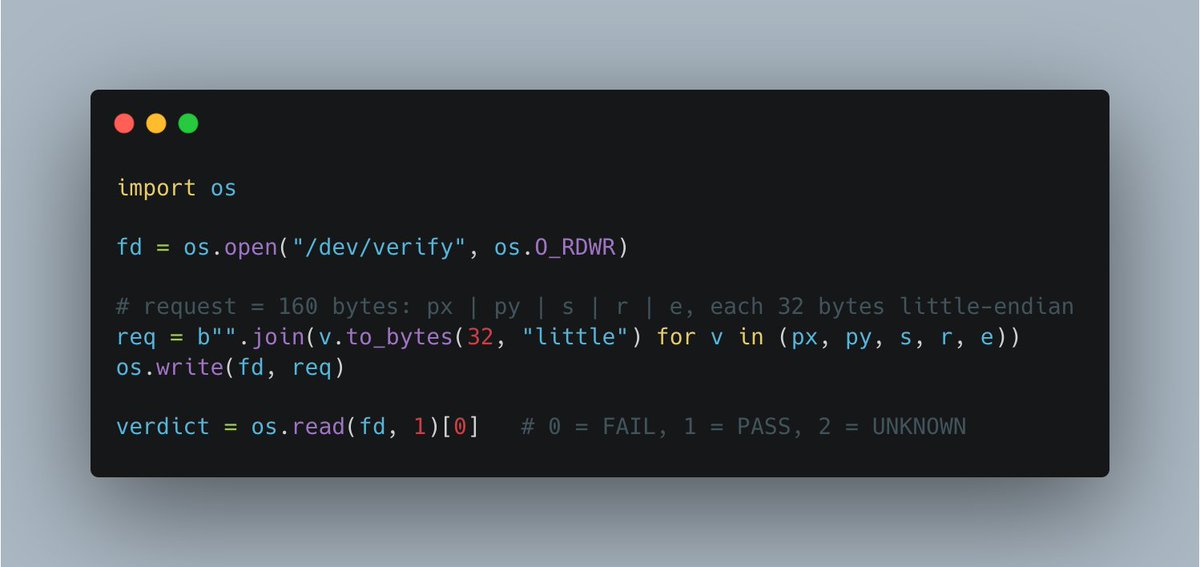
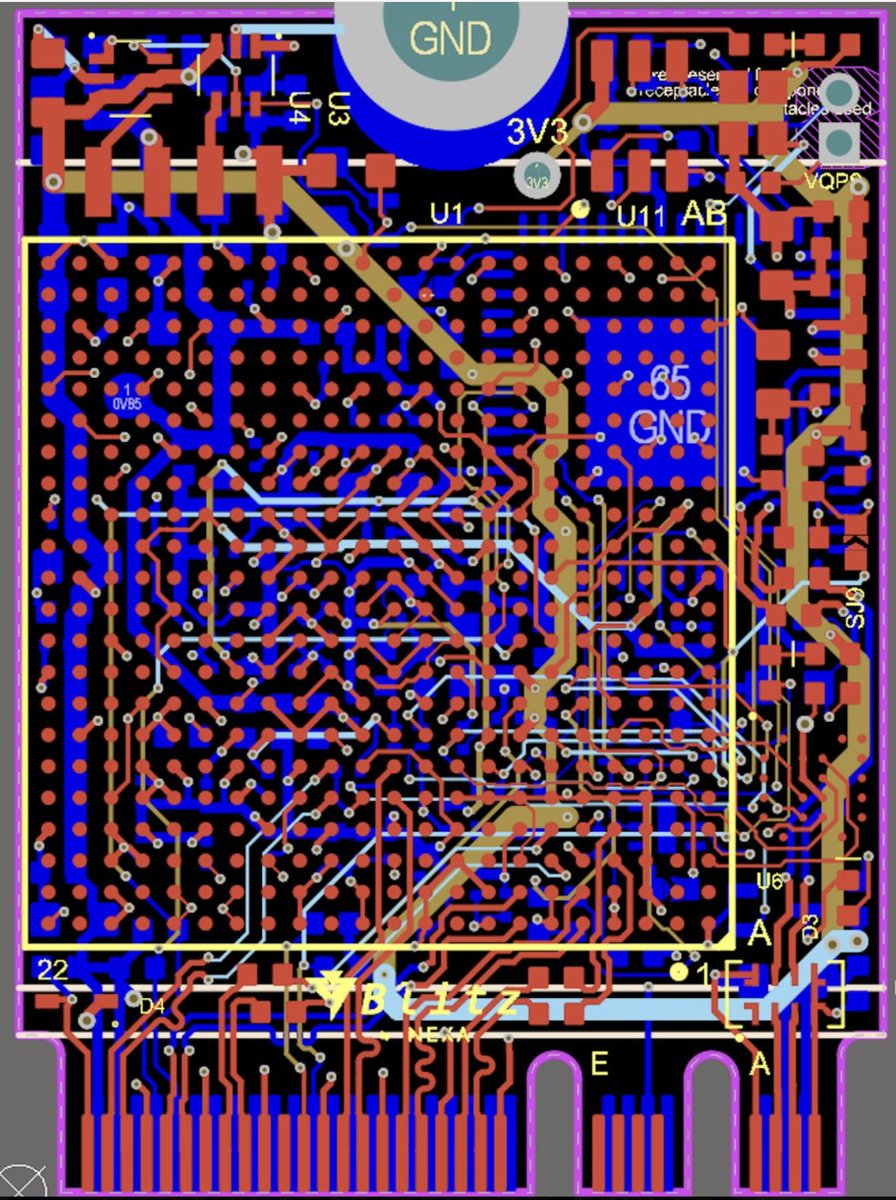
I can't get over how cool it is that custom silicon can just become part of your computer. Our Blitz FPGA verifies secp256k1 signatures, and to Linux it's a regular file: open /dev/verify, write 160 bytes, read back 1 byte — PASS or FAIL.
Any number of processes can do this at once. A small kernel driver tags each request and routes every verdict home; PCIe DMA rings + MSI interrupts do the heavy lifting. 151.7k sigchecks/sec, zero errors, from os.write().
Blitz is an M.2 card that talks PCIe. You write signature checks to /dev/verify and read the verdicts back. Full multithreading via DMA, MSI interrupts, and a simple kernel driver. 150k Schnorr verifies/sec proven on silicon—300k+ in reach with more RTL work.
They said Bitcoin couldn't scale: watch our tiny Blitz FPGA accelerator card verify every signature in the Nexa blockchain (10.6 million) in 75 seconds.
🎂 Join us 28 November 2025 at 19:00 UTC for the Bitcoin Unlimited 10-Year Anniversary Space! The team will rewind the past decade and look to the future.
https://t.co/pDzr9hhSK8
It was a huge pleasure having @PeterRizun on to go over the latest breakthroughs in crypto scaling.
It's crazy to think that we could do millions of transactions per second on super cheap consumer-grade hardware. 🤯
The whole block size war was around whether everyone can run a node. Well, looks like you can while scaling massively now.
Timestamps:
(0:00:00) Intro
(0:03:14) The UTXO vs. account model
(0:27:13) Using customized hardware to scale UTXO chains massively
(0:47:00) Which way will the crypto world scale?
(1:01:08) Can UTXO coins mass-scale privacy?
(1:05:23) What is Nexa?
(1:18:08) Wrap-up and shill-o'clock
Good day Nexa community!
Want to know more about the latest progress on Nexa? Then check out this stunning AMA hosted by MineSum10. 🙌🏼
Paul has been privileged to talk about Tokenize, Smart-Contracts, Proof of Work and much more. 🧠
If you want to learn the ins and outs of the latest tech developments, then check it out below! 👇🏼
https://t.co/uMiKqhYf0m
We're proud to announce Otoplo wallet is now on the Apple app store. 🎉
Competition time!
1. Download the app
2. Set up a HODL Vault
3. Comment with your address & screenshot of your Vault & we'll send a few of you some #NEXA
Longest HODLs win!
https://t.co/09KQfDROnG
BCH Unlimited 2.0.0 has now been released.
This keeps the BCH Unlimited client in consensus with the rest of the BCH network during the May 15th hardfork.
Read the full details at:
https://t.co/txBm1EJTYU
Dear $NEXA Community,
It's time to rally the troops.
We are announcing a crowdfunding campaign for the listing on @MEXC_Global
We understand the need for a mid-tier exchange so that we can all freely and confidently exchange $NEXA
1/4